A new proposal expected to reduce the amount of solar radiation reaching the earth’s surface has raised concerns among policymakers.

They indicate it could provide an incentive for countries not to reduce greenhouse gas emissions. The Solar Radiation Management proposal is currently being discussed among several stakeholders with the aim of addressing some of the risks associated with climate change. It is expected to inject sulphate particles into the earth’s stratosphere, which will reduce the amount of solar radiation and add a cooling effect with respect to the earth’s temperatures.

Following the Conference of the Parties, which was held in France last year, several countries committed to reducing their greenhouse gas emissions in a bid to curtail global temperatures. Clifford Mahlung, project administrator at the Climate Change Division in the Ministry of Economic Growth and Job Creation, said while he welcomes any initiative to mitigate against the effects of climate change, it is critical that any such project takes into account the importance of reducing greenhouse gas emissions.

“It wouldn’t reduce greenhouse gas emissions, but it would have a cooling effect on the earth’s temperature. It’s a new science initiative. It hasn’t been tried anywhere else in the world, but there are some conclusions that it has very good potential …” he said.

“The big concern for me, though, being from a small island which suffers greatly from the negative impact of climate change, is that it could also provide an incentive for countries not to reduce their greenhouse emissions. Instead, they would rely on this technology, which would be defeating the whole purpose to combating climate change. It could give people a false sense of hope,” Mahlung told The Gleaner.

“Also, you are not sure how long those sulphates will remain in the atmosphere and, if, over time, it will not have a reverse effect. There’s a concern with respect to what is known as acid rain, which is a mixture of ordinary rainfall and sulphur dioxide which can be harmful to trees,” he added.

However, he said that once the project is properly thought through, it could produce positive results.

Gleaner

Screen Shot 2016-03-16 at 13.39.34

German artist Hermann Josef Hack’s World Climate Refugee Camp in Hannover displaying 600 miniature climate refugee tents. The model camp is a public art intervention that depicts the social impacts of climate change.

Scientists predict that if there is an increase in global temperature of up to 4° Celsius — which the current trajectory has us reaching by the end of this century, small island developing states (SIDS) face the threat of extinction. SIDS, with similar characteristics of tropical climates, small populations and related socio-economic and development challenges, are perhaps the most vulnerable countries to this phenomenon of global warming, primarily because of their low-lying position in relation to the sea and their limited economic ability to respond to catastrophic events.

For a small island like Jamaica, which has already begun to experience effects of climate change, using the significant beach erosion in the tourist areas of Negril and Hellshire, as well as lengthy periods of droughts as examples, a call for action cannot be overemphasised. Let’s act while we still can.

Identifying the problem

The unfortunate reality of industrialisation is that, although it has improved the lives of many, it has single-handedly resulted in a wealth of environmental catastrophes — climate change is arguably the worst.

Historically, States like the US and China, in their quest to becoming developed, have played a notorious role contributing to the destruction of the environment. Ironically, however, despite SIDS having contributed the least to global warming (accounting for less than one per cent towards GreenHouse Gas (GHG) emissions), they stand to be the worst affected.

Extreme weather patterns, like extended droughts and increased temperatures, are just some of the threats of climate change. Of the list, perhaps the most serious is a rise in sea levels. This will not only potentially cause ground and surface water sources to become contaminated but also affect the livelihoods of many. Sectors like tourism and agriculture, both of which are heavily relied on by many SIDS for economic growth and stability, will suffer greatly as beaches become eroded, fisheries collapse, and arable lands are destroyed. As a consequence, governments will have to contemplate strategies at domestic and regional levels to address issues of public health and job and food security.

In addition to the threat to infrastructure and economies, climate change also puts millions at risk of becoming either internally displaced or altogether stateless. That would create the real possibility of climate migration in the future. Issues surrounding statelessness and climate refugees have been widely discussed in the public domain, with many questioning the ability of the international community to cope with yet another humanitarian crisis.

Some critics believe that the overwhelming number of migrants that will result from climate change will far exceed the scale and gravity of any of the humanitarian disasters being experienced today. What’s worse, they posit that if the response of the international community to the humanitarian crisis in Syria is anything to go by, it is unlikely that attitudes towards climate-related event will be any different. For those who live amongst SIDS, this should be a matter of grave concern.

Maldives and Kiribati are two SIDS which have already researched relocating their populations to different countries due to their imminent threat of becoming submerged by rising seas. Other SIDS ought to follow suit with urgency to avoid the worst.

Solving the problem

It is prudent for States to appreciate that climate change is an economic issue just as much as it is an environmental one. Numerous developing countries, including SIDS, have traditionally concentrated their efforts on advancing development while postponing action on pertinent environmental issues. In recent years, the issue of climate change has increasingly gained recognition by the international community and has been put at the forefront of the agendas of many world leaders. Of note is the Paris Agreement arrived at in December last year, in which some 150 countries have agreed to take steps to limit global temperatures at or below 2° Celsius.

Caricom, including Jamaica, which lobbied in Paris as part of the Alliance of Small Island States, had pushed for it to be capped at 1.5° Celsius. It would therefore be now remiss of us not to follow through and implement practical steps towards achieving the target.

Traditionally, economics has influenced decision-making on a domestic and international level, and although it is justifiable to some degree, States need to divorce the practice of allowing economics alone to dictate political momentum. Environmental problems are becoming increasingly acute and nothing but short-term pain for long-term gain will bring about the kind of revolutionary change towards reducing carbon footprint and creating a greener space.

The truth is that the problems posed by climate change can no longer be ignored; they are here to stay. SIDS have the choice of mitigating the threats and adapting to the changes now, or suffering the consequences later.

While some may prefer one option over the other, particularly since adaptation over the longterm can be significantly more costly than mitigation, the Paris Agreement calls for both methods to be employed. SIDS have little option but to do both, for again, they contribute the least to the problems, but will be the ones most affected.

On a wider scale, reducing GHG emissions in line with the Paris Agreement is a target that all States should buy into as successfully ‘holding the increase in the global average temperature to well below 2°C above pre-industrial levels’ is contingent on the participation of all states.

It is hoped that with the US$100 billion pledged to developing countries under the Paris Agreement, SIDS will receive greater financial assistance that facilitate promote capacity building, sustainable livelihoods, and appropriate mitigation and adaptation schemes. It is hoped, too, that countries don’t wait until it is too late to act, but move with urgency now.

Jamaica Observer

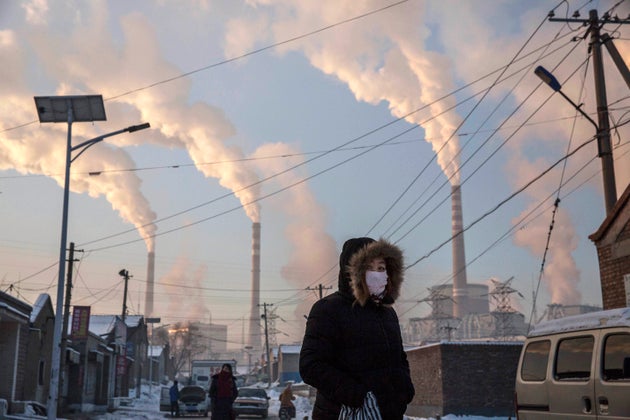
A woman wears as mask while walking in a neighbourhood next to a coal-fired power plant on Nov. 26, 2015, in Shanxi, China.

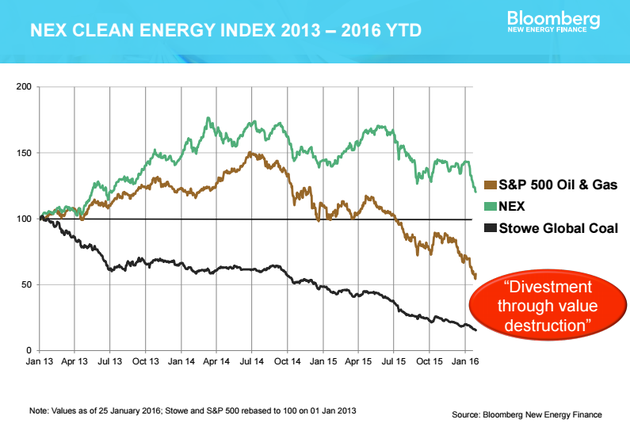
The market is encouraging pension funds and institutions to jettison fossil fuels from their portfolios, waving a clear warning flag to investors about the financial future of oil and coal companies.

Fossil fuel stocks are performing poorly compared to the market as a whole — and perhaps most importantly, compared to renewable energy stocks, said Michael Liebreich, chairman of Bloomberg New Energy Finance, at a summit on climate risk put on by the nonprofit sustainability advocacy group Ceres.

Referring to investors who won’t divest and continue to own fossil fuel stocks, Liebreich pointedly said that the market was “divesting through value destruction” — in other words, cutting their holdings in traditional, polluting energy companies by slashing their value.

Renewable energy stocks have dramatically outperformed fossil fuels.

Over the last 10 years, the S&P 500 index is up just over 50 percent. Yet energy stocks over the same time period have risen only 1.3 percent.

For big investors to simply allow their holdings in big energy companies to fall toward a vanishing point of worthlessness is deeply irresponsible, observers say.

Indeed, former Vice President Al Gore, who shared the Nobel Peace Prize in 2007 for his work on climate change, compared the risk that some fossil fuel companies’ assets will become worthless to the danger of mortgage-backed securities, whose collapse triggered the 2008 financial crisis.

The nonprofit research group Carbon Tracker estimates that if the world changes its energy sources to keep climate change below 2 degrees Celsius, $2 trillion in fossil fuel assets will be stranded — that is, unusable, far less valuable, and in some cases, liabilities.

Huffington Post

Jamaica is to reduce greenhouse gas emissions by the equivalent of 1.1 million metric tonnes of carbon dioxide per year by 2030, as part of its global commitment to take climate-change mitigation action.

To bring this about, the island – as reflected in its nine-page Intended Nationally Determined Contributions (INDCs) document to the United Nations Framework Convention on Climate Change – has undertaken to implement energy policies that ensure the island:

– uses energy wisely and aggressively to pursue opportunities for conservation and efficiency;

– has a modernised and expanded energy infrastructure that enhances energy generation capacity and ensures that energy supplies are safely, reliably and affordably transported to homes, communities and the productive sectors on a sustainable basis; and

– achieves its energy resource potential through the development of renewable energy sources by increasing their share in its primary energy mix of 20 per cent by 2030.

Such policies are also to ensure that government agencies and ministries are a model/leader in energy conservation and environmental stewardship, and that the island has a well-defined and established governance, institutional, legal, and regulatory framework.

Fully implemented energy polices need, too, to ensure that private industry embraces “efficiency and ecological stewardship to advance international competitiveness and to move towards a green economy”, the document said.

The Gleaner

A coal miner works to secure the roof with bolts in an underground coal mine roughly 40-inches-high. Preliminary government figures released Friday show U.S. coal production has fallen to its lowest level in nearly 30 years as cheaper sources of power and stricter environmental regulations reduce demand.

United States (US) coal production has fallen to its lowest level in nearly 30 years as cheaper sources of power and stricter environmental regulations reduce demand, according to preliminary government figures.

A report released last Friday by the US Energy Information Administration estimates that 900 million short tons of coal were produced last year, a drop from about 1 billion short tons in 2014.

That’s the lowest volume since 1986.

The slump has led to bankruptcies and layoffs at mining companies, but the effects have rippled outward, stressing state budgets and forcing layoffs in other sector, such as railroads, which are transporting less coal.

Power plants are increasingly relying on cheaper and cleaner-burning natural gas to provide electricity and comply with regulations aimed at reducing pollution that contributes to climate change.

A sweeping agreement adopted last month in Paris by nearly 200 countries determined to further reduce greenhouse gas emissions is likely to make coal an even less viable choice in the decades ahead.

The Gleaner

THE EDITOR, Sir:

As many countries, including Jamaica, continue to baffle with extremely high energy costs, the debate continues to rage on to viable alternatives that will allow for a less costly and sustainable outcome that reduces dependence on fossil fuels.

As a youth advocate, this particular issue affects everyone, and especially our youth. I did some research to identify some tips that our Government and key stakeholders should take into consideration. These tips include:

Family planning: