Armed with comments from the Office of the Attorney General (AG), Jamaica is looking at next year to ratify the Paris Agreement, which sets the framework for the global response to climate change.

“We have received the comments of the AG, which point out the obligations the country would have under the agreement. We now have to complete a series of consultations with the various stakeholders that would have a critical part to play in meeting those obligations,” revealed Colonel Oral Khan, chief technical director in the Ministry of Economic Growth and Job Creation.

“So we are going to be entering into that period of consultation before we seek the formal approval to ratify. We do not anticipate any hurdles; it is just now a process that we have to go through to ensure that we do not leave anybody behind. When we ratify, everybody must understand their obligations,” he added. Among other things, Jamaica will need to satisfy the United Nations Framework Convention on Climate Change (UNFCCC) requirement for nationally determined contributions (NDCs) to reducing greenhouse gas emissions, which fuel global warming.

“We already submitted our INDCs (Intended Nationally Determined Contributions) and we are to confirm they are to move from INDCs to NDCs. So we have to formally notify the UNFCCC of our NDCs,” Khan explained.

PROCEDURAL MATTERS

There are, too, a number of procedural matters to deal with “such as some reporting requirements that will have to be met”, he noted. Jamaica’s adaptation strategy and action plans are among those items that will need to be reported on. Already, the island has identified a number of priority sectors for these plans, including water, health, tourism, human settlement and coastal resources, in addition to agriculture, forestry and energy.

“We will have to keep the UNFCCC updated on our steps to implement and in preparing those annual reports that we have to make,” Khan said.

At the same time, the chief technical director indicated that ministries, such as the Ministry of Science, Energy and Technology, will have “a significant role to play”.

“A lot of our targets in the NDCs are things that fall under the energy policy in terms of switching to renewable energy and so on,” Khan noted. Once the consultations are finalised, they will report to Cabinet for the required approval to proceed with the instruments of ratification.

“We have to satisfy the Cabinet that we have engaged all the stakeholders so they have a fair appreciation of what is involved,” Khan said. He has, however, cautioned that the process will take some time.

“We can’t just wish it and it is done,” Khan told The Gleaner. “The time of the year we are in and approaching and with members of our Climate Change Division participating in the COP (the 22nd Conference of the Parties to the UNFCCC in Morocco), that kind of slows our process down in terms of our resources to undertake and lead in some of the consultations.”

Added Khan: “So for the month of November, we are going to be pretty much tied up and the environment in December will not be conducive to consultations. So we could end up seeing the process drag into next year.”

Gleaner

Representatives from nearly 200 member countries of the Montreal Protocol agreed on a deal to reduce emissions of powerful greenhouse gases at a summit Saturday in Kigali, Rwanda.

The landmark deal will reduce the use of hydrofluorocarbons, or HFCs, the world’s fastest-growing greenhouse gases, the UN Environment Program said in a statement.
HFCs are potent greenhouse gases commonly used in refrigeration and air conditioning instead of other ozone-depleting substances.
“The amendment to the Montreal Protocol on Substances that Deplete the Ozone Layer endorsed in Kigali today is the single largest contribution the world has made towards keeping the global temperature rise ‘well below’ 2 degrees Celsius, a target agreed at the Paris climate conference last year,” the UN agency said in a statement Saturday.
According to the agency, the agreed reduction in HFCs could prevent up to 0.5 degrees Celsius (0.9 degrees Fahrenheit) of global warming by the end of this century. The deal was reached at a Meeting of the Parties to the Montreal Protocol, which started Thursday. Several high-profile leaders attended the meeting, including US Secretary of State John Kerry.

“It is not often you get a chance to have a 0.5-degree centigrade reduction by taking one single step together as countries — each doing different things perhaps at different times, but getting the job done,” Kerry said in a speech Friday.
“If we continue to remember the high stakes for every country on Earth, the global transition to a clean-energy economy is going to accelerate.”
The European Union also welcomed the deal. Miguel Arias Cañete, EU commissioner for climate action and energy, described it as “huge win for the climate” and the first step toward delivering on promises made on climate change in Paris in December.
The agreement in Kigali comes only days after enough countries ratified the Paris Agreement on climate change — which calls for the world to become carbon neutral this century — to become international law.
“Last year in Paris, we promised to keep the world safe from the worst effects of climate change. Today, we are following through on that promise,” said Erik Solheim, executive director of the UN Environment Program.
The White House
Today, nearly 200 countries took an historic step to for future generations by phasing down HFCs: http://go.wh.gov/qnkYar pic.twitter.com/f2wUyaLTt3
President Barack Obama also hailed the Kigali deal.
“Today’s agreement caps off a critical 10 days in our global efforts to combat climate change,” the US leader said. “In addition to today’s amendment, countries last week crossed the threshold for the Paris Agreement to enter into force and reached a deal to constrain international aviation emissions.
“Together, these steps show that, while diplomacy is never easy, we can work together to leave our children a planet that is safer, more prosperous, more secure and more free than the one that was left for us.”

Growing demand for cooling

The rapid increase in HFC emissions — put by the UN agency at 10% a year — is due in part to a growing demand for cooling, particularly in developing countries with hot climates and an expanding middle class, the agency said.
The agreement includes provisions for hot countries to reduce their use of HFCs at a slower rate. Developed countries will start to reduce the use of HFCs by 2019, while developing nations have been given a longer time frame in which to freeze their use of the damaging gases.
Funding for measures to reduce HFC use and research into alternatives is to be finalized next year, the UN agency said.
Kerry recalled how the world’s nations had worked together on climate change since first meeting in the 1980s in Montreal in a bid to protect the world’s fragile ozone layer from ozone-depleting chemicals such as chlorofluorocarbons.
“Thanks to the cooperation and the courage that we summoned at that critical time almost 30 years ago, the hole in the ozone layer — which had been growing at an alarming rate, and which was the reason that we came together — that hole is now shrinking, and it’s on its way to full repair,” he said.
“So we proved that we can make a difference. We proved that science has a value. We proved that if we come together in a forum like this, we can actually do things that affect the entire planet.”
Kerry also acknowledged that HFCs had turned out not to be the best solution for the problem of ozone depletion.
“We replaced the ozone depleting substances, but we came to understand the hard way that HFCs may be safe for the ozone layer, but they are disastrous for our climate, in many cases thousands of times more damaging than carbon dioxide,” he said.
Used in everyday household items such as refrigerators and air conditioners, he said, “in a single year, these substances emit as much CO2 equivalent as nearly 300 coal-fired power plants.”
The head of Rwanda’s climate change unit, Faustin Munyazikwiye, also welcomed the world’s commitment on HFCs after long hours of negotiations in Kigali.

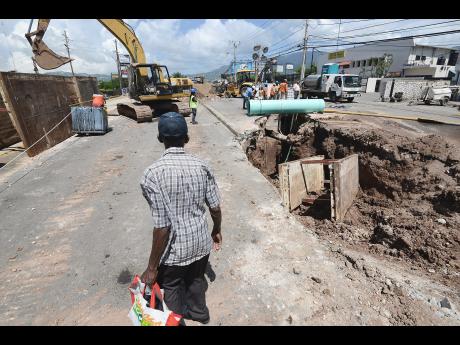
A man walks along a construction site on Constant Spring Road, St Andrew on Friday, October 7. The roadway in the vicinity of the Marketplace commercial complex is being repaired following its collapse from rains associated with Hurricane Matthew.

After a period of uncertainty, it has been confirmed that the Paris Agreement on Climate Change will enter into force on November 4.

This is good news for the Caribbean, one of the parts of the world most at risk from sea level change and severe climatic events.

By global treaty standards, formal agreement has been achieved remarkably quickly, especially as the solutions that the treaty proposes remain politically controversial in many of the nations that agreed last December to the final text.

Normally, ratification takes years to achieve. However, faced with evidence that the planet continues to warm and the possibility that Donald Trump could become the next US president and may pick apart the hard-won agreement, the world’s largest carbon emitters – China, the United States, Brazil, the European Union, and India, but not so far Japan or Russia – have agreed to ratify, thereby reaching the agreed target of 56.87 per cent of all global emissions, for the treaty to come into force.

In many respects, this is a victory for the Caribbean, for CARICOM in particular, and the African, Caribbean and Pacific Group of States (ACP) and other small-island developing states, which in Paris last December made clear that a positive outcome was existential.

In outline, the 31-page agreement proposes that a balance between greenhouse gas emissions and the sinks for ameliorating them is achieved in the second half of this century.

It emphasises the need to hold the increase in the global average temperature well below 2 degrees Celsius (36 degrees Fahrenheit) above pre-industrial levels; proposes “pursuing efforts to limit the temperature increase to 1.5 degrees Celsius (35 degrees Fahrenheit)”; and recommends that a peak in global greenhouse gas emissions be achieved as soon as possible. It allows for an asymmetrical approach, enabling all developing countries – including large industrialising carbon emitters like China, India and Brazil – to have more time to adapt.

In a section that addresses loss and damage, the agreement establishes funding at the minimum annual rate of US$100 billion up to 2030 to enable support for mitigation and adaptation in developing nations. However, it does not set a timescale for reaching greenhouse gas emission neutrality.

Unlike the earlier Kyoto Protocol of 2005, which required major carbon emitters to agree to binding emissions reductions, but failed when the US decided not to ratify because of exclusion of nations like China, the Paris agreement requires all countries to devise their own climate action plans and then improve on them at regular intervals.

What comes next is likely to be difficult, requiring all of the diplomatic and political skills that the Caribbean and other small-island developing states have.

ACCESS TO RESOURCES

While Hurricane Matthew and the damage that it wreaked in Haiti, The Bahamas, and Cuba was a salutary global reminder of the risk that low-lying states with limited resources face, CARICOM, as its Secretary General, Irwin LaRocque, noted earlier this year, now faces the challenge of being able to access the resources the agreement promises.

An important recent development in this respect has been the establishment by the Commonwealth Secretariat, with Australian finance, of a new facility intended to assist governments obtain available funding.

The idea is that a Commonwealth Climate Finance Access Hub will locate national climate-finance advisers in countries for two-year periods to help access climate change support. Among the first countries likely to receive such support are Antigua, Barbados, Dominica, Guyana, Jamaica, and St Kitts, as well as other small island states in the Indian Ocean and the Pacific.

Other funding options are also being considered. Recently, Jamaica’s Prime Minister Andrew Holness indicated that Jamaica is to work with its international development partners to pursue debt for climate-change swaps. Such an approach, he says, has the potential to provide fiscal relief while helping to unlock climate financing to fund adaptation and mitigation initiatives.

What is clear is that when it comes to funding, the treaty agreement as is so far little more than an aspirational framework.

For this reason, at the forthcoming climate change conference in Marrakesh in November, CARICOM will need – together with its Alliance of Small-Island States – the global grouping which brings together small island and low-lying coastal countries that share similar development concerns – to hold the world to account for what has been agreed.

This will not just be a test of the Caribbean’s staying power and the willingness of regional governments to fund and support a continuing focus. It will also require the Caribbean to remind the countries that it supported during the negotiations, and which expressed concern about the implications of climate change for the region, of their commitments.

Put more bluntly, it is now the time for China and Brazil, as much as the US and Europe, to ensure that the support for adaptation that the region needs, now materialises.

In this, both CARICOM and the CARICOM Climate Change Centre will continue to have a critical role in coordinating the regional effort. But it will also be up to individual governments to maintain the political momentum, demonstrate a unity of purpose, and be determined to address the Caribbean’s implementation deficit.

CLOSE TO THE SEA

Climate change is an issue on which the Caribbean has had every reason to have its voice heard and be taken very seriously. Fifty per cent of its population and the majority of the region’s productive enterprise and infrastructure lie within 1.2 miles of the sea. Its low-lying nature, its fragile ecosystems, and extreme weather events demonstrate that it is a prime candidate to benefit from what has been agreed.

While countries in the region are often accused of allowing mendacity to drive their foreign policy, here is an example where the Caribbean deserves a transfer of resources if it quite literally is not to disappear beneath the sea.

Climate change also has a strategic importance. It enables the Caribbean to demonstrate an approach that owes more to the future than to the past; it is an issue on which it has a better chance to exert leverage; and one that can deliver national and regional development objectives. It is an issue on which the region occupies the moral high ground and has popular international support.

Gleaner

In this 2012 file photo, an engineer installs traffic lights in Kingston. A new energy project aims to address traffic jams by synchronising stoplights across the Kingston Metropolitan Area.

A new energy-saving project costing US$30 million ($3.8 billion) will seek to reduce traffic jams in the Kingston Metropolitan Area (KMA) by synchronising 140 stop lights through a fibre-optic ring, while also cutting energy consumption at scores of government buildings.

The plan requires funding approval from donor agencies Inter-American Development Bank (IDB) and Japan International Cooperation Agency. Both are considering loans of up to US$15 million each to a project that has Petroleum Corporation of Jamaica acting as the executing agency.

The project, dubbed ‘Jamaica Energy Management and Efficiency Programme’, involves three components: it aims to fast-track Government’s National Energy Conservation and Efficiency Policy 2010-2030, target a 70 per cent reduction in energy “intensity”, and reduce greenhouse gas emissions by 10 per cent, said the IDB.

The traffic component aims to reduce the idle time that cars run on the road, which would reduce gas consumption. It would achieve this by implementing a more robust urban traffic management system – UTMS – which involves linking into the fibre-optic ring already developed by telecoms providers.

The IDB revealed the project late August and released documents on the project profile and environmental analysis. Both documents contain figures which vary slightly when breaking down each component, but the objectives remain consistent.

Regarding the road network, the government will upgrade or implement technologies for nine road segments, most of which are located in Kingston and one in Spanish Town.

39-50 Per Cent Growth

The IDB, utilising data from the National Works Agency (NWA), indicated that traffic growth along some of the KMA’s key corridors has increased 39-50 per cent over a decade, 2005-2015, without any associated improvements in road or intersection capacity.

Additionally, the absence of a complete UTMS to sync the operation of 140 traffic lights, with average spacing of 300 metres in between, remains a key factor causing congestion in the KMA.

“Most of the population commutes within urban centres, resulting in significant amount of congestion, lost time and wasted gasolene during idling or stalled traffic, especially the capital city Kingston,” stated the IDB.

Component I of the project amounts to US$24 million to finance energy efficiency and energy-conservation measures in government facilities, which could span 75 entities, with focus on educational and health facilities. Component II, at US$2.8 million, involves the financing of fuel efficiency in the transport sector. Component III, at US$1.8 million, will finance institutional strengthening for energy planning by developing information systems and training.

In 2015, public-sector facilities consumed some 7.4 per cent of all electricity generated in Jamaica, or approximately 393 gigawatt hours, costing the GOJ around US$36 million in oil imports, or an estimated US$102 million in electricity bills, the IDB said. Of this figure, roughly 22 per cent related to education and health facilities.

Gleaner

A new proposal expected to reduce the amount of solar radiation reaching the earth’s surface has raised concerns among policymakers.

They indicate it could provide an incentive for countries not to reduce greenhouse gas emissions. The Solar Radiation Management proposal is currently being discussed among several stakeholders with the aim of addressing some of the risks associated with climate change. It is expected to inject sulphate particles into the earth’s stratosphere, which will reduce the amount of solar radiation and add a cooling effect with respect to the earth’s temperatures.

Following the Conference of the Parties, which was held in France last year, several countries committed to reducing their greenhouse gas emissions in a bid to curtail global temperatures. Clifford Mahlung, project administrator at the Climate Change Division in the Ministry of Economic Growth and Job Creation, said while he welcomes any initiative to mitigate against the effects of climate change, it is critical that any such project takes into account the importance of reducing greenhouse gas emissions.

“It wouldn’t reduce greenhouse gas emissions, but it would have a cooling effect on the earth’s temperature. It’s a new science initiative. It hasn’t been tried anywhere else in the world, but there are some conclusions that it has very good potential …” he said.

“The big concern for me, though, being from a small island which suffers greatly from the negative impact of climate change, is that it could also provide an incentive for countries not to reduce their greenhouse emissions. Instead, they would rely on this technology, which would be defeating the whole purpose to combating climate change. It could give people a false sense of hope,” Mahlung told The Gleaner.

“Also, you are not sure how long those sulphates will remain in the atmosphere and, if, over time, it will not have a reverse effect. There’s a concern with respect to what is known as acid rain, which is a mixture of ordinary rainfall and sulphur dioxide which can be harmful to trees,” he added.

However, he said that once the project is properly thought through, it could produce positive results.

Gleaner

Jamaica is to reduce greenhouse gas emissions by the equivalent of 1.1 million metric tons of carbon dioxide per year by 2030 as part of its global commitment to take climate change mitigation action.

To bring this about, the island – as reflected in its nine-page Intended Nationally Determined Contributions (INDCs) document to the United Nations Framework Convention on Climate Change – has undertaken to implement energy policies that ensure that the island uses energy wisely and aggressively to pursue opportunities for conservation and efficiency has a modernised and expanded energy infrastructure that enhances energy-generation capacity and ensures that energy supplies are safely, reliably, and affordably transported to homes, communities, and the productive sectors on a sustainable basis, and achieves its energy resource potential through the development of renewable energy sources by increasing their share in its primary energy mix of 20 per cent by 2030.

Such policies are also to ensure that government agencies and ministries are models and leaders in energy conservation and environmental stewardship and that the island has a well-defined and established governance, institutional, legal, and regulatory framework.

Private Industry Support

Fully implemented energy polices need, too, to ensure that private industry embraces “efficiency and ecological stewardship to advance international competitiveness and to move towards a green economy”, the document said.

Realising Nationally Determined Contributions is essential if the target of the climate deal, brokered in Paris in December, is to be reached.

That agreement – to which Jamaica is a party – looks to hold “the increase in the global average temperatures to well below two degrees above pre-industrial levels and to pursue efforts to limit the temperature increase to 1.5 degrees Celsius above pre-industrial levels”.

New Activities

It is against this background that Jamaica is continuing its own mitigation efforts.

“Certain new activities have started up again under the memorandum of understanding we had with the Americans, for example, particularly around natural gas, that will allow us to have much more efficient plants …” a source from the Ministry of Water, Land, Environment, and Climate Change told The Gleaner at the start of the year.

“Natural gas generation, generally speaking, can be made to respond very well to changes in demand … . For example, if you have a solar plant and production dips, it is relatively easy for you to ramp up the production of electricity from a natural gas plant,” the source added.

There are also other efforts afoot.

“Recognising that energy is not just electricity, it is also transport, some of the work we will be doing in respect of sector planning will involve a closer look at transportation and transportation efficiency and how we can reduce the amount of oil consumed there,” the source noted.

Further, to achieve 20 per cent renewables in the island’s energy mix, the source said, “You can increase the amount of renewables or decrease the amount of other fuels in the mix. There, you are talking efficiency measures and the Government is looking at efficiency in a number of respects.”

The Gleaner

The Marathon refinery in Detroit is shown Monday, January 4, 2016.


Michigan, USA (AP) — Michigan environmental regulators are poised to allow the Marathon refinery in south-west Detroit to increase emissions of at least eight air pollutants.

The state Department of Environmental Quality said it proposes to approve revised permits for refinery modernisation and expansion that would increase emissions of oxides of nitrogen, carbon monoxide, volatile organic compounds, small particulate pollution and sulfuric acid mist.

This, on the heels of the Paris climate talks in December where 195 countries, including the US, agreed to reduce carbon and other greenhouse gas emission with a view to keeping global temperature rise this century well below two degrees Celsius and driving efforts to limit the temperature increase even further to 1.5 degrees Celsius above pre-industrial levels.

The proposal would increase emissions of sulfur dioxide in an area that the US Environmental Protection Agency (EPA) has designated as being out of compliance with federal air pollution standards, the Detroit Free Press reported, but the agency’s analysis of Marathon’s permit requests notes that the emissions increases all fall within allowable state and federal regulations. The permit requests involve installation of equipment by Marathon to produce lower sulfur gasoline that will meet new EPA standards.

“The project will enable the facility to produce fuels that comply with the EPA regulation by reducing sulfur dioxide emissions from gasoline,” Marathon spokesman Jamal Kheiry said in an e-mail to the Free Press.

Kheiry added that the refinery’s emission levels “will continue to be well below those allowed under its existing permit”. Changes at the facility triggered the DEQ’s permit process.

Four Detroit-area state senators — Coleman Young II, Morris Hood III, Bert Johnson and Vincent Gregory — want the DEQ to reject the permits.

“When we allow our refineries and coal-fired power plants to belch toxic fumes into our neighbourhoods, we set ourselves up for a legacy of poor health and skyrocketing medical bills,” said the lawmakers, all Democrats.

Ray Holland, 60, who has lived in a nearby neighbourhood his whole life, doesn’t like the idea of the proposed changes.

“I think they should leave it like it is — or put more pollution controls on it,” he said of the refinery.

The DEQ plans an information session and public hearing tonight at the River Rouge High School auditorium in nearby River Rouge. The agency plans to consider public comments prior to taking final actions on Marathon’s permit applications.

The Observer

The biggest federal policy development of the year for renewables plays out on Congress’ last day of work in 2015.

Screen Shot 2015-12-18 at 14.23.04

Lawmakers in the House and Senate passed a spending package today that includes multi-year extensions of solar and wind tax credits, plus one-year extensions for a range of other renewable energy technologies.

The pair of bills, which included tax extenders and $1.1 trillion in funding to keep the government running for the next year, passed hours before lawmakers adjourned for the holidays.

“May the force be with you,” said Senator Dianne Feinstein, urging her fellow Senators to vote in favor of the package shortly after the House approved the bills.

The force was certainly with renewables.

Under the legislation, the 30 percent Investment Tax Credit (ITC) for solar will be extended for another three years. It will then ramp down incrementally through 2021, and remain at 10 percent permanently beginning in 2022.

The 2.3-cent Production Tax Credit (PTC) for wind will also be extended through next year. Projects that begin construction in 2017 will see a 20 percent reduction in the incentive. The PTC will then drop 20 percent each year through 2020.

Also included were geothermal, landfill gas, marine energy and incremental hydro, which will each get a one-year PTC extension. Those technologies will also qualify for a 30 percent ITC, if developers choose. In addition, the bill expanded grants for energy and water efficiency.

Business groups and analysts say the extensions will support tens of billions of dollars in new investment and hundreds of thousands of new jobs throughout the U.S.

“There’s no way to overstate this — the extension of the solar ITC is the most important policy development for U.S. solar in almost a decade,” said MJ Shiao, GTM’s director of solar research.

According to GTM Research, the ITC extension will help spur nearly 100 cumulative gigawatts of solar installations by 2020, resulting in $130 billion in total investment. More than $40 billion of investment will be “directly attributable to the passage of the extension,” said Shiao.

The American Wind Energy Association expects similar growth. The group did not issue precise figures, but said the PTC extension would support tens of gigawatts of new wind projects through 2020.

The legislation also lifts a 40-year ban on exports of crude oil produced in the U.S. In exchange for lifting the ban, Democrats pushed for multi-year extensions of renewable energy tax credits and demanded that Republicans strip out any riders that would weaken environmental laws.

Both sides got what they wanted.

However, Pelosi publicly worried yesterday that she didn’t have enough votes to support the bill. Many Democrats expressed concern about the oil export ban tradeoff, saying it would increase subsidies to fossil fuels and boost carbon emissions.

Congressional leaders and the White House lobbied hard to convince the Democratic base that the bill would be a win for the environment.

“While lifting the oil ex­port ban re­mains atrocious policy, the wind and solar tax credits in the Om­ni­bus will eliminate around 10 times more car­bon pollution than the ex­ports of oil will add,” wrote Pelosi in a letter to lawmakers.

Katherine Hamilton, a partner with 38 North Solutions, called the bill “sausage-making at its most intense.”

“The product should be palatable for most parties in clean energy. Extensions for renewables and efficiency tax credits were key sweeteners. In addition, clean energy R&D funding, land and water conservation funds, and clean energy funds were included in the deal,” she said.

Other independent analysts found that the deal would be a net positive for the climate. Although emissions would increase slightly because of increased drilling activity, they would be easily offset by increasing renewable energy development and decreased coal consumption.

“Our bottom line: Extension of the tax credits will do far more to reduce carbon dioxide emissions over the next five years than lifting the export ban will do to increase them. While this post offers no judgment of the budget deal as a whole, the deal, if passed, looks like a win for climate,” wrote Council on Foreign Relations fellows Michael Levi and Varun Sivaram.

The tax credit extensions cap a big month for renewable energy policy.

In early December, world leaders agreed to a framework for lowering global greenhouse gas emissions — a deal that will leverage hundreds of billions of dollars in private investment for clean technologies.

And earlier this week, California regulators issued a new proposal on net metering that would preserve the retail rate paid to rooftop solar systems. The new rules — combined with the continued federal tax credit — will ensure strong activity in the top solar state.

National groups will now likely reset their sights on local battles around the U.S., said Hamilton.

“The renewable energy industries can turn their focus to state and local policies, siting and permitting issues, and compliance strategies for the Clean Power Plan,” she said. 

President Obama is expected to sign the bill into law today.

Greentech Media

Khan … I would say to the private sector, look at investing in renewable energy and energy efficiency.

The new global climate deal, reached after two weeks of intense negotiations, is a signal to the private sector, local and international, of the need to reassess current investment flows.

Jamaican negotiator Dr Orville Grey said the private sector will be critical, given the stated goal of the new deal of “holding the increase in the global average temperature to well below 28C above pre-industrial levels and to pursue efforts to limit the temperature increase to 1.58C above pre-industrial levels, recognising that this would significantly reduce the risks and impacts of climate change”.

“The private sector will at some point have to take the lead because the technologies that are likely to take us to carbon neutrality will likely come from the private sector and not the public sector, at least as it relates to technology,” Grey, coordinator for adaptation for the Alliance of Small Island States during the negotiations, told The Gleaner.

If the world is to meet the ‘well-below-two’ target, it will require a significant shift in the current high levels of consumption of fossil fuels, including coal and oil, towards renewables such as solar and wind.

Colonel Oral Khan, chief technical director in the Ministry of Water, Land, Environment, and Climate Change and himself a member of the Jamaica delegation to the talks, was in full agreement.

“The private sector is encouraged under this agreement to support the mobilisation of finance to support adaptation and mitigation,” he said.

On Jamaica’s private sector, Khan said: “The State has submitted its intended nationally determined contribution commitment to [reducing greenhouse gas emissions] to the UNFCCC (United Nations Framework Convention on Climate Change) Secretariat. Our commitment is consistent with the goal of our National Energy Policy. I would say to the private sector, look at investing in renewable energy and energy efficiency. In time, I hope that we will see more entities entering into public-private partnerships.”

A Historic Turning Point

Neither Grey nor Khan is alone in their thinking; international leaders in business have echoed their sentiments.

“The business case for eliminating greenhouse gases by 2050 is irrefutable. Indeed, solving climate change presents the greatest economic and social development opportunity of our time,” said Sir Richard Branson, founder of the Virgin Group, in a release to the media on Saturday.

“The new climate agreement is a historic turning point. Now business can and must innovate to lead the transition to a clean economy. Together, it is our duty as human beings, responsible citizens and business leaders to protect the environment. A transition to a clean and green economy will lift millions out of poverty, and ensure the planet’s health for generations to come,” he added.

Arianna Huffington, president and editor-in-chief of the Huffington Post, mirrored his comments.

“This is truly a turning point in human history. We now have the chance to advance the well-being of people everywhere, while creating millions of new jobs and ending our reliance on fossil fuels,” she said in the same release.

“This will help us build a safer, more peaceful world for all. This is exactly what business needs in order to thrive in the long run,” added Huffington.

The Gleaner

WITH ONLY two days to go before the official end to the climate talks here, Caribbean negotiators are working feverishly to safeguard the region’s interest in the final outcome document.

That document – referred to as ‘the text’ throughout the negotiating process – is widely expected to inform the global response to climate change.

“All of the Caribbean issues are still alive, which is a good thing … . We haven’t lost anything in the text,” said head of the CARICOM Task Force on Climate Change Dr James Fletcher.

But, he cautioned: “We haven’t sealed the deal on too many things. What has happened is that the COP [Conference of the Parties to the United Nations Framework Convention on Climate Change] president (Laurent Fabius) has put out the latest version of the text.”

“It is a shortened version … but we are still not anywhere near a final text because there are so many options still on the table,” explained Fletcher, who is also St Lucia’s minister of sustainable development, energy, science, and technology.

He was speaking to The Gleaner following the 3 p.m. release of the latest text yesterday, which reflects the current state of play of the negotiations on issues such as adaptation, loss and damage, finance, technology, and mitigation.

The options the minister referred to are the so-called ‘bracketed text’, on which no consensus has been reached among countries. Until they are agreed, the brackets cannot be removed and there can be no final document.

Areas Of Interest

Among the Caribbean’s particular areas of interest are loss and damage; 1.5 degrees Celsius as the target for a cap on greenhouse gas emission increases; and additional, predictable, and adequate financing.

“What has been happening since that draft text was distributed is that the various groups have been meeting to review the text to identify where there are possible areas of compromise, where there are significant red lines [points of no return] and issues that they cannot live with,” he said.

Once those groups – including the Alliance of Small Island States of which CARICOM countries form a part – come back, the process will move forward with a meeting of all countries, as they attempt to reach consensus on a final document.

A Mountain To Climb

In commenting on the work it would take to get there, one of Jamaica’s senior negotiators, Jeffrey Spooner, said: “It is not a hill but a mountain that we have to climb.

“And we all have to climb it, in the interest of the planet for the next generation,” he added.

Meanwhile, Spooner said there was no question of the Caribbean pressing home what it needs in order to ensure its survival in the face of climate impacts, including sea-level rise, coastal erosion, droughts, stronger hurricanes, among other things.

“By tomorrow [today], we will know exactly where we stand and, of course, we will still press for our concerns. ‘1.5 to Stay Alive’ and loss and damage – these are two important items for us,” he said.

Fletcher agreed.

“By and large, all of our issues are on the table, and that is a good thing. What has to happen now is that we have to fight to ensure that not only do they remain on the table, but that they are reflected in the final text … “.

The Gleaner