A JPS workman installs power lines in the Springfield housing development in Clarendon on August 17, 2016. The Jamaican Government plans to divest its near 20 per cent holdings in the power utility.
Opposition spokesman on mining and energy, Phillip Paulwell, says if the Government divests its nearly 20 per cent stake in Jamaica Public Service Company (JPS) at this time, the asset would fetch the least possible value.

However, Dennis Chung, the chief executive officer of the Private Sector Organisation of Jamaica (PSOJ), says if Government wants to divest its shares in JPS it might make sense, noting the valuation of the shares would be based on future prospects of the business.

Governor General Sir Patrick Allen, delivering the Throne Speech in Parliament on February 9, said the Government will this year begin the process of privatising its minority shareholding in JPS.

“The Government will take steps to ensure that there is broad retail and institutional participation and Jamaican owners in the divestment process,” he said, adding that an enterprise team will be appointed to lead it.

JPS is primarily owned by Marubeni of Japan and Korea East West Power Company, each of which holds 40 per cent interest.

Paulwell said the Government’s expressed plan to offload its shares in the power utility “doesn’t mean it’s going to happen as we have seen from last year’s Throne Speech”.

Notwithstanding that, “I am opposed to the divestment of the shares at this time because we would get the least possible value on those assets in JPS, largely because everybody is aware that 290 megawatt of JPSCo capacity will become scrap metal in a matter of time when the new 190MW plant is established.”

The 190MW plant to which he referred is the proposed gas-fired power station at Old Harbour Bay, St Catherine, on which construction is slated to start in early March.

“For me, the Government should participate in the new 190 (megawatt) plant which will preserve and enhance its value, and after that plant has been established, that’s the time you can think about selling the shares,” Paulwell told the Financial Gleaner.

$2-billion debt

“If you were to sell the shares now, we would end up not getting much because we owe JPSCo so much money now; so nothing will go to the government’s coffers, because any money we make from the sale will have to go and clear our debt with JPS,” he said.

He noted that the Government currently owes the JPS more than $2 billion in bills, including for street lighting.

“So if it were to sell the shares now it will be at a depressed value. The net effect would not mean anything coming into Government’s coffers,” said the energy spokesman.

What the Government needs to do is to participate fully in construction of the 190-megawatt plant, Paulwell said. “It will cost them about US$20 million in equity,” he said, noting that for that plant, the JPS has a 20-year power purchase agreement which guarantees that project a significant rate of return on the investment for 20 years.

“That is one of the safest investments you could make. Why would the Government not be a part of that? And at that time it could contemplate on how to dispose of its shares,” said Paulwell.

“And, in any event, if it’s going to do that, the Jamaican people must be the people to whom those shares are sold,” he said.

Chung indicated that in making the decision to divest its shares in JPS, the Government must know what is happening.

He said he did not see it as a big deal to divest the shares and make Jamaicans a part of the ownership.

Referring to Paulwell’s opposition to the sale at this time, Chung noted that valuation of the shares would be done based on what is expected in terms of business.

“If you know, for example, that you have a contract to sell twice what you sold this year, then you can build that knowledge into the valuation,” he said, adding that the valuation would also be based on future prospects.

He noted that shares are traded at a price-earnings ratio and sometimes can be valued at many times more than the book value of an entity.

“So it’s based on information that people have,” he said, adding that if investors believe they are going to make a killing “out of this thing, going forward, then you value the shares accordingly”.

Gleaner

The Office of Utilities Regulation (OUR) says it will ensure that power utility Jamaica Public Service Company does not increase bills to consumers based on the delay in the delivery of cheaper gas fuel.

The first delivery of liquefied natural gas – LNG – by JPS’ supplier was expected in April, but has been pushed back to August.

New Fortress Energy has developed a terminal in Montego Bay to feed gas to JPS’ Bogue plant, which has been converted to burn either LNG or automotive diesel oil.

“The OUR has moved to assure consumers that it will be vigilant in ensuring that the delay in the delivery of liquefied natural gas to the Bogue power plant will not result in an increase in the price of electricity,” said the regulator in a statement.

While welcoming the completion of the conversion of the 120-megawatt combined cycle plant, the OUR signalled disappointment with the “four-month delay” in the delivery of the overall project.

The gas supply agreement signed by JPS and New Fortress Energy on August 5, 2015, stipulated that gas delivery would commence April 2016, the OUR stated.

“Safeguards for customers were included in the agreement with New Fortress to ensure that any delay on its part would not result in negative cost implications for customers,” noted OUR Director General Albert Gordon. “The OUR has been monitoring the project closely and will continue to keep the public abreast of its progress.”

Project’s goal

The Bogue project’s goals, which are aligned to those in the National Energy Policy, were to reduce fuel cost, and lower the operations and maintenance expenditure of electricity generation. Gordon noted that the OUR’s involvement in the project began in 2008 and that the agency mandated that the plant be upgraded to burn gas in the 2014-2019 JPS tariff determination.

“To ensure this, the OUR also made provisions for the setting up of the Bogue Plant Reconfiguration Fund (BPRF), financed through the tariff, to facilitate the conversion cost,” the agency said.

The revenues for the BPRF – which totalled $15 million – were collected by the JPS through a line item in the monthly fuel rate calculation on customers’ bills, over a twelve-month period, between February 2015 and January 2016, the OUR said.

Requests to JPS for comment were unanswered up to press time.

The Gleaner

Screen Shot 2016-03-29 at 13.04.35

PARIS, France (AFP) — Investment in renewable energy hit a record US$286 billion (256 billion euros) in 2015, more than half of which came from developing countries for the first time, according to a UN report released Thursday.

All told, new money put into solar, wind, biofuels and other cleaner energy technologies has exceeded US$2.3 trillion since 2004, when total investment was less than US$50 billion, it said.

“Renewables are becoming ever more central to our low-carbon lifestyles,” said Achim Steiner, executive director of the UN Environment Programme, which co-wrote the report.

“Importantly, for the first time in 2015, renewables investments were higher in developing countries than developed.”

That shift was led by China and India, both of which have invested heavily in clean energy even as their juggernaut economies continue to be mainly powered by carbon-intensive fossil fuels.

Renewables added more to global energy generation capacity in 2015 than all other technologies combined, including nuclear, coal, gas and mega-hydro projects of more than 50 megawatts.

Despite rock-bottom fossil fuel prices, new clean energy capacity — even excluding nuclear—- outstripped new coal and gas by more than 100 per cent, said the report, Global Trends in Renewable Energy Investment 2016.

The rapid transition to renewables, especially in developing and emerging economies, is “helped by sharply reduced costs, and by the benefits of local power production over reliance on imported commodities”, said Michael Liebreich, chairman of the advisory board of Bloomberg New Energy Finance, which co-launched the report.

As in previous years, the growth in clean energy in 2015 was dominated by solar photovoltaics and wind, which together added 118 gigawatts in generating capacity, nearly a quarter more than the year before.

Wind contributed 62GW and photovoltaics 56 GW, with more modest inputs coming from biomass, geothermal, solar thermal and ‘waste-to-power’, in which waste products are recycled.

The fact that renewables far exceeded conventional energy for new capacity in 2015 shows that a “structural change is underway”, the report said.

But the ultimate goal of a “carbon neutral” global economy enshrined by the world’s nations at UN climate talks in Paris in December is still a distant prospect.

Excluding major hydro projects, renewables still only account for 16 per cent of the world’s total power capacity, even if that figure has consistently climbed by double digits in recent years.

Plummeting costs

Actual electricity generated is even less — barely 10 per cent.

“Despite the ambitious signals from COP21 and the growing capacity of new, installed renewable energy, there is still a long way to go,” said Udo Steffens, president of the Frankfurt School of Finance and Management.

The Paris Agreement inked at the 195-nation ‘COP21’ talks vowed to cap global warming at below two degrees Celsius (3.6 degrees Fahrenheit), a goal that scientists say will require a wholesale shift away from fossil fuels.

Much of the record-breaking investment in clean energy last year came from China, which spent nearly US$103 billion (92 billion euros), 17 per cent more than in 2014 and 36 per cent of the world total.

India was a distant second, spending US$10.2 billion, followed by South Africa (US$4.5 billion), Mexico (US$4 billion) and Chile (US$3.4 billion).

Morocco, Turkey and Uruguay filled out the list of nations, investing at least US$1 billion.

Overall, developing countries poured 17 times more money into clean energy last year than in 2004.

Jamaica Observer

The oil-fired JPS power plant in Old Harbour Bay, St Catherine is to be replaced with a gas-fired plant.

Jamaica Public Service Company (JPS) says the National Environment and Planning Agency (NEPA) has approved the construction of the 190-megawatt gas-fired power plant at Old Harbour Bay, St Catherine.

The Office of Utilities Regulation and the Electricity Sector Enterprise Team have also given formal approval of the power purchase agreement for the new facility, the power utility said.

JPS President and CEO Kelly Tomblin said the utility was now finalising details of the project with equipment supplier General Electric Corp, and engineering procurement and construction company Power China. The latter company has been contracted to build the plant.

The arrangements for the project are to be finalised within the next two weeks.

JPS’ disclosure of the project approval follows its weekend announcement, via a posting on its website, that it had finalised an agreement with New Fortress Energy to supply the Old Harbour plant with natural gas.

“We are now at an advanced stage in relation to closing the financing of the project, which we expect to be completed by the end of April,” said the JPS chief executive.

New Fortress is also the utility’s gas supply partner for the power plant at Bogue in Montego Bay.

The Old Harbour plant will be a brand new facility. Once built, JPS plans to dismantle the current oil-fired plant at Old Harbour and return the site to brownfield status.

“We anticipate that this new power plant will be generating electricity at below 13 US cents per kWh when it comes on line, which is remarkable, given the necessity to build new infrastructure and bear the transportation and other logistic costs,” Kelly said.

The timelines for the project were laid out during last November’s public consultations on the environmental impact assessment report.

JPS said yesterday that there are no changes to the timeline for site preparation for the liquefied natural gas plant, which is scheduled to begin in the first quarter of 2016, giving the utility just days to hit that deadline.

Construction will begin by the second quarter and the plant’s commissioning is expected by July 2018.

JPS entered into a memorandum of understanding in December 2015 with a Chinese company, now identified as Power China to build the 190, megawatt plant.

The Chinese company replaced the Spanish engineering and renewable energy firm Abengoa, which filed for bankruptcy protection just days after striking a deal with JPS.

The Jamaican utility reaffirmed on Wednesday that the 190MW project is expected to cost around US$300 million.

The gas component, which includes development of a terminal and pipelines to the JPS plant, is a separate project to be undertaken by New Fortress. The arrangement is similar to that agreed for the Bogue plant.

JPS also already had dealings with General Electric, which is converting the diesel-fired Bogue plant to a combined cycle operation to burn either diesel or LNG.

The conversion is costing JPS US$22.74 million or about $2.7 billion, and is scheduled to wrap up by midyear.

Gleaner

The organisation that represents major oil-consuming nations said Friday that signs of a market that has “bottomed out” are emerging.

US crude prices jumped to a high for the year. Brent crude, used as a global benchmark, hit a high for the year Tuesday and rose one per cent Friday.

Energy companies have been shutting down rigs and laying off thousands of workers as oil prices plunged to around US$30 per barrel, from well over US$100 per barrel just two years ago.

A broad retreat by the energy sector played out again last Friday on both fronts.

The number of oil and natural gas rigs active in the US fell for the 12th consecutive week, according to Baker Hughes on Friday, to 480. That’s the lowest level in decades, and perhaps the fewest since the earliest days of the oil drilling industry.

And Texas driller Anadarko Petroleum Corp. said that it would cut 1,000 workers, 17 per cent of its work force.

The pain at Anadarko and other energy companies may finally be translating into a reduction of a massive and global oversupply of oil, the International Energy Agency said Friday.

OPEC production tumbled by 90,000 barrels a day last month, the IEA said. US production that had surged due to new drilling technology, is expected to fall by almost 530,000 barrels a day this year, according to the IEA.

The Paris organisation, however, said that the recovery in crude prices in recent days from multiyear lows does not mean that there will be a significant and sustained rebound in the short-term. There have been sharp declines in demand, particularly in the United States and China, it said.

China, the world’s second-largest oil consumer, is attempting to quell anxiety over a slowing economy and labour unrest. Earlier this month, it cut its growth expectations for the year.

Goldman Sachs said last Friday that production is unlikely to increase in the US until 2017, and that prices could volatile in the next few months.

Analysts with Goldman said that if US drillers ramp up production with any rise in oil prices, “we believe a self-defeating rally in oil prices/equities could result.”

The report buoyed stocks of energy companies last Friday, making the sector the second-best performer on the Standard & Poor’s 500 index.

In the energy markets on Friday, US crude added 66 cents, or 1.7 per cent, to US$38.50 per barrel on the New York Mercantile Exchange. Brent crude, which is used to price international oils, gained 34 cents, or 0.8 per cent, to US$40.39 a barrel and natural gas gained 3.4 cents to US$1.822 per 1,000 cubic feet.

Gleaner

The JPS power station at Bogue, Montego Bay, which is being converted to run on LNG.

New Fortress Energy, the company seeking to supply liquefied natural gas (LNG) to Jamaica, has secured a two-year contract for an LNG vessel and is to start shipping gas this month.

Golar LNG Limited, a Bermuda-registered company which operates the vessel Golar Artic, revealed the contract details to its investors.

“Golar has now concluded a two-year charter agreement with New Fortress Energy Transport Partners LLC (NFE) for the employment of Golar Arctic in Jamaica,” said Golar its statements obtained by the Financial Gleaner.

New Fortress has an agreement with Jamaica Public Service Company (JPS) to supply gas to its 120MW power plant at Bogue in Montego Bay, a contract New Fortress will service via gas infrastructure under development at the Montego Bay port. JPS has been mum on the price at which the gas will be supplied to Bogue.

The American company is also expected to develop gas infrastructure and supply JPS’ Old Harbour plant with LNG once it is built, but those negotiations continue.

Bogue is currently being converted to run on gas as well as diesel oil, the fuel on which it was originally commissioned in 2003. General Electric is doing the retrofitting under a US$22.74-million contract from JPS. Bogue will become a combined-cycle plant, capable of switching between gas and diesel.

New Fortress Energy assumes the costs for delivering gas to the burner tip. JPS has no stake in the gas infrastructure project.

New Fortress’ ambition Golar said the deal it has with New Fortress solves a long-standing problem regarding the cost of regasification, and that it fits with New Fortress’ ambition to become a regional supplier of LNG to Caribbean countries.

“Jamaica has long sought to replace liquid fuels with LNG, however, the size of the market has always made it difficult to justify the cost of a conventional floating storage and regasification unit,” said the fuel shipping company.

“New Fortress have now solved this challenge by utilising ship-to-ship transfer of LNG from Golar Arctic on to smaller LNG carriers to service a number of locations within the country of Jamaica.”

Golar Arctic is scheduled to load the first LNG cargo in support of this new business “during March 2016”. Golar and New Fortress believe this new approach to delivering LNG to niche markets has wide application within the Caribbean and other similar markets around the world, stated Golar.

“New Fortress have, with their entrepreneurial approach to business development, shown that downstream LNG markets can be developed within a much shorter time frame than is customary. Similar fast-track solutions will be essential if consumers are to benefit from the large incremental volumes of LNG that will be delivered to market over the next three-four years,” stated Golar.

The Financial Gleaner sought a project update from both JPS and New Fortress, but none came up to press time.

Golar LNG this week reported a fourth-quarter adjusted operating loss of US$35.9 million.

The Gleaner

Screen Shot 2016-02-25 at 17.08.42

RIYADH, Saudi Arabia (AFP) — The Nigerian and Saudi leaders yesterday supported efforts to stabilise the oil market but Africa’s top producer did not commit to a production freeze.

After talks in the Saudi capital Riyadh, Nigeria’s President Muhammadu Buhari and Saudi King Salman “committed themselves to doing all that is possible to stabilise the market and rebound the oil price,” Buhari’s office said in a statement.

Buhari was in Riyadh a week after Saudi Arabia, Russia, Venezuela and Qatar agreed at talks in Doha to freeze production at January levels in a bid to stem the dramatic fall in oil prices.

The agreement is conditional on other major producers joining in, as oil heavyweights seek to ensure others not to take advantage of output limits to win market share.

The statement after yesterday’s talks made no mention of Nigeria joining the freeze but analysts say the OPEC member is likely to eventually support the move.

The official

Saudi Press Agency also reported that talks between Prince Abdulaziz bin Salman, the Saudi deputy oil minister, and his Nigerian counterpart, junior oil minister Emmanuel Ibe Kachikwu, focused on “the best way for (market) stability” and “the cooperation of producing countries inside and outside OPEC” to achieve this.

Saudi Arabia and its gulf allies in the Organisation of Petroleum Exporting Countries had been refusing to limit or reduce production, leading to a supply glut that has seen prices fall by 70 per cent since mid-2014.

Poorer OPEC members, including Nigeria, have been hard hit by the price drop but even the wealthy Gulf states have been forced to adopt austerity measures to cope with falling oil revenues.

“I wouldn’t be surprised to see them voice their support to the freeze agreed in Doha,” Abhishek Deshpande, lead oil market analyst at Natixis in London, said of Nigeria.

But he said that unless Iraq and Iran also commit to limit production such talks “carry very little weight”.

The two countries are OPEC’s second- and third-largest producers.

Iran, returning to world markets as sanctions are lifted under its nuclear deal, has insisted on boosting production to pre-sanctions levels.

“Some neighbouring countries have increased their production over the years to 10 million barrels per day and export this amount, then say let’s all freeze our oil production,” Oil Minister Bijan Zanganeh said yesterday.

“They freeze production at 10 million bpd and we freeze at 1 million bpd. This is a very funny joke.”

Saxo Bank analyst Christopher Dembik told

AFP that Nigeria’s position is “a bit ambiguous,” supporting the mooted freeze but at the same time wanting to increase its production to respond to domestic market needs.

Nigeria could be crucial

“In the longer term, there is no reason why the country won’t align itself with the position of Saudi Arabia and Russia,” Dembik said.

Nigeria and Saudi Arabia would also discuss their position towards Iran and Iraq, he added.

“Nigeria could have a crucial role in this respect because of its measured position” that Iran and Iraq should elevate their production before envisaging freezes, Dembik said.

“It is probable, then, that Nigeria meanwhile establishes a bridge for negotiations, notably between Riyadh and Tehran.”

According to OPEC’s Monthly Oil Market Report, Iraq produces about 4.4 million barrels a day, followed by Iran at more than 2.9 million.

Saudi Arabia’s output is close to 10.1 million barrels a day, according to January data.

Kachikwu, who is head of Nigeria’s state-run oil firm, also discussed joint oil and gas investments during his meeting with Abdulaziz, SPA reported.

Oil prices nudged higher Tuesday as the two OPEC members met.

US benchmark West Texas Intermediate crude for delivery in April was up one cent at US$33.40 a barrel. Brent North Sea crude for April rose 18 cents to US$34.87 compared with Monday’s close.

After the Saudi visit, the Nigerian delegation was to travel to Qatar for more oil talks.

Jamaica Observer

power-lines
Getty Images

Solar’s threat to the utility industry is deeper than not having to purchase electricity

Now that solar power is reaching prime time, the fossil fuel industry is doing all that it can to stop its growth.

For many years solar was on the periphery, installed by early adopters and helped along by government subsidy. But over the last several years, solar has emphatically become mainstream. It is still growing from a low base, but it is now one of the most preferred sources of new electricity generation. The cost of residential solar have been cut in half since 2010, and utility-scale solar has achieved even greater cost declines.

In 2015, the U.S. saw 16 gigawatts of new renewable energy capacity installed, which accounted for two-thirds of the total. Solar alone accounted for about one-third of new capacity last year. Natural gas only captured 25 percent of the newly installed capacity despite several years of incredibly low prices. The banner year for clean energy occurred while 11 gigawatts of coal-fired electricity came offline as old plants were retired amid rising costs and stricter environmental regulation. The clean energy transition is very much underway.

TIME

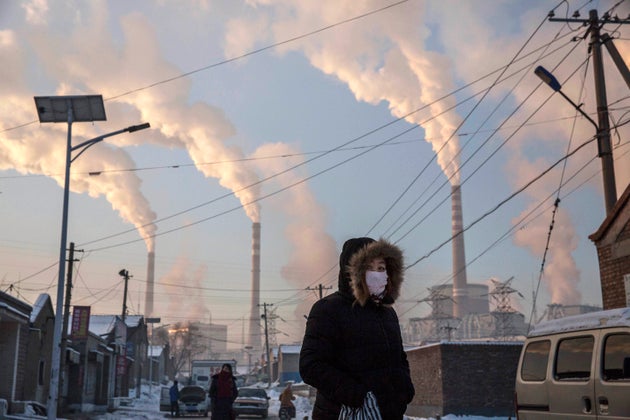
A woman wears as mask while walking in a neighbourhood next to a coal-fired power plant on Nov. 26, 2015, in Shanxi, China.

The market is encouraging pension funds and institutions to jettison fossil fuels from their portfolios, waving a clear warning flag to investors about the financial future of oil and coal companies.

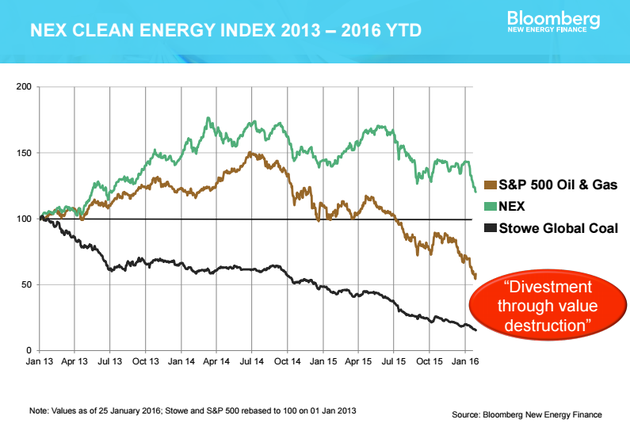
Fossil fuel stocks are performing poorly compared to the market as a whole — and perhaps most importantly, compared to renewable energy stocks, said Michael Liebreich, chairman of Bloomberg New Energy Finance, at a summit on climate risk put on by the nonprofit sustainability advocacy group Ceres.

Referring to investors who won’t divest and continue to own fossil fuel stocks, Liebreich pointedly said that the market was “divesting through value destruction” — in other words, cutting their holdings in traditional, polluting energy companies by slashing their value.

Renewable energy stocks have dramatically outperformed fossil fuels.

Over the last 10 years, the S&P 500 index is up just over 50 percent. Yet energy stocks over the same time period have risen only 1.3 percent.

For big investors to simply allow their holdings in big energy companies to fall toward a vanishing point of worthlessness is deeply irresponsible, observers say.

Indeed, former Vice President Al Gore, who shared the Nobel Peace Prize in 2007 for his work on climate change, compared the risk that some fossil fuel companies’ assets will become worthless to the danger of mortgage-backed securities, whose collapse triggered the 2008 financial crisis.

The nonprofit research group Carbon Tracker estimates that if the world changes its energy sources to keep climate change below 2 degrees Celsius, $2 trillion in fossil fuel assets will be stranded — that is, unusable, far less valuable, and in some cases, liabilities.

Huffington Post

Yang Xiaorui (left) shows Phillip Paulwell, minister of science, technology, energy and mining, an area of the oil and gas exploration vessel that docked at the Port of Kingston yesterday.

International oil and gas explorers are once again in Jamaican waters with the blessing of the National Environment and Planning Agency (NEPA) and promises to the local fishing community.

This time, the explorers are venturing on a data-collection exercise.

The first exploration company in 10 years to re-energise the search for oil offshore, the United Kingdom-based Tullow Oil has brought the gamut of data-capturing equipment for the second phase of its venture.

“This is a major deal for Jamaica’s oil-and-gas exploration,” asserted Phillip Paulwell, minister of science, technology, energy and mining, during a tour of the vessel, BGP Challenger, yesterday at the Kingston Port.

Paulwell, who was accompanied on the tour by State Minister Julian Robinson, said: “For them to start this work, they had to get approval from NEPA, and they have signed an important agreement with our fisherfolk in the event of any matter for full compensation.”

In November 2014, the Petroleum Corporation of Jamaica (PCJ) signed a production-sharing agreement with Tullow Oil (Jamaica) for oil and gas exploration in Jamaica’s offshore areas.

“We first started (explorations) in the 1980s when the then Government of Jamaica was responsible for funding,” said Paulwell.

He asserted that it has gained momentum with the private sector coming on board with Tullow Oil signing an agreement.

Paulwell told The Gleaner that US$70 million was committed to the project.

“They have so far spent US$10 million, and this exercise will cost them another US$4 million to acquire additional data.”

He added: “Although we are convinced that we have oil and gas in and around Jamaica, we really have to pinpoint the location before drilling can take place.”

He continued: “They have demonstrated a firm commitment, in spite of the fact that the price of oil has plummeted.”

The minister noted that when the agreement was signed 15 months ago, the price of oil was well over US$100 a barrel.

“Today, it is about US$30, but they are still committed, and not only them, since we signed the agreement, others have approached PCJ.”

NEGOTIATIONS ONGOING

Paulwell disclosed that negotiations are ongoing with another major firm.

“Shortly, we are going to sign another agreement,” he said.

“It means that there is a high level of ‘prospectivity’ and there is tremendous confidence in what we have done so far,” he added.

John McKenna, external affairs manager of the London-based Tullow Oil, who has been involved in the project since its onset, said the second phase related to the imaging of the seabed.

“This is the second part, which is the two-dimensional seismic expedition programme.”

He noted that it involves the acquiring of more than 3,000 kilometres of additional data.

“We are focusing initially on the eastern part of the offshore where very little data has been acquired in the past.”

The Gleaner