
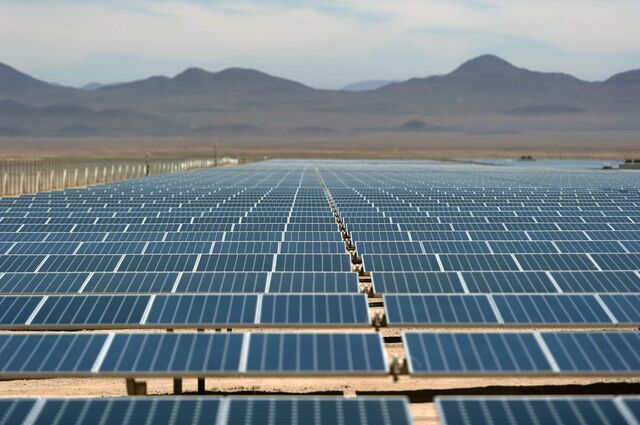
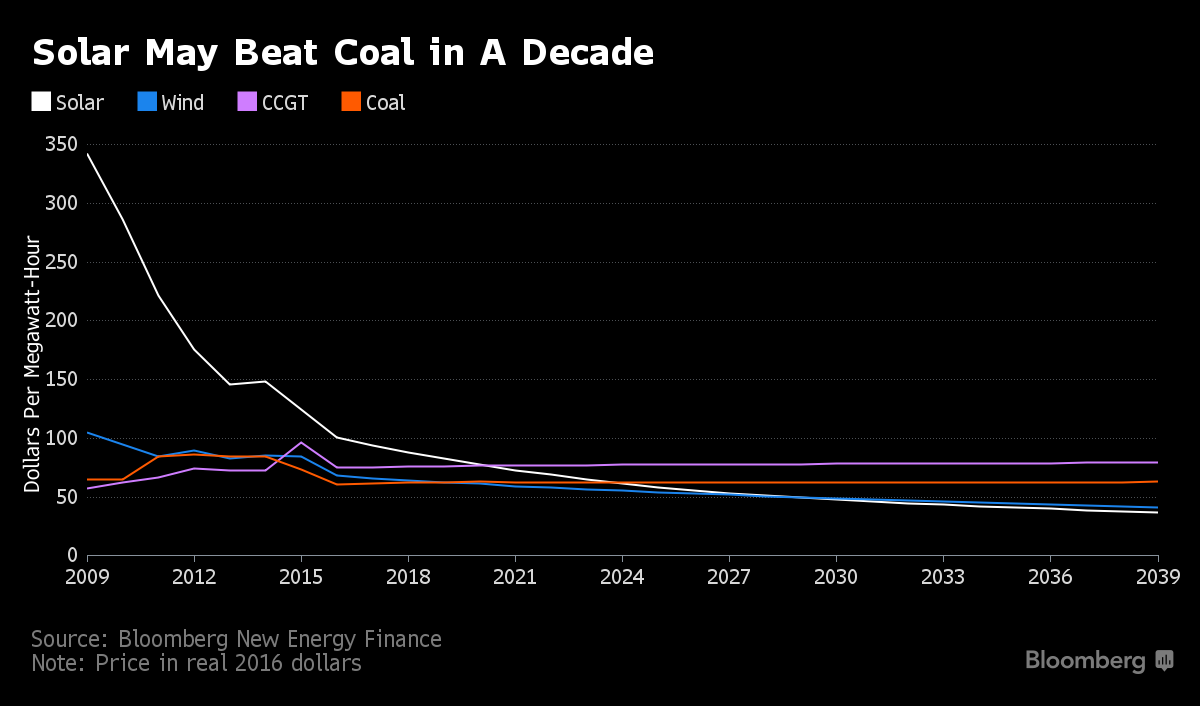
Solar power is now cheaper than coal in some parts of the world. In less than a decade, it’s likely to be the lowest-cost option almost everywhere.

In 2016, countries from Chile to the United Arab Emirates broke records with deals to generate electricity from sunshine for less than 3 cents a kilowatt-hour, half the average global cost of coal power. Now, Saudi Arabia, Jordan and Mexico are planning auctions and tenders for this year, aiming to drop prices even further. Taking advantage: Companies such as Italy’s Enel SpA and Dublin’s Mainstream Renewable Power, who gained experienced in Europe and now seek new markets abroad as subsidies dry up at home.

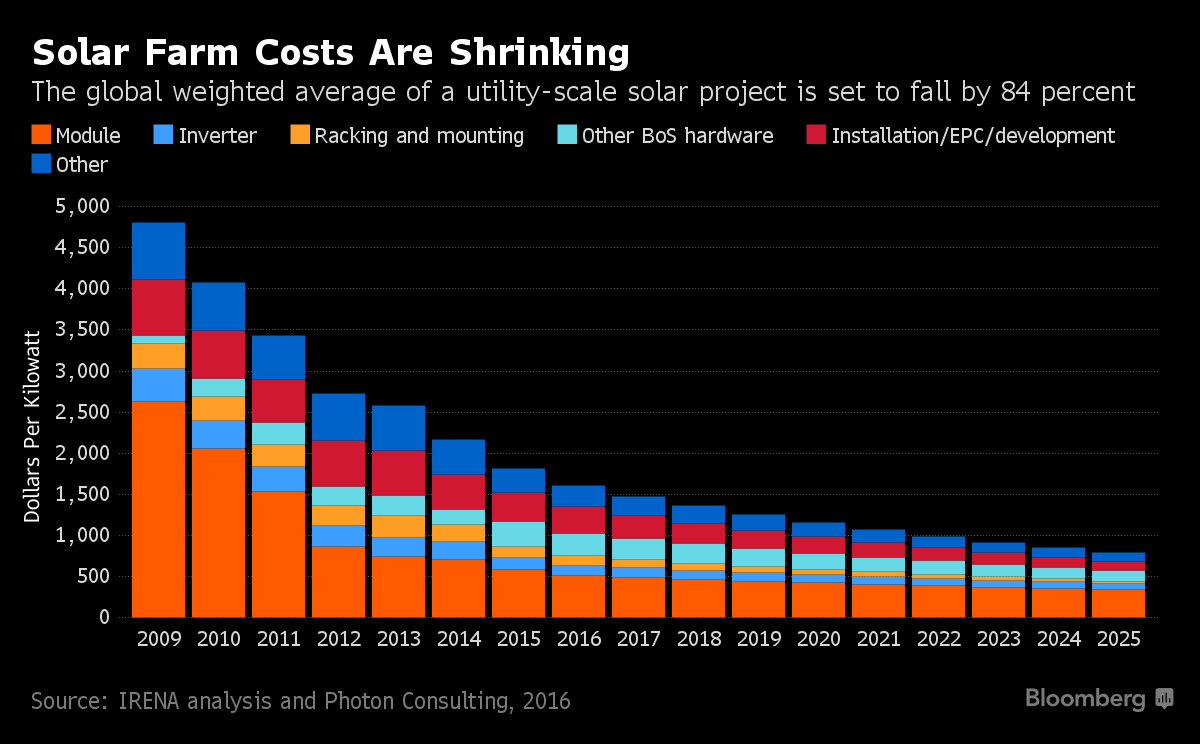
Since 2009, solar prices are down 62 percent, with every part of the supply chain trimming costs. That’s help cut risk premiums on bank loans, and pushed manufacturing capacity to record levels. By 2025, solar may be cheaper than using coal on average globally, according to Bloomberg New Energy Finance.

“These are game-changing numbers, and it’s becoming normal in more and more markets,” said Adnan Amin, International Renewable Energy Agency ’s director general, an Abu Dhabi-based intergovernmental group. “Every time you double capacity, you reduce the price by 20 percent.”
Better technology has been key in boosting the industry, from the use of diamond-wire saws that more efficiently cut wafers to better cells that provide more spark from the same amount of sun. It’s also driven by economies of scale and manufacturing experience since the solar boom started more than a decade ago, giving the industry an increasing edge in the competition with fossil fuels.

The average 1 megawatt-plus ground mounted solar system will cost 73 cents a watt by 2025 compared with $1.14 now, a 36 percent drop, said Jenny Chase, head of solar analysis for New Energy Finance.

That’s in step with other forecasts.

  • GTM Research expects some parts of the U.S. Southwest approaching $1 a watt today, and may drop as low as 75 cents in 2021, according to its analyst MJ Shiao.
  • The U.S. Energy Department’s National Renewable Energy Lab expects costs of about $1.20 a watt now declining to $1 by 2020. By 2030, current technology will squeeze out most potential savings, said Donald Chung, a senior project leader.
  • The International Energy Agency expects utility-scale generation costs to fall by another 25 percent on average in the next five years.
  • The International Renewable Energy Agency anticipates a further drop of 43 percent to 65 percent for solar costs by 2025. That would bring to 84 percent the cumulative decline since 2009.

The solar supply chain is experiencing “a Wal-Mart effect” from higher volumes and lower margins, according to Sami Khoreibi, founder and chief executive officer of Enviromena Power Systems, an Abu Dhabi-based developer.

The speed at which the price of solar will drop below coal varies in each country. Places that import coal or tax polluters with a carbon price, such as Europe and Brazil, will see a crossover in the 2020s, if not before. Countries with large domestic coal reserves such as India and China will probably take longer.

Coal’s Rebuttal

Coal industry officials point out that cost comparisons involving renewables don’t take into account the need to maintain backup supplies that can work when the sun doesn’t shine or wind doesn’t blow. When those other expenses are included, coal looks more economical, even around 2035, said Benjamin Sporton, chief executive officer of the World Coal Association.

“All advanced economies demand full-time electricity,” Sporton said. “Wind and solar can only generate part-time, intermittent electricity. While some renewable technologies have achieved significant cost reductions in recent years, it’s important to look at total system costs.”

Even so, solar’s plunge in price is starting to make the technology a plausible competitor.

In China, the biggest solar market, will see costs falling below coal by 2030, according to New Energy Finance. The country has surpassed Germany as the nation with the most installed solar capacity as the government seeks to increase use to cut carbon emissions and boost home consumption of clean energy. Yet curtailment remains a problem, particularly in sunnier parts of the country as congestion on the grid forces some solar plants to switch off.
Sunbelt countries are leading the way in cutting costs, though there’s more to it than just the weather. The use of auctions to award power-purchase contracts is forcing energy companies to compete with each other to lower costs.

An August auction in Chile yielded a contract for 2.91 cents a kilowatt-hour. In September, a United Arab Emirates auction grabbed headlines with a bid of 2.42 cents a kilowatt-hour. Developers have been emboldened to submit lower bids by expectations that the cost of the technology will continue to fall.

“We’re seeing a new reality where solar is the lowest-cost source of energy, and I don’t see an end in sight in terms of the decline in costs,” said Enviromena’s Khoreibi.

Bloomberg

HEAD OF the Intergovernmental Panel on Climate Change (IPCC) Hoesung Lee has urged attention and focus on the science and not politics in decision-making about climate change.

“One common question (at the Marrakech climate talks held recently in Morocco) was whether political developments in some countries could hinder the global community in providing a science-based response to climate change. My view, the scientists’ view, is that values and political beliefs may vary, but science is the common ground where these conflicting views can find a common understanding,” he said.

Lee was speaking in Jamaica recently where the IPCC the international body that assesses the science related to climate change held its most recent outreach event for the region and which formed a part of Climate Change Awareness Week celebrations on the island.

His comments come even as the world waits to see what the new United States (US) President and climate sceptic, Donald Trump, will do.

The US, up to now, has been one of the more significant contributors to the work of the IPCC, for example, and has done much to bolster global adaptation and mitigation efforts.


Urgent Action

According to Lee, the science has so far revealed the need for urgent action on climate change.

“Responding to climate change is not an either/or choice for a country, it’s part of its development strategy. You all know that,” he said, while referencing the IPCC’s Fifth Assessment Report (AR5).

The synthesis report of the AR5 points, among other things, to ongoing and exacerbated warming of the planet due to human actions.

“Emissions of carbon dioxide from fossil fuel combustion and industrial processes contributed about 78 per cent of the total GHG emissions increase from 1970 to 2010, with a similar percentage contribution for the increase during the period 2000 to 2010,” reads a section of the report.

“Globally, economic and population growth continued to be the most important drivers of increases in carbon dioxide emissions from fossil fuel combustion,” it added.


Population Growth

“The contribution of population growth between 2000 and 2010 remained roughly identical to the previous three decades while the contribution of economic growth has risen sharply,” the document said further.

In the wake of those findings, the IPCC and its team of scientists from across the globe, is to contribute more to the existing body of knowledge on the subject.

Among other things, they are to prepare a special report on the impacts of warming of 1.5 degrees Celsius and related emissions pathways.

“Earlier this year, we brought experts together to scope out that report, and we signed off the outline the table of contents and structure in October. We are now recruiting authors to write the report, which will be delivered in 2018,” Lee said.

All this, while seeking to make their work more accessible.

“We are looking at how to work with our new authors to encourage them to produce their summaries for policymakers in clear, accessible language for non-specialists, and with academies to help them develop educational materials based on our reports,” Lee said to an audience of not only NGOs and policymakers, but also students.

Gleaner


Members of the Jamaican delegation to COP21 at the Wider Caribbean Pavilion (from left) Ambassador Sheila Sealy Monteith, under secretary for the Multilateral Affairs Division at the Ministry of Foreign Affairs and Foreign Trade; Vilma McNeish, ambassador to the Kingdom of Belgium and the European Union; Senator Arnold J Nicholson, minister of foreign affairs and foreign trade; Dr Orville Grey, senior technical officer in the Ministry of Water, Land, Environment and Climate Change; and Jeffrey Spooner, head of the Meteorological Service of Jamaica.


PARIS, France — An unprecedented coalition of close to 40 governments, hundreds of businesses and influential international organisations have called for accelerated action to phase out fossil fuel subsidies, a move that would help bridge the gap to keep global temperature rise below 2°C and perhaps close to the 1.5°C for which Caricom and other Small Island Developing States are advocating.

On the opening day of the UN Conference on Climate Change (COP21) last week, New Zealand Prime Minister John Key formally presented the Fossil Fuel Subsidy Reform Communiqué to Christiana Figueres, executive secretary of the UN Framework Convention on Climate Change (UNFCCC), on behalf of the Friends of Fossil Fuel Subsidy Reform, The Prince of Wales Corporate Leaders Group and other supporters of the communiqué.

The communiqué calls on the international community to increase efforts to phase out perverse subsidies to fossil fuels by promoting policy transparency, ambitious reform and targeted support for the poorest.

Governments spend over $500 billion of public resources a year to keep domestic prices for oil, gas and coal artificially low. Removing fossil fuel subsidies would reduce greenhouse gas emission by 10 per cent by 2050. It would also free up resources to invest in social and physical capital like education, healthcare and infrastructure, while levelling the playing field for renewable energy.

“Fossil fuel subsidy reform is the missing piece of the climate change puzzle,” Prime Minister Key said. “It’s estimated that more than a third of global carbon emissions, between 1980 and 2010, were driven by fossil fuel subsidies. Their elimination would represent one-seventh of the effort needed to achieve our target of ensuring global temperatures do not rise by more than 2°C. As with any subsidy reform, change will take courage and strong political will, but with oil prices at record lows and the global focus on a low carbon future, the timing for this reform has never been better.”

In accepting the communiqué, Figueres said: “These subsidies contribute to the inefficient use of fossil fuels, undermine the development of energy efficient technologies, act as a drag on clean, green energy deployment and in many developing countries do little to assist the poorest of the poor in the first place.

“The huge sums involved globally could be better spent on schools, health care, renewable energies and building resilient societies. The current, very low oil prices are a good opportunity to really get going on this issue.”

Chair of The Prince of Wales Corporate Leaders Group (CLG) and former president of Alstom Power, Philippe Joubert, also spoke last Monday.

“The CLG’s long-standing efforts to put a price on carbon, including most recently working with the World Bank through the Carbon Pricing Leadership Coalition, will soon deliver results. It doesn’t make sense that, at the same time, governments artificially deflate the cost of coal, oil and gas, the primary cause of GHG emissions. Fossil fuel subsidies must be ended to stop this contradiction and enhance a real transition to low carbon energy,” he said.

For the OECD’s part, Secretary-General Angel Gurría commented that countries need to demonstrate their seriousness about combating climate change with concrete actions and policies.

“Reforming harmful fossil-fuel support is a good place to start,” Gurría stressed.

Close to 40 countries have endorsed the Fossil Fuel Subsidy Reform Communiqué, including Canada, Chile, France, Germany, Italy, Malaysia, Mexico, Morocco, Peru, The Netherlands, The Philippines, Samoa, the United Kingdom, the United States, Uganda, and Uruguay.

The communiqué is supported by The Prince of Wales’s Corporate Leaders Group (23 global companies employing two million people worldwide with combined revenues exceeding US$170 billion) and other business organisations working with thousands of corporations and investors, including The B Team, the World Business Council for Sustainable Development and the We Mean Business coalition.

The communiqué has also been endorsed by influential international organisations, including the International Energy Agency, the OECD and the World Bank.

Eliminating fossil fuel subsidies can accelerate the economic shift needed to tackle climate change and remove one of the obstacles to delivering the low-carbon future for which COP21 is aiming.

“History will prove fossil fuel to be a dead end,” Stefan Löfven, prime minister of Sweden, said. “Sweden will be amongst the first fossil-free welfare nations of the world. And eliminating fossil fuel subsidies is an important step on this path.”

Hakima El Haite, Morocco’s environment minister and candidate for the presidency of COP22, added: “Not only do fossil fuel subsidies put a strain on government coffers but they also don’t help the poorest of society.”

COP21 began on November 30 and will run until Friday, December 11.

Jamaica Observer

A dramatic rise in the oil bill alongside flat tourism inflows caused Jamaica’s current account deficit to more than double last year.

The trade gap with overseas partners also yawned wider at the end of 2011, with imports of goods valued at US$5.9 billion outpacing goods exports of US$1.7 billion by 256 per cent or US$4.26 billion.

Balance of payments (BOP) data released by the Bank of Jamaica (BOJ) indicate that the current account deficit worsened to US$2.07 billion, compared to US$934 million in 2010.

“In particular, mineral fuel imports expanded by US$856.3 million, partly reflecting a 19.6 per cent increase in the average price of oil for the period,” said the BOJ in its December 2011 BOP report.

The spike in the oil bill also wiped out gains in the bauxite sector.

The services sector, which includes transport and travel, was hurt by increased sea freight charges amid narrow movement in inflows from tourism, which inched up 1.3 per cent to US$1.8 billion.

Some positive signs

Private remittances also recovered slightly by US$106 million to US$1.92 billion, while total remittances were reported at US$2.04 billion.

Improved earnings from crude materials

A solar panel used at the Ecological farm near...
Image via Wikipedia

Allow me space in your publication to respond to a letter in which Member of Parliament Lisa Hanna defends her thesis on ‘clean coal‘ as a possible energy source on which to build our economic future.

I’m quite in agreement on the points made in her first two paragraphs, but must violently disagree on her postulation about Jamaica’s economic future being built on cheap energy source, and that source being clean coal. Her view about the stability of coal price is myopic.

May I remind her about our cheap bauxite in the 1970s, how it became expensive when we thought that all and sundry were benefiting – except us, the primary producer. All commodities are subject to market manipulation, politically or otherwise.

Here is my solution for building our economy, by marrying two renewable resources, our people and renewable energy, we will create a symbiosis which has perpetuity. Consider the vehicle you love, the great value lies in the head of those who manufactured it, so will the solution to solve our energy needs. For it is the value that is added to any resource that gives value, by developing our human resource to harness the abundant energy which bathe our beloved island daily we will have a dependable source of energy, and can even be net exporters of energy-harvesting equipment.

No good foundation

MP Hanna points to the competitiveness of economies having cheaper energy source, but here are the calculations. For solar energy, the most expensive at present price using a life of about 40 years, the cost is US 13 cents per kilowatt-hour and set to go down as the industry matures.

She said coal-based power supplies 40 per cent of the world’s electricity and this is set to go up with China’s ever increasing wealth and its desire to improve the lot of its citizens. Coal, whether clean or not, is set to see greater demand and, hence, price movement. That’s not a good foundation on which to base a country’s future, when we have a source of energy that is in our hands, for a better way to build one’s future.

Global warming

We are all concerned about the global state of the world environment; research indicates that global warming is due, in part, to the use of fossil fuel. A shift to renewable energy will lead to a reduction of our carbon footprint. Over time, this could be brought near to zero.

This approach will render the development of resources in the constituency she now represents feasible, but further arguments can be made about the country as a whole. The natural scientists, business persons, civil engineers, manufacturers, artisans and even casual labourers will be beneficiaries of this policy approach. This is development.

In the final paragraphs of the letter, the issue of liquefied natural gas (LNG) was discussed. Again, as with her discussion on coal, the decision to embrace LNG as the fuel of choice is wrong. Proponents of both fuel miss the key issue. It is the human resource that should be at the centre of policy.

Both sets of proponents see the Jamaican people as objects to be exploited while a bone is thrown their way. I can show a policy path that can lead us into wealth, creativity and, finally, a proud people which have the capacity to solve our problems. My friends say there is a dinosaurian tendency among the young politicians, by association, and they are about to redo the failure of the last 48 years. We can point them the way to a better future.

I am, etc.,

AUBREY MURRAY

Atlantic Solar Corporation

10 Chisholm Avenue

Kingston 10

Jamaiaca Gleaner

see Lisa Hanna article below

Coal can supply north coast with power, says Hanna

Member of Parliament (MP) for South East St Ann, Lisa Hanna, is suggesting that, using the clean coal technology to safeguard the environment, a coal power plant located in St Ann could generate enough power to satisfy demands on Jamaica’s north coast.

“Right now Jamaica is producing energy at US$0.30 per kilowatt hour whereas countries which are competitive are producing at five cents,” Hanna told The Gleaner. “And you are not going to have persons running to do business in Jamaica if the energy costs are eating up their profit, which is also what is happening.”

The St Ann MP said she wanted efforts to be made to export limestone and bring in coal.

“If you look at a constituency like South East St Ann or South West St Ann, if you put a clean coal power plant up there you can power the entire north coast with it,” she argued. “That is something that I would like to realise.”

Hanna argued that the Government’s pursuit of liquefied natural gas (LNG) as a solution to Jamaica’s energy problems would be an expensive venture when compared to using coal.

Energy and Mining Minister James Robertson has stated that Government’s LNG project was expected to save Jamaica US$1.2 billion in energy cost.

Expensive venture

However, according to Hanna, the cost would still be high as Jamaica would have to import the LNG.

“That is going to be an expensive venture and clean coal technology is technology that is being used in different places of the world quite successfully,” Hanna said. “And there are places that have the coal and need limestone and the ships could export (limestone) and import the coal at the same time.”

In the United States, the cost of a megawatt of electricity produced by coal runs between $20 and $30, while a megawatt of energy produced from natural gas ranges between $45 and $60.

Hanna’s comments reflect a concern expressed by Jamaicans who over the years have been calling for alternate sources of energy in order to reduce Jamaica’s dependency on oil. Solar, wind and hydropower sources have been suggested as viable alternatives.

Loan programme

The National Housing Trust (NHT) has taken a step in this direction by introducing a loan programme to assist home owners install solar powered water heaters in their homes.

Research shows that approximately 40 per cent of the world’s energy was derived from oil, while 23 per cent was derived from coal.

Experts estimate that, by 2025, 80 per cent of the world’s oil reserves would have been used. Coal reserves, on the contrary, are capable of lasting 1,000 years.

One drawback of the use of coal however, is that its negative impact on the environment is greater than oil and natural gas