
screen-shot-2016-10-28-at-6-20-33-pm

What will Donald Trump actually do?

It’s a question many Americans are asking themselves now that the U.S. has wrapped up one of its least policy-specific elections ever. The president-elect has offered only the loosest of legislative prescriptions, including whatever plans he may have for the energy industry.

The mystery hangs over turbine manufacturers like Vestas Wind Systems, which fell 12 percent since the election, and coal companies such as Peabody Energy Corp., which soared 73 percent. In his only major energy speech, Trump, 70, said he would rescind “job-destroying” environmental regulations within 100 days of taking office and revive U.S. coal. It’s terrible news for efforts to slow the pace of climate change, but the impact on the renewable energy revolution may be limited. Here’s what it could mean for America’s clean-energy darling, Tesla Motors Inc.:

1. Solar and wind subsidies are probably safe

Tesla is, first and foremost, an electric car company. But on Nov. 17 shareholders will vote on final approval of CEO Elon Musk’s $2.2 billion deal to buy SolarCity Corp. The acquisition would make Tesla the biggest U.S. rooftop solar installer and the first major manufacturer to integrate solar panels with battery backup to extend power into the night.

The swift spread of rooftop solar in the U.S. has been made possible by two government policies. First, most utilities are required to credit homeowners for the excess power they send back to the grid. Those requirements are state-level and shouldn’t be affected by Trump. Second is the 30 percent federal tax credit to offset the cost of installations. The credits were first signed into law under Republican President George W. Bush in 2005 and extended by a Republican Congress late last year. Given their broad support, the subsidies are unlikely to be repealed.

2. Even without incentives, renewables will get cheaper

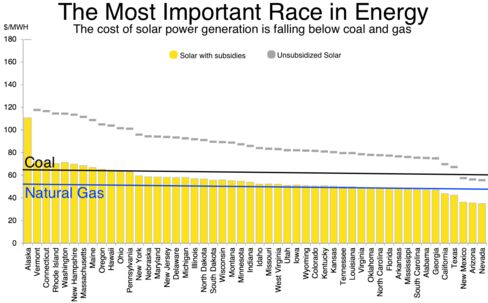
Solar panel prices have dropped, on average, more than 15 percent a year since 2013. On a utility scale, solar power is already cheaper than coal-fired grid electricity across most of the U.S., after subsidies. Even if the incentives were suddenly removed next year—an improbable and economically destructive scenario—the industry would eventually recover as prices continue to fall.

Incentives are designed to make superior new technologies initially affordable, but once those technologies take off, economies of scale take over.
Source: Bloomberg New Energy Finance

A loss of the federal tax credit could slow the rollout of Tesla’s unusual new rooftop solar shingles. Traditional rooftop panels, however, are almost ready to stand on their own. The payback period currently ranges from about 5 to 10 years, after subsidies and state rebates. If Tesla can achieve the cost savings it hopes for with the merger, it won’t be long before that’s the payback timeline without subsidies.

3. Gasoline fuel-efficiency targets could be dismantled

One of President Barack Obama’s most significant climate achievements was to push through ambitious fuel-economy regulations for U.S. vehicles. The Environmental Protection Agency is scheduled next year to re-asses rules intended to double the average efficiency of cars and trucks to almost 55 miles per gallon by 2025. Those goals could be delayed or dismantled under Trump, accelerating America’s shift to trucks and SUVs. Stocks of Detroit carmakers have predictably surged, while Tesla shares fell 4.9 percent in the two days after the election.

This is obviously bad news for human health and the environment, but it’s impact on Tesla won’t be catastrophic. The price of batteries is dropping rapidly, and by the early 2020s electric cars should be cheaper and better performing than their gasoline-powered equivalents across the board. Lowering efficiency standards will make gasoline cars a bit cheaper to manufacture, but it will also make them more costly to drive over the life of the vehicle.

4. Electric vehicle incentives will expire on their own

The U.S. push for electric cars was set in motion by a $7,500 federal tax break. The Trump administration could eliminate the subsidy, but the impact would be short-lived for electric pioneers including Nissan Motor Co., General Motors Co., and Tesla. That’s because the electric-vehicle subsidies were already designed to phase out after each automaker reaches its 200,000th domestic EV sale. Tesla may be first to cross that finish line, probably in the first half of 2018.

The incentives were intended to overcome steep startup costs and slow initial demand for new electric vehicles. Removing the tax break now would effectively pull the ladder up behind Tesla and make it more expensive for other automakers to transition to battery power, a result that wouldn’t be in anyone’s best interest.

5. States wield the power of their own incentives

Some of the biggest incentives in renewable energy are offered by states, not the federal government. Each state has authority over its own solar and wind rebates, credits for power sold back to the grid, renewable-mix requirements for utilities, and electric-car subsidies. These policies cross ideological borders into deeply Republican states. For example, Louisiana residents can get an additional tax credit of almost $10,000 for buying a long-range electric car. In Colorado, it’s an extra $5,000.

Under Trump, the role of cities and states in regulating pollution and expanding clean energy will increase. So will the disparity between states that prioritize the issue and those that don’t. But again, don’t expect the energy revolution to follow rigid red-state, blue-state definitions. The states producing the most wind power in the U.S. include Texas, Kansas, and Oklahoma. For solar, Arizona, North Carolina, and Nevada are among the top ten. Of those, Hillary Clinton won only Nevada.

6. Keystone’s resurrection won’t make gasoline cheaper

This election was great news for oil companies. Reviving the Keystone XL pipeline, which was rejected under Obama, is on Trump’s list of priorities for his first 100 days. He is also likely to support the beleaguered Dakota Access Pipeline. The company building it, Energy Transfer Partners LP, says business is “only going to get better” under Trump.

These pipelines are hugely symbolic for climate activists who say we can’t keep building infrastructure for oil we can’t afford to burn. But the impact of the pipelines themselves is open to debate. They increase profitability for oil companies, but as oil trades on a global market, the impact on U.S. gasoline prices and by extension demand for electric cars is negligible.

7. Trade barriers with Mexico would hurt Tesla’s rivals

Trump wants to scrap or renegotiate the North American Free Trade Agreement (NAFTA). That could be a dicey proposition for the car industry. Since 2010, nine automakers, including Ford Motor Co., GM and Fiat Chrysler have announced more than $24 billion in Mexican investments. They rely on Mexican plants to produce millions of vehicles and a high volume of parts.

By contrast, Tesla’s manufacturing and assembly are done almost entirely in California and Nevada. Tesla also plans to begin solar-panel production next year at SolarCity’s massive plant in Buffalo, N.Y. Tariffs on solar panels made outside the U.S. would make Tesla’s American-made products more competitive.

In the end, the confluence of all of these forces, but especially the precipitous decline of coal and increasing affordability of renewable sources of energy, is probably too strong to be reversed by the incoming Republican administration. That’s good news for Tesla, and a lot of other companies working to clean up the energy supply.

Bloomberg

THE Inter-American Development Bank (IDB) and University of Technology (UTech) recently collaborated on a one-day workshop designed to teach non-technical professionals about the energy sector and how it affects their lives and businesses.

Billed ‘Demystifying the Energy Industry’, the event targeted business people, entrepreneurs, banking and insurance executives, among others. It zeroed in such areas as energy costs and renewable alternatives to fossil fuels.

IDB Country Representative Therese Turner-Jones noted that “because energy is a complex and technical topic, discussions are often dominated by energy sector professionals”.

But the workshop, she said, would help non-technical professionals “navigate discussions involving issues like petroleum-derived fuel products, natural gas, wind, solar, waste-to-energy, biofuels and energy efficiency”.

Dr Ruth Potopsingh, associate vice-president of Sustainable Energy at UTech noted that “knowledge of the energy sector can better equip us all to make sound business decisions”.

IDB Consultant Dr Earl Green presented the results of the IDB/DBJ Energy Efficiency Pilot Projects for Small & Medium Enterprises and a video called Success Stories in Energy Efficiency in Jamaica.

Lumas Kendrick Jr, senior energy specialist, IDB, moderated a panel discussion on Finding Solutions for Jamaica’s Energy Sector Challenges, which included panellists Fitzroy Vidal, director of energy, Ministry of Science, Technology, Energy & Mining; Christopher Brown, business development manager, Development Bank of Jamaica; Dr Ruth Potopsingh, associate vice-president-Sustainable Energy, UTech; and IDB/DBJ Grant recipients Yorkin Waltes, owner, Triple Seven Farms and Pauline Wilson, general manager, Pioneer Meats.


Jamaica Observer

Phillip Paulwell - File
Phillip Paulwell – File

Damion Mitchell, Editor – Radio & Online

The Science, Technology, Energy & Mining Minister, Phillip Paulwell, is to meet with private sector stakeholders in Montego Bay this afternoon.

They are to explore investments opportunities within the industry.

There have been increasing calls for Jamaica to shift its reliance on oil to produce energy and instead pursue other sources like wind and solar.

Paulwell says he wants to facilitate the interest of potential investors in the energy sector.

The forum is scheduled to be held at the Montego Bay Convention Centre.

Read more:

CARICOM
ENERGY POLICY
In A Nutshell

— —————————-——–

This is a Summary of the CARICOM Energy Policy which was approved by the Forty-First
Special Meeting of the COTED on ENERGY held 1 March 2013, in Trinidad and Tobago

The Goal/ Vision of the CARICOM Energy Policy

Fundamental transformation of the energy sectors of the Member States of the Community through the provision of secure and sustainable supplies of energy in a manner which minimizes energy waste in all sectors, to ensure that all CARICOM citizens have access to modern, clean and reliable energy supplies at affordable and stable prices, and to facilitate the growth of internationally competitive Regional industries towards achieving sustainable development of the Community

OBJECTIVES OF CARICOM ENERGY POLICY

In fulfillment of the Goal /Vision of the CARICOM Energy Policy and to assure access to
affordable, adequate, safe and clean energy products necessary for the development of Member States and for the consolidation of the CSME (established by the Revised Treaty of
Chaguaramas), the Community will develop a programme of regional actions in a coherent and comprehensive way in pursuit of the following objectives:

(a) sustainable and secure energy supplies through diversification of energy sources;
(b) accelerated deployment of renewable and clean sources of energy supplies
towards increased energy supply diversification and affordability;
(c) sustained growth of intra-Community trade in energy;
(d) increased energy efficiency and conservation in all sectors, including the
transportation sub-sector;
(e) establishment and enforcement of labeling and standards for the importation of
electrical appliances as well as standards for vehicles importation;
(f) increased investment in production, transformation and distribution of viable
energy resources;
(g) strengthening and enhancement of the human and institutional capacities in the
Community energy sector;
(h) programmed expansion of electricity generation, transmission, distribution and
trade;
(i) improved access to affordable energy by the poor and vulnerable;
(j) greater use of renewable energy for electricity generation as well as in the
transportation, industrial and agricultural sectors;
(k) coordinated approach to exploring and establishing an institutional framework
for leveraging financing mechanisms for the development of viable energy
resources;
(l) increased technology transfer and information sharing;
(m) established regional and national targets for emissions reduction with
corresponding mitigation actions;
(n) strategies for maintenance of adequate energy reserves in the event of disasters;
and
(o) Strengthened research, development and innovation efforts in energy sector
especially in areas of clean and renewable energy sources and technologies.

Quantitative Regional level targets for sustainable energy will be established in the context of the Caribbean Sustainable Energy Roadmap and Strategy (C-SERMS), based on rationalization of the potential energy resources and human and institutional capacity which will accompany the CEP and provide a implementation framework engaging all Member State and actors in the energy sector.

SUMMARY OF BROAD CARICOM ENERGY POLICY ACTIONS

In order to realize the Goal/Vision for the energy sector of the Community, it is the Policy of CARICOM to:

SECURITY OF SUPPLY AND FUEL DIVERSIFICATION (Chapter 1)

1. Ensure increased energy security through timely access to adequate, reliable and
affordable supplies of energy by all Member States of CARICOM.

EXPLOITATION OF HYDROCARBON SOURCES AND DEVELOPMENT OF FOSSIL FUEL MARKETS
(Chapter 2)

2. Secure least cost hydrocarbon resources for each Member State and ensure that
appropriate standards for petroleum and petroleum related products are introduced
and enforced.

RENEWABLE ENERGY (Chapter 3)

3. Diversify the energy sources through increased use of renewable energy in a manner
that assures optimization with other sectors.

ELECTRICITY SECTOR (Chapter 4)

4. Ensure the sustainability of the electricity sector through increased use of renewable
energy, improved legislative and regulatory framework and cross border trade of
electricity generated from indigenous renewable energy sources.

ENERGY CONSERVATION AND EFFICIENCY (Chapter 5)

5. Promote energy savings efforts in all sectors

ENERGY USE FOR TRANSPORTATION (Chapter 6)

6. Promote fuel switching in the transportation sector to cleaner energy sources and
encourage greater efficiency of energy use in the transportation sector.

ENERGY INVESTMENT (Chapter 7)

7. Undertake the necessary reforms in a timely manner to encourage greater investment
in the energy sector.

INTRA-COMMUNITY TRADE IN HYDROCARBON ENERGY SOURCES (Chapter 8)

8. Ensure fair pricing and access to hydrocarbon resources by all Member States to
improve the competitiveness of regional industries.

ENERGY AND THE ENVIRONMENT (Chapter 9)

9. Ensure that energy is supplied and consumed in a manner that creates minimal
adverse impact on the environment.

ENHANCEMENT OF HUMAN AND INSTITUTIONAL CAPACITY (Chapter 10)

10. Build and strengthen the human capacity and skills as well as institutional capacity
within the Region, encourage research and development and increase public education
and awareness to ensure energy sector development.

ENERGY ACCESS AND POVERTY ALLEVIATION (Chapter 11)

11. Eliminate energy poverty and ensure access to clean, affordable and reliable energy
supplies by all citizens of the Region poverty.

CROSS-CUTTING ISSUES (Chapter 12)

12. Encourage sustainable energy practices within all other sectors and areas where there
is linkage to energy use such as agriculture, youth and culture, etc.

ENERGY AND CLIMATE CHANGE (Chapter 13)

13. Establish regional and national targets for the reduction of greenhouse gas emissions
in the energy sector and implement appropriate mitigation actions relevant to the
energy sector.

ENERGY AND DISASTER PREPAREDNESS (Chapter 14)

14. Develop strategies to ensure the availability of energy supplies and products and a
strategic response to any oil spill and sustainability of energy services during any
crisis.

TRADE IN ENERGY SERVICES (Chapter 15)

15. Develop strategies to take advantage of opportunities for trade in energy services
regional and internationally.

PRINCIPLES GUIDING ACTIONS OUTLINED IN

THE CARICOM ENERGY POLICY

The CARICOM Energy Policy is guided by the following:

1. Community Mandates on Energy and Revised Treaty of Chaguaramas;
2. Focus on the Regional Level Energy Sector Challenges and Opportunities;
3. Recognition that Member States

At the risk of revocation of poetic license, allow the liberty to suggest that Shakespeare’s Hamlet, faced with Jamaica’s high energy charges, would have voiced his soliloquy thus:

“To conserve, or to produce: that is the question:

Work crews from Turning Mill Energy install 245-watt solar panels from the ET energy company, made in China, in West Barnstable, Massachusetts (Photo: AP)

Whether ’tis more arduous on the pocket to suffer

The slings and arrows of outrageous energy bills,

Or to produce from the abundance of sun and wind,

And, by such deed, oppose the tide of oil importation?”

A simple example will explain. If your energy consumption was 500KWh (kilo-Watt Hours) per month (equal to about 42 barrels of oil over five years) and a cost of about $220,000 annually and if, somehow, you had access to a facility of up to $1.5 million to resolve this, what are your options?

A renewable energy system (RE) – solar panels and/or wind turbine using the full $1.5 million could be installed. Or, for about $450,000, the solution could be energy conservation measures (EC) such as changing out bulbs to LEDs, tinting windows, photo cell switches, insulating the roof, use of inverter technology for fridges air-conditioners and practicing stringent energy management etc. If the strictest EC measures are adopted up to 175KWh per month may be saved and so, after expenditure on EC, there would still be an annual electricity bill of about $145,000 for 325KWh (27 barrels of oil over five years) saving $75,000 annually. This is a best case (or wishful thinking) scenario which assumes flat or stable oil prices over the next five years

At the end of EC however, your electricity bill may only be reduced by 35 per cent and so, when you take the inflation in energy charges into account, you may have saved some oil but you could be back to square one financially!

Conservation may not therefore be the answer and so consideration must be given to another option to answer the question “to produce or to conserve”? As it is in so many instances in life, the answer is in the grey area – neither EC nor RE but a combination of both.

If, after EC, consumption is reduced from 500KWh to 325KWh then install a 325KWh RE system and use a portion of the annual savings to carry out the EC measures – a combined approach. An achievable target could be to reduce consumption by an average of about 44KWh annually over five years after commissioning your RE system. Nothing would be done to attract expenditure until the end of the first year after accumulating the savings in electricity bills and the expensive EC measures would be accomplished over years two to five.

After one year the consumption would be reduced from 500KWh to 455KWh. After two years consumption is reduced from 455KWh to 410 KWh while production remains at 325KWh. At the end of five years consumption equals production. At the end of year one, savings is about $140,000 and this increases annually until the end of the fifth year when the electricity bill becomes zero and $220,000 is saved that year and afterwards. In five years the energy rates would have increased and the savings would be more in dollars and cents. Oil used by this combined approach would be about 7 barrels compared to about 27 barrels if only EC were employed but after 5 years of RE plus EC no oil would be used at all!

Excellent from the economic viewpoint but the financial reality is that, the combined approach demands repayment for the $1,500,000 capital cost of the RE system. At the most concessionary rate over 10 years this would be near $192,000/year. Therefore, for the first three to four years (depending on how much energy cost increases), the monthly repayment for the RE system plus energy charges from the electricity provider would significantly exceed the original electricity charge. This reason is that after five years the savings in electricity bills would be about $900,000 of which about one-half would have been expended in EC measures leaving only $450,000 to pay the $960,000 finance charges. But this does not mean that RE is not financially feasible!

Now, if EC only were employed the expenditure would only be about $450,000 which, under the above conditions would attract a finance charge of under $60,000 annually against saving $75,000 each year. Financially feasible but there is still the question of the continued use of oil.

This is a classic case for government intervention – brilliant economic gains (including oil savings and carbon credits) but significant negative financial consequences if attempted under conventional banking practices. The solution is a combination of creative, out-of-the-box initiatives including bulk purchases by the Government and loans with a two to three year moratorium ideally from the petrocaribe fund which appears to have been set up for just such a situation.

And so, back to the revised Hamlet, who, in his time, only appeared to have bigger problems because he was not faced with Jamaica’s high energy charges. Be not be inspired by what he was talking to himself about however, as a means to escape expensive energy regimen.

“Thus independence does make heroes of us all;

And thus the self-generation revolution

Is strengthened with creative thought,

And enterprises of great pith and moment

Will flourish throughout the land

And doff the yolk of fossil oppressors.

Be all their sins remember’d.”

Robert Evans is a practicing engineer.

Read more: