Seated from (left) Audrey Sewell, permanent secretary in the Ministry of Economic Growth and Job Creation; Milverton Reynold, managing director of the Development Bank of Jamaica; Gillian Hyde, general manager of JN Small Business Loans, and Allison Rangolan McFarlane, chief technical director, Environmental Foundation of Jamaica sign a Memorandum of Understanding (MOU) to facilitate the administration of the Climate Change Adaptation Line of Credit (CCALoC). The CCALoC will provide financing to Micro, Small and Medium Size Enterprises in the tourism and agri-business sectors across Jamaica, to increase resilience to climate change in these sectors. The signing took place at the Office of the Prime Minister in St. Andrew last year. Looking on are Minister with Portfolio in the Office of the Prime Minister with responsibility for Economic Growth and Job Creation, Daryl Vaz and Therese Turner-Jones, general manager of the Inter-American Development Bank Caribbean Department.

Jamaica National Small Business Loans (JNSBL) is looking to vamp up interest in its US$2.5-million adaptation to climate change line of credit, catering exclusively to small and medium size enterprises (SMEs) from the agriculture, tourism and related sectors.

“In the coming months, JNSBL will be strengthening its efforts through collaborations with related parties in the tourism and agro value chain to further promote the special loan facility,” said Jacqueline Shaw Nicholson, JNSBL’s communications and client services manager.

“We will also support the education of persons on matters of climate change as well as adaptive and mitigation techniques available to them,” she told The Gleaner.

So far, SMEs have drawn down on J$19.5 million of the available funds to finance the installation of rainwater harvesting systems, drip irrigation systems, water recirculation systems, solar water heating system, and energy smart system.

The first loan was approved in December, following the official launch of the line of credit earlier in the year.

“JNSBL is pleased with the take up of the loan facility so far, with 51 per cent to the Tourism sector and 49 per cent to the agro sector in disbursements,” said Shaw Nicholson.

For those persons wishing to drawn down on the funds, criteria for selection include not only that they be operating a tourism or agro-related business, but also that proposed projects must enhance their capacity to cope better with the increased changes and effects of climate change.

“Collateral is required and can include machinery and equipment of trade or to be purchased, motor vehicles that can be comprehensively insured or registered titles as well as lien on deposits, guarantors are also acceptable,” revealed Shaw Nicholson.

The maximum loan amount that can be awarded is $5 million, with an interest rate of four per cent per annum on the reducing balance.

However, Shaw Nicholson said, “borrowers can also utilise other loan facilities available at JNSBL to further support project implementation where needed”.

The line of credit is one of two financing mechanisms under the Pilot Programme for Climate Resilience. The other is the Special Climate Change Fund (SCCAF) that is being administered by the Environmental Foundation of Jamaica (EFJ).

The SCCAF finances adaptation and disaster risk-reduction projects and cover associated programme management cost.

It is accessible by community-based organisations, other civil-society groups and select public-sector agencies specifically for “clearly defined high-priority activities, particularly related to building the resilience of the natural environment and contributing to livelihoods protection and poverty reduction”, according to project documents.

The EFJ recently awarded 18 grants to the tune of $84.9 million to undertake projects designed to boost the ability of communities to respond to climate change threats.

Counted among those threats are increased and/or more severe extreme weather events, such as hurricanes and droughts, which destroy agricultural and tourism livelihoods.

Climate change also brings warmer temperatures, which, too, have negative implications for not only human livelihoods but also marine life. This is given, as one example, the negative effects of increased sea surface temperatures on coral reefs.

It is a look at these implications that, at least in part, provides the basis of JNSBL’s decision to pursue administration of the line of credit under the PPCR.

“Increasingly, agro-related activities were experiencing negative changes in production yield, both in quality and quantity, which affected their ability to earn as per usual. We, therefore, wanted to assist with educating our clients and staff on matters of climate change and assist them to obtain the systems and techniques necessary to adequately respond to matters of climatic variability,” Shaw Nicholson said.

“JNSBL is also cognisant of the wider threat climate change poses to food security and as a part of our own mandate to support economic sustainability, JNSBL wanted to provide well needed support to the MSME sector to adequately mitigate and adapt for sustainability,” she added.

Gleaner

Special Climate Change Adaptation Fund administrators from the Environmental Foundation of Jamaica and beneficiaries show off the cheque representing the most recent awards at the signing ceremony last Monday.

WITH A changing climate that threatens to wash away entire communities and derail livelihoods, local civil society organisations and small businesses are being empowered to respond – with capital.

This is thanks to financing made available through the Pilot Programme for Climate Resilience (PPCR).

There exist two financing mechanisms, according to Dr Winsome Townsend, project manager for the Adaptation Programme and Financing Mechanism under the PPCR.

One is the Special Climate Change Fund (SCCAF) that is being administered by the Environmental Foundation of Jamaica.

The SCCAF, according to project documents, is “to finance adaptation and disaster risk-reduction projects and cover associated programme management costs”.

“Grants from this trust fund will be accessed by community-based organisations, other civil-society groups and selected public-sector agencies, for clearly defined high-priority activities, particularly related to building the resilience of the natural environment and contributing to livelihoods protection and poverty reduction,” the documents revealed.

Last Monday, the first 18 beneficiary organisations were awarded sums to the tune of $84.9 million to undertake projects designed to enhance resilience at the community level.

“There was a call for proposals in October last year and out of that, about 80 proposals were received and about half that amount were shortlisted. They were further assessed and out of that, an initial 18 were approved,” said Townsend.

“Twelve were pending approval. Those 12 have now been approved. So out of that first call, approximately 30 have been approved,” she added.

PROJECTS TO BE PURSUED

Projects to be pursued include water harvesting and greenhouses, aquaponics systems and food processing, as well as various ecosystem restoration initiatives.

Townsend said another call will be issued later this month or early March.

The second mechanism is a line of credit, intended “to provide loan financing to support adaptation measures of farmers and other businesses in the agricultural sector, and small hoteliers and other businesses in the tourism sector”.

Five projects have been approved to the tune of some $25 million, Townsend said. However, the overall level of interest in the line of credit – administered by JN Small Business Loan – is not immediately clear.

“Because it has started soft, we don’t know yet. We can’t at this time make any determination as to the level of enthusiasm,” Townsend said.

Still, she is hopeful for its success, given what is at stake.

“It is not just the Government who needs to put in measures in terms of climate change adaptation, but everybody, including citizens. Of particular interest is the private sector because businesses are under threat from climate change, and so the private sector needs to respond to these threats,” she said.

“The micro, small and medium-size businesses are at greater risk because of their capacity to respond. They are not as resilient as the more established or bigger enterprises,” Townsend noted.

Gleaner

WITH ECONOMIES under threat due to climate change and prevailing high production costs, the recent Caribbean Sustainable Energy Forum (CSEF) served as a call to urgent action to realise energy efficiency and energy sustainability within CARICOM.

Kim Osborne of the Executive Secretariat for Integral Development at the Organisation of American States, said it is past time that talk be translated into action.

“There is always the challenge of maintaining a healthy balance between dialogue and implementation. Several studies and reports have noted that our region faces an ‘implementation deficit’, but I would venture to say that the region also suffers from a ‘dialogue surplus’,” she noted.

She was addressing participants at the Caribbean Sustainable Energy Forum (CSEF), held in The Bahamas last week.

“There is a serious mismatch between meetings and results in our region. My point here is twofold: that dialogue is not an end to itself, and that dialogue that does not lead to action and to results is meaningless,” Osborne added.

At the same time, she said that energy must not be looked at in isolation, but rather in the context of sustainable development.

“In the normal course of things, energy is not provided in a vacuum. It impacts and is impacted by several factors, such as poverty, water availability, disaster risk, climate change, health, education and human resource development, human rights, and coastal and marine management,” Osborne said.

“I am proposing that to the fullest extent possible, an integrated approach should be adopted towards the goal of sustainable energy management,” she added.

For his part, Dr Devon Gardner, programme manager for energy with the CARICOM Secretariat, emphasised three things – partnership, integration and action.

“The partnerships are not just for the CSEF, but with the World Bank and the United States Government, we are able to implement the Caribbean Sustainable Energy Road Map ad Strategy (C-SERMS) platform … . Because of partnerships, we have been able to work with the member states,” he said.

UNITY MAKES SENSE

On integration, he noted: “The CARICOM secretariat is really there to serve the member states. We do what the member states require to get the job done. The CARICOM is a group of countries within the Caribbean that we want to do some things together because it makes sense for us to work together to achieve mutual and shared objectives. And the role of the secretariat is to help the member states to realise this objective.”

Added Gardner: “We believe that all that CARICOM desires – from economic development to climate resilience to social resilience to security – is underpinned by having a strong energy sector … . We see energy as a critical part of the regional integration tool.”

In the end, Gardner said there was no question of realising C-SERMS energy targets that include 47 per cent renewable power capacity by 2027 without urgent action.

A number of regional leaders – among them Dr Regilio Dodson, Minister of Natural Resources in Suriname – have noted their support for an integrated and unified approach to the energy efficiency and sustainability in the region.

“We should work together … . We have to actively promote success stories … and learn from each other and go together and try to determine what is for our region the best way forward,” he said.

“If we work together to get this going and get the cooperation between CARICOM countries going, then we will have our energy security in our own hands, ” he added.

Among the topics explored over the three days of discussions at CSEF 2017 were ‘The CARICOM Energy Policy Road Map and Strategy: Shifting the C-SERMS from Concept to Action’; ‘The Regulator Within the Integrated Resource Planning Process’; and ‘The CARICOM Energy Transition: Lessons from the Last Five Years’.

The forum also saw the meeting of regional working groups on key thematic areas, including information and knowledge management, finance, capacity building and research, as well as policy and regulations.

Gleaner

BEGINNING FEBRUARY 7, the USAID-funded Jamaica Rural Economy and Ecosystems Adapting to Climate Change II (Ja REEACH II) project, in collaboration with the Meteorological Service of Jamaica and the Rural Agricultural Development Authority will host a series of agrometeorology farmers’ fora.

The fora are geared at equipping farmers and other stakeholders with climate-smart risk management strategies. The series will explore common terminologies used by weather experts in delivering the weather news, enabling farmers to interpret and use this information. The workshop will also feature presentations on climate outlook for the upcoming six months and how to prepare for any unexpected changes in the weather to reduce exposure of livelihoods.

“The farmers will also benefit from awareness sessions focused on the impact of climate change and variability on agri-business enterprises, the role of insurance products in the management of climate risks, and planning for climate risks at the farm or community level using the participatory integrated climate services for agriculture tool. This will be complemented by an interactive demonstration of the risk associated with disasters and early warning climate service (flooding or drought) by the MSJ,” Ja REEACH II said in a release to the media.

INSURANCE POLICY

GraceKennedy Insurance has partnered with the Ja REEACH II project to provide Livelihood Protection Policy coverage valued at $300,000 which will be presented to selected farmers during the series. The Livelihood Protection Policy offered by GK Insurance is a trigger-based insurance policy which is designed to help especially non-salary income earners to cope with severe impacts on their livelihood following extreme weather events (rain and wind).

This is the third staging of the agrometeorology fora which builds on the engagement of some 575 farmers, extension officers and other stakeholders who have participated.

The Ja REEACH II project is a four-year initiative funded by the USAID and implemented by ACDI/VOCA. Through a range of interventions, Ja REEACH II works with government, private sector, civil society and community- based organisations to increase awareness and application of practical actions that help Jamaicans to become more resilient to the impacts of climate change.

Gleaner


The effort to mainstream gender in climate change considerations while cementing the place of women in decision-making in that arena has a supporter in Dr James Fletcher, recent head of the CARICOM Task Force on Sustainable Development.

“Women are disproportionately affected by climate change, particularly in small-island developing states. Anytime here in Saint Lucia, if there is a drought, the people you see going miles to collect water are not the men, it is the women because they are the ones who, unfortunately, have the children on their hands and the household on their hands,” he noted.

“So women are always the ones who are disproportionately affected by natural disasters, and I think there must be some sensitivity in funding to the fact that there is a gender imbalance in the impacts of climate change and other natural disasters,” Fletcher added.

He was speaking with journalists at the Marrakech Climate Talks in November last year on the issue of a lack of funding to support the gender work programme that emerged from the Lima Climate Talks two years earlier.

Decisions in that work programme include:

– To enhance the implementation of the decision to promote gender balance and improve the participation of women in United Nations Framework Convention on Climate Change (UNFCCC) negotiations and in the representation of parties in bodies established in line with the Convention or the Kyoto Protocol; and

– that additional efforts be made by parties to the convention to improve the participation of women in their delegations and in all of the bodies established under the convention.

Among other things, it also invites parties to advance gender balance and promote gender sensitivity in developing and implementing climate policy and achieve gender-responsive climate policy in all relevant activities under the UNFCCC.

However, in Marrakech – as in Lima – it emerged that financing to achieve the provisions of the work programme is a challenge.

Fletcher’s advice to the women and gender constituency is to press ahead with their efforts.

“The thing with some of these discussions is it takes a while for common sense to prevail. So things you think people would get immediately, they don’t, and you must have a lot of back and forth. But I think that is the nature of the multilateral process. People come with different agendas, different perspectives,” he said.

CONTINUING THE PROCESS

“It really speaks to the need to continue having faith in the process, to continue pressing the line, and continue developing a coalition and seeking out allies and seeing how you can get support,” added Fletcher, who is also the former sustainable development minister for Saint Lucia.

He revealed that this is what had happened in the small island developing states’ effort to have the world take up the issue of loss and damage associated with climate change.

“When we started out with loss and damage, loss and damage was quintessentially a small-island state issue, and then suddenly, other people realised ok, there is a lot of merit in this, and we started developing allies and having more people come and support our cause,” he said.

“It is unfortunate that on a gender issue you need to go in that way because you figure anybody should realise that is an issue. But I think, probably, it is one of these areas where we need to do more work and where we need to do more sensitisation and make people understand the imperative of making sure that the funding is gender sensitive,” Fletcher noted.

Gleaner

HEAD OF the Intergovernmental Panel on Climate Change (IPCC) Hoesung Lee has urged attention and focus on the science and not politics in decision-making about climate change.

“One common question (at the Marrakech climate talks held recently in Morocco) was whether political developments in some countries could hinder the global community in providing a science-based response to climate change. My view, the scientists’ view, is that values and political beliefs may vary, but science is the common ground where these conflicting views can find a common understanding,” he said.

Lee was speaking in Jamaica recently where the IPCC the international body that assesses the science related to climate change held its most recent outreach event for the region and which formed a part of Climate Change Awareness Week celebrations on the island.

His comments come even as the world waits to see what the new United States (US) President and climate sceptic, Donald Trump, will do.

The US, up to now, has been one of the more significant contributors to the work of the IPCC, for example, and has done much to bolster global adaptation and mitigation efforts.


Urgent Action

According to Lee, the science has so far revealed the need for urgent action on climate change.

“Responding to climate change is not an either/or choice for a country, it’s part of its development strategy. You all know that,” he said, while referencing the IPCC’s Fifth Assessment Report (AR5).

The synthesis report of the AR5 points, among other things, to ongoing and exacerbated warming of the planet due to human actions.

“Emissions of carbon dioxide from fossil fuel combustion and industrial processes contributed about 78 per cent of the total GHG emissions increase from 1970 to 2010, with a similar percentage contribution for the increase during the period 2000 to 2010,” reads a section of the report.

“Globally, economic and population growth continued to be the most important drivers of increases in carbon dioxide emissions from fossil fuel combustion,” it added.


Population Growth

“The contribution of population growth between 2000 and 2010 remained roughly identical to the previous three decades while the contribution of economic growth has risen sharply,” the document said further.

In the wake of those findings, the IPCC and its team of scientists from across the globe, is to contribute more to the existing body of knowledge on the subject.

Among other things, they are to prepare a special report on the impacts of warming of 1.5 degrees Celsius and related emissions pathways.

“Earlier this year, we brought experts together to scope out that report, and we signed off the outline the table of contents and structure in October. We are now recruiting authors to write the report, which will be delivered in 2018,” Lee said.

All this, while seeking to make their work more accessible.

“We are looking at how to work with our new authors to encourage them to produce their summaries for policymakers in clear, accessible language for non-specialists, and with academies to help them develop educational materials based on our reports,” Lee said to an audience of not only NGOs and policymakers, but also students.

Gleaner

Electric avenues that can transmit the sun’s energy onto power grids may be coming to a city near you.

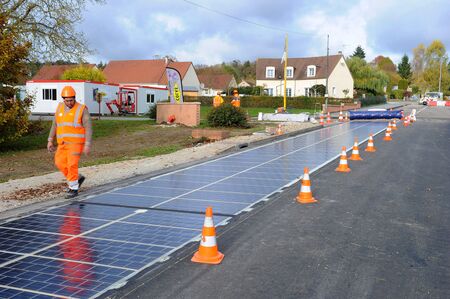
A subsidiary of Bouygues SA has designed rugged solar panels, capable of withstand the weight of an 18-wheeler truck, that they’re now building into road surfaces. After nearly five years of research and laboratory tests, they’re constructing 100 outdoor test sites and plan to commercialize the technology in early 2018.

Wattway’s solar road in Tourouvre

“We wanted to find a second life for a road,” said Philippe Harelle, the chief technology officer at Colas SA’s Wattway unit, owned by the French engineering group Bouygues. “Solar farms use land that could otherwise be for agriculture, while the roads are free.”

As solar costs plummet, panels are being increasingly integrated into everyday materials. Last month Tesla Motors Inc. surprised investors by unveiling roof shingles that double as solar panels. Other companies are integrating photovoltaics into building facades. Wattway joins groups including Sweden’s Scania and Solar Roadways in the U.S. seeking to integrate panels onto pavement.

To resist the weight of traffic, Wattway layers several types of plastics to create a clear and durable casing. The solar panel underneath is an ordinary model, similar to panels on rooftops. The electrical wiring is embedded in the road and the contraption is topped by an anti-slip surface made from crushed glass.

A kilometer-sized testing site began construction last month in the French village of Tourouvre in Normandy. The 2,800 square meters of solar panels are expected to generate 280 kilowatts at peak, with the installation generating enough to power all the public lighting in a town of 5,000 for a year, according to the company.

For now, the cost of the materials makes only demonstration projects sensible. A square meter of the solar road currently costs 2,000 ($2,126) and 2,500 euros. That includes monitoring, data collection and installation costs. Wattway says it can make the price competitive with traditional solar farms by 2020.

screen-shot-2016-11-27-at-21-44-24


The electricity generated by this stretch of solar road will feed directly into the grid. Another test site is being used to charge electric vehicles. A third will power a small hydrogen production plant. Wattway has also installed its panels to light electronic billboards and is working on links to street lights.

The next two sites will be in Calgary in Canada and in the U.S. state of Georgia. Wattway also plans to build them in Africa, Japan and throughout the European Union.

“We need to test for all kinds of different traffic and climate conditions,” Harelle said. “I want to find the limits of it. We think that maybe it will not be able to withstand a snow plow.”

The potential fragility joins cost as a potential hurdle.

“We’re seeing solar get integrated in a number of things, from windows in buildings to rooftops of cars, made possible by the falling cost of panels,” Bloomberg New Energy Finance analyst Pietro Radoia said. “On roads, I don’t think that it will really take off unless there’s a shortage of land sometime in the future.”’

Bloomberg


THE average Jamaican, while being aware of worsening beach erosion, hotter temperatures and an increased mosquito population, does not necessarily know that excessive amounts of green-house gases belched into the air by industrial processes is at the root of the problem. Neither does he know how to address it.

For that reason, the Government has declared November 28 – December 3 Climate Change Awareness Week and plans to engage policymakers, business leaders, academia, the media, young people and the wider public through a series of events.

“Climate Change Awareness Week is designed to build awareness about climate change and its impacts,” chief technical director in the Ministry of Economic Growth and Job Creation Lt Col Oral Khan told the Jamaica Observer on Monday.

“The climate is changing already and will continue to change and if we’re not prepared the effects will be disastrous for us,” he added.

The slate of activities for the week includes a journalism training workshop, a two-day workshop for the scientific coomunity at the University of the West Indies Regional Headquarters, a meeting with members of the Youth Environmental Advocacy Programme (YEAP) and high school students from across the country, a session with permanent secretaries, and a two-day Climate Smart Expo at Emancipation Park on December 2-3.

The week coincides with a regional outreach visit to Jamaica by the Intergovernmental Panel on Climate Change (IPCC) intended to:

1. Raise awareness in the region about the IPCC, its role, activities and workplan for the Sixth Assessment Report (AR6);

2. Present the outcome of the Fifth Assessment Report AR5 and demonstrate how climate change is affecting the region;

3. Enlist the participation of the local science and research community in climate research and encourage regional participation in AR6; and

4. Foster a better understanding among the news media about climate science, solutions to climate change and the IPCC process.

Khan, as well as project administrator and senior climate negotiator in the Climate Change Division Clifford Mahlung — who was part of Jamaica’s delegation to COP22 in Marrakech over the last two weeks; founder of the Climate Studies Group at the University of the West Indies, Mona, nobel laureate and professor emeritus Anthony Chen; physicist Dr Tannecia Stephenson; and managing director of Environmental Solutions Limited Eleanor Jones were guests of the newspaper at its weekly Monday Exchange

Jamaica Observer

screen-shot-2016-11-23-at-12-49-25

Professor Emeritus Anthony Chen, advocate in renewable energy mitigation and founder of the Climate Studies Group at The University of the West Indies, explains the environmental and health hazards that the proposed coal fire plant in St Elizabeth would create. (Photos: Naphtali Junior)

FOUNDER of the Climate Studies Group at the University of the West Indies (The UWI), Professor Anthony Chen, says the unawareness among politicians about the impact of climate change on small island states such as Jamaica is contributing to a lack of sustainability of mitigation efforts.

“We are not going to solve the problem until we get the political directorate involved (and) committed, and that requires awareness. Most of us are not really aware of the full implications of climate change… I think we need to make the politicians much more aware,” Chen said, pointing to the two per cent growth in the economy over the last quarter.

He was among a team of climate change experts from the Ministry of Economic Growth and Job Creation who were guests at the Jamaica Observer Monday Exchange.

He noted that it was the agricultural sector which accounted for this jump, and that this was directly attributable to a significant increase in rainfall following two years of drought. Professor Chen said politicians must take note of developments such as these so that the country can prepare itself for what will certainly come next — another period of harsh drought.

“If politicians understood full understanding of climate change they would know that the next drought may very well be much worse (than the last) and it will continue to get worse,” he said.

“We have to convince the politicians,” Professor Chen insisted, noting his disappointment that the Inter-governmental Panel on Climate Change team that will visit Jamaica from November 28 to December 1 will not have the opportunity to meet with parliamentarians because of local government election activities.

Professor Chen also argued that Jamaicans, politicians included, are not paying nearly enough attention to the country’s level of greenhouse emissions and the increasing negative consequences.

“In Jamaica we don’t realise this. We concentrate a lot on adaptation, so people believe that taking care of the environment will solve climate change, and it will not. We have to get major developed countries to cut back on greenhouse gases,” he said.

In fact, Professor Chen argued that there needs to be much greater pressure and advocacy at international meetings for developed countries with the highest emissions, such as China and the United States to help fix the damage they cause, such as assisting small island developing states with storage for renewable energy.

Meanwhile, chief technical director at the Ministry of Economic Growth and Job Creation, Lieutenant Colonel Oral Khan, emphasised that climate change policy does feed into the Government’s wider economic development. He explained that Cabinet is usually briefed, through the portfolio minister, on any important findings that is expected to have an impact on the economic planning process.

“When plans or projects are put forward, if they are going to have an impact on the environment, or if they have a large footprint, NEPA would usually require that an Environmental Impact Assessment be conducted to see the feasibility of the project to determine the impact on the environment and what mitigating factors or actions would have to be put in place,” he outlined. Khan also noted the recent appointment of a Climate Change Advisory Board to advise the minister and the division on critical climate change matters.

Professor Chen suggested that an economic unit should be incorporated into the Climate Change Department, to determine the economic cost of climate change in various areas.

Project administrator and senior climate change negotiator, Clifford Mahlung, noted that the Climate Change Division is seeking to streamline and synergise the climate change activities that are already being carried out across all ministries, agencies and departments, to develop sector strategies.

Jamaica Observer 

MARRAKECH, Morocco:

Jamaica is choosing, at least for now, not to worry over whether climate finance flows from the United States (US) will dry up under the presidency of Donald Trump.

This is despite news that the president-elect – a climate-change sceptic – may be looking to opt out of the historic Paris Agreement.

The US ratified the agreement on September 3 under President Barack Obama, who, after submitting the documents to the United Nations, is reported to have said: “Some day we may see this as the moment when we decided to save our planet.”

Fast-forward just two months and the victory of the Republican Trump over the Democrats’ Hillary Clinton to succeed Obama has triggered anxiety among participants here at the international climate talks.

Holness Not Worried

Jamaican Prime Minister Andrew Holness, who was in Marrakech last week, does not share in the worry.

“I think the public should be aware that the US is a party to this agreement; it is an international agreement. So, too, are other major powers in the world, including China and India, and that is significant,” he noted.

“The signing of the Paris Agreement is a significant movement in the world – towards making some definitive attempts to address the issue of climate change. I believe it is still early days yet for us to cast any conclusions. I am still confident and very optimistic that the movement which has started will not be turned back,” Holness added.

At the same time, the PM hinted at the intention to do whatever possible to ensure the success of the agreement.

“There is always room for negotiations, for change, for improvement, and for Jamaica, it is in our interest to ensure that this movement continues because we are susceptible [to climate threats]. We are seeing the effects of increased tropical storms, of sea-level rise, of droughts, unpredictable weather events, which are impacting on our infrastructure – damage to our roads, our gullies, our drains,” said the PM, who was attending the COP for the first time.

“[There is also] the emergence in recent times of various health threats which are transmitted because of changes in the weather which allow the breeding of various vectors, particularly mosquitoes. So we have a vested interest in ensuring there is a global movement that will protect our environment,” Holness added.

Jamaica is not alone in choosing not to worry over the future of US climate financing.

“We work with the US government and the US institutions, US researchers, and we look forward to continuing the work with the new administration,” Jonathan Lyn, head of communications and media relations at the Intergovernmental Panel on Climate Change (IPCC), told The Gleaner.

The IPCC is the international body for assessing climate science. Set up in 1988 by the World Meteorological Organisation and the United Nations Environment Programme, it provides policymakers with regular assessments of the scientific basis of climate change, its impacts and future risks, and options for adaptation and mitigation.

Wait And See

“There is a new administration. We are waiting to see what the policies will be. The US has been a very active participant in the IPCC, and not just in terms of financial contributions but contributing experts,” said Lyn, who will be in Jamaica later this month for an IPCC-led regional workshop.

“We have seen how the world is using our scientific findings to work together on tackling climate change, and there has been real momentum on that in the last few months. We expect that global effort to continue and we expect to continue to contribute to that with good, robust science,” he added.

The US has contributed some US$2 million annually to the work of the IPCC over the last five years. Since the international climate talks in Copenhagen in 2009, it has “ramped up its climate finance for developing countries fourfold”, according to the Overview of the Global Climate Change Initiative: US Climate Finance 2010-2015report available on the State Department’s website.

“Between 2010 and 2015, the United States allocated $15.6 billion in climate finance across adaptation, clean energy, and sustainable landscapes activities. Additionally, in 2014 the United States pledged $3 billion to the Green Climate Fund, the largest pledge by any country,” it added.