


What will Donald Trump actually do?
It’s a question many Americans are asking themselves now that the U.S. has wrapped up one of its least policy-specific elections ever. The president-elect has offered only the loosest of legislative prescriptions, including whatever plans he may have for the energy industry.
The mystery hangs over turbine manufacturers like Vestas Wind Systems, which fell 12 percent since the election, and coal companies such as Peabody Energy Corp., which soared 73 percent. In his only major energy speech, Trump, 70, said he would rescind “job-destroying” environmental regulations within 100 days of taking office and revive U.S. coal. It’s terrible news for efforts to slow the pace of climate change, but the impact on the renewable energy revolution may be limited. Here’s what it could mean for America’s clean-energy darling, Tesla Motors Inc.:
1. Solar and wind subsidies are probably safe
Tesla is, first and foremost, an electric car company. But on Nov. 17 shareholders will vote on final approval of CEO Elon Musk’s $2.2 billion deal to buy SolarCity Corp. The acquisition would make Tesla the biggest U.S. rooftop solar installer and the first major manufacturer to integrate solar panels with battery backup to extend power into the night.
The swift spread of rooftop solar in the U.S. has been made possible by two government policies. First, most utilities are required to credit homeowners for the excess power they send back to the grid. Those requirements are state-level and shouldn’t be affected by Trump. Second is the 30 percent federal tax credit to offset the cost of installations. The credits were first signed into law under Republican President George W. Bush in 2005 and extended by a Republican Congress late last year. Given their broad support, the subsidies are unlikely to be repealed.
2. Even without incentives, renewables will get cheaper
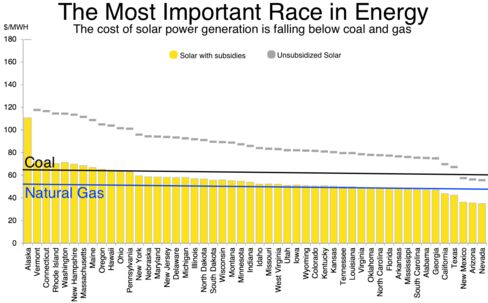
Solar panel prices have dropped, on average, more than 15 percent a year since 2013. On a utility scale, solar power is already cheaper than coal-fired grid electricity across most of the U.S., after subsidies. Even if the incentives were suddenly removed next year—an improbable and economically destructive scenario—the industry would eventually recover as prices continue to fall.
Incentives are designed to make superior new technologies initially affordable, but once those technologies take off, economies of scale take over.
Source: Bloomberg New Energy Finance
A loss of the federal tax credit could slow the rollout of Tesla’s unusual new rooftop solar shingles. Traditional rooftop panels, however, are almost ready to stand on their own. The payback period currently ranges from about 5 to 10 years, after subsidies and state rebates. If Tesla can achieve the cost savings it hopes for with the merger, it won’t be long before that’s the payback timeline without subsidies.
3. Gasoline fuel-efficiency targets could be dismantled
One of President Barack Obama’s most significant climate achievements was to push through ambitious fuel-economy regulations for U.S. vehicles. The Environmental Protection Agency is scheduled next year to re-asses rules intended to double the average efficiency of cars and trucks to almost 55 miles per gallon by 2025. Those goals could be delayed or dismantled under Trump, accelerating America’s shift to trucks and SUVs. Stocks of Detroit carmakers have predictably surged, while Tesla shares fell 4.9 percent in the two days after the election.
This is obviously bad news for human health and the environment, but it’s impact on Tesla won’t be catastrophic. The price of batteries is dropping rapidly, and by the early 2020s electric cars should be cheaper and better performing than their gasoline-powered equivalents across the board. Lowering efficiency standards will make gasoline cars a bit cheaper to manufacture, but it will also make them more costly to drive over the life of the vehicle.
4. Electric vehicle incentives will expire on their own
The U.S. push for electric cars was set in motion by a $7,500 federal tax break. The Trump administration could eliminate the subsidy, but the impact would be short-lived for electric pioneers including Nissan Motor Co., General Motors Co., and Tesla. That’s because the electric-vehicle subsidies were already designed to phase out after each automaker reaches its 200,000th domestic EV sale. Tesla may be first to cross that finish line, probably in the first half of 2018.

The incentives were intended to overcome steep startup costs and slow initial demand for new electric vehicles. Removing the tax break now would effectively pull the ladder up behind Tesla and make it more expensive for other automakers to transition to battery power, a result that wouldn’t be in anyone’s best interest.
5. States wield the power of their own incentives
Some of the biggest incentives in renewable energy are offered by states, not the federal government. Each state has authority over its own solar and wind rebates, credits for power sold back to the grid, renewable-mix requirements for utilities, and electric-car subsidies. These policies cross ideological borders into deeply Republican states. For example, Louisiana residents can get an additional tax credit of almost $10,000 for buying a long-range electric car. In Colorado, it’s an extra $5,000.
Representatives from nearly 200 member countries of the Montreal Protocol agreed on a deal to reduce emissions of powerful greenhouse gases at a summit Saturday in Kigali, Rwanda.
The landmark deal will reduce the use of hydrofluorocarbons, or HFCs, the world’s fastest-growing greenhouse gases, the UN Environment Program said in a statement.
HFCs are potent greenhouse gases commonly used in refrigeration and air conditioning instead of other ozone-depleting substances.


History is made! #MontrealProtocol countries agree to curb powerful greenhouse gases in largest climate breakthrough since Paris.
“The amendment to the Montreal Protocol on Substances that Deplete the Ozone Layer endorsed in Kigali today is the single largest contribution the world has made towards keeping the global temperature rise ‘well below’ 2 degrees Celsius, a target agreed at the Paris climate conference last year,” the UN agency said in a statement Saturday.
According to the agency, the agreed reduction in HFCs could prevent up to 0.5 degrees Celsius (0.9 degrees Fahrenheit) of global warming by the end of this century. The deal was reached at a Meeting of the Parties to the Montreal Protocol, which started Thursday. Several high-profile leaders attended the meeting, including US Secretary of State John Kerry.
“It is not often you get a chance to have a 0.5-degree centigrade reduction by taking one single step together as countries — each doing different things perhaps at different times, but getting the job done,” Kerry said in a speech Friday.
“If we continue to remember the high stakes for every country on Earth, the global transition to a clean-energy economy is going to accelerate.”
The European Union also welcomed the deal. Miguel Arias Cañete, EU commissioner for climate action and energy, described it as “huge win for the climate” and the first step toward delivering on promises made on climate change in Paris in December.
The agreement in Kigali comes only days after enough countries ratified the Paris Agreement on climate change — which calls for the world to become carbon neutral this century — to become international law.
“Last year in Paris, we promised to keep the world safe from the worst effects of climate change. Today, we are following through on that promise,” said Erik Solheim, executive director of the UN Environment Program.
 The White House
Today, nearly 200 countries took an historic step to #ActOnClimatefor future generations by phasing down HFCs: http://go.wh.gov/qnkYar pic.twitter.com/f2wUyaLTt3
President Barack Obama also hailed the Kigali deal.
“Today’s agreement caps off a critical 10 days in our global efforts to combat climate change,” the US leader said. “In addition to today’s amendment, countries last week crossed the threshold for the Paris Agreement to enter into force and reached a deal to constrain international aviation emissions.
“Together, these steps show that, while diplomacy is never easy, we can work together to leave our children a planet that is safer, more prosperous, more secure and more free than the one that was left for us.”
Growing demand for cooling
The rapid increase in HFC emissions — put by the UN agency at 10% a year — is due in part to a growing demand for cooling, particularly in developing countries with hot climates and an expanding middle class, the agency said.
The agreement includes provisions for hot countries to reduce their use of HFCs at a slower rate. Developed countries will start to reduce the use of HFCs by 2019, while developing nations have been given a longer time frame in which to freeze their use of the damaging gases.
Funding for measures to reduce HFC use and research into alternatives is to be finalized next year, the UN agency said.
Kerry recalled how the world’s nations had worked together on climate change since first meeting in the 1980s in Montreal in a bid to protect the world’s fragile ozone layer from ozone-depleting chemicals such as chlorofluorocarbons.
“Thanks to the cooperation and the courage that we summoned at that critical time almost 30 years ago, the hole in the ozone layer — which had been growing at an alarming rate, and which was the reason that we came together — that hole is now shrinking, and it’s on its way to full repair,” he said.
“So we proved that we can make a difference. We proved that science has a value. We proved that if we come together in a forum like this, we can actually do things that affect the entire planet.”
Kerry also acknowledged that HFCs had turned out not to be the best solution for the problem of ozone depletion.
“We replaced the ozone depleting substances, but we came to understand the hard way that HFCs may be safe for the ozone layer, but they are disastrous for our climate, in many cases thousands of times more damaging than carbon dioxide,” he said.
Used in everyday household items such as refrigerators and air conditioners, he said, “in a single year, these substances emit as much CO2 equivalent as nearly 300 coal-fired power plants.”
The head of Rwanda’s climate change unit, Faustin Munyazikwiye, also welcomed the world’s commitment on HFCs after long hours of negotiations in Kigali.
NEW YORK — The United Nations General Assembly (UNGA) kicked off on Tuesday here with more than 140 heads of state and government and a yearly tradition of speeches made to the 193 member states of the chief deliberative, policymaking and representative organ of the United Nations.
This year marks the 71st session of the UNGA, convened under the theme ‘The Sustainable Development Goals: a universal push to transform our world’, with particular focus on Goal #13: Take urgent action to combat climate change and its impacts.
This high-level week with world leaders is an opportunity for the Kingdom of Morocco to promote the 22nd Conference of the Parties to the United Nations Framework Convention on Climate Change (COP22) set to take place in Marrakech, November 7 to 18. Salaheddine Mezouar, Minister of Foreign Affairs and Cooperation, will be on hand for a series of side-events and bilateral meetings aimed at reinforcing and promoting Morocco’s climate initiatives, including those on energy, agriculture, capacity building, adaptation and finance, discussing global warming issues affecting the most vulnerable countries and island states, and mobilising the international community for an ambitious global climate action agenda in Marrakech to implement the Paris Agreement.
United Nations Secretary
hosted a special event to encourage parties to ratify the agreement. According to the United Nations Framework on Climate Change, as of Tuesday, 29 parties have ratified the agreement, accounting for 40.12 per cent of global emissions. The Kingdom of Morocco will be among approximately 20 countries to deposit their instruments of ratification here during this week’s proceedings, inching closer to the 55 per cent necessary for legal entry into force when the agreement takes effect and becomes legally binding for those countries that have joined.
During his opening remarks, Ban underscored the importance of the climate change agenda.
“With the Paris Agreement we are tackling the defining challenge of our time. We have no time to lose. I urge you to bring the Agreement into force before the end of year. We need 26 more countries equalling 15 per cent of global emissions for entry into force,” he stated.
US President Barack Obama, during his last speech to the UNGA, called on the international community to keep working together to solve global issues including climate change. “The Paris Agreement gives us a framework to act, but only if we scale up our ambition,” he stated.
UNGA President Peter Thomson, the first from a Pacific Island nation (Fiji), underscored the need to act on climate change to avoid its negative impacts. “We are steadily moving towards the ratification of the Paris Agreement. We must not delay any further.”
Brazilian President Michel Temer affirmed his country’s commitment to fighting global warming, saying: “Tomorrow I will deposit Brazil’s instruments of ratification of the Paris Agreement.”
As the first African head of state to address the UNGA, Idriss Déby Itno, president of Chad, highlighted the importance of working with the international community to fight global warming on the continent. “It’s not about giving charity to Africa, it’s about true partnership with Africa to tackle climate and global challenges,” he said.
The traditional roll call of speeches to the UNGA starts with the United Nations secretary general, followed by the President of the UNGA, president of Brazil (first Member State to speak in the general debate since the 10th session of the General Assembly) and president of the United States (host country). For all other member states, the speaking order is based on the level of representation, preference and other criteria such as geographic balance.
United States (US) Vice-President Joe Biden has warned regional leaders that volatile oil prices will return. On this basis, he is urging them to use every opportunity to explore clean and alternative energy sources to bolster the prosperity of the Caribbean and Central America.
“This is a moment of opportunity to turn that progress into sustainable energy security that will endure when volatile oil prices return. And they will return,” Biden cautioned the heads of government during the US-Caribbean-Central American Energy Summit in Washington, DC, held earlier this month.
“The good news is that we’re at a nexus for transforming, with transformative opportunities here. Low oil prices mean more money this day is available for investment in new energy infrastructure,” said Biden.
“It’s equivalent to US$1 billion of stimulus just in the region [and] lower energy prices. Our abundance of natural gas provides a critical, clear transition fuel as we’re moving towards adopting renewable technologies.”
Biden said strengthening energy security was among the focus areas for himself and US President Barack Obama.
He noted that North America – Mexico, the US and Canada – is the epicentre of energy production in the world and pointed out that his country recently inaugurated a liquefied natural gas export terminal that has just sent its first cargo of gas to Latin America.
The US had also announced a deal to export natural gas to Jamaica during last year’s staging of the Summit.
“Here’s the truth. We want you to be energy secure so more people across this region can – your region can start businesses, connect to the Internet, generate opportunities, attract foreign investment, grow, grow. The more you grow, the more you prosper, the better off my country is. And it strengthens our security, as well as yours. And it opens up new opportunities for shared economic growth,” he said.

Mahlung
Kamina Johnson Smith, minister of foreign affairs and foreign trade, will this Friday represent Jamaica during the official signing of the Paris climate-change agreement in New York, following last November’s conference in France.
Some 200 countries had gathered in Paris for the COP 21 climate conference and, in December, adopted the new agreement, which aims to limit carbon emissions.
Clifford Mahlung, project administrator at the Climate Change Division in the Ministry of Economic Growth and Job Creation, told The Gleaner that the signing is a significant step towards strengthening the work that has started to mitigate the effects of climate change.
“We will be among the other heads of state who will be there. This is the first step towards becoming a party to the Paris agreement because this has to be followed up by ratification,” he said.
“The process towards ratification will require government approval, and so that process is on the way. We should be complete before the year ends.”
Mahlung said now that the agreement is open for signature by the parties to the convention, United Nations Secretary General Ban Ki-moon has been asked to convene a crucial ceremony, which will be attended by United States President Barack Obama, among others.
NEED FOR SENSITISATION
Making reference to a post-COP 21 discussion held last week at the Four Seasons Hotel in New Kingston, Mahlung said it was important that Jamaicans are sensitised to the importance of the agreement, especially as it relates to carbon emissions.
“With the significance of COP 21, we decided to have this discussion one week before the official signing. This new climate-change agreement builds on the convention and provides the basis which will accommodate further work, with respect to the climate-change process,” Mahlung said.
The agreement itself consists of many areas, including the new long-term goal in keeping future temperatures well below 2˚C and pursuing efforts to keep those temperatures as close to 1.5˚C as possible.
“Even though we contribute less than one per cent to the global emissions, it is important that we do our part to control our energy output, which will signal to the emitters that we are serious about climate change, which will mean also that they have no excuse but to reduce their emissions as well,” he said.

Kelly Tomblin, president and chief executive officer of the Jamaica Public Service Company (JPS), is arguing that the visit of United States President Barack Obama to Jamaica last year has improved the energy prospects for the island.
Tomblin, one of the participants in a Gleaner project ahead of Friday’s one-year anniversary of Obama’s visit, said: “Obama’s visit gave Jamaica greater strength in gas negotiations with gas suppliers by signalling support for US gas to Jamaica, thus increasing competition and the number of available suppliers and supporting greater optimisation of Jamaica’s renewable resource.”
During his two-day visit to the island, Obama announced the formation of an energy fund to finance clean-energy projects in the region. He made the announcement at the Caribbean Community (CARICOM)-US Summit.
“Caribbean countries have one of the highest energy costs in the world. Today, we are announcing new partnerships and a new fund to mobilise private-sector projects in clean energy for the Caribbean and Central America,” he said at the conclusion of the summit.
OPPORTUNITIES NEEDED
The energy fund now forms part of the Caribbean Energy Security Initiative, which aims to reduce the region’s reliance on fossil fuels.
According to Tomblin: “Obama’s visit created more opportunities throughout the energy sector by voicing confidence in Jamaica’s landscape and supporting US investment in Jamaica’s energy sector.”
She called for Jamaica to act fast in capitalising on the opportunities created in the energy sector by the initiatives announced by Obama.
“The only threat exposed during Obama’s visit was the truth that if we don’t act fast, other Caribbean countries will take advantage of the new open door in the energy market and secure the hub position,” she said.
In giving further reflections on the anniversary of the visit, Tomblin highlighted the need for Jamaica to position itself as the hub for the provision of gasolene as a cheaper source of energy.
“Let’s make sure we step fully into this moment he opened up by driving this gas-procurement process through quickly and position Jamaica as an obvious hub for that product which will be key for our neighbours to meet their overall environmental commitments,” she said.
“We cannot afford bureaucracy now.”

Sir Ronald Saunders

Small island states lost out to their larger, more industralised seniors at COP21.
The results of the climate change conference in Paris (COP21) give no reason for small island states to cheer. The agreement reflects many promises and little action.
The one item of concrete action is merely an undertaking to evaluate carbon emissions every five years — and even that has no teeth.
What is not in the agreement is a firm, legally binding commitment to limit average global temperature increases to 1.5 degrees Celsius. Also, not in the agreement is a legally binding commitment to provide developing countries with the funds needed to adapt to, and mitigate against the effects of climate change.
There isn’t even a commitment to a fund, in the sum of US$100 billion a year, that was frequently touted before the conference began.
Once again, the industrialised nations of the world — the worst polluters — took advantage of the weakness of the smallest countries of the world, which are the least polluters and the biggest victims of climate change.
To their credit, though, through the Alliance of Small Island States (AOSIS), representatives of small states did put up a good showing in Paris. Armed with the latest statistics and bolstered by a structured expert report released by the UN Framework Convention on Climate Change, they argued for the containment of global warming to 1.5 degrees Celsius, showing that, at 2 degrees, destruction would be widespread and irreversible. But, in the end, despite all the hoopla, applause and celebration, small states lost.
Representatives of AOSIS countries might have been flattered by a brief visit to them by US President Barack Obama, when he declared: “These nations are not the most populous nations, they don’t have big armies, they have a right to dignity and sense of place.” But, while President Obama was undoubtedly sincere in what he said, he also knew, even as he was saying it, that he could not deliver ratification by the US Congress of any agreement that limited carbon emissions or bound the US legally to warming no higher than 1.5 degrees Celsius.
So, the world has a so-called agreement, still to be ratified by the 196 participating countries, that only expresses an objective to limit global warming to “well below two degrees above pre-industrial levels”. The goal of 1.5 degrees Celsius, as described by Amber Rudd, the British minister for energy and climate change, is merely “aspirational”. In making her statement that the target of 1.5 degrees is aspirational, the minister was sending a clear signal to the British industrial world that driving down carbon emissions from fossil fuels is not an immediate objective and therefore will not affect their business.
In truth, the climate change action plans submitted by 188 countries would lead to a temperature rise as high as 2.7 degrees Celsius. And, if that is not bad enough, the signatories to the Paris agreement are under no legal obligation even to meet that objective; they are legally free to enlarge carbon emissions further. So, no cause for small island states to celebrate over that one, and profound reason for them to worry.
At three degrees, the size of islands will shrink, productive areas will be under water, people will have to move habitats inland and many will be forced to migrate, legally and illegally. We have to hope that all the scientists who predict this scenario are wrong.
On the money side, the developed countries declined to insert into the Paris agreement their often-made oral commitments to transfer funds to poorer countries in order to help them adapt. Yet, all the studies show that even the US$100 billion a year that was promised would not be enough to help developing countries build up a power system quickly or cheaply enough on renewable energy sources rather than coal or oil. Incidentally, even if the US$100 billion a year fund was achieved, access to it by small states in the Caribbean would be long and arduous, particularly if the criterion of “per capita” income continues to be applied as it is now by international financial institutions. The portion available to the Caribbean region would be a small fraction of the total sum.
Some may argue that there are two aspects of the Paris agreement that are beneficial to small states, therefore, attention should be paid to them. The participating countries recognised “the importance of averting, minimising and addressing loss and damage associated with the adverse effects of climate change, including weather events and slow onset events”. But, liability is completely ignored because it was opposed by the polluting industrialised countries. Recognition of a problem is far removed from committing to action to cure it.
Then there is the single binding legal requirement in the agreement. Every country is now required to come back every five years with new targets for reducing their carbon emissions. But there is no sanction if they fail to meet their previous commitment, and no sanction if they simply carry on business as usual.
COP21 in Paris may have been a triumph for some nations, but no self-respecting small island State should claim any satisfaction.
That is why each small State, individually and within the many organisations in which they are members — including AOSIS, the Commonwealth, La Francophonie, the Organization of American States and others — must now redouble their efforts to work on the developed country governments, but also to move beyond them to the conscience of the people of the industrialised world.
This is about survival and development — two defining challenges of this century for small states. It is the work of everyone; governments, businesses and civil society, all are involved and all could be consumed.
Sir Ronald Sanders is Antigua and Barbuda’s ambassador to the US; an international affairs consultant; as well as senior fellow at Massey College, University of Toronto, and the Institute of Commonwealth Studies, London. The views expressed are his own. For responses and to view previous commentaries:
www.sirronaldsanders.com.

United States Flag
THE US yesterday announced that it will be contributing $30 million to climate risk insurance initiatives in the Pacific, Central America, and Africa to help small island nations respond to severe climate-related impacts.
At a meeting with leaders of small island nations in the three regions, President Barack Obama said the move was part of a broader set of actions to help vulnerable populations strengthen their climate resilience, from providing climate data, tools and services, to incorporating climate resilience considerations into development assistance.
“The announcement is an important step toward the goal G-7 leaders set this summer to increase by up to 400 million the number of people in the most vulnerable developing countries who will have access to insurance against the negative impact of climate change hazards by 2020,” the WHite House said in a statement to the press yesterday.
The funds will support insurance initiatives under the Pacific Catastrophic Risk Assessment and Financing Initiative, expand the Caribbean Catastrophic Risk Insurance Facility to include Central American countries, and support the African Risk Capacity programme.
KINGSTON, Jamaica – United States President Barack Obama says he is pleased with the level of talks between himself and Prime Minister, Portia Simpson Miller this morning, on a range of issues including security, energy and economic growth.
In his statement issued at the Office of the Prime Minister Wednesday following a bilateral meeting, the US president said energy was one of the main areas discussed as well as his country’s role in helping Jamaica and other Caribbean states reduce costs associated with it.
“People in the Caribbean despite having less resources, are paying significantly higher prices for energy. If we can lower those costs through the development of clean energy and increased energy efficiency, we could release a whole host of additional investment and growth. There are going to be a whole host of areas where the US can be helpful,” he said.
The commitment comes, even as Venezuela, backed by 29 countries, including four Caricom states, signed a letter which it issued to the United States embassy in that country, and which was carried in one local newspaper, calling on the president to withdraw the executive order which the White House issued earlier this month, labelling the oil-rich South American country a threat, and imposing new sanctions against it.
A number of Caricom countries, including Jamaica, now enjoy preferential arrangements through the PetroCaribe Agreement, under which they are allowed to buy oil from Venezuela, and repay a percentage of the cost up front. In Jamaica’s case, the balance must be repaid over 21 years, at one per cent interest. But, the International Monetary Fund (IMF) has cautioned such countries that there could be a negative impact on their economies if Venezuela’s external liquidity problems escalate.
In the meantime Jamaica’s prime minister said within the context of the government’s extended fund facility with the IMF, the leaders had “explored additional ways of imploring our trade and economic relations”, including in the area of energy security and renewable energy.
She also pointed out that one of the outcomes of the visit was the signing of a statement of intent between the countries, to pursue the development and deployment of energy-related technologies.
“We aim to encourage increased bilateral trade, boost the development of emerging technologies and industries and pave the way for future innovation in energy-related fields,” she said.
The US President leaves the island later today for the Seventh Summit of the Americas, in Panama.
Alphea Saunders