
ENERGY MINISTER Andrew Wheatley has sought to quiet ongoing concerns over reports that the new Chinese owners of ALPART, Jiuguan Iron and Steel, are looking to set up a 1,000-megawatt coal plant in Jamaica to support their operations.

“Where we are right now, we have not received any application, any proposal, as it relates to a coal-fired plant at ALPART. What we know for a fact is that the new owners are rehabilitating, retrofitting the old ALPART facility,” he told The Gleaner on the sidelines of the Caribbean Sustainable Energy Forum (CSEF) in The Bahamas on Tuesday.

“The plan is for them to use the traditional source of fuel – HFO – to drive that bauxite facility. We expect that facility to be up and running in another 16 to 18 months, starting to produce bauxite and employing Jamaicans,” he added.

“I don’t want to speak for them, but I know they are exploring other sources of energy, separate and apart from coal,” Wheatley said further.

At the same time, the minister suggested that this ministry would not readily entertain any such application.

“The truth is that coal is a part of our energy policy, a part of that mix. But if we are to embark on such a direction, it would have to be after serious consultation. We would have to ensure that there is some technology that would, more or less, mitigate against the negative environmental impacts associated with coal in the past,” he noted.


CLEAN TECHNOLOGY


“So there is a clean-coal technology being mooted. That is something that we would have to explore. But we would never engage or embark on the use of coal – at least that capacity of producing 1,000 megawatts – without our having the necessary consultations with the different stakeholders,” he said.

News of the 1,000-megawatt plant accompanied the sale of ALPART to Jiuguan last year. The construction of such a plant would exceed Jamaica’s current generating capacity of some 800 megawatts while threatening to undermine efforts to treat with climate change, which prompted outcry from among civil society actors.

The minister’s statements on what would need to happen regarding any coal project, meanwhile, are in line with what the Council of the Jamaica Institute of Environmental Professionals called for last August.

“We look forward to seeing the holistic analysis on the full economic costs and benefits for the chosen source of energy, including the lifetime costs of energy production, the cost of treatment of pollutant emissions and effluent, the cost of any investment or operation costs for ensuring compliance with all relevant national environmental and working standards,” the entity said.

“This analysis should include critical factors such as the economic cost of health effects and medical treatment from exposure to plant emissions and effluent on workers and communities surrounding the plant,” the council added.

Ultimately, like a number of other civil society actors, it concluded: “It is our position that a coal-fired plant is counter-productive to Jamaica’s own Vision 2030 and our other commitments on energy, sustainable development, and climate change,” it said.

“We hasten to point out that there is a cost associated with sourcing and transportation of coal from overseas; the potential impact on human health, including long-term treatment; and the cost of ensuring that all relevant national standards are met,” they added.

Gleaner

CARICOM Secretary General Ambassador Irwin LaRocque (left) with Dr James Fletcher, who led CARICOM negotiators, in discussion with regional heads of government and ministers at the Paris Climate Talks last year.

With the Marrakech climate change talks now only weeks away, the few CARICOM member states that have not yet ratified the Paris Agreement – Jamaica among them – have been urged to do so.

The appeal has come from Dr James Fletcher, former head of the CARICOM Task Force on Sustainable Development.

He predicted that the failure to ratify will see those islands running the risk of not having a say in the first meeting of the parties to the global deal next month.

“Given that the Paris Agreement will enter into force in the Marrakech meeting … if you haven’t ratified the Paris Agreement, then really you cannot be at the table determining rules and procedures and everything else,” he cautioned.

“If you have not ratified the agreement, then you don’t have a voice at the meeting. There will be CARICOM countries there (who share similar challenges) and who will speak on your behalf, but I don’t think it is a position you want to be in because you cannot articulate your own concerns,” added Fletcher, also the former minister of sustainable development for St Lucia.

Ten CARICOM countries have so far ratified the agreement. They include Antigua and Barbuda, Barbados, The Bahamas, Belize, Dominica, Grenada, Guyana, St Kitts and Nevis, St Lucia, and St Vincent and the Grenadines.

They are among the 81 countries to have ratified the agreement, which prescribes the way forward for the planet in its battle against the changing climate.

Caribbean islands and other small-island developing states (SIDS) are counted among those most vulnerable to climate threats.

Those threats include extreme weather events, the likes of Hurricane Matthew, which barrelled across the region recently, leaving in its wake death and destruction in places such as Haiti, Cuba and The Bahamas.

In Haiti alone, the death toll is registered at more than 900, with millions of dollars in loss and damage to infrastructure.

Meanwhile, Fletcher – a respected regional statesman reputed for his work in climate change and other development issues, including energy – is buoyed with the progress on the Paris Agreement. Still, he cautions that there are still miles to go to where the region needs to get in its readiness for climate change.

“We are very encouraged by how quickly this agreement has come into force … It really is awesome for me that the community has rallied to this cause and there seems to be an urgency that, at least philosophically, we need to move in a particular direction,” he said.

LACK OF URGENCY

“What is worrying to me is that there does not seem to be an urgency where climate action is concerned. If you look at the level of ambition for the level of greenhouse gases, it is still not taking us below 2.7 degrees Celsius. Nobody has come out and said, for example, that they will reduce their emissions by another 25 per cent,” Fletcher added.

This, he noted, is what is required if the world is to realise one of the objectives of the Paris Agreement, to hold “the increase in the global average temperature to well below 2 degrees Celsius above pre-industrial levels and to pursue efforts to limit the temperature increase to 1.5 degrees Celsius above pre-industrial levels, recognising that this would significantly reduce the risks and impacts of climate change”.

“I would like to see greater pledges from major emitters to reduce their emissions and more pledges where finance is concerned,” the former minister noted.

“There is a lot that has to be done where SIDS are concerned. (We are in a time when we) have hurricanes hitting multiple countries and travelling in pairs. So the situation is ominous; the projections are all showing that our area will be one of the hardest hit by climate change, and we don’t have the funds to adapt,” he said.

“We are really are saying to our residents that they are in for a very bleak future when we should be saying, having signed the agreement, we can now assure that the climate finance is going to flow and action is going to be taken to reduce greenhouse gases to get us close to 1.5,” added Fletcher, who will be in Marrakech next month to support CARICOM.

“We are not in a good place where bending that temperature curve is concerned, and making finance more readily available to SIDS is one way to get there,” he said.

Gleaner

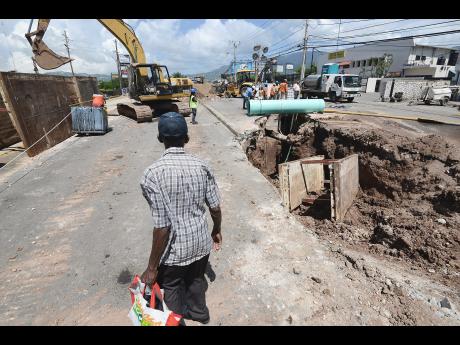
A man walks along a construction site on Constant Spring Road, St Andrew on Friday, October 7. The roadway in the vicinity of the Marketplace commercial complex is being repaired following its collapse from rains associated with Hurricane Matthew.

After a period of uncertainty, it has been confirmed that the Paris Agreement on Climate Change will enter into force on November 4.

This is good news for the Caribbean, one of the parts of the world most at risk from sea level change and severe climatic events.

By global treaty standards, formal agreement has been achieved remarkably quickly, especially as the solutions that the treaty proposes remain politically controversial in many of the nations that agreed last December to the final text.

Normally, ratification takes years to achieve. However, faced with evidence that the planet continues to warm and the possibility that Donald Trump could become the next US president and may pick apart the hard-won agreement, the world’s largest carbon emitters – China, the United States, Brazil, the European Union, and India, but not so far Japan or Russia – have agreed to ratify, thereby reaching the agreed target of 56.87 per cent of all global emissions, for the treaty to come into force.

In many respects, this is a victory for the Caribbean, for CARICOM in particular, and the African, Caribbean and Pacific Group of States (ACP) and other small-island developing states, which in Paris last December made clear that a positive outcome was existential.

In outline, the 31-page agreement proposes that a balance between greenhouse gas emissions and the sinks for ameliorating them is achieved in the second half of this century.

It emphasises the need to hold the increase in the global average temperature well below 2 degrees Celsius (36 degrees Fahrenheit) above pre-industrial levels; proposes “pursuing efforts to limit the temperature increase to 1.5 degrees Celsius (35 degrees Fahrenheit)”; and recommends that a peak in global greenhouse gas emissions be achieved as soon as possible. It allows for an asymmetrical approach, enabling all developing countries – including large industrialising carbon emitters like China, India and Brazil – to have more time to adapt.

In a section that addresses loss and damage, the agreement establishes funding at the minimum annual rate of US$100 billion up to 2030 to enable support for mitigation and adaptation in developing nations. However, it does not set a timescale for reaching greenhouse gas emission neutrality.

Unlike the earlier Kyoto Protocol of 2005, which required major carbon emitters to agree to binding emissions reductions, but failed when the US decided not to ratify because of exclusion of nations like China, the Paris agreement requires all countries to devise their own climate action plans and then improve on them at regular intervals.

What comes next is likely to be difficult, requiring all of the diplomatic and political skills that the Caribbean and other small-island developing states have.

ACCESS TO RESOURCES

While Hurricane Matthew and the damage that it wreaked in Haiti, The Bahamas, and Cuba was a salutary global reminder of the risk that low-lying states with limited resources face, CARICOM, as its Secretary General, Irwin LaRocque, noted earlier this year, now faces the challenge of being able to access the resources the agreement promises.

An important recent development in this respect has been the establishment by the Commonwealth Secretariat, with Australian finance, of a new facility intended to assist governments obtain available funding.

The idea is that a Commonwealth Climate Finance Access Hub will locate national climate-finance advisers in countries for two-year periods to help access climate change support. Among the first countries likely to receive such support are Antigua, Barbados, Dominica, Guyana, Jamaica, and St Kitts, as well as other small island states in the Indian Ocean and the Pacific.

Other funding options are also being considered. Recently, Jamaica’s Prime Minister Andrew Holness indicated that Jamaica is to work with its international development partners to pursue debt for climate-change swaps. Such an approach, he says, has the potential to provide fiscal relief while helping to unlock climate financing to fund adaptation and mitigation initiatives.

What is clear is that when it comes to funding, the treaty agreement as is so far little more than an aspirational framework.

For this reason, at the forthcoming climate change conference in Marrakesh in November, CARICOM will need – together with its Alliance of Small-Island States – the global grouping which brings together small island and low-lying coastal countries that share similar development concerns – to hold the world to account for what has been agreed.

This will not just be a test of the Caribbean’s staying power and the willingness of regional governments to fund and support a continuing focus. It will also require the Caribbean to remind the countries that it supported during the negotiations, and which expressed concern about the implications of climate change for the region, of their commitments.

Put more bluntly, it is now the time for China and Brazil, as much as the US and Europe, to ensure that the support for adaptation that the region needs, now materialises.

In this, both CARICOM and the CARICOM Climate Change Centre will continue to have a critical role in coordinating the regional effort. But it will also be up to individual governments to maintain the political momentum, demonstrate a unity of purpose, and be determined to address the Caribbean’s implementation deficit.

CLOSE TO THE SEA

Climate change is an issue on which the Caribbean has had every reason to have its voice heard and be taken very seriously. Fifty per cent of its population and the majority of the region’s productive enterprise and infrastructure lie within 1.2 miles of the sea. Its low-lying nature, its fragile ecosystems, and extreme weather events demonstrate that it is a prime candidate to benefit from what has been agreed.

While countries in the region are often accused of allowing mendacity to drive their foreign policy, here is an example where the Caribbean deserves a transfer of resources if it quite literally is not to disappear beneath the sea.

Climate change also has a strategic importance. It enables the Caribbean to demonstrate an approach that owes more to the future than to the past; it is an issue on which it has a better chance to exert leverage; and one that can deliver national and regional development objectives. It is an issue on which the region occupies the moral high ground and has popular international support.

Gleaner

Energy Minister, Phillip Paulwell

An energy efficiency project aimed at cutting energy costs in smaller hotels is to be implemented in Jamaica by the end of the year.

The project, which is called the Caribbean Hotel Energy Efficiency and Renewable Energy Action Programme, has been successfully tested in Barbados and will be extended to The Bahamas and other countries in the region.

In endorsing the energy saving initiative, Jamaica

Energy Minister, Phillip Paulwell

An energy efficiency project aimed at cutting energy costs in smaller hotels is to be implemented in Jamaica by the end of the year.

The project, which is called the Caribbean Hotel Energy Efficiency and Renewable Energy Action Programme, has been successfully tested in Barbados and will be extended to The Bahamas and other countries in the region.

In endorsing the energy saving initiative, Jamaica

The Bahamas government says it is important to develop alternate forms of energy, complaining that the high cost is also impacting foreign investment into the country.

These are issues that concern us and let me just state it for you. The cost of electricity is an extraordinary drain and has an extraordinary impact on Bahamian families. We all agree with that,” Prime Minister Perry Christie said.

“The impact on investors, for those that exist, is an extraordinary high impact in the sense that investors are telling us, he said, noting that a senior official of the Bahamas Electricity Corporation (BEC) had recently indicated that the operational costs for investors and commercial entities is as high as 20 per cent.

“Anyone looking at the economic situation in our country and saying that they want to invest, whether it is in Bimini, whether it is in Grand Bahama, they face this extraordinary, intimidating circumstance of the costs, Christie said.

“When we were in opposition, we made a determination that a priority would mean addressing electricity (prices). We had, as you have heard, any number of proposals. The FNM was obviously driven to try and do the same thing, Prime Minister Christie said as he reflected on past debates on the issue in Parliament.

Christie said the government has had proposals to convert solid waste into electricity, solar into electricity, windmills and wave energy. He said of the significant number of proposals, some have been very strong in having the private sector generate electricity.

The prime minister said a group of Bahamians visited a plant in Malaysia, where six engineers ran the 500 megawatts computer operated electricity plant that generated wind energy into electricity and that generating that kind of power is equivalent to twice the size of the current electricity yielding of the diesel generator operations housed at BEC.

“This is the point I stood up to make. Every member of this Parliament knows the history of BEC, the history of labour relations of BEC, the history of The Bahamas of being able to have government corporations that have to be subsidised, government corporations that are over dependent on labour, government corporations that when you do a cost analysis of it, that it actually really messes around with our people,” said Christie.

“My government is determined to bring an improvement to this sometime this year. We have established a technical team of Bahamians who have been joined with two external consultants who are now examining these proposals,” Prime Minister Christie added.

CMC

Read more:

The Caribbean Aviation Training Centre and Airports Authority of Jamaica hosted the Boscobel Jamaica Air Show, held at the Ian Fleming International Airport in April last year. - Winston Sill/Freelance Photographer
The Caribbean Aviation Training Centre and Airports Authority of Jamaica hosted the Boscobel Jamaica Air Show, held at the Ian Fleming International Airport in April last year. – Winston Sill/Freelance Photographer

Alessandro Boyd, Gleaner Writer

As the Ian Fleming International Airport (IFIA) celebrated its second anniversary last week, the management has expressed delight at the growth experienced over the period. However, they concede that there is much room for improvement.

The airport that is situated in Boscobel, St Mary, can accommodate at least six international aircraft with a maximum wingspan of 55 feet and a maximum length of 65 feet, as well as three small aircraft all at the same time.

Alfred McDonald, senior director of commercial development and planning at the Airports Authority of Jamaica, has stated that traffic performance fell below the levels recorded in the previous year; however, a major initiative that they project will enable a significant up-tick in the use of IFIA by general aviation aircraft is near completion.

The number of aircraft arrivals at the IFIA has decreased in 2012 as the total number of arrivals was 1,515 compared to 1,569 in 2011.

“The work currently being done is to complete and commission a fuel-farm facility to ensure the supply of jet A1 fuel (which is currently available from a fuel bowser) and Avgas (which is not now readily available). The AAJ has continued it marketing efforts to attract additional traffic to the airport and increased promotion will be done on completion of the fuel farm,” Mcdonald told

The Caribbean Aviation Training Centre and Airports Authority of Jamaica hosted the Boscobel Jamaica Air Show, held at the Ian Fleming International Airport in April last year. - Winston Sill/Freelance Photographer
The Caribbean Aviation Training Centre and Airports Authority of Jamaica hosted the Boscobel Jamaica Air Show, held at the Ian Fleming International Airport in April last year. – Winston Sill/Freelance Photographer

Alessandro Boyd, Gleaner Writer

As the Ian Fleming International Airport (IFIA) celebrated its second anniversary last week, the management has expressed delight at the growth experienced over the period. However, they concede that there is much room for improvement.

The airport that is situated in Boscobel, St Mary, can accommodate at least six international aircraft with a maximum wingspan of 55 feet and a maximum length of 65 feet, as well as three small aircraft all at the same time.

Alfred McDonald, senior director of commercial development and planning at the Airports Authority of Jamaica, has stated that traffic performance fell below the levels recorded in the previous year; however, a major initiative that they project will enable a significant up-tick in the use of IFIA by general aviation aircraft is near completion.

The number of aircraft arrivals at the IFIA has decreased in 2012 as the total number of arrivals was 1,515 compared to 1,569 in 2011.

“The work currently being done is to complete and commission a fuel-farm facility to ensure the supply of jet A1 fuel (which is currently available from a fuel bowser) and Avgas (which is not now readily available). The AAJ has continued it marketing efforts to attract additional traffic to the airport and increased promotion will be done on completion of the fuel farm,” Mcdonald told