Screen Shot 2016-02-01 at 10.24.56

Energy Minister Phillip Paulwell

ALMOST a year after net billing was suspended, there are indications that the programme is to resume, although Energy Minister Phillip Paulwell is yet to set a timeline.

He said recommendations have been made to the Office of Utilities Regulation (OUR) to resume processing licences. But, before that can happen, the Electricity Lighting Act must be amended and the Jamaica Solar Energy Association (SEA) raised concerns that nothing has been done to have the legislation amended.

At Wednesday’s national conference for the development of an energy services company industry in Jamaica, Paulwell said that the Government is committed to reopening net billing.

He, however, explained that while the law names the Energy Sector Enterprise Team (ESET) as the body responsible for regulating new generation capacity, it was felt that it (net billing) is not appropriately placed at ESET, and that the OUR is expected to resume processing net billing licences.

So far, more than 300 licences have been issued, but solar energy providers have not been able to interconnect to the JPS grid since May of last year.

David Barrett, president of SEA, says the association’s membership is still in a state of confusion.

“It’s static now (the sector) because people have no entity to get a licence from, they don’t know who to go to. Some persons have gone to the OUR or the JPS (Jamaica Public Service company) but they can’t do it because of the obvious reasons,” he told the Jamaica Observer last Thursday.

Over the months, entrepreneurs in the solar energy sector have complained bitterly of suffering millions in losses after the JPS stopped net billing to carry out an assessment of the pilot. The review was completed by the United States’ National Renewable Energy Laboratory and the report made public in June, but all grid interconnection for new net billing projects islandwide have still remained on hold.

Solar energy providers say the prolonged suspension has dealt their outfits a serious blow, arguing, too, that the JPS has too much power over the arrangement and that the Government needs to act decisively on the issue.

Barrett said the members are neither pleased with the pace of the process nor the new conditions that are being established.

“What has been decided is that the cap is to be five megawatts instead of 11 as it would have been in the previous phase, and that the cap for the individual locations will remain as they are. The association is not too happy about that because we feel that there is easy opportunity to increase potential for renewables in Jamaica without disturbing the grid in any way,” he told the Observer earlier this month.

Additionally, Barrett expressed disappointment that the association had not been invited to the table when the new cap was being set. “So we don’t have the information that fed into the decision-making process,” he stated.

Net billing permits JPS customers, who own renewable energy generators, to produce electricity for personal use and to sell excess energy to the light and power monopoly at wholesale prices, which are set by the OUR.


Jamaica Observer 

Ten companies submitted bids to build and operate renewable energy plants that run on solar, wind, water or waste, but two are in danger of being disqualified for non-payment of the bid security.

The Office of Utilities Regulation (OUR) received the bids for supply of up to 37 megawatt of renewable power to the grid on Wednesday and will determine the preferred bidders by April.

The bids included a 24.7MW waste-to-energy plant at US$110 million, by Green Waste Energy Inc; a 37MW wind plant at US$61 million by Wigton WindFarm Limited; a 20MW solar plant, at US$33.15 million, by WRB Enterprise Inc and a separate bid to build a 37MW solar plant at US$72.15 million, which contains three options.

Great Valley bid US$50 million to develop a 26.4MW wind farm; Tamarind Energy proposed a 36.3MW at US$76.96 million; and BMR Jamaica bid US$18.27 million for a 9.9MW wind farm to expand the existing wind farm that it is developing in central Jamaica.

The other four bids were a 37MW solar project at US$48.7 million with an alternative option by Eight Rivers Energy Company Limited; a 2MW hydropower project, at US$8.9 million, by Petroleum Corporation of Jamaica; a 37MW solar plant at US$77.14 million by Jamaica Energy Partners; and a 30MW biothermal energy plant, at US$93.8 million by Bio Energy Resources Limited.

“We are happy with the process. It was done in an orderly and professional manner,” said Angella Rainford of Eight Rivers Energy Company following the bid openings held at the OUR.

“The returns are attractive, but it’s also the right fit for the country as it mitigates against the reliance on oil,” said Rainford.

Eight Rivers took no chances and submitted a US$700,000 bid security.

Two of the 10 bidders – Green Waste Energy and Bio Energy Resources – did not put up the required security, OUR legal Chenee Rily disclosed at the bid opening.

The OUR required each bidder to submit security equivalent to one per cent of the project cost.

“The only two bids with firm capacity failed to offer a bid security it’s unfortunate,” said Cecil Gordon, the director of generation at Jamaica Energy Partners, in discussion with the Financial Gleaner at the OUR event. “Waste-to-energy gives a constant output so it’s firm capacity.”

Gordon explained that wind solar and hydro can fluctuate depending on external factors, including weather. He also indicated that waste-to-energy projects are more expensive to operate – “which means a lower return,” he added.

OUR said on Thursday that the decision on whether to disqualify the two waste-to-energy bids would be considered by the bid review committee when it convenes.

Last July, the OUR issued a Request for Proposals (RFP) from local and international interests to supply up to 37MW of electricity generation from renewable energy resources on a build, own and operate basis. Wednesday was the deadline for the receipt of bid documents.

This latest project is to complete an RFP process started in 2012 to identify interested entities to submit proposals for the supply of one or more plants of varying configurations greater than 100kW and up to 115MW of renewable energy. At that time, 78MW was identified from three successful bidders.

The Gleaner

A woman wears as mask while walking in a neighbourhood next to a coal-fired power plant on Nov. 26, 2015, in Shanxi, China.

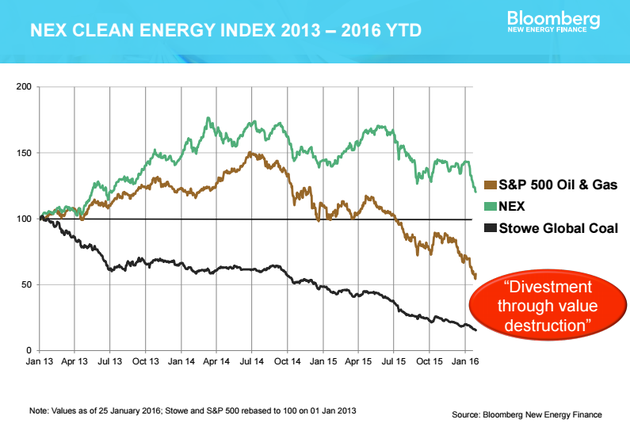
The market is encouraging pension funds and institutions to jettison fossil fuels from their portfolios, waving a clear warning flag to investors about the financial future of oil and coal companies.

Fossil fuel stocks are performing poorly compared to the market as a whole — and perhaps most importantly, compared to renewable energy stocks, said Michael Liebreich, chairman of Bloomberg New Energy Finance, at a summit on climate risk put on by the nonprofit sustainability advocacy group Ceres.

Referring to investors who won’t divest and continue to own fossil fuel stocks, Liebreich pointedly said that the market was “divesting through value destruction” — in other words, cutting their holdings in traditional, polluting energy companies by slashing their value.

Renewable energy stocks have dramatically outperformed fossil fuels.

Over the last 10 years, the S&P 500 index is up just over 50 percent. Yet energy stocks over the same time period have risen only 1.3 percent.

For big investors to simply allow their holdings in big energy companies to fall toward a vanishing point of worthlessness is deeply irresponsible, observers say.

Indeed, former Vice President Al Gore, who shared the Nobel Peace Prize in 2007 for his work on climate change, compared the risk that some fossil fuel companies’ assets will become worthless to the danger of mortgage-backed securities, whose collapse triggered the 2008 financial crisis.

The nonprofit research group Carbon Tracker estimates that if the world changes its energy sources to keep climate change below 2 degrees Celsius, $2 trillion in fossil fuel assets will be stranded — that is, unusable, far less valuable, and in some cases, liabilities.

Huffington Post

Jamaica is to reduce greenhouse gas emissions by the equivalent of 1.1 million metric tonnes of carbon dioxide per year by 2030, as part of its global commitment to take climate-change mitigation action.

To bring this about, the island – as reflected in its nine-page Intended Nationally Determined Contributions (INDCs) document to the United Nations Framework Convention on Climate Change – has undertaken to implement energy policies that ensure the island:

– uses energy wisely and aggressively to pursue opportunities for conservation and efficiency;

– has a modernised and expanded energy infrastructure that enhances energy generation capacity and ensures that energy supplies are safely, reliably and affordably transported to homes, communities and the productive sectors on a sustainable basis; and

– achieves its energy resource potential through the development of renewable energy sources by increasing their share in its primary energy mix of 20 per cent by 2030.

Such policies are also to ensure that government agencies and ministries are a model/leader in energy conservation and environmental stewardship, and that the island has a well-defined and established governance, institutional, legal, and regulatory framework.

Fully implemented energy polices need, too, to ensure that private industry embraces “efficiency and ecological stewardship to advance international competitiveness and to move towards a green economy”, the document said.

The Gleaner

NCB Group headquarters, The Atrium, at Trafalgar Road, New Kingston. The banking group’s energy initatives have cuts its electricity bill by 20 per cent across its network.

National Commercial Bank Jamaica (NCB) has cut its energy consumption by 20 per cent over the past four years and is projecting half-billion dollars of new savings over the next four.

By tinting its windows, changing its light and air-conditioning units, and installing some solar photovoltaic (PV) systems, the bank hopes to cut its electricity bill by another eight per cent in 2016.

If it achieves its latest goal, NCB would spend $140 million less on energy this year than it would if it had not implemented any of the energy-saving initiatives that started in 2011.

Back then, the financial institution forked out over $600 million to keep the lights on. Air conditioning accounted for more than 60 per cent of the energy use while lighting accounted for another 20 per cent, so it was decided that light-emitting diode (LED) lights would be installed across its locations, while high efficiency air-condition units and solar systems have been put in place at select sites, such as NCB’s head office on Trafalgar Road.

Reflective tinting on windows, roof insulation, and automated light controls have also helped protect the bank’s buildings from heat infiltration and have enhanced the energy-saving process.

This year, NCB plans to “continue implementing projects to install high-efficiency air-conditioning systems at relevant locations and increase the use of LED and PV panels,” according to the latest annual report.

So far, it has spent $500 million to implement various energy-reduction initiatives.

“We have an energy portfolio that is continuously being assessed, and our expenditure is guided by our environmental policy and, therefore, is subject to variations,” said NCB in reply to Sunday Business queries.

With the energy-saving expenditure, the banking group has so far avoided some $300 million in energy cost over the past four years, and expects to save another $500 million over the next four, based on current energy rates.

NCB can also boast a positive contribution to the environment. By reducing its energy consumption by 2.7 million kilowatt-hours – which is equivalent to the electricity used by 1,350 homes in Jamaica – it has reduced its footprint by approximately 1,800 metric tonnes of carbon dioxide annually. That’s the equivalent of the emissions given off by a plane making 25 round trips to and from New York, or by 100 cars driving from Kingston to Mandeville and back every day for a year.

The Kingston-based bakery Honey Bun Limited is planning to spend US$250,000 to invest in its own 100-kilowatt solar-energy system at its factory in Kingston with the objective of increasing efficiency.

The project is expected to save the company, funded and run by the Chong family, up to 30 per cent on its electricity bill. The company’s strategy is to stagger the solar project over five stages with the first completed in December.

“Honey Bun strives to be more efficient while considering the impact we have on our environment. To that end, we aim to reduce our carbon footprint through Jamaica’s natural solar energy,” according to Chief Operating Officer Daniel Chong.

The company started installing solar panels on the roof of the factory since September 2015, Chong said. In the first phase,

24 kilowatts of inter-connected self-consumption photovoltaic power was installed. This will run concurrently with power supplied by the Jamaica Public Service, in order to increase energy output while lowering cost, he added. The precise timeline for the remaining stages remains undetermined.

“This will be concurrent with the expected build-out of factory space for increased output capacity,” Honey Bun said in response to Wednesday Business queries.

The project is expected to lower the $36 million spent in its 2015 financial year ($38.8 million in 2014) on an expense-line item termed rates, taxes, telephone, fuel and electricity.

Honey Bun’s property, plant and equipment, fair valued at $278 million, remains its largest asset which drives the electricity spend. Honey Bun acquired two properties in the company’s financial year ending September 2014. The acquisitions resulted in $145 million worth of additions to its property, plant and equipment during the 2014 financial year.

The company reportedly bought a 20,000-square foot property that joins its existing operations on Retirement Crescent to another piece it bought in October 2014. Its three properties combined are contiguous at numbers 22, 24 and 26 Retirement Crescent. The properties total some 1.3 acres or 57,000 square feet.

Honey Bun earned $69.9 million in profit from $885 million in sales for its September 2015 year end, compared with $22 million the previous year.

The company manufactures and distributes baked products to the local and export markets. It was listed on the junior market of the Jamaica Stock Exchange in June 2011. The profit rise contributed to the company’s stock jumping from $1.71 to $6.18 over 52 weeks.

The Gleaner

The clean-energy boom is about to be transformed. In a surprise move, U.S. lawmakers agreed to extend tax credits for solar and wind for another five years. This will give an unprecedented boost to the industry and change the course of deployment in the U.S.

The extension will add an extra 20 gigawatts of solar power—more than every panel ever installed in the U.S. prior to 2015, according to Bloomberg New Energy Finance (BNEF). The U.S. was already one of the world’s biggest clean-energy investors. This deal is like adding another America of solar power into the mix.

The wind credit will contribute another 19 gigawatts over five years. Combined, the extensions will spur more than $73 billion of investment and supply enough electricity to power 8 million U.S. homes, according to BNEF.

 “This is massive,” said Ethan Zindler, head of U.S. policy analysis at BNEF. In the short term, the deal will speed up the shift from fossil fuels more than the global climate deal struck this month in Paris and more than Barack Obama’s Clean Power Plan that regulates coal plants, Zindler said.
Data Source: Bloomberg New Energy Finance

This is exactly the sort of bridge the industry needed. The costs of installing wind and solar power have dropped precipitously—by more than 90 percent since the original tax credits took effect—but in most places coal and natural gas are still cheaper than unsubsidized renewables. By the time the new tax credit expires, solar and wind will be the cheapest forms of new electricity in many states across the U.S.

The tax credits, valued at about $25 billion over five years, will drive $38 billion of investment in solar and $35 billion in wind through 2021, according to BNEF. The scale of the new projects will help push costs down further and will stimulate new investment that lasts beyond the extension of the credits.

Data Source: Bloomberg New Energy Finance

Few people in the industry expected a five-year extension. Stocks soared. SolarCity, the biggest rooftop installer, surged 34 percent yesterday. SunEdison, the largest renewable-energy developer, climbed 25 percent, and panelmaker SunPower increased 14 percent.

Congress is expected to vote by the end of this week on the tax credits as part of a broader budget deal that also lifts the 40-year-old ban on U.S. oil exports. Oil producers have lobbied for years to lift the ban, but it isn’t likely to significantly affect either consumption of oil or deployment of renewables. Leaders from both parties reached an agreement on the bill late Tuesday.

The 30 percent solar tax credit was set to expire next year and will now extend through 2019 before tapering to 10 percent in 2022. The wind credit had expired at the end of 2014, and the extension will be retroactively applied from the start of 2015 through 2019, declining in value each year.

Wind power has had an especially tumultuous relationship with U.S. lawmakers, who have kept the industry’s credits alive through a disruptive ping-pong game of short-term extensions every year or two. “You open manufacturing plants and then you close them. And then you open them and you close them,” BNEF’s Zindler said. “It’s economically inefficient. This will give them a good five-year line of sight on what the market will look like, and that’s really important.”

Bloomberg

The biggest federal policy development of the year for renewables plays out on Congress’ last day of work in 2015.

Screen Shot 2015-12-18 at 14.23.04

Lawmakers in the House and Senate passed a spending package today that includes multi-year extensions of solar and wind tax credits, plus one-year extensions for a range of other renewable energy technologies.

The pair of bills, which included tax extenders and $1.1 trillion in funding to keep the government running for the next year, passed hours before lawmakers adjourned for the holidays.

“May the force be with you,” said Senator Dianne Feinstein, urging her fellow Senators to vote in favor of the package shortly after the House approved the bills.

The force was certainly with renewables.

Under the legislation, the 30 percent Investment Tax Credit (ITC) for solar will be extended for another three years. It will then ramp down incrementally through 2021, and remain at 10 percent permanently beginning in 2022.

The 2.3-cent Production Tax Credit (PTC) for wind will also be extended through next year. Projects that begin construction in 2017 will see a 20 percent reduction in the incentive. The PTC will then drop 20 percent each year through 2020.

Also included were geothermal, landfill gas, marine energy and incremental hydro, which will each get a one-year PTC extension. Those technologies will also qualify for a 30 percent ITC, if developers choose. In addition, the bill expanded grants for energy and water efficiency.

Business groups and analysts say the extensions will support tens of billions of dollars in new investment and hundreds of thousands of new jobs throughout the U.S.

“There’s no way to overstate this — the extension of the solar ITC is the most important policy development for U.S. solar in almost a decade,” said MJ Shiao, GTM’s director of solar research.

According to GTM Research, the ITC extension will help spur nearly 100 cumulative gigawatts of solar installations by 2020, resulting in $130 billion in total investment. More than $40 billion of investment will be “directly attributable to the passage of the extension,” said Shiao.

The American Wind Energy Association expects similar growth. The group did not issue precise figures, but said the PTC extension would support tens of gigawatts of new wind projects through 2020.

The legislation also lifts a 40-year ban on exports of crude oil produced in the U.S. In exchange for lifting the ban, Democrats pushed for multi-year extensions of renewable energy tax credits and demanded that Republicans strip out any riders that would weaken environmental laws.

Both sides got what they wanted.

However, Pelosi publicly worried yesterday that she didn’t have enough votes to support the bill. Many Democrats expressed concern about the oil export ban tradeoff, saying it would increase subsidies to fossil fuels and boost carbon emissions.

Congressional leaders and the White House lobbied hard to convince the Democratic base that the bill would be a win for the environment.

“While lifting the oil ex­port ban re­mains atrocious policy, the wind and solar tax credits in the Om­ni­bus will eliminate around 10 times more car­bon pollution than the ex­ports of oil will add,” wrote Pelosi in a letter to lawmakers.

Katherine Hamilton, a partner with 38 North Solutions, called the bill “sausage-making at its most intense.”

“The product should be palatable for most parties in clean energy. Extensions for renewables and efficiency tax credits were key sweeteners. In addition, clean energy R&D funding, land and water conservation funds, and clean energy funds were included in the deal,” she said.

Other independent analysts found that the deal would be a net positive for the climate. Although emissions would increase slightly because of increased drilling activity, they would be easily offset by increasing renewable energy development and decreased coal consumption.

“Our bottom line: Extension of the tax credits will do far more to reduce carbon dioxide emissions over the next five years than lifting the export ban will do to increase them. While this post offers no judgment of the budget deal as a whole, the deal, if passed, looks like a win for climate,” wrote Council on Foreign Relations fellows Michael Levi and Varun Sivaram.

The tax credit extensions cap a big month for renewable energy policy.

In early December, world leaders agreed to a framework for lowering global greenhouse gas emissions — a deal that will leverage hundreds of billions of dollars in private investment for clean technologies.

And earlier this week, California regulators issued a new proposal on net metering that would preserve the retail rate paid to rooftop solar systems. The new rules — combined with the continued federal tax credit — will ensure strong activity in the top solar state.

National groups will now likely reset their sights on local battles around the U.S., said Hamilton.

“The renewable energy industries can turn their focus to state and local policies, siting and permitting issues, and compliance strategies for the Clean Power Plan,” she said. 

President Obama is expected to sign the bill into law today.

Greentech Media

Khan … I would say to the private sector, look at investing in renewable energy and energy efficiency.

The new global climate deal, reached after two weeks of intense negotiations, is a signal to the private sector, local and international, of the need to reassess current investment flows.

Jamaican negotiator Dr Orville Grey said the private sector will be critical, given the stated goal of the new deal of “holding the increase in the global average temperature to well below 28C above pre-industrial levels and to pursue efforts to limit the temperature increase to 1.58C above pre-industrial levels, recognising that this would significantly reduce the risks and impacts of climate change”.

“The private sector will at some point have to take the lead because the technologies that are likely to take us to carbon neutrality will likely come from the private sector and not the public sector, at least as it relates to technology,” Grey, coordinator for adaptation for the Alliance of Small Island States during the negotiations, told The Gleaner.

If the world is to meet the ‘well-below-two’ target, it will require a significant shift in the current high levels of consumption of fossil fuels, including coal and oil, towards renewables such as solar and wind.

Colonel Oral Khan, chief technical director in the Ministry of Water, Land, Environment, and Climate Change and himself a member of the Jamaica delegation to the talks, was in full agreement.

“The private sector is encouraged under this agreement to support the mobilisation of finance to support adaptation and mitigation,” he said.

On Jamaica’s private sector, Khan said: “The State has submitted its intended nationally determined contribution commitment to [reducing greenhouse gas emissions] to the UNFCCC (United Nations Framework Convention on Climate Change) Secretariat. Our commitment is consistent with the goal of our National Energy Policy. I would say to the private sector, look at investing in renewable energy and energy efficiency. In time, I hope that we will see more entities entering into public-private partnerships.”

A Historic Turning Point

Neither Grey nor Khan is alone in their thinking; international leaders in business have echoed their sentiments.

“The business case for eliminating greenhouse gases by 2050 is irrefutable. Indeed, solving climate change presents the greatest economic and social development opportunity of our time,” said Sir Richard Branson, founder of the Virgin Group, in a release to the media on Saturday.

“The new climate agreement is a historic turning point. Now business can and must innovate to lead the transition to a clean economy. Together, it is our duty as human beings, responsible citizens and business leaders to protect the environment. A transition to a clean and green economy will lift millions out of poverty, and ensure the planet’s health for generations to come,” he added.

Arianna Huffington, president and editor-in-chief of the Huffington Post, mirrored his comments.

“This is truly a turning point in human history. We now have the chance to advance the well-being of people everywhere, while creating millions of new jobs and ending our reliance on fossil fuels,” she said in the same release.

“This will help us build a safer, more peaceful world for all. This is exactly what business needs in order to thrive in the long run,” added Huffington.

The Gleaner

This week Paris hosts nearly 200 governments at the climate talk in hopes to agree a deal that keeps the dangers of global warming in check. In light of this historic event taking place, Solar Buzz Jamaica wants to educate you on what you can do to save the planet for the generations to come.


What is global warming?

Carbon dioxide and greenhouse gases are released by burning of fossil fuels, land clearing, agriculture, and other human activities believed to be the primary sources of the global warming.

Resulting from this, the catastrophic climate change that has occurred in the last 50 years doesn’t just threaten our health, but our environments, homes, food and water supplies as well as the survival of many species.


What can be done?

Eat less meat – agriculture produces high levels of greenhouse gases.

Burn less turf – it doesn’t just cause biodiversity damage, but is more carbon-intensive than coal.

Reduce, reuse, recycle – recycle paper, plastic, metal and glass. Let store managers and manufacturers know you want products with minimal or recyclable packaging.

Choose renewable power – this is one of the most important solutions to the global warming crisis.


Benefits of going solar to combat climate change:

Solar energy can be easily utilised by both home and business and requires lower setup costs as compared to other renewable solutions.

Non-polluting: Solar energy is an alternative for fossil fuels as it is non-polluting, clean, reliable and renewable source of energy. It does not pollute the air by releasing harmful gases like carbon dioxide, nitrogen oxide or sulphur oxide. So damage to the environment is reduced.

Renewable Source: Solar energy is a renewable source of energy as it can be used to produce electricity as long as the sun exists. Solar energy reduces our dependence on the grid, lowers monthly bills, and can be used to harness power in the most remote locations.

Low maintenance: Solar systems generally don’t require much maintenance and run for a long time, they create no noise and have no moving parts. More solar panels can be added from time to time when needed. Initial cost tends to be recovered within 4-6 years.


Going solar can truly lower your carbon footprint while funnelling clean energy into the grid and into our homes and businesses. Green financing is becoming more readily available as climate awareness grows.

Be apart of something great, help combat climate change in your home and business.

Climate awareness + renewable sustainability = save the earth.