Prime Minister Dr Andrew Holness has called on Caribbean businesses to take the lead in transforming the region’s energy landscape, saying the time has come for bold investment in renewables to drive down costs and strengthen economic resilience.

His comments come amid confirmation that the Government of Jamaica will not renew the all-island licence of the Jamaica Public Service (JPS) when it expires in 2027, a move that signals a major shift in the country’s energy future.

Speaking at the CARICOM Private Sector Organisation (CPSO) breakfast at Sandals Montego Bay on Tuesday, Monday, Holness said the Caribbean is blessed with abundant renewable resources, from solar and wind to hydro and geothermal, and must leverage them to reduce the high cost of living.

“Every island is bathed with incredible solar energy,” he said. “Some of us have wind, some hydro, some geothermal. The question is, how can we cooperate to use it beneficially for all?”

He pointed to hydrogen as a potential game-changer, referencing discussions with European partners interested in sourcing clean hydrogen from the Caribbean, should the region be able to convert its renewable energy at scale.

“If we can convert our solar and wind into hydrogen, there is a huge market we could supply endlessly,” Holness said. “I am throwing that out to the business community. We need you to apply greater innovation in the energy sector.”

Jamaica’s own decision to end the JPS monopoly has reenergized the conversation on energy independence and competition. With the current agreement ending in 2027, the government now has an opportunity to open the energy sector to new players, including regional and international investors in renewable infrastructure.

Holness did not directly address the JPS decision in his speech, but his remarks on innovation, regional collaboration, and de-risking frameworks for green energy investment struck a clear tone of urgency.

“Most of us are struggling with the overarching cost of living. Energy is a big part of that,” he said. “Government must provide the regulatory and de-risking support, but the private sector must seize the economic opportunity.”

Energy costs remain among the highest operational burdens for Caribbean businesses and households, affecting everything from food prices to digital services.

He also framed energy security as part of a broader national security strategy, protecting not just electricity access, but economic and cyber infrastructure. “Security is not just violence. It is the security of our telecommunications, our shipping and logistics, our financial systems. Energy underpins all of it.”

Jamaica Gleaner

PITTSBURGH, Pennsylvania, July 15 (Reuters) – President Donald Trump joined executives from some of the largest U.S. tech and energy companies for a summit in Pittsburgh on Tuesday as the administration prepares more measures to power the U.S. expansion of artificial intelligence.

Top economic rivals, the U.S. and China, are locked in a technological arms race over who can dominate AI as the technology takes on increasing importance everywhere from corporate boardrooms to the battlefield.

The Energy and Innovation Summit at Carnegie Mellon University brought tech executives and officials from top energy and tech firms, including Meta (META.O), Microsoft (MSFT.O), Alphabet (GOOGL.O) and Exxon Mobil (XOM.N), to discuss how to position the U.S. as a leader in AI.

Trump and the summit’s host, U.S. Senator Dave McCormick, a Republican ally from Pennsylvania, highlighted some $90 billion in artificial intelligence and energy investments in the state.

“This is a really triumphant day for the people of the Commonwealth and for the United States of America, we’re doing things that nobody ever thought possible,” Trump told the attendees.

Big Tech is scrambling to secure enough electricity to power the energy-guzzling data centers needed for its rapid expansion of artificial intelligence.

Companies began announcing their plans early on Tuesday, with Google inking a $3 billion electricity deal and CoreWeave (CRWV.O) touting a $6 billion AI data center.

Google said it secured as much as 3 gigawatts of U.S. hydropower in a deal between the tech firm and Brookfield Asset Management (BAM.TO) that includes initial 20-year power purchase agreements for electricity generated from two facilities in Pennsylvania.

Asset management firm Blackstone’s (BX.N) President Jon Gray also said they will announce on Tuesday a $25 billion investment in data centers and energy infrastructure in Pennsylvania.

The CEOs that attended included Khaldoon Al-Mubarak of Abu Dhabi investment company Mubadala, Rene Haas of Arm (O9Ty.F), Larry Fink of BlackRock (BLK.N), Darren Woods of Exxon Mobil, Brendan Bechtel of Bechtel and Dario Amodei of Anthropic.

The White House is considering executive actions in the coming weeks to make it easier for power-generating projects to connect to the grid and also provide federal land on which to build the data centers needed to expand AI technology, Reuters previously reported.

The administration is also weighing streamlining permitting for data centers by creating a nationwide Clean Water Act permit, rather than requiring companies to seek permits on a state-by-state basis.

Trump ordered his administration in January to produce an AI Action Plan that would make “America the world capital in artificial intelligence” and reduce regulatory barriers to its rapid expansion.

That report, which includes input from the National Security Council, is due by July 23.

Trump is set to mark that deadline with a major speech as part of an event titled “Winning the AI Race,” organized by White House AI and crypto czar David Sacks and his co-hosts on the All-In podcast, a White House official told Reuters.

U.S. power demand is hitting record highs this year after nearly two decades of stagnation as AI and cloud computing data centers balloon in numbers and size across the country.

The demand is also leading to unprecedented deals between the power industry and technology companies, including the attempted restart of the Three Mile Island nuclear power plant in Pennsylvania between Constellation Energy (CEG.O) and Microsoft.

The surge has led to concerns about power shortages that threaten to raise electricity bills and increase the risk of blackouts, while slowing Big Tech in its global race against countries like China to dominate AI.

Reuters

KINGSTON, Jamaica — The Government has signalled it will not be renewing the Jamaica Public Service’s (JPS) all-island licence to supply electricity without re-negotiation of the current terms, and is open to exploring other contracts with interested parties.

Minister of Science, Energy, Telecommunications and Transport Daryl Vaz made the announcement during a press briefing on Tuesday.

He indicated that the Government’s position was that the licence itself, which was signed for a 20-year period and gives JPS the power to operate, was “flawed”, resulting in “flawed service”. However, the Government will continue to operate under those conditions as mandated, until its expiry in 2027.

“In the meantime, the Government of Jamaica is going to start looking at our options, [those] options include any and everybody. Whoever it is that we end up going to the table with for a final negotiation for a new licence with new terms as of May 2027 will be terms that are favourable to the Jamaican people,” he said.

Vaz maintained that, under its current terms, the licence has not served the country well.

“The terms under the current licence have yielded electricity prices which are amongst the highest in the region. The arrangements are deeply flawed and in need of significant reform,” he said.

Forefront in that reform must be an increase in the use of renewable energy to generate the country’s electricity, according to Vaz.

“There has been a significant global reduction in the cost of renewables. The Government of Jamaica is determined that consumers of electricity in Jamaica should be placed in the best position to benefit from these developments. The current licensing arrangements with the JPS does not provide sufficient incentives to bring renewables onto the grid at scale, and it provides for generation via imported fossil fuels which is not cost-effective,” the minister said.

JPS was informed by letter of the Government’s intention to renegotiate, via condition 27 of the current licence, which allows the Government to acquire the licensed business at the expiration of the term of the licence, Vaz explained.

He stressed that the Government does not intend to take over electricity provision, and will instead renegotiate.

The minister maintained that the timing of the announcement, months before an election is expected to be called, was in fact the best “first opportunity presented to the current administration” to renegotiate the contract from a position of authority, pre-empting accusations of it being an election ploy.

“These were the timelines…July 8th 2023 for the Government to communicate to the licensee… and 2027, for the expiry of the existing licence,” he said.

Added Vaz, “We are getting an opportunity to draw a line in the sand, learn from our mistakes on an even keel to get the best results.”

In fending off the possibility of lower quality of service as the contract comes to an end, Vaz said he would deal with any dip in service quality by employing the strength of the Office of Utilities Regulation (OUR), but stressed he did not expect this to happen.

Jamaica Observer

The Government of Jamaica has formally notified the Jamaica Public Service Company (JPS) of its intention not to renew the current all-island electricity licence under the existing terms upon its expiration on July 8, 2027.

Energy Minister, the Honourable Daryl Vaz, MP, made the announcement on Tuesday (July 1, 2025), underscoring the Government’s commitment to meaningful reform in Jamaica’s electricity sector and the delivery of better outcomes for the Jamaican people.

“This morning, in my capacity as Energy Minister, I wrote the Jamaica Public Service Company (JPS) and gave formal notice of the Government’s intention upon expiration of the current all-island licence NOT to renew under existing terms,” Minister Vaz announced.

The Government’s decision is rooted in the need to reduce Jamaica’s high electricity costs, expand the use of renewables, and introduce more favourable licensing arrangements. Minister Vaz emphasized that “the people of Jamaica have NOT been served well by the existing electricity supply arrangements. The terms under the current licence have yielded electricity prices which are amongst the highest in the region. The arrangements are deeply flawed and in need of significant reform.”

The Government’s notification to JPS is in accordance with Condition 27 of the current licence, which provides for the Government of Jamaica to acquire the licensed business upon expiration.

Minister Vaz was clear in stating that the Government does not intend to take over operations of the JPS. Instead, the Government will pursue negotiations for a new licence with more favourable terms for the Jamaican people and is open to exploring offers from potential investors, including JPS.

“The action I have taken today, on behalf of the Government of Jamaica, in giving formal notice to the JPS of the Government’s intention to acquire the licensed business at the expiration of the term of the licence, is a step towards achieving the change which our country demands,” Minister Vaz stated.

The Energy Minister assured Jamaicans that this move will not disrupt electricity services and that stability will be maintained throughout the transition period.

In the meantime, Minister Vaz reaffirmed the Government’s goal: “This administration of Prime Minister Andrew Holness will NOT enter into arrangements which do not provide a framework for positive reformation of the energy sector. We fully intend to deliver real and sustainable results for the people of Jamaica.”

The Government will now move forward with the development of a long-term plan aimed at securing more reliable, affordable, and renewable energy solutions for Jamaican households and businesses.

OPM News

Solar Buzz Jamaica commends the Government’s recent announcements on the non-renewal of the current JPS licence and its renewed emphasis on expanding renewables to lower electricity costs. These measures echo proposals that industry bodies – including the Jamaica Renewable Energy Association (JREA) for over a decade and the recently formed JMEA Energy Committee – have advanced. 

While the renewed focus is welcome, the real measure of success will be in how swiftly and effectively the Government addresses the practical hurdles that have slowed our energy transition.

Government Announcements

JPS Licence Renewal
On July 1st 2025, Minister Daryl Vaz confirmed that Jamaica Public Service’s all-island licence will not be renewed under its current terms when it expires on July 8th 2027.

Private-Sector Leadership
At the CARICOM summit days later, Prime Minister Andrew Holness encouraged businesses to invest boldly in renewables, highlighting their role in lowering bills and building resilience.

Net-Billing: A Critical Bottleneck

Distributed rooftop solar has enormous potential to reduce system demand, stabilize the grid, and deliver low-cost energy to all Jamaicans. 

Yet the Net-Billing framework remains encumbered by:

  • Complex Application Requirements — multiple technical reviews and declarations that can feel duplicative.

  • Substantial Up-Front Fees — including a J$19,000 non-refundable processing charge.

  • Prolonged Approval Timelines — often stretching weeks or months beyond statutory targets.

These procedural barriers deter many prospective applicants and slow the very renewable deployment the Government now champions.

Residential Tax Breaks: Unintended Consequences

In March 2025, MSET imposed the Net-Billing licence requirement for homeowners applying for residential renewables tax credits just days before the  April 1st 2025 deadline. The last-minute rule change stipulated that only those with approved Net-Billing licences would qualify – a requirement that was not initially imposed when the incentive was announced with great fanfare. 

Although Minister Vaz granted a limited extension until April 1st 2025, this effectively means all homeowners with solar systems now need a Net-Billing licence or risk operating illegally. This is not only impractical and, at this point, impossible to govern, but the Electricity Act itself states that homeowners who self-generate power from solar, with no intention of selling back, are exempt from needing a Net-Billing licence.

Recommendations for Practical Progress

To convert policy intent into real-world impact, we urge the Government to:

  1. Set and Enforce Clear Timelines
    Institute a statutory 10-business-day window for Net-Billing licence decisions, with automatic escalation if unmet.

  2. Simplify Documentation
    Review and eliminate overlapping technical or financial declarations to streamline the customer experience.

  3. Stabilize Incentive Rules
    Publish any changes to tax-credit eligibility at least six months before they take effect, ensuring homeowners can plan with certainty – and clarifying that self-generating systems with batteries do not require a Net-Billing licence.

Engage Stakeholders Continuously
Convene regular working groups with industry, regulators, and consumer representatives to monitor progress and troubleshoot emerging issues – rather than announcing new policies that do not sync with the Vision 2030 policy or the Government’s renewed focus on high energy costs.

Solar Buzz Jamaica stands ready to partner with MSET, the Office of Utilities Regulation, Tax Administration of Jamaica and other stakeholders to translate today’s announcements into tomorrow’s clean-energy achievements. 

With targeted adjustments to Net-Billing procedures and tax-incentive clarity, we can accelerate the deployment of distributed rooftop solar across the island – not just large, tendered grid installations – bringing lower bills, greater job creation, and enhanced resilience for all Jamaicans, especially at the residential level.


Jason Robinson
Chief Executive Officer
Solar Buzz Jamaica

Investment in big batteries hit $2.4bn in the first three months of 2025, making it the second strongest quarter for energy storage on record in Australia.

The latest data from the Clean Energy Council found six new storage projects – totalling 1.5 gigawatts capacity – reached financial close (the financial commitment that means the project is likely to be built) and a level of investment last seen in the final quarter of 2023 with a record $2.8bn.

The largest was the four-hour Wooreen battery system in Victoria, at 350MW, which was supported by the federal government’s capacity investment scheme.

Three large-scale battery systems in South Australia, one in Queensland and one in New South Wales also reached financial close.

Renewable energy had a slower start to the year, with two solar farms – totalling 386MW and $410m investment – reaching financial close. A quieter first quarter was typical, the CEC said, with investment ramping up throughout the year.

“Over the past five years, new investment commitments in the first quarter of the year have averaged 427MW, compared to a Q4 average of 1,153MW over the same period,” it said.

By the end of March, 82 renewable energy projects had either reached financial commitment or were under construction, representing 12GW of capacity.

The strong result for storage in the first quarter followed Australia’s biggest yearfor clean energy investment in 2024, in which rooftop solar installations on homes and businesses raced past 4m, the CEC’s annual snapshot found.

Investment in large-scale renewable energy hit $9bn, a 500% increase on 2023. This combined with investment in energy storage to deliver the nation’s highest clean energy investment on record at $12.7bn.

The CEC’s chief policy and impact officer, Arron Wood, said political certainty would continue to help drive the “eye-watering” levels of private sector investment needed for the government to meet its target of 82% renewable energy by 2030.

“The target is ambitious, but it’s achievable,” Wood said. “With the election behind us, inflation easing and strong industry participation in the Capacity Investment Scheme, the early signs suggest we can expect to see private sector investment in both renewable power generation and battery storage projects continue to increase as the year progresses.”

Renewable energy provided 40% of Australia’s total electricity generation in 2024, up from 39.4% in 2023. The CEC report said an additional 6GW from wind and solar farms would be needed annually by 2030 to replace retiring coal generation.

“The Clean Energy Australia report has a lot of really good news in it,” Wood said, adding that it showed investment flowed with the right policy settings and continuity.

“The willingness to build Australia’s energy transition is there. But that’s not something where you can just set and forget.”

New transmission lines were critical to maintaining the pace, along with connecting projects to the grid as quickly and efficiently as possible, Wood said. Working with communities to build support for the transition and maximise local benefits was also important.

The director of Clean Energy Finance, Tim Buckley, said there was cause for optimism but maintaining the pace of investment and development required much quicker approvals, construction and commissioning.

“We need to get speed and scale way beyond current rates, particularly with extended delays to grid connection,” he said.

“There is great momentum, and more to do,” said Anna Skarbek, the chief executive of Climateworks Centre.

She said the electricity transition was tracking well in terms of replacing fossil fuels with renewable power.

“We know that to achieve a prosperous economy, in a fully decarbonised global economy, when all sectors are net zero – that actually will use a lot more electricity than what we use today,” she said.

Reaching the government’s legislated target of net zero by 2050 would mean at least a doubling in electricity demand as other sectors including transport, mining and industry sought to cut their emissions.

“We know that Australia has the capacity to do that,” Skarbek said. “Australia does have very large-scale potential to use renewable energy in its heavy industry sectors, and that’s a really important contribution to global trade. And also we have world-class solar penetration at what’s considered small scale or distributed energy in households.”

The Guardian

BYD on Monday unveiled a new platform for electric vehicles (EVs) that it said could charge EVs as quickly as it takes to pump gas and announced for the first time that it would build a charging network across China.

The so-called “super e-platform” will be capable of peak charging speeds of 1,000 kilowatts (kW), enabling cars that use it to travel 400 km (249 miles) on a 5-minute charge, founder Wang Chuanfu said at an event livestreamed from the company’s Shenzhen headquarters.

Charging speeds of 1,000 kW would be twice as fast as Tesla’s (TSLA.O), opens new tab superchargers whose latest version offers up to 500 kw charging speeds. Fast-charging technology has been key to increasing EV adoption as it is seen to help assure EV drivers’ concerns over being able to charge their cars quickly.

“In order to completely solve our user’s charging anxiety, we have been pursuing a goal to make the charging time of electric vehicles as short as the refuelling time of petrol vehicles,” Wang said.

“This is the first time in the industry that the unit of megawatt (charge) has been achieved on charging power,” he said.

The new charging architecture will be initially available in two new EVs – Han L sedan and Tang L SUV priced from 270,000 yuan ($37,328.91) and BYD said it would build over 4,000 ultra-fast charging piles, or units, across China to match the new platform.

The company didn’t specify the time frame or how much it would invest in building such facilities. To date, BYD owners have largely relied on other automakers’ charging facilities or public charging poles run by third-party operators to charge their vehicles.

Tesla has offered its superchargers in China since 2014 and BYD’s smaller Chinese peers such as Nio (9866.HK), opens new tab, Li Auto (2015.HK), opens new tab, Xpeng (9868.HK), opens new tab and Zeekr (ZK.N), opens new tab have also been investing extensively and building charging facilities for years.

BYD mostly relies on plug-in hybrids for its sales, which hit 4.2 million units last year. It has targeted selling 5-6 million units this year. 

Reuters

Global wariness of Chinese solar and E.V. domination offers India an opening. The government is spending money to try to catch up, but it has a long way to go.

China, the world’s clean-energy juggernaut, faces a rival right next door. And one of its top customers, no less.

India, a big buyer of Chinese solar panels and electric vehicle batteries, is using a raft of government incentives to make more green gear at home. It is driven not just by the need to satisfy the galloping energy demands of its 1.4 billion people, but also to cash in on other countries that want to China-proof their energy supply chains, not least the United States.

India remains a tiny and tardy entrant. Last year it produced around 80 gigawatts of solar modules, while China produced more than 10 times that. India is still tied to coal, the dirtiest fossil fuel: Coal is its largest source of electricity, and India plans to mine for more of it.

But India is aggressively trying to take advantage of a global energy transition and a backlash against Chinese dominance of new energy technologies.

Hoping to spur a clean energy manufacturing boom, the government is offering lucrative subsidies for locally produced solar cells and batteries, and it is restricting foreign products in its biggest renewable-energy projects. To cash in on government contracts to install rooftop solar for 27 million households by the end of this decade, for instance, companies must make the panels at home.

For New Delhi, there are social, economic and geopolitical imperatives. China is its most formidable rival — the two countries have in the past gone to war over border disputes — so India’s quest to build solar, wind and electric vehicle factories is partly designed to secure its energy supply chain. At the same time India wants to create good-paying manufacturing jobs.

Still, India confronts a dilemma facing many other countries: Either buy renewable energy technologies as cheaply as possible from China, or spend more to make the goods at home.

“Strategically, to ensure we have energy independence, we need to have manufacturing capacity,” said Sudeep Jain, additional secretary in India’s Ministry of New and Renewable Energy. “Currently, yes, there is a cost arbitrage.”

The problem is that China commands the building blocks of renewable energy goods. More than 90 percent of the polysilicon that goes into solar panels is in Chinese control. So even as India rapidly expands its production of solar panels, it still imports most of the cells that go into the panels, mainly from Chinese companies. And Indian companies that make solar cells typically import silicon wafers mainly from China.

India has a very tiny battery industry, and it has proven difficult, for a host of reasons, to scale up. Two Indian companies making electric vehicle batteries, Reliance Industries and Ola Electric, recently missed production targets they had promised to hit in exchange for government subsidies. It doesn’t help that China dominates the processing of key battery minerals like lithium.

China has “first mover’s advantage,” said Amit Paithankar, chief executive of Waaree Energies, the country’s largest solar panel maker. “It’s about us being proactive, and being a part of the solution in diversifying the supply chain for India, for the U.S. and for the world.”

Borrowing China ideas

India is lifting from the Chinese playbook in at least one way. It is counting on its enormous domestic demand.

India’s wind and solar capacity has nearly doubled in the past five years, according to the research firm Ember, making it the world’s third largest generator of electricity from renewable sources after China and the United States. It plans to incorporate 500 gigawatts of non-fossil-fuel sources into its electricity grid by 2030.

The government has put in place both carrots and sticks to encourage production.

For the past several years, there were subsidies for locally produced solar panels. Those are now being discontinued, but new subsidies are kicking in next year for locally produced solar cells that go into panels, as well as for battery cells.

Domestic demand isn’t the only driver. Last year, more than half of India’s solar modules ended up on American soil.

Now, the wild card for India’s export dreams is the tariff chaos sown by President Trump.

The latest Trump administration duties on goods imported from India are far lower (27 percent) than new duties on Chinese goods (145 percent) and on those from Southeast Asia (up to 3,500 percent), where Chinese companies have set up shop.

Prime Minister Narendra Modi of India has sought to cultivate warm relations with Mr. Trump, and officials from the two countries say they hope to negotiate a bilateral trade deal in May. “Whatever the United States is going to import, we may still be the most competitive to supply it,” Mr. Jain said.

Wanted: More good jobs

The global energy transition potentially brings India something it badly needs: factory jobs.

Two out of three Indians are under the age of 35. A majority of people still work in agriculture. And manufacturing as a share of the national economy is still barely 13 percent, a bit lower than it was a decade ago.

The southern state of Tamil Nadu has been among the most forceful in attracting new factories, including in the clean-energy sector. Wind blade makers arrived nearly a decade ago, followed by solar panel makers and electric vehicle companies.

Tamil Nadu offered ready land and government subsidies. The state supported pensions and housing for workers.

“These are all schemes we came up with, peering into the future, looking at how the world is going,” the state’s industry minister, T.R.B. Rajaa, said in an interview. “Energy is everything. Energy security must be localized.”

Perhaps most important, Tamil Nadu, with a long record of women’s education, offered an army of women workers with college degrees.

Which is how 26-year-old Amala K. came to chase her dreams at the Tata Power solar panel factory on the outskirts of a small town, Tirunelveli, near India’s southern tip. (Like most people in the region, she uses her father’s initial as a surname.)

Around 2,000 women like her run the machines round the clock at this factory. Every day, starting at dawn, they move in and out by the busload. Dark blue uniforms. Backpacks. Sandals that are traded for steel-toe factory shoes. The factory floor is largely automated. Human workers are there to make sure robot arms are working properly, to solder a junction box or pick up broken shards of wafers that have slipped in between cracks.

The sun was already shining bright and hot by 7 a.m. on a recent Wednesday, as Amala boarded a company bus after her all-night shift. The bus pulled out of the parking lot, drove past banana orchards, and wove through a river of honking cars and motorcycles. Some of the women nodded off. A few scrolled through their phones.

Amala leaned against the window. For her, the job was partly a way to defer the inevitable arranged marriage. “If I stayed home, I’d be married by now,” she said.

In between work shifts, she was preparing to take an exam to become a physics professor.

Varsha A.R., 26, sitting one row up, had to persuade  her mother to let her take this job.

Her mother worried about Varsha living two hours away from home, in a workers’ dorm. So Varsha brought her there and introduced her to other workers. “I explained that this is an opportunity for my life and my career,” Varsha said.

The job meant different things to different women workers. Some said they were saving to buy gold jewelry for their weddings. Others said they were saving to go to graduate school. A few said they liked being able to buy gifts for their nieces and nephews — or buy themselves an ice cream when they wanted.

Varsha and Amala stepped off the bus and walked down a narrow lane to their dorm, two workers in an energy industry all but unknown in their parents’ time. Each year, at least seven million young Indians like them enter the labor market, according to the International Labor Organization. India’s efforts to expand its clean-energy business is a key test of the country’s efforts to deliver the skilled jobs that a new generation of Indians has come to expect.

The solar panels they help make in Tirunelveli furnish Tata Power’s four-gigawatt solar farm on the other side of the country, in the northwestern desert of Rajasthan. The wafers still come from China. So, too, many of the glass panels on which they are affixed.

The risks of relying on Chinese suppliers became abundantly clear during the coronavirus epidemic, Tata Power’s chief executive, Praveer Sinha, recalled. Shipments were disrupted. There were unexpected price swings.

“It’s very important you have a supply chain that’s not vulnerable to two or three countries,” he said.

At the time, during President Biden’s term, the United States agreed. The U.S. International Development Finance Corporation, a government lender, supported the Tata project with a $425 million loan, with the goal of “diversifying global supply chains.”

First Solar, a U.S. company, set up shop near the state capital, Chennai, also with financing from the U.S. government. Vikram Solar, which makes solar modules near Chennai, is set to build one gigawatt of battery storage.

In an industrial park farther west in Tamil Nadu, the Indian electric scooter company, Ola, is getting ready to produce its own battery cells. At the moment, like most electric car and scooter makers in India, a majority of battery cells come from China.

Selling to America

The question for renewable energy companies now is whether they focus on the Indian market or push to sell Indian-made goods abroad.

Until recently, an export strategy was enormously profitable for Waaree Energies. It made most of its money last year exporting its Indian-made solar panels to the United States. Lured by tax breaks offered by the Biden administration, Waaree invested $1 billion in a solar-panel plant in Houston.

Other companies’ exports surged, too. Between 2022 and 2024, the export of Indian solar modules grew “exponentially” by 23 times, according to the Institute for Energy Economics and Financial Analysis, a research group. So spectacular was the growth that the group concluded that India could potentially replace Southeast Asian countries as the leading supplier of solar photovoltaics to the United States.

Then Mr. Trump took office. Solar’s future in the United States became far more uncertain. Waaree stocks slumped. The company intends to continue to make solar panels for Americans, Mr. Paithankar, Waaree Energies’ chief executive, said.

In the end, whether Indian companies can muscle in on the renewable energy supply chain depends less on India and more on the geopolitical trade-offs that every government will have to make. “Whether we can become an alternative to China depends on what other countries do,” said Sumant Sinha, chief executive of ReNew Power, which builds solar and wind equipment for the Indian domestic market. “If everyone says, ‘I’m going to buy cheap,’ then China will come out dominating.”

The New York Times

Daily blackouts averaging four hours or more have become the new normal across Cuba’s capital of Havana, an unsettling sign of a still-unresolved energy crisis as the sultry Caribbean summer sets in.

Havana’s misfortune follows a string of nationwide blackouts over several months, most recently in March, that plunged the country’s frail grid into near-total disarray, stressed by fuel shortages, natural disaster and economic crisis.

The major commercial hub on the island and a top tourist destination, Havana has long endured occasional blackouts but until this year had been largely shielded from the worst of the outages by the grid operator.

“People are stressed,” said Aramis Bueno, a 47-year-old resident of the densely populated Central Havana neighborhood of Dragones, as he sat on his doorstep during an evening blackout this week.

“It’s not easy living like this. Look at what time it is. We haven’t been able to shower, to eat … because of the blackouts.”

The worsening power outages in Havana come as the United States has severely tightened sanctions on Cuba, returning the island nation to a list of state sponsors of terrorism and ratcheting up restrictions on remittances, tourism and trade.

Blackouts in the capital, unlike in much of the rest of the country, are largely scheduled, and far shorter than in the outlying and more rural provinces, where outages sometimes span 15 hours or more per day.

But they are increasingly the talk of the town in Havana.

“It’s terrible, it’s terrible. The electricity system in this country right now just isn’t working,” said Dayamí Cheri, 52, a resident of cramped Old Havana. “With this heat and no electricity, no one can survive.”

Recent outages led to school and workplace closures, reinforcing an already deep shortfall in economic output, which fell 1.9% in 2023. The economy did not expand in 2024, when more severe blackouts set in, though the government has not yet released last year’s growth figures.

There are glimmers of hope, however.

Cuba is making progress this year on a China-backed plan to install more than 50 solar parks capable of churning out more than 1,000 megawatts of electricity.

Eleven such solar parks have been installed since February, offering the promise of a better future, though most Habaneros say they’re still hunkering down for a long summer.

“I was born with blackouts,” said Yasunay Perez, 46, of central Havana. “This is nothing new.”

Reuters

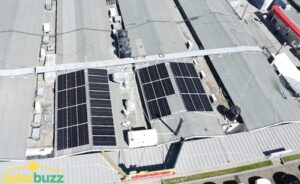
Tastee returned to Solar Buzz once again to power operations at their newest location in the Harbour View Shopping Centre with clean, renewable energy. 

After consistent results at their Half Way Tree branch, they were ready for a repeat success to reduce energy costs and maximize profitability.

Tailored for Tastee’s Energy Needs

At Solar Buzz, we design systems that perform exactly as projected. By analyzing each client’s actual energy usage, we custom design solar solutions that maximize return on investment.

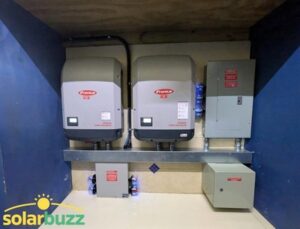
After analyzing Tastee’s load profile, a 20.7kW grid-tied (no batteries)  system with a 4-year payback period was designed and installed. 

Due to their 24/7 cold storage needs, Tastee has significant nighttime usage accounting for 54% of their total usage. Considering their nighttime usage and roof space availability, we engineered a system projected to offset  20% of their total energy usage. This offset is a reduction of over 3,000 kWh per month which is a projected savings of J$1,392,788 annually. 

Delivering as Promised: Another Solar Win!

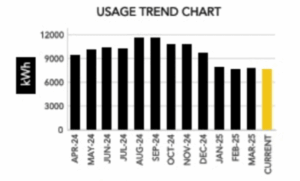
Tastee Harbour View switched to solar in December 2024. Below is the  Tastee Harbour View JPS chart showing January 2025 as the first full month on solar.  The graph reinforces the project as a solar success story with the system delivering consistent savings as projected.


Country Traders Ltd: Another Solar Success! 

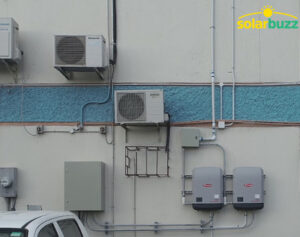
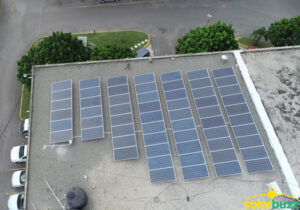
Country Traders Ltd partnered with Solar Buzz to reduce their carbon footprint while maximizing energy savings and production.

Custom-Designed for Maximum Impact

After analyzing Country Trader’s load profile, a 19.8kW grid-tied system with an average energy offset of 62% was designed and installed. With minimal night usage and no cold storage demands, their operations made them an ideal candidate for a high offset solar system and a 4-year payback period. 

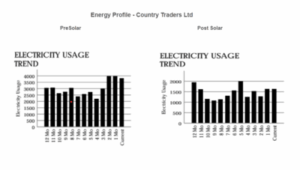
Below are the JPS charts for Country Traders Ltd showing their energy profile before and after solar energy installation.

These graphs show the system delivering energy savings as predicted. Our client was also able to increase production when needed without impacting projected savings!

The Results Are In!

Since installation of their solar system, our client has already secured full payback on their investment as promised, while continuing to enjoy real energy savings!

Ready to Energise Your Business?

It’s time to reduce your operating costs and invest in your bottom line; not someone else’s. 

Let Solar Buzz energize your business today with clean, renewable energy and systems that perform as promised.

Contact us today to begin your journey to sustainable success!

Deidre Wedderburn is the Client Relations Manager at SolarBuzz, dedicated to building long-term partnerships and delivering a top-tier client experience (deidre@solarbuzzjamaica.com).