Outages during Christmas reflect poorly on utility forecasting and natural gas units. It’s past time for the states and their utilities to lead and not wait until the grid regulators Federal Energy Regulatory Commission and North American Electric Reliability Corporation conclude their joint investigation.

To ensure safety and reliability, utility leaders should pay consumers to reduce consumption, embrace distributed energy resources in their resource planning, and make interconnecting rooftop solar and residential storage easier.

The question is, however, will they?

Anticipating NERC’s response

FERC and NERC have announced a joint investigation into what happened in North Carolina during Winter Storm Elliot because of multiple outages during Christmas.

The economic and reliability regulators want to get in on regulation and standards after an event, but there is no focus or attention paid before. Maybe that’s just human tendency?

History has always told us, at least in the electric utility industry, that major regulations come after blackouts. The National Electric Reliability Council was formed after the 1965 blackout. Read about fascinating NERC history here (It’s only 177 pages!). NERC came out of regional councils such as Mid-Atlantic Area Coordination Group, which is now ReliabilityFirst.

The Council became a corporation —the North American Electric Reliability Corporation— after the Sep. 2003 blackout with the mandate to levy fines of up to $1 million per day if utilities violated reliability standards, including tree trimming regulations.

Incentivizing DERs before an event

Fast forward to Feb. 2021.

Did we learn anything from winter storm Uri in Texas? We have already forgotten that Texas went through a similar winter storm event a decade earlier, in 2011.

Yes, FERC and NERC jointly investigated and released a report back then. I am sure they will also release a report for Elliott, too. But the jury is still out on Uri’s lessons. A recent proposal in Texas to incentivize generators (not load) to ensure they show up during a grid emergency.

Look at what is happening right now in PJM

PJM just announced that it had more unit outages during the Christmas week than forecasted. If 23% of PJM’s total capacity was forced out, 87% was from natural gas and coal units. And we have executives from Duke Energy Carolinas apologizing for inconveniencing their customers during Christmas. These utilities and RTOs have not taken steps to incentivize demand response and distributed energy resources, yet they are the custodians of safety and reliability.

Why should they pay load to avoid blackouts? Because that’s how MISO avoided blackouts in Feb. 2021.

Utilities must speed up distributed resource interconnections via automation

Whenever the topic of distributed energy resources interconnection comes up, utilities always bring up the fact that they are responsible for the safety and reliability of the distribution grid. Never mind that those utilities have already studied these DER interconnections. They want to “screen” them again so that a solar project is not exporting more than it should when storage is added at the same site.

Solar interconnections can be severely limited on the distribution system due to capacity constraints that could be resolved without the cost and delay associated with major feeder upgrades. In some cases, voltage and current imbalance will limit the feeder capacity. This constraint exists even though capacity is available in other phases.

Companies like Switched Source offer a distribution automation solution, the Phase EQ, that will automatically balance the voltage and current to unlock the capacity of the feeder. In other cases, the ideal location to site a solar project may be served by a feeder at capacity; however, adjacent feeders have the capacity but are not tied together due to the risk of loop flows.

Switched Source also offers another distribution automation solution, the Tie Controller, that can enable adjacent feeders to be tied together and controls the power flow between them to balance the load on the feeders.

Utilities must embrace distribution automation solutions to identify feeders with phase imbalance issues or capacity constraints and deploy solutions to address the issues to enable more load and solar interconnections.

Utilities must reflect accurate modeling of distributed solar in resource plans

Whenever utilities have integrated resource plan (IRP) proceedings, renewable and environmental advocates must push the utilities to incorporate distributed solar in their future capacity expansion plans. It’s like pulling teeth.

The excuse utilities give for not including distributed solar in future resource plans is that they don’t have much capacity value compared to utility-scale solar or utility-scale natural gas plants.

But the recent Christmas event in PJM shows many more outages than forecasted on the system. Additionally, unanticipated outages led to capacity deficiencies in the New England region during Christmas. And the New England grid operator is levying non-performance penalties on non-performing units, but we won’t know who owns these units.

So why are the utilities and their regulators more focused on an antiquated integrated resource planning process that incentivizes more non-renewable generation and the transmission needed to interconnect, when we should be looking at more distributed options on the demand side?

To reduce the magnitude of a blackout or even the likelihood of entering into an emergency event, grid planners should be talking to policy professionals and educating them before it is too late. It is easy to think about policy during an emergency event. It is hard to think about the policy before an event.

It’s up to states to take action

Even after all these events in recent years and so many different slides and jazzy pictures from institutions like NOAA that show that multiple weather-related events are occurring more frequently, utilities are asking for rate recovery for generation and transmission but not interconnection of distributed resources and demand response compensation.

Policymakers and grid planners should gather once again in a workshop in each state and debate whether we are paying enough attention to demand and distributed resources and consumers generating their electricity.

Utilities should allow rooftop solar, residential batteries, and customer-sited storage solutions on the grid to avoid human loss during grid emergencies.
Renewable Energy World

KEY POINTS
  • Amazon, Facebook parent company Meta and Google, owned by parent company Alphabet, are the top three corporate purchasers of wind and solar energy, according to a report published Wednesday from the American Clean Power Association, an industry group.
  • In total, 326 companies contracted 77.4 gigawatts of wind and solar energy by the end of 2022, which is enough energy to power over a thousand data centers or 18 million American homes.
  • Texas is benefitting more than any other state. Companies have bought clean energy from 540 projects located in 49 states, Washington DC and Puerto Rico, but 35% of contracted capacity bought by companies is coming from Texas, the report finds.


Technology companies are leading the charge of companies buying wind and solar power.

Amazon, Facebook parent company Meta, and Google, owned by parent company Alphabet, are the top three corporate purchasers of wind and solar energy, according to a report published Wednesday from the American Clean Power Association, an industry group.

Amazon had contracted 12.4 gigawatts of clean wind and solar energy in the United States through September 2022, while Meta had contracted 8.7 gigawatts and Google had contracted 6.2 gigawatts, according to the report.

These procurement totals are since the first time these companies have announced they were buying wind and solar power last decade.

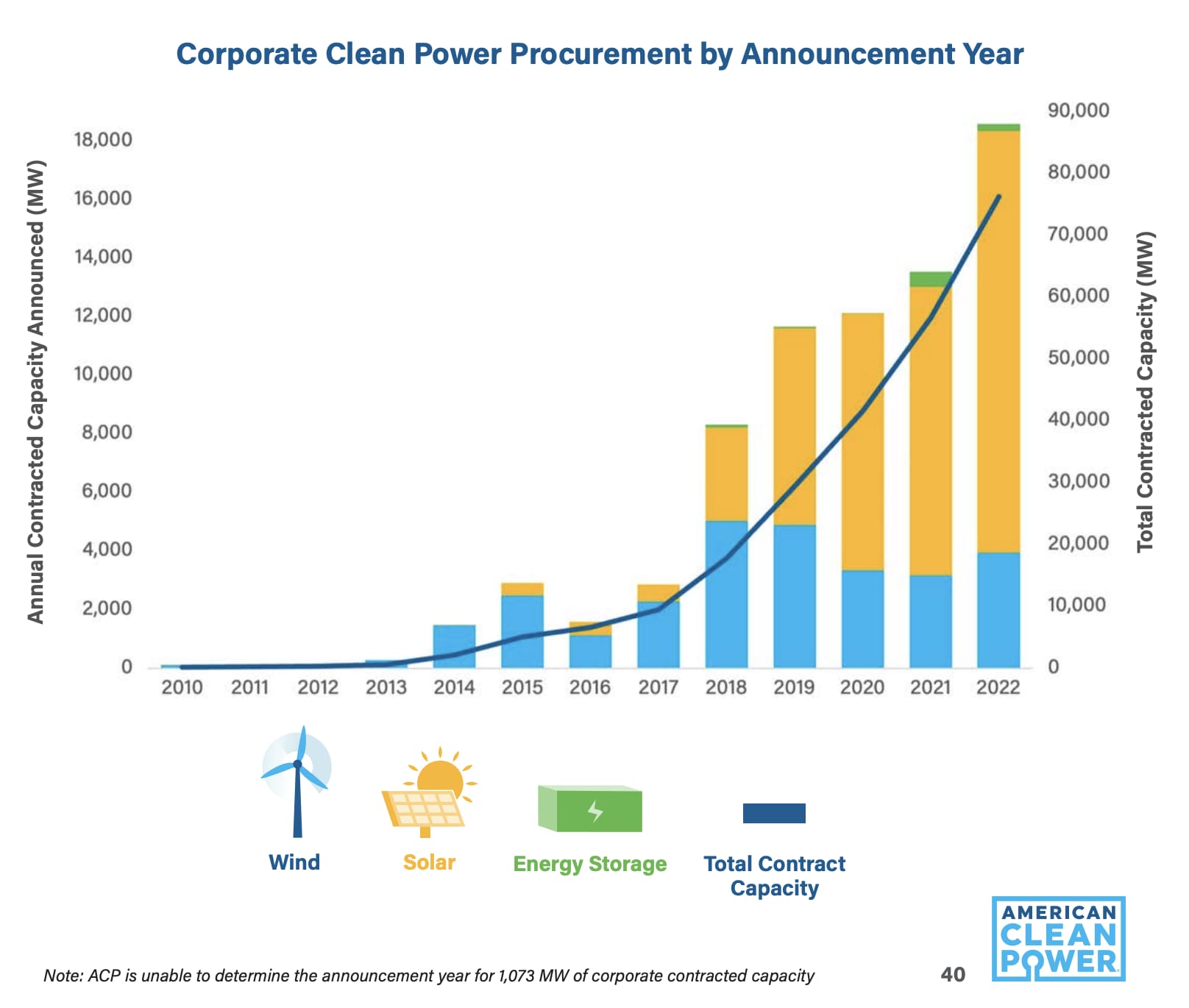
The technology sector is certainly outpacing other industries in buying clean power, but it’s been increasing across all industries. From 2012 to 2022, the amount of wind and solar energy bought by companies has increased by an average of 73 percent per year. It passed 1 gigawatt in 2015, 8 gigawatts in 2018, and nearly 20 gigawatts last year.

Wind and solar power procured by companies by year, according to the American Clean Power Association, an industry group.

The switch is not just driven by a desire to save the world from climate change. The price of clean power has been falling steadily. In the past decade, the cost has fallen 71 percent and 47 percent, respectively, according to the report.

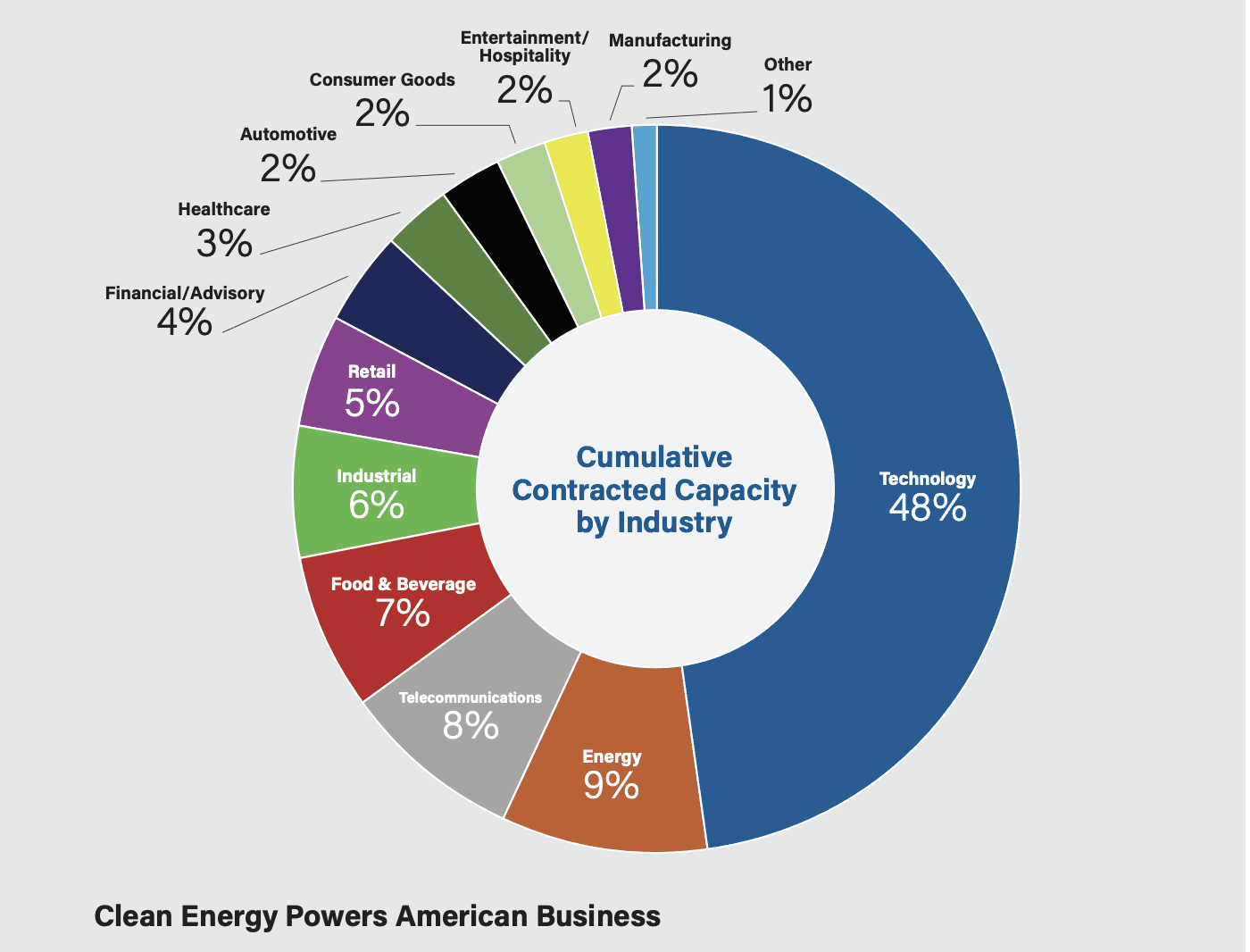
The technology sector is the clear leader when it comes to buying clean energy, and has contracted 48 percent of all wind and solar power. The energy, telecommunications and food and beverage sectors are the next largest corporate buyers and have contracted 9, 8 and 7 percent of total contracted wind and solar, respectively.

Total contracted wind and solar power by industry, according to the American Clean Power Association, an industry group.

In total, 326 companies contracted 77.4 gigawatts of wind and solar energy by the end of 2022, which is enough energy to power over a thousand data centers or 18 million American homes.

Of that 77 plus gigawatts of wind and solar power that has been contracted, 36 gigawatts or 47 percent is currently operating, meaning more than half still is still in development. The time it takes to go from a company buying wind or solar power and the project being online depends, but most of the procured projects are expected to come online in the next three years, a spokesperson for American Clean Power told CNBC.

Companies represent a significant piece of the total wind and solar landscape: 16 percent of wind and solar energy was headed towards corporations by the end of 2022. The remaining 84 percent goes to other energy purchasers, like utility companies.

As companies increase their purchasing of wind and solar power, Texas is benefitting more than any other state. Companies have bought clean energy from 540 projects located in 49 states, Washington DC and Puerto Rico, but 35% of contracted capacity bought by companies is coming from Texas, the report finds.

CNBC

Ricardo Case, director of engineering services at the Jamaica Public Service (JPS), is calling for the Government to act quicker as it relates to the implementation of policies and licensing for renewable energy.

Case noted that the Government has implemented some good policies that have been instrumental in the development of the sector, but a more aggressive approach is needed.

The JPS recently established 10 charging stations in Jamaica, with plans to double that amount by the end of 2023. However, a larger expansion of charging stations is pending government policy, said Case.

“We have to temper ourselves with where we see government policy going, so if there was a more aggressive government policy where the EV market was booming, we could act faster,” he told Our Today.

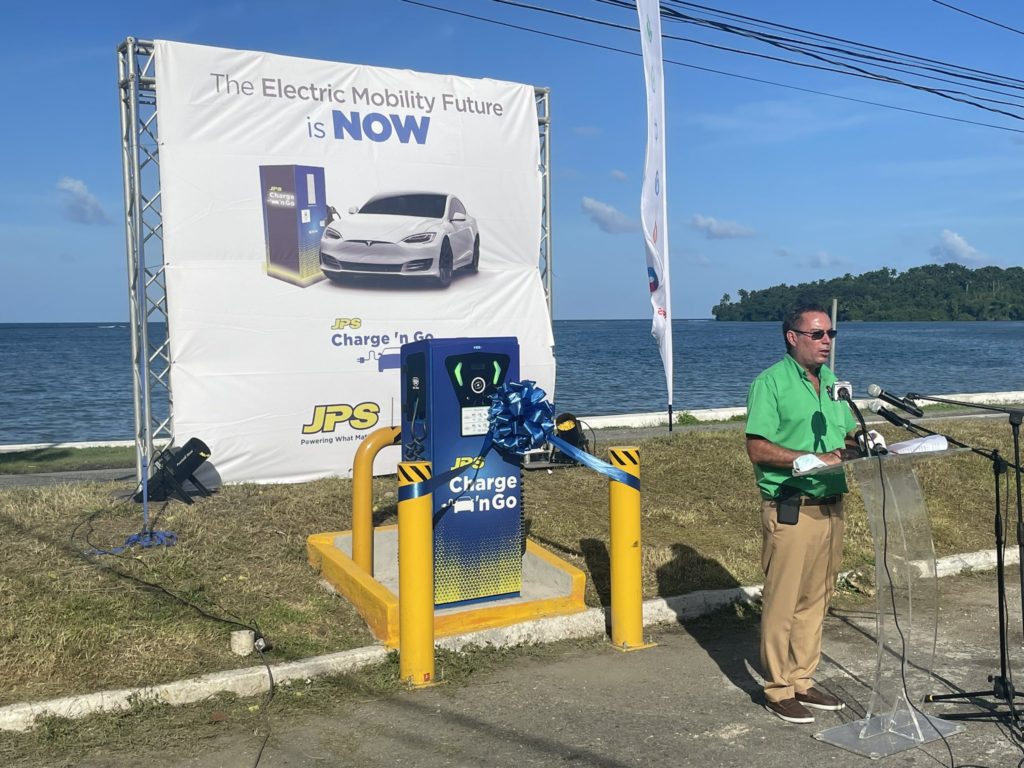
Energy Minister Daryl Vaz delivers his keynote address at the official commissioning ceremony for the Jamaica Public Service’s first electrical charging station in Port Antonio, Portland last November. (Photo: Twitter @myJPSOnline)

Case added that, though the Government has reduced taxes on electric vehicles, the age of the car that people can import is “practically new”, which means that they are expensive. In addition to this, most people charge their cars at home or at work. As such, he said the JPS is awaiting stronger signals from the Government before it invests in a larger scale of charging stations.

As it relates to the issue of licensing, he shared that it often takes up to six months or more for a licence to be approve and is recommending that the Government move faster in this regard.

He noted that “timing is everything in the industry”.

Case added: “So, if you’re gonna have something that is taking too long, it’s going to defeat the purpose for some people and it’s going to frustrate everybody else.”

Prime Minister Andrew Holness had stated that the Government plans to increase its target for use of renewable energy from 30 per cent to 50 per cent by 2030. But Case said proper planning in needed in relation to land space.

“To get 50 per cent of energy, it means that you have to have a whole lot more capacity on the grid to deliver that amount of energy because the nature of renewable energy facilities is not a 100 per cent relationship,” said Case.

He continued by sharing that the concern he has “is that, when you are looking at the expansion and the development of the system, it cannot be done in isolation of just JPS alone. When you are planning the whole energy eco system, everything comes into play”.

Case also pointed out that, often, the land on which solar parks are being developed is often not used for anything else and requires a large space.

“With the development of these solar parks, they are not using the land for anything else apart from the solar parks. So, we are going to get to a critical point where we are going to run out of land if we are not reusing the land for other purposes outside just generation because these solar facilities take up a lot of space.”

He then stated that, for engineers, this can cause an issue in the design process because, without the necessary information from the Government about future plans, they cannot create modular systems.

“We need to know the expansion plans that the Government has and where our new roads are going to be, because those are going to be your corridors and the right of way that you need to use to expand your system. It is a holistic partnership,” he stressed.

Our Today

Danny Hurn (left), an observer on the Polarcus Adira vessel, explains to Dr Andrew Wheatley (centre) minister of science, energy and technology, the workings of the equipment that will be used in the seismic survey for oil. John McKenna of Tullow Oil looks on.

Dr Andrew Wheatley, minister of science, energy and technology, has warned against any unrealistic expectations of a financial windfall in the short term from the three-dimensional (3-D) seismic survey for offshore oil and gas exploration now getting under way in Jamaican waters.

On Friday, Wheatley led a tour of the Polarcus Adira, the state-of-the-art 3-D seismic vessel docked at Berth 2, Kingston Wharves, which will undertake a detailed data-gathering survey covering a 2,250-square-kilometre section within the Walton Morant block south of Jamaica.

Wheatley told journalists afterwards that while there was reason to be optimistic, this should not be interpreted as a guarantee of success, and he appealed for help in enlisting divine intervention.

“I want us as a country to not get overly optimistic because it is a work in progress … but what we want our people to do is to be very optimistic and to think of the possibilities and, of course, do a little praying as well,” the energy minister said.

Meanwhile, John McKenna, country manager for Tullow Oil, the firm conducting the seismic survey, put into perspective the reason for the all-round optimism.

“This obviously is an exciting time for Tullow and for Jamaica. This is the first 3-D survey that is actually going to be undertaken offshore Jamaica, so we are very excited about it. We hope to get some good data and that the survey is completed safely and without any incidents and issues,” he said during the on-board briefing.

McKenna, however, also spoke to the need for patience: “This programme will take 45-50 days,” he explained. “Because it’s such a large volume of data, it can take six to nine months to process. And then it could take another six months to nine months to actually be confident enough to identify and to mature prospects into drilling a location.”

Speaking with The Gleaner afterwards, the Tullow executive said: “I don’t think we’ll know anything (definitive) before probably early next year as to whether or not it makes sense to drill, and then, of course, there may be more than one site that potentially could offer good results.”

Gleaner

Minister of Science, Energy and Technology Dr Andrew Wheatley (left), interacts with students of the Merl Grove High School in Kingston on Wednesday. Also pictured (from second left) are president and chief executive officer of the Jamaica Public Service, Emanuel DaRosa; and principal of Merl Grove, Dr. Majorie Fullerton.

Minister of Science, Energy and Technology Dr Andrew Wheatley said the Government is leading by example and saving money as it works to encourage Jamaicans to use energy responsibly.

He noted that through various initiatives under the Energy Efficiency and Conservation Programme (EECP), the aim is to ensure that government ministries, departments and agencies (MDAs) become a model for the rest of the society in terms of energy management.

“We believe that if we as the public sector show the rest of Jamaica how we are saving as it relates to managing electricity, (by) cutting down our electricity bill, it will not only act as a perfect example, but also you will see the workers within the public sector bringing to their homes, their communities, the practices that we are doing within the public sector,” he said.

Dr Wheatley was speaking at a ceremony for the relaunch of the JPS Foundation Energy Club at Merl Grove High School in Kingston on Wednesday.

He informed that the Government has realised $135 million in savings to date under the EECP.

LOWER CONSUMPTION

The initiative, being implemented by the Petroleum Corporation of Jamaica through funding from international partners, aims to retrofit a range of government facilities, including public health, administrative and educational buildings, and facilitate training in best practices for energy efficiency and conservation.

Some of the conservation measures undertaken include coating glass windows/doors to reduce the amount of heat entering buildings; improving the cooling system by using more energy-efficient air-conditioning units; and installing cool-roofing systems.

Over 40 government facilities from the health, finance, education and security sectors have, so far, been retrofitted with solar-control film, cool-roof solutions or energy-efficient air-conditioning systems.

To ensure continued responsible energy use at government facilities, Dr Wheatley pointed out that just last month, an Energy Efficiency and Conservation Standards Guide was launched, which contains standards to which MDAs will be held accountable in order to lower electricity consumption.

The guide, which will be made available in April, was developed through the EECP.

Gleaner

The Public Service Company of New Mexico is asking for project proposals, including renewables and battery storage, designed to help reach its coal-free goal by 2031.

It’s an ambitious, audacious goal.

In its 20-year 2017 Integrated Resource Plan submitted to the New Mexico Public Regulation Commission (NMPRC)earlier this year, Public Service Company of New Mexico (PNM) announced its intentions to be coal-free by 2031. Now it’s taken the first steps toward reaching those goals.

Last week, the state’s largest utility issued a request for proposals (RFP) for 456 MW of new generation resources, including renewable resources and battery storage. The RFP is predicated on the assumption that the utility’s San Juan Generating Station does not continue to operate post 2022.

The inclusion of battery storage in the RFP is part of a new NMPRC mandate that all the state’s utilities include those options in their future plans. The mandate was implemented in August.

In its August decision, the NMPRC said the original 2008 regulation that mandated IRPs didn’t take storage into account because the technology wasn’t sophisticated enough, and what did exist was too expensive. Now the technology is more easily deployable, adding them to the list of requirements makes far more sense – and PNM has taken the commission’s requirements into consideration with its new RFP.

But with new technologies available and prices coming down, the NMPRC decided the time was right to add it to the data requirements included in the reports.

PNM wants proposals that will help its portion of the grid provide the necessary reliability requirements and minimum operating resources that will meet North American Electric Reliability Corporation (NERC) and Western Electricity Coordinating Council (WECC) criteria.

PV Magazine 

A joint study by Finland’s Lappeenranta University of Technology and Energy Watch Group presented on the sidelines of the COP23 talks in Bonn demonstrates that a global transition to 100% renewable electricity could be achieved by 2050, and would be more cost effective than the current electricity system.

Longi Solar

The study, ‘Global Energy System Based on 100% Renewable Energy – Power Sector’ was presented during the Global Renewable Energy Solutions Showcase event, a sideline to the United Nations Climate Change Conference COP23 currently underway in Bonn.

The study’s key overall finding is that a global shift to 100% renewable electricity is feasible with current technology, and would be more cost effective than the current system led by fossil fuels and nuclear generation.

The study found that in a projected scenario for energy demand in 2050, 100% could be met by current renewable technologies, at a global average LCOE of €52/MWh, compared with 2015’s average LCOE of €70.

In EWG’s 2050 scenario, solar PV covers 69% of electricity demand, wind 18%, hydro 8% and bioenergy 2%. The study predicts that wind will briefly overtake solar in the 2020s, before further price drops put solar back in the lead.

Storage is outlined as the key supporting technology for solar, with around 31% of total demand covered by storage technologies. 95% of this is projected to come from short term storage provided by batteries, with power to gas conversion providing seasonal storage.

“There is no reason to invest one more dollar in fossil or nuclear power production,” exclaims EWG President Hans Josef. “All plans for a further expansion of coal, nuclear, gas and oil have to be ceased. More investments need to be channeled in renewable energies and the necessary infrastructure for storage and grids. Everything else will lead to unnecessary costs and increasing global warming.”

The report is based on an original model developed by Lappeenranta University of Technology, which calculates the most cost-effective mix of technologies based on available resources in 145 regions for a full reference year. The full study is published here.

Only time will tell whether this study’s recommendation will translate into reality. As lead author Christian Breyer sums up: “Energy transition is no longer a question of technical feasibility or economic viability, but of political will.”

PV Magazine

BRIDGETOWN, Barbados (CMC) — The Barbados government says independent power producers interested in supplying electricity to the national grid will be able to apply for licences by early next year. Energy Minister Darcy Boyce said that recommendations on licensing systems for these producers should be in hand by the end of the year and that proposals for pricing of renewable energy would also go before the Fair Trading Commission early next year.

“We can give certainty to investors of what they will earn,” he said, adding that the recommendations on pricing will be made after stakeholder consultations.

Boyce was speaking at a signing ceremony between the Division of Energy and Enermax Limited to facilitate the installation of solar photovoltaic systems at 28 community centres and nine polyclinics.

The project, which will be implemented over the next three months, forms part of the Disaster Risk and Energy Access Management (DREAM) Project funded by the Global Environmental Facility (GEF) with project support from the United Nations Development Programme (UNDP).

Its primary objectives are to reduce greenhouse gas emissions through the use of renewable energy and to strengthen Barbados’ disaster risk response by promoting decentralised photovoltaic electricity generation with battery back-up.

Boyce said that eventually he would like to see all community centres, polyclinics, the Queen Elizabeth Hospital and all schools with renewable energy systems.

He said this would result in a reduction in electricity costs, provide critical battery support when there were outages and ensure that communities and schools were not impacted in carrying out their programmes because of high electricity bills.

Jamaica Observer

Prime Minister Andrew Holness says Jamaica must capitalise on the availability of renewable energy. He explained that the country would be in a far better position if it could convert naturally occurring forces into energy.

“It is possible for Jamaica to go to approximately 50 per cent of its energy needs provided by alternatives,” Holness declared during a tour of BMR Jamaica Wind Limited in Potsdam, St Elizabeth, on Wednesday.

BMR Jamaica Wind Limited is the builder, owner and operator of Jamaica’s largest privately funded renewable energy project. The 36.3MW wind-generating facility has been in operation since July 1, 2016. At a cost of US$89.9 million, this represents a major investment in the parish of St Elizabeth.

LOCAL ENERGY A PREFERENCE

“From a policy perspective, we would much prefer to have more of our energy locally generated, and from that perspective, renewables are very important to us,” said Holness.

He pointed out that there is great potential between the parishes of Manchester and St Elizabeth for an expansion in wind-generating plants and that the significant investment made by BMR Limited is an indication that there can be even greater investment in wind energy in Jamaica.

Meanwhile, the Prime Minister said that the Government is doing an integrated resource plan which will project what are the country’s future needs. In addition, the plan will incorporate how the country can supply those future needs integrating renewables, in particular wind and solar.

PROBLEM WITH SUPPLY

“Of course, the problem with renewables is the intermittency of the supply, and even that can be overcome with battery technology, which has increased and improved, and so I hold a very optimistic view of the future of energy supply in Jamaica. We are now looking at expansion in solar,” added the Prime Minister.

According to Holness, another solar plant will be opened very soon and the Government is also examining waste energy as a solution.

The BMR Jamaica Wind project holds the distinction of being the first project funded in Jamaica by the Overseas Private Investment Company (OPIC). US$62.7 million was provided by OPIC and US$20 million from the International Finance Company (IFC).

The project is the recipient of the OPIC impact award 2016, as well as, the CREF Wind Project of the Year 2017.

Gleaner

UN CLIMATE CHANGE PRESS RELEASE / 10 NOV, 2017