Screen Shot 2016-03-29 at 12.58.21

ANGRA DOS REIS, Brazil — In this September 22, 2010 file photo, workers stand by the construction of Petrobras oil platforms in the BrasFels shipyard in Angra dos Reis, Brazil. Brazil’s State-run oil company reported on Monday a record quarterly loss due to a large reduction in some of its assets amid lower oil prices.

Energy stocks and energy-related bonds have had a rough ride over the past year and a half after outperforming considerably over the last decade.

The reason for the decline was simple: the sharp decline in oil prices from over US$100 a barrel to just above US$40 currently.

WTI crude, which was at a high of US$96 in June 2014, is currently trading at US$40 a barrel for a 58 per cent drop, while Brent crude which traded as high as US$107.75 in June 2014 fell 62 per cent to be trading around the US$41 level.

The slide began due to significantly increased supply of US oil production, as hydraulic fracturing was able to retrieve oil from previously difficult to get at locations, as a result of improved drilling technologies. The combination of high oil prices and low interest rates, emanating from Central Banks’ accommodative monetary policies, made such projects economically viable. Consequently, US oil production increased 80 per cent from 2008 through 2014, according to one estimate.

Crude oil inventories in storage at Cushing, Oklahoma, the largest storage hub in the US, increased from 20 million barrels in the middle of 2014 to just below 70 million presently. In addition, on the demand side, slower growth in demand from China seemingly played a significant role in prices declining.

Finally, there was quite a bit of feeling that the high price of oil merely reflected trading and speculation, and that the whole situation would unravel at some point as fundamentals declined. In this case, the catalyst was OPEC’s strategy to increase production in an already oversupplied market to protect market share and ultimately force production cuts from non-OPEC sources as the price plunge continued.

Oil prices fell in excess of 30 per cent in 2014, 40 per cent in 2015, and by mid-February 2016 had plunged by a further 30 per cent, trading in the mid-20s, but have since rallied some 50 per cent to around US$40 a barrel currently. So what’s next for oil? While it’s difficult to predict the future, a continued recovery or at least stability in oil prices, should persist as supply and demand dynamics come back into balance.

Oil slumped to a 12-year low this year on protracted excess supply concerns before rising on speculation that stronger demand and falling US output, coupled with talks of a production freeze between OPEC and Russia, would ease the global surplus. Additionally, there’s the potential for supply shocks in the future after energy companies from Chevron Corp to BP Plc cut billions of US dollars in spending amid the price crash, according to the International Energy Agency (IEA).

Support for oil on the demand side should come from the observation that oil demand tends to go up over time. Global demand for oil, according to an economic estimate, increased from 75.9 million barrels per day in 2000 to 94.2 million barrels per day in 2015 and is expected to rise to 95.6 million in 2016.

The IEA recently expressed the view that oil prices had reached their bottom, given recent developments on the supply side of the equation in particular and improving outlook on the demand side.

OPEC also is apparently anticipating average oil prices of US$50.00 for 2016. It has become increasingly apparent that given the difference fracking has made in increasing available supply to the United States, we will not see US$100 a barrel for a long time — perhaps never again as we begin a slow but likely definite transition to cleaner fuels.

As oil prices continue to rise, look out for more lucrative buying opportunities in some still beaten-down energy assets — but as usual be sure to consult with your investment advisor to ensure that your selections are right for you.


Jamaica Observer

Trinidad & Tobago is confronting a major shock with the sharp fall in energy prices that accelerated early this year.

In a statement following the conclusion of a mission from the International Monetary Fund earlier this year, head of the IMF mission Elie Canetti said that based on available information, including that of job losses and continued supply-side constraints in the energy sector, Trinidad’s economy is expected to contract one per cent this year.

The mission also said that declines in energy-based revenues will constrain the government’s ability to act as an engine of growth.

Still: “With substantial financial buffers and low, albeit rising levels of public debt, Trinidad and Tobago is not in a crisis. Nonetheless, in recent years, taking into account the size of energy revenue windfalls, the country has under-saved and underinvested in its future,” the IMF said.

“As a consequence, the imbalances that are now starting to build up could lead the country to uncomfortable levels of debt and external financial cushions absent further action. The new Government agrees that policy adjustments are needed.”

The fund noted that in the half-year since they took office, the Keith Rowley-led administration has already taken “some difficult but necessary steps”, such as widening the value tax base, cutting fuel subsidies, and cutting the number of ministries.

BUDGET DEFICIT

Despite these measures, the IMF said it projects a 2016 Budget deficit at some 11 per cent of GDP. However, if asset sales were to be counted as revenue rather than financing, the deficit would be equivalent to about five per cent of GDP, it said.

“Continued projected deficits of this size call for further fiscal consolidation, perhaps of around 6 per cent of GDP over the next few years,” said the multilateral agency.

Trinidad has agreed to conduct a wide-ranging expenditure review, and will seek the assistance of the World Bank to rationalise and reverse the unsustainable increases in spending on transfers and subsidies over the last several years.

“We support the Government’s intent to conduct a national dialogue on fuel subsidies with a view to phasing them out over time,” said the fund. “The country’s external situation has been very challenging. Against a backdrop of foreign exchange shortages that have intensified since the beginning of 2015, the recent sharp falls in energy prices are further reducing the available supply.”

During the recent visit, the mission met with government officials, banks, and private-sector representatives to assess the foreign exchange market. The fund noted that the current shortage appears to be driven by business uncertainty but also speculative trades.

“While it is appropriate that the central bank paused in its interest rate hiking cycle in January, there is little scope, as the bank agrees, to cut interest rates, at least until shortages of foreign exchange are ameliorated,” the IMF said.

Gleaner

The organisation that represents major oil-consuming nations said Friday that signs of a market that has “bottomed out” are emerging.

US crude prices jumped to a high for the year. Brent crude, used as a global benchmark, hit a high for the year Tuesday and rose one per cent Friday.

Energy companies have been shutting down rigs and laying off thousands of workers as oil prices plunged to around US$30 per barrel, from well over US$100 per barrel just two years ago.

A broad retreat by the energy sector played out again last Friday on both fronts.

The number of oil and natural gas rigs active in the US fell for the 12th consecutive week, according to Baker Hughes on Friday, to 480. That’s the lowest level in decades, and perhaps the fewest since the earliest days of the oil drilling industry.

And Texas driller Anadarko Petroleum Corp. said that it would cut 1,000 workers, 17 per cent of its work force.

The pain at Anadarko and other energy companies may finally be translating into a reduction of a massive and global oversupply of oil, the International Energy Agency said Friday.

OPEC production tumbled by 90,000 barrels a day last month, the IEA said. US production that had surged due to new drilling technology, is expected to fall by almost 530,000 barrels a day this year, according to the IEA.

The Paris organisation, however, said that the recovery in crude prices in recent days from multiyear lows does not mean that there will be a significant and sustained rebound in the short-term. There have been sharp declines in demand, particularly in the United States and China, it said.

China, the world’s second-largest oil consumer, is attempting to quell anxiety over a slowing economy and labour unrest. Earlier this month, it cut its growth expectations for the year.

Goldman Sachs said last Friday that production is unlikely to increase in the US until 2017, and that prices could volatile in the next few months.

Analysts with Goldman said that if US drillers ramp up production with any rise in oil prices, “we believe a self-defeating rally in oil prices/equities could result.”

The report buoyed stocks of energy companies last Friday, making the sector the second-best performer on the Standard & Poor’s 500 index.

In the energy markets on Friday, US crude added 66 cents, or 1.7 per cent, to US$38.50 per barrel on the New York Mercantile Exchange. Brent crude, which is used to price international oils, gained 34 cents, or 0.8 per cent, to US$40.39 a barrel and natural gas gained 3.4 cents to US$1.822 per 1,000 cubic feet.

Gleaner

The JPS power station at Bogue, Montego Bay, which is being converted to run on LNG.

New Fortress Energy, the company seeking to supply liquefied natural gas (LNG) to Jamaica, has secured a two-year contract for an LNG vessel and is to start shipping gas this month.

Golar LNG Limited, a Bermuda-registered company which operates the vessel Golar Artic, revealed the contract details to its investors.

“Golar has now concluded a two-year charter agreement with New Fortress Energy Transport Partners LLC (NFE) for the employment of Golar Arctic in Jamaica,” said Golar its statements obtained by the Financial Gleaner.

New Fortress has an agreement with Jamaica Public Service Company (JPS) to supply gas to its 120MW power plant at Bogue in Montego Bay, a contract New Fortress will service via gas infrastructure under development at the Montego Bay port. JPS has been mum on the price at which the gas will be supplied to Bogue.

The American company is also expected to develop gas infrastructure and supply JPS’ Old Harbour plant with LNG once it is built, but those negotiations continue.

Bogue is currently being converted to run on gas as well as diesel oil, the fuel on which it was originally commissioned in 2003. General Electric is doing the retrofitting under a US$22.74-million contract from JPS. Bogue will become a combined-cycle plant, capable of switching between gas and diesel.

New Fortress Energy assumes the costs for delivering gas to the burner tip. JPS has no stake in the gas infrastructure project.

New Fortress’ ambition Golar said the deal it has with New Fortress solves a long-standing problem regarding the cost of regasification, and that it fits with New Fortress’ ambition to become a regional supplier of LNG to Caribbean countries.

“Jamaica has long sought to replace liquid fuels with LNG, however, the size of the market has always made it difficult to justify the cost of a conventional floating storage and regasification unit,” said the fuel shipping company.

“New Fortress have now solved this challenge by utilising ship-to-ship transfer of LNG from Golar Arctic on to smaller LNG carriers to service a number of locations within the country of Jamaica.”

Golar Arctic is scheduled to load the first LNG cargo in support of this new business “during March 2016”. Golar and New Fortress believe this new approach to delivering LNG to niche markets has wide application within the Caribbean and other similar markets around the world, stated Golar.

“New Fortress have, with their entrepreneurial approach to business development, shown that downstream LNG markets can be developed within a much shorter time frame than is customary. Similar fast-track solutions will be essential if consumers are to benefit from the large incremental volumes of LNG that will be delivered to market over the next three-four years,” stated Golar.

The Financial Gleaner sought a project update from both JPS and New Fortress, but none came up to press time.

Golar LNG this week reported a fourth-quarter adjusted operating loss of US$35.9 million.

The Gleaner

Screen Shot 2016-02-25 at 17.08.42

RIYADH, Saudi Arabia (AFP) — The Nigerian and Saudi leaders yesterday supported efforts to stabilise the oil market but Africa’s top producer did not commit to a production freeze.

After talks in the Saudi capital Riyadh, Nigeria’s President Muhammadu Buhari and Saudi King Salman “committed themselves to doing all that is possible to stabilise the market and rebound the oil price,” Buhari’s office said in a statement.

Buhari was in Riyadh a week after Saudi Arabia, Russia, Venezuela and Qatar agreed at talks in Doha to freeze production at January levels in a bid to stem the dramatic fall in oil prices.

The agreement is conditional on other major producers joining in, as oil heavyweights seek to ensure others not to take advantage of output limits to win market share.

The statement after yesterday’s talks made no mention of Nigeria joining the freeze but analysts say the OPEC member is likely to eventually support the move.

The official

Saudi Press Agency also reported that talks between Prince Abdulaziz bin Salman, the Saudi deputy oil minister, and his Nigerian counterpart, junior oil minister Emmanuel Ibe Kachikwu, focused on “the best way for (market) stability” and “the cooperation of producing countries inside and outside OPEC” to achieve this.

Saudi Arabia and its gulf allies in the Organisation of Petroleum Exporting Countries had been refusing to limit or reduce production, leading to a supply glut that has seen prices fall by 70 per cent since mid-2014.

Poorer OPEC members, including Nigeria, have been hard hit by the price drop but even the wealthy Gulf states have been forced to adopt austerity measures to cope with falling oil revenues.

“I wouldn’t be surprised to see them voice their support to the freeze agreed in Doha,” Abhishek Deshpande, lead oil market analyst at Natixis in London, said of Nigeria.

But he said that unless Iraq and Iran also commit to limit production such talks “carry very little weight”.

The two countries are OPEC’s second- and third-largest producers.

Iran, returning to world markets as sanctions are lifted under its nuclear deal, has insisted on boosting production to pre-sanctions levels.

“Some neighbouring countries have increased their production over the years to 10 million barrels per day and export this amount, then say let’s all freeze our oil production,” Oil Minister Bijan Zanganeh said yesterday.

“They freeze production at 10 million bpd and we freeze at 1 million bpd. This is a very funny joke.”

Saxo Bank analyst Christopher Dembik told

AFP that Nigeria’s position is “a bit ambiguous,” supporting the mooted freeze but at the same time wanting to increase its production to respond to domestic market needs.

Nigeria could be crucial

“In the longer term, there is no reason why the country won’t align itself with the position of Saudi Arabia and Russia,” Dembik said.

Nigeria and Saudi Arabia would also discuss their position towards Iran and Iraq, he added.

“Nigeria could have a crucial role in this respect because of its measured position” that Iran and Iraq should elevate their production before envisaging freezes, Dembik said.

“It is probable, then, that Nigeria meanwhile establishes a bridge for negotiations, notably between Riyadh and Tehran.”

According to OPEC’s Monthly Oil Market Report, Iraq produces about 4.4 million barrels a day, followed by Iran at more than 2.9 million.

Saudi Arabia’s output is close to 10.1 million barrels a day, according to January data.

Kachikwu, who is head of Nigeria’s state-run oil firm, also discussed joint oil and gas investments during his meeting with Abdulaziz, SPA reported.

Oil prices nudged higher Tuesday as the two OPEC members met.

US benchmark West Texas Intermediate crude for delivery in April was up one cent at US$33.40 a barrel. Brent North Sea crude for April rose 18 cents to US$34.87 compared with Monday’s close.

After the Saudi visit, the Nigerian delegation was to travel to Qatar for more oil talks.

Jamaica Observer

Oil powerhouses Russia and Saudi Arabia joined Qatar and Venezuela in pledging Tuesday to cap their crude output if other producers do the same, aiming to halt a slide that has pushed oil prices to their lowest point in more than a decade.

The decision followed an unexpected closed-door meeting involving the four countries in the Qatari capital, Doha, and reflects growing concern among big producers about the effects the slump poses to their domestic economies.

Russian Energy Minister Alexander Novak said in a statement issued after the meeting that the four countries would be ready to cap production based on last month’s output levels if others join.

“We are ready to maintain, on average in 2016, the level of oil production of January 2016 and not exceed it,” he said in a subsequent statement.

Whether the plan is enough to put a floor under prices is uncertain. The proposal depends on cooperation from a range of producers with differing budget priorities all scrambling for market share since prices began falling in summer 2014.

Among the hardest to bring on board will likely be Iran. It was noticeably absent from Tuesday’s gathering even though it shares control of a major underwater natural gasfield with fellow OPEC member Qatar.

Iran is eager to ramp up its exports now that sanctions related to its nuclear programme have been lifted, saying recently it aims to put another 500,000 barrels a day on the market. Figures from the International Energy Agency show that it pumped 2.9 million barrels daily in December, before sanctions were lifted.

Iran’s petroleum minister, Bijar Namdar Zangeneh, signalLed the Islamic Republic has no intention of giving up its share of the market. He acknowledged that global markets are “oversupplied,” but said Iran “will not overlook its quota,” according to comments carried by his ministry’s Shana news service.

Venezuelan Oil Minister Eulogio Del Pino heads to Tehran next for talks with his Iranian and Iraqi counterparts today, Wednesday.

“The key OPEC members that need to take part are Iran and Iraq, where the big increases are likely this year, but there are big doubts over whether this can be achieved,” Barclays analysts Miswin Mahesh and Kevin Norrish said in a research note.

Efforts to make the plan work are complicated by deep levels of distrust between regional rivals Saudi Arabia and Iran, which has built close ties to Iraq’s government in the years since the 2003 US-led invasion.

The two countries are in opposing camps in regional disputes from Yemen to Syria. Last month, Sunni-ruled Saudi Arabia cut diplomatic ties with Shiite powerhouse Iran after the Saudi embassy and a consulate were torched by Iranian protesters angry over the kingdom’s execution of a prominent Shiite cleric.

Speaking to reporters after the meeting, Saudi Oil Minister Ali Naimi said producers would continue to assess the state of the market in the months ahead. He described freezing output at January levels as an “adequate” step for now.

All of the countries at Tuesday’s meeting, except Russia, are part of OPEC. Saudi Arabia dominates policymaking within the 13-member bloc of oil-producing countries, which has refused to cut its official production targets. Doing so could bolster faltering prices.

The aim of OPEC’s keep-pumping strategy has been to attempt to ride out the 12-year lows in prices and force higher-cost producers, including shale drillers in the US, out of the market.

The bloc collectively pumped 39 million barrels of crude and natural gas liquids a day in December, or about two out of every five barrels globally. Russia pumps around 11 million barrels a day.

After rising soon after the meeting, a barrel of benchmark New York crude was trading down 35 cents at US$29.09 by midmorning in New York. A barrel of Brent, the international standard, fell 59 cents to US$33.42.

The Gleaner

image1.jpeg

The Jamaica Public Service Company (JPS) says it is unable to definitively state how the use of both automotive diesel oil and liquefied natural gas (LNG) at the Bogue power plant in St James will impact the price of electricity to consumers.

It said the power plant currently burns on automotive diesel oil “and we are doing a conversion that adds the capability to also burn natural gas. So we will end up with the ability to burn both fuels at no extra cost”.

Responding to Wednesday Business queries about the rationale for the dual-fuel facility, the JPS said natural gas will be the primary fuel on which the plant operates and automotive diesel oil will be a back-up fuel “in case we have any problems with receiving natural gas”.

It added that under normal conditions, the plant will effectively be a gas-fired power plant.

IMPACTON ELECTRICITY PRICES

As to how it will impact the price of electricity the JPS said in emailed responses that “we cannot speak to the likely impact on electricity prices given the uncertainty of prices in the future (for oil vs LNG)”.

However, it said that the impact is expected to be negligible given that Bogue only represents approximately 10 per cent of the company’s total costs.

“What we can say with fairly good certainty is that the cost of electricity today is 30 per cent lower than it was one year ago, and we expect that trend to continue throughout 2016, given that 80 per cent of our net generation (production) will still be based on oil, 10 per cent will be from natural gas, and we expect renewables to make up 10 per cent of our net generation once the three renewable energy projects currently under construction (for circa 80 megwatts) are completed before the end of 2016.”

The JPS, an integrated electric utility company and the sole distributor of electricity in Jamaica, added that “that means we continue doing a good job as a country of increasing the penetration of renewable, while also diversifying our fuel mix and reducing our overexposure to oil”.

It said that it is hoping to continue doing more of that through the 37 megawatts of renewables currently being pursued by the Office of Utilities Regulation through a request for proposal, as well as its 190 megawatt gas-fired power plant that will be commissioned in mid-2018.

IMPROVING COMPETITIVENESS

Reducing the cost of electricity is critical to improve competitiveness, according to the International Monetary Fund’s latest updated memorandum of economic and financial policies.

It said that the action plan prepared by the Electricity Sector Enterprise Team foresees replacing current oil-fired generation capacity with gas, coal and ethane-fired plants to achieve significant cost savings.

Next steps will include the conversion of the Bogue power station from oil to gas, a process which the JPS is currently undertaking.

In addition, said the memorandum, the Government has approved the construction of Jamaica’s first natural gas-fired power plant, a 190-megawatt facility to be built and operated by JPS, and to be completed by 2018. Several renewable energy projects are also under way.

The Government said it will prepare a plan to ensure that all public entities – central government, local government and public bodies – meet their financial obligations in a timely manner.

In the memorandum, the Government also pointed out that urgent actions will be taken to reduce the time needed for entrepreneurs to get an electricity connection. Plans foresee the automation of the work processes within the government electrical regulator and the acquisition of an Application Management and Data Automation (AMANDA) software to streamline procedures for scheduling, inspecting, approving and certifying electrical installations.

An action plan for implementation of the reforms and adoption of the AMANDA system are expected to be completed in fiscal year 2016/17, with support from the Inter-American Development Bank.

The Gleaner

The Private Sector Organisation of Jamaica (PSOJ) says it is in the country’s best interest to further hedge against the upward movement in the price of oil, a strategy the Government first adopted in June last year.

The hedge purchased by Jamaica last year at a strike price of US$66 has come in for criticism because oil prices are currently falling, and analysts are predicting further decreases this year.

However, PSOJ president William Mahfood said if the world crude prices remain low for an extended period, the options to buy will also be reduced and gives Jamaica an opportunity to hedge at concomitantly lower prices.

“We feel strongly that if the strike prices are attractive and if prices are maintained at these lower levels that it is in the country’s best interest to buy that insurance policy going forward,” Mahfood told Wednesday Business.

Asked if the PSOJ would encourage the Government to negotiate any differently in entering into such contracts, Mahfood, while noting that “it’s really a function of time, and it’s a question of volatility,” emphasised that “if oil prices remain low for an extended period of time, what you will find is that the option prices will come down, and if those prices come down further, it will definitely be in the country’s interest for us to hedge further”.

While some projections are for prices to fall to US$20, Mahfood said that no one knows exactly where they will end up.

“The best analysts in the world will tell you that the oil price might be a US$53 in December or it might be at US$100.”

He said the PSOJ feels strongly about maintaining some sort of stability in terms of the prices, given what the impact the lower costs have had on the economy in terms of energy which has, for example, resulted in lower electricity bills for both households and manufacturers.

In a release on Monday, the PSOJ said it has taken note of commentary on the oil hedge strategy Jamaica effected last year by purchasing options to buy eight million barrels of oil, representing about half the country’s annual requirement, at a price of US$66 per barrel.

The total cost of the option, which became effective in June 2015 and expires September this year, was approximately US$20 million.

One argument, the PSOJ said, was that the hedge was a waste of money as oil prices have fallen to US$30 per barrel, and the strike price, where Jamaica would have started to benefit, is US$66 per barrel.

The PSOJ noted that projections last year were for oil prices to recover in 2016 with most expecting it to go past US$66 per barrel and settling at around US$80 per barrel, which at 17 million barrels per year, would have had an annual cost above the strike price of US$234 million.

“If this had happened then we would have saved US$214 million (net of the option cost of US$20m). So for us to even have broken even on the cost of the option, oil prices would have had to go to US$67.20 per barrel (additional US$20 million based on our usage above the strike price),” PSOJ said.

It noted that the hedge is not a contract for supply at the strike price of US$66, but an option to purchase at that price so the only cost would be the US$20 million fee.

“It is also important to note that the amount applied to pay for the hedge was applied while prices were falling, so it was not an additional cost, which was important as it did not reduce already existing consumption spending,” the private sector group said.

“The fact is that we could ill afford oil moving back to US$80 per barrel, and the cost of US$20 million to mitigate a US$200 million risk, like insurance, makes good business sense,” said the PSOJ.


The Gleaner

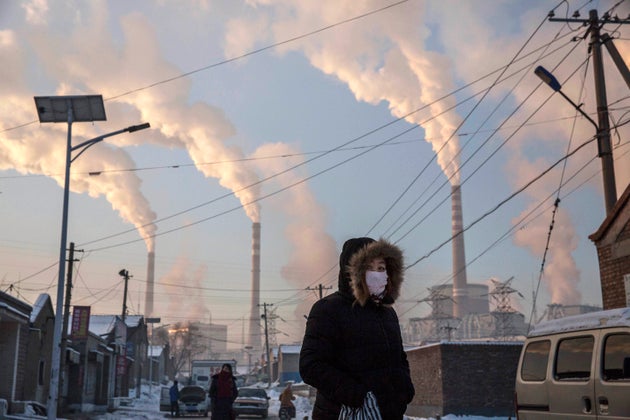
A woman wears as mask while walking in a neighbourhood next to a coal-fired power plant on Nov. 26, 2015, in Shanxi, China.

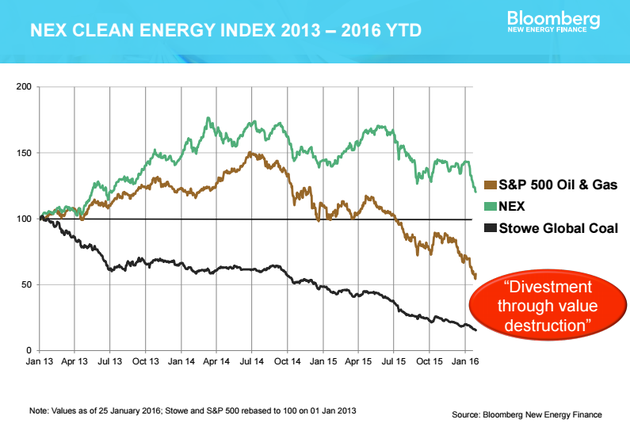
The market is encouraging pension funds and institutions to jettison fossil fuels from their portfolios, waving a clear warning flag to investors about the financial future of oil and coal companies.

Fossil fuel stocks are performing poorly compared to the market as a whole — and perhaps most importantly, compared to renewable energy stocks, said Michael Liebreich, chairman of Bloomberg New Energy Finance, at a summit on climate risk put on by the nonprofit sustainability advocacy group Ceres.

Referring to investors who won’t divest and continue to own fossil fuel stocks, Liebreich pointedly said that the market was “divesting through value destruction” — in other words, cutting their holdings in traditional, polluting energy companies by slashing their value.

Renewable energy stocks have dramatically outperformed fossil fuels.

Over the last 10 years, the S&P 500 index is up just over 50 percent. Yet energy stocks over the same time period have risen only 1.3 percent.

For big investors to simply allow their holdings in big energy companies to fall toward a vanishing point of worthlessness is deeply irresponsible, observers say.

Indeed, former Vice President Al Gore, who shared the Nobel Peace Prize in 2007 for his work on climate change, compared the risk that some fossil fuel companies’ assets will become worthless to the danger of mortgage-backed securities, whose collapse triggered the 2008 financial crisis.

The nonprofit research group Carbon Tracker estimates that if the world changes its energy sources to keep climate change below 2 degrees Celsius, $2 trillion in fossil fuel assets will be stranded — that is, unusable, far less valuable, and in some cases, liabilities.

Huffington Post

Jamaica is to reduce greenhouse gas emissions by the equivalent of 1.1 million metric tonnes of carbon dioxide per year by 2030, as part of its global commitment to take climate-change mitigation action.

To bring this about, the island – as reflected in its nine-page Intended Nationally Determined Contributions (INDCs) document to the United Nations Framework Convention on Climate Change – has undertaken to implement energy policies that ensure the island:

– uses energy wisely and aggressively to pursue opportunities for conservation and efficiency;

– has a modernised and expanded energy infrastructure that enhances energy generation capacity and ensures that energy supplies are safely, reliably and affordably transported to homes, communities and the productive sectors on a sustainable basis; and

– achieves its energy resource potential through the development of renewable energy sources by increasing their share in its primary energy mix of 20 per cent by 2030.

Such policies are also to ensure that government agencies and ministries are a model/leader in energy conservation and environmental stewardship, and that the island has a well-defined and established governance, institutional, legal, and regulatory framework.

Fully implemented energy polices need, too, to ensure that private industry embraces “efficiency and ecological stewardship to advance international competitiveness and to move towards a green economy”, the document said.

The Gleaner