BEIJING, Jan 9 (Reuters) – China will cancel value-added tax export rebates for photovoltaic products from April 1, the finance ministry said in a joint statement with the State Taxation Administration on Friday.
The ministry also said VAT export rebates for battery products will be cut to 6% from 9% between April and December and scrapped entirely from January 1, 2027.
Consumption-tax rebate rules for these products will remain unchanged, the statement added.
The China Photovoltaic Industry Association, in a statement later on Friday, said the move should help curb an excessive decline of export prices in the long run as China’s PV products face intensifying competition in overseas markets.
It noted that some Chinese exporters were using rebates as a price discount for foreign buyers.
“Timely reduction or cancellation of export rebates for photovoltaic products can help promote a rational return of foreign market prices and reduce the risk of trade frictions,” the association said.
China previously reduced the export tax rebate for PV products to 9% from 13% in December 2024 as part of its broader efforts to curb overcapacity and deflationary price wars amid international trade tensions.
Applications to build battery storage drive boom as offshore wind projects given go-ahead jump sevenfold year on year
A record number of renewable energy projects were given the go-ahead in Great Britain in 2025, after planning approvals almost doubled year on year, according to an analysis.
The energy capacity of new battery, wind, and solar projects that received approval climbed to 45GW this year, 96% higher than in 2024, according to data from Cornwall Insight.
The boom was driven by applications to build new battery storage, which almost doubled to 28.6GW this year from 14.9GW in 2024. Planning approvals for offshore wind developments jumped more than sevenfold to 9.9GW from 1.3GW last year.
Planning approvals for battery, wind and solar power have risen by more than 400% over the past five years.
The energy secretary, Ed Miliband, said: “After years of delay and underinvestment, this government is keeping its promise to take back control of Britain’s energy with clean homegrown power.
“Every project we approve, every investment we make is about getting the country off the rollercoaster of fossil fuel markets, protecting households and lowering bills for good.”
The record-breaking surge in planning approvals signals real momentum in the UK’s energy transition, according to Robin Clarke, a senior analyst at Cornwall Insight, but many could still face delays starting up.
“On paper, the UK’s renewables pipeline has never looked stronger,” he said. “But approvals don’t generate electricity, and we urgently need to move from ambition to actual delivery of these projects. Too much capacity is still stuck in queues or waiting on grid upgrades. Grid bottlenecks remain one of the biggest risks to turning today’s approvals into tomorrow’s power.”
Although approvals have accelerated, the pace of projects starting up has lagged behind, largely as a result of long construction timelines and grid connection delays, according to Cornwall.
Many projects have been stuck in a “first come, first served” connections queue, but recent reforms to remove “zombie projects” from the queue and shift to a “first ready, first needed, first connected” approach is expected to clear some of the bottlenecks and quicken the pace of Britain’s renewable energy buildout.
Britain’s energy system operator pulled the plug on hundreds of electricity generation projects earlier this month to clear a huge backlog that had stopped many “shovel-ready” schemes from connecting to the power grid.
More than half of the energy projects in the queue will be removed to make way for about £40bn-worth of schemes considered the most likely to help meet the government’s goal to build a virtually zero-carbon power system by 2030.
Britain’s growing renewables industry may also have accelerated in 2025 as developers rush to get their projects over the line before tougher rules over which projects can connect to the grid, and upcoming local elections that could create uncertainty over future renewable energy planning policies.
Clarke said: “The recent grid connection reforms are a significant step forward, and should help clear some of the backlog, but they won’t solve everything. We need faster decisions, more investment in the grid, and real collaboration between government, regulators and industry. Without that, these record numbers risk becoming just another statistic.”
Cornwall added that the rapid expansion of renewable projects would also mean the UK must reinforce and build out its electricity grid at scale.
“The current infrastructure was never designed for such high volumes of intermittent generation and storage, so investment in grid flexibility, transmission upgrades, and smart technologies will be critical to ensure these projects can deliver power where and when it’s needed,” it said.
Editor’s Note: Our clients and systems were referenced in a recent New York Times article examining the impact of Hurricane Melissa and how rooftop solar systems performed during and after the storm. Readers who wish to view the article may do so using the link below.
Resilience is not a foreign concept in Jamaica. For generations, Jamaicans have navigated environmental uncertainty and economic constraint with ingenuity, perseverance, and resolve. From small business owners reopening their doors after floodwaters recede, to households restoring order and routine in the aftermath of storms, adaptability is not merely a response – it is our defining trait.
As climate change accelerates and extreme weather events intensify, hurricanes of Melissa’s magnitude are no longer exceptional. In this reality, resilience can no longer rely solely on human determination.
Our capacity to recover must be reinforced by infrastructure, particularly energy systems, that are designed to endure disruption and enable swift recovery. Jamaica’s solar and energy storage systems must deliver continuity, reliability, and stability precisely when communities need them most.
Resilience requires energy systems built to perform under pressure.
Systems That Stand When It Matters Most
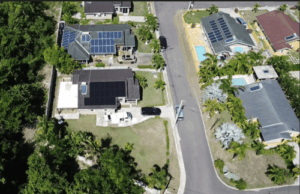
In recent storms, a quiet yet consequential shift has been unfolding across the island. Properly designed solar energy systems have emerged as a cornerstone of resilience, supporting not only individual households but entire communities. Installed solar capacity has expanded from less than 1.4 megawatts in 2015 to nearly 65 megawatts by 2024, now accounting for approximately ten percent of Jamaica’s electricity mix.
Beyond capacity figures, solar has revealed a deeper dimension of resilience. When engineered correctly and installed to rigorous standards, these systems become anchors of care and solidarity.
Homes that retain power after a storm often evolve into community lifelines and spaces where neighbours gather to charge devices, preserve food, access information, and reconnect with loved ones. In these moments, resilience transcends technology; it becomes collective.
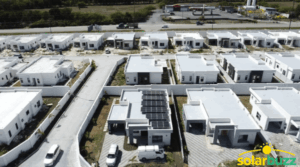
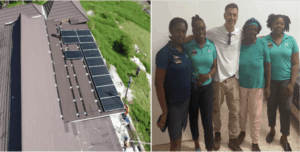
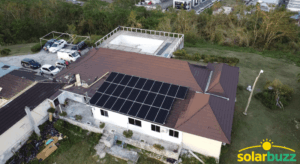
Post-Melissa reporting in a recent New York Times article underscored this reality. Properly mounted solar panels largely withstood hurricane-force winds, maintained uninterrupted power supply throughout the storm, and enabled households to remain operational while serving as points of support for their communities. The article, After Jamaica’s Disastrous Storm, Solar Power Is a Bright Spot, featuring SolarBuzz clients in Treasure Beach and Kingston, highlights how rooftop solar systems, when done right, deliver continuity of power and meaningful community benefit.
One featured client, Jennifer Hue of Treasure Beach, experienced flooding and property damage during the hurricane, yet her rooftop solar system remained fully operational. While the grid failed, her home stayed powered, allowing neighbours to charge phones, preserve food, and maintain vital communication.
Similarly, Twila-Mae Logan of Kingston was able to use her solar-equipped home as a hub for food storage and family support during the outage.
At SolarBuzz, we view solar not as a lifestyle enhancement, but as essential infrastructure that is central to household safety, economic stability, and energy independence.
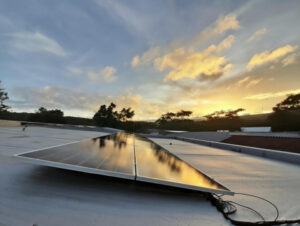
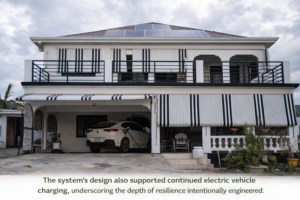
These featured systems did not endure by chance. They performed as designed because they were engineered for Jamaica’s environmental realities and installed to standards capable of withstanding hurricane-force winds and extreme conditions.
Breaking the Cycle of Darkness
Despite this progress, access to resilient solar and storage systems remains uneven. While declining global equipment costs, government incentives such as the solar tax credit, financing mechanisms, and net billing policies should, in theory, make solar more attainable, local bureaucratic barriers continue to impede adoption.
Lengthy approval timelines, complex banking and net billing requirements, and lingering policy ambiguity place resilient energy solutions beyond the reach of many Jamaicans. However, climate realities demand the opposite approach.
Reducing dependence on long, vulnerable transmission lines and decentralising power generation directly at the point of use is no longer optional; it is imperative.
Incentive frameworks must therefore be clear, accessible, and free from protracted delays or cost-intensive administrative requirements.
Competitive financing from major banks, including the ability to integrate solar systems into new mortgages, is essential to broadening access to properly designed solar and battery solutions.
As Caribbean leaders continue to call for greater international support to address climate impacts the region played little role in creating, local action must demonstrate clarity, urgency, and execution.
Jamaicans deserve a straightforward, efficient, and affordable pathway to resilient solar adoption, alongside continued investment in strengthening the national grid.
For Jamaica, resilience now means empowering homeowners to invest confidently in high-quality solar and storage systems designed to withstand hurricane-force winds and deliver long-term energy security.
Deidre Wedderburn is the Client Relations Manager at SolarBuzz, dedicated to building long-term partnerships and delivering top-tier client experience (deidre@solarbuzzjamaica.com).
On the edge of the sleepy town of Figueruelas, a single, vast wind turbine spins around, casting its shadow over the buildings nearby.
It’s a reminder of the importance of renewable electricity in this windswept area of Aragón, in north-eastern Spain, whose plains are host to many of the country’s wind and solar energy farms.
Figueruela’s status as a symbol of Spain’s green transition has been further boosted recently, as work starts nearby on the construction of a vast factory that will produce batteries for electric vehicles.
Chinese firm CATL and the Netherlands-based Stellantis are investing a combined €4bn ($4.7bn; £3.5bn) in the facility. Yao Jing, China’s ambassador in Spain, described it as “one of the biggest Chinese investments Europe has ever seen”.
Luis Bertol Moreno, mayor of the town, says the area was a logical choice for the project.
“We’re in Aragón, where there’s wind all year round, there are lots of hours of sunshine, and we are surrounded by wind turbines and solar panels,” he says.
“Those [energy sources] will be crucial in generating electricity for the new factory, and I understand that was the key reason for building it here in Figueruelas.”
The factory can be seen as vindication of Spain’s energy model, which prioritises renewable sources. In 2017, renewables contributed just a third of Spain’s electricity production, but last year they represented 57%.
By 2030, the government wants them to contribute 81% of electricity output.
Earlier this year, Prime Minister Pedro Sánchez summarised his government’s approach as he delivered a riposte to US President Donald Trump’s pro-fossil fuel “Dig, baby, dig” slogan. “Green, baby, green,” said the Socialist, as he pointed to the benefits of renewable energy.
However, in recent months, Spain’s all-in commitment to renewables has come under scrutiny. This was in great part due to an 28 April blackout that left homes, businesses, government buildings, public transport, schools and universities in the dark across Spain and neighbouring Portugal for several hours.
With the government unable to offer a full explanation for the outage, the country’s energy mix became a fiercely-debated political issue. Alberto Núñez Feijóo, leader of the conservative opposition, accused the government of “fanaticism” in pursuing its green agenda, suggesting that an over-reliance on renewables might have caused the incident.
Feijóo and others on the right advocated a rethink of the national energy model.
The fact that, a week before the blackout, solar generation in mainland Spain registered a record 61.5% of the electricity mix has fuelled such claims.
Yet the government and national grid operator Red Eléctrica have both denied that the outage was linked to the preponderance of renewable energy sources in Spain.
“We have operated the system with higher renewable rates [previously] with no effect on the security of the system,” says Concha Sánchez, head of operations for Red Eléctrica. “Definitely it’s not a question of the rate of renewables at that moment.”
Ms Sánchez said the blackout was caused by a combination of issues, including an “unknown event” in the system moments before, which saw anomalous voltage oscillations.
However, Red Eléctrica and the government are still awaiting reports on the incident that they hope will determine the exact cause. A cyber-attack has repeatedly been ruled out.
Meanwhile, since April, Spain’s electricity mix has been modified somewhat, with greater reliance on natural gas, reinforcing the notion that the country is at an energy crossroads.
Spain’s nuclear industry, which currently contributes around 20% of national electricity, has been particularly vocal since the blackout, pushing back against government plans to close the country’s five nuclear plants between 2027 and 2035.
With many European countries undergoing a nuclear renaissance, the planned closures make Spain something of an outlier. The companies that own the Almaraz plant in south-western Spain, due to be the first to shut down, have requested a three-year extension to its life until 2030. That request is currently under consideration.
Ignacio Araluce, president of Foro Nuclear, an association that represents the industry, says Spain is the only country in the world that is scheduling the closure of nuclear plants that are in operation. He believes nuclear energy provides stability while being compatible with the green energy transition.
“It’s prudent to have a mix of renewables and nuclear energy,” he says.
Mr Araluce praises renewable sources because they only require natural elements to generate electricity, but points out that they are not able to operate around the clock or when weather is unfavourable.
“How can you produce energy in those hours when the renewables are not producing?” he asks. The answer, he added, is “with a source like nuclear, that is not producing CO2, that is producing all hours of the year”.
The political opposition is staunchly opposed to the nuclear shut-down. The far-right Vox, criticising what it saw as a lack of explanation by the government for the April blackout, recently described nuclear power as “a crucial source of stability”.
Ms Sánchez acknowledges that there is room for improvement for Spain’s electricity model, pointing to the Iberian peninsula’s relative isolation from the European grid compared to most of its EU neighbours. She also sees storage as an issue.
“While we have taken a good path when it comes to renewable installation, we cannot say the same regarding storage,” she says. “We need to foster storage installation.”
Spain’s political panorama adds an element of uncertainty to its energy future. The Socialist-led coalition has been mired in corruption scandals and its parliamentary majority appears to have collapsed in recent weeks, raising the possibility of a snap election in the coming months.
A right-wing government, which polls suggest would be the likely outcome, would almost certainly place less emphasis on renewables and advocate a partial return to more traditional energy sources.
But in the meantime, Spain’s renewable transition continues.
And for Figueruelas, in Aragón, that means not just cheap, clean energy, but investment. The town’s population, of just 1,000, is due to increase dramatically, with 2,000 Chinese workers scheduled to arrive to help build the new battery plant, which is expected to create up to 35,000 indirect jobs once it starts operating.
“These kinds of investments revitalise the area, they revitalise the construction sector, hostelry,” says local man Manuel Martín. “And the energy is free – it just depends on the sun and the wind.”
People with rooftop solar panels got their power back almost immediately. The ‘entire neighbourhood benefits’, one resident said.
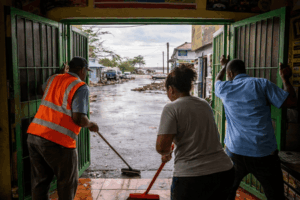
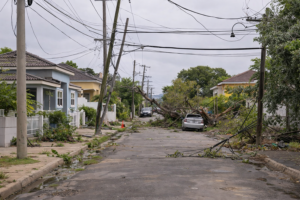
The morning after Hurricane Melissa tore through Jamaica, Jennifer Hue, a retired tax auditor living close to hard-hit Treasure Beach, woke up to devastation. Her mango, breadfruit and papaya trees were lost, their tops snapped off by 180-mile-per-hour winds. There was water everywhere.
But her roof was intact, and just as importantly, so were the solar panels she had installed two years ago. Most of her neighbors didn’t have electricity. But she did.
Neighbors began stopping by to charge their phones, to take a cool drink from the refrigerator, to message loved ones to let them know they were safe. Ms. Hue is still hosting a cousin and his mother, as well as two medical students from the local university, whose accommodations were damaged.
“The wind was like a tornado, and water came through every crevice,” Ms. Hue said. “But we didn’t lose any solar panels, and the next morning, the sun was shining bright and early,” she said. “We had our power back.”
A small but vibrant market for rooftop solar panels in Jamaica has long been seen as a promising way to wean the nation off imported fossil fuels. The country is reliant on oil and gas from abroad for its power plants, which not only is polluting but also makes Jamaica’s electricity some of the priciest in the world per kilowatt-hour.
But now, solar power is also seen as a way for Jamaica and other nations in one of the world’s most hurricane-prone regions to become more resilient to ever-intensifying storms.
Rooftop solar has grown significantly in Jamaica over the past decade, from less than 1.4 megawatts in 2015 to nearly 65 megawatts in 2023, a significant amount for a small island, experts say. Overall, solar and other forms of renewable energy made up about 10 percent of Jamaica’s power generation in 2023.
The hope is that growth will start to cut down on Jamaica’s dependence on imported oil and liquefied natural gas, which is shipped in tankers to the island nation, at a time when ports, refineries, power plants and transmission lines are becoming vulnerable to extreme weather worsened by a warming planet.
Wide swaths of the country remain without electricity after Hurricane Melissa hit Jamaica as a Category 5 storm last week, killing at least 32 people and destroying an untold number of buildings and homes. “You’re talking about restoring a very lengthy, complex and expensive infrastructure,” said David Gumbs, an expert on energy in the Caribbean at the Rocky Mountain Institute and the former chief executive of the Anguilla Electricity Company.
“With solar, you maintain some ability to continue generating electricity” without relying on hundreds of miles of damaged power lines, he said. “And in the Caribbean context, when the hurricane passes, if I have rooftop solar and batteries and if I can keep my refrigerator running, my entire neighborhood benefits.”
The solar panels must survive the high winds, of course. Jason Robinson, who runs Solar Buzz, an installer based in Kingston, Jamaica’s capital, has been surveying the damage this week, navigating roads on the west side of the island strewed with downed trees and power lines. “With nearly 200 mile-per-hour winds, you’re in the universe’s hands,” Mr. Robinson said.
But so far, none of his nearly 300 clients have reported extensive damage, he said. Panels installed flat against the roof, in particular, fared well. Some rooftop solar owners have taken to removing their panels ahead of strong winds. Many were already back online.
“As long as you install to code, and your roof stays on, you have a chance of surviving extremely long power outages,” Mr. Robinson said. “Resiliency is becoming even more important than lowering your bill.”
Solar panels remain beyond the reach of many Jamaicans, but prices are falling rapidly as Chinese gear floods into the market. In recent years the Jamaican government has also started providing a solar income-tax credit, and banks have begun to offer more financing. Jamaica’s electric utility also now compensates solar households for excess electricity they put back into the grid.
That’s helping Jamaica make progress toward its goal of generating 50 percent of its electricity from renewable sources by 2030.
Annabelle Todd manages an oceanfront guest villa on Treasure Beach, where two dozen panels and battery storage were installed two-and-a-half years ago. The panels survived, apart from one that was punctured by flying debris. She had electricity and air-conditioning the morning after the storm, much to the envy of her neighbors.
The systemwasn’t cheap, costing about $30,000. But it has virtually eliminated electricity bills that used to top $1,000 a month, because her guests “would run that A.C. morning and noon and night,” she said. “Honestly, we could pay it off in two, three years,” she said.
More than that, not losing power has been a relief, she said. It’s the second year in a row that the seaside community, known for its black sand beaches, has been ravaged by a hurricane.
“Now everyone who runs villas here wants solar. I already see solar suppliers driving up and down Treasure Beach,” Ms. Todd said. “They got hit two years in a row, and they’re not going to fool around anymore.”
Twila-Mae Logan, deputy executive director of the University of the West Indies’ business school, spent about $20,000 to install panels at her Kingston home two years ago. The capital was spared the worst of Hurricane Melissa, but even then, her neighborhood lost power, making her home one of the few with electricity. Ahead of the storm, her brother and her niece rushed to her home to store food in her freezer so it wouldn’t spoil.
“We’re a third-world country and our government is significantly under-resourced, but I really do think our government has put some fair degree of priority behind solar,” she said. “Most people would go solar, save for the expense.”
Leaders across the Caribbean have demanded more financial assistance from the world’s rich countries to help Jamaica contend with the consequences of climate change. Caribbean island nations will suffer the most from climate change, despite being least responsible for the greenhouse gas emissions that are warming the world, they say. The International Monetary Fund says the region requires about $100 billion in economic investment to build resilience to climate-fueled disasters.
Ms. Hue, the retired tax auditor, doesn’t expect to quickly make back the tens of thousands of dollars she paid for her solar panels in 2023. But “it was never about that,” she said. “It was about having very reliable power, and having peace of mind.”
“We were just fortunate to have the sun out the next morning,” she said.
Investment in big batteries hit $2.4bn in the first three months of 2025, making it the second strongest quarter for energy storage on record in Australia.
The latest data from the Clean Energy Council found six new storage projects – totalling 1.5 gigawatts capacity – reached financial close (the financial commitment that means the project is likely to be built) and a level of investment last seen in the final quarter of 2023 with a record $2.8bn.
The largest was the four-hour Wooreen battery system in Victoria, at 350MW, which was supported by the federal government’s capacity investment scheme.
Three large-scale battery systems in South Australia, one in Queensland and one in New South Wales also reached financial close.
Renewable energy had a slower start to the year, with two solar farms – totalling 386MW and $410m investment – reaching financial close. A quieter first quarter was typical, the CEC said, with investment ramping up throughout the year.
“Over the past five years, new investment commitments in the first quarter of the year have averaged 427MW, compared to a Q4 average of 1,153MW over the same period,” it said.
By the end of March, 82 renewable energy projects had either reached financial commitment or were under construction, representing 12GW of capacity.
Investment in large-scale renewable energy hit $9bn, a 500% increase on 2023. This combined with investment in energy storage to deliver the nation’s highest clean energy investment on record at $12.7bn.
The CEC’s chief policy and impact officer, Arron Wood, said political certainty would continue to help drive the “eye-watering” levels of private sector investment needed for the government to meet its target of 82% renewable energy by 2030.
“The target is ambitious, but it’s achievable,” Wood said. “With the election behind us, inflation easing and strong industry participation in the Capacity Investment Scheme, the early signs suggest we can expect to see private sector investment in both renewable power generation and battery storage projects continue to increase as the year progresses.”
Renewable energy provided 40% of Australia’s total electricity generation in 2024, up from 39.4% in 2023. The CEC report said an additional 6GW from wind and solar farms would be needed annually by 2030 to replace retiring coal generation.
“The Clean Energy Australia report has a lot of really good news in it,” Wood said, adding that it showed investment flowed with the right policy settings and continuity.
“The willingness to build Australia’s energy transition is there. But that’s not something where you can just set and forget.”
New transmission lines were critical to maintaining the pace, along with connecting projects to the grid as quickly and efficiently as possible, Wood said. Working with communities to build support for the transition and maximise local benefits was also important.
The director of Clean Energy Finance, Tim Buckley, said there was cause for optimism but maintaining the pace of investment and development required much quicker approvals, construction and commissioning.
“We need to get speed and scale way beyond current rates, particularly with extended delays to grid connection,” he said.
“There is great momentum, and more to do,” said Anna Skarbek, the chief executive of Climateworks Centre.
She said the electricity transition was tracking well in terms of replacing fossil fuels with renewable power.
“We know that to achieve a prosperous economy, in a fully decarbonised global economy, when all sectors are net zero – that actually will use a lot more electricity than what we use today,” she said.
Reaching the government’s legislated target of net zero by 2050 would mean at least a doubling in electricity demand as other sectors including transport, mining and industry sought to cut their emissions.
“We know that Australia has the capacity to do that,” Skarbek said. “Australia does have very large-scale potential to use renewable energy in its heavy industry sectors, and that’s a really important contribution to global trade. And also we have world-class solar penetration at what’s considered small scale or distributed energy in households.”
Kevin Wen is one of a growing number of Australians with rooftop solar who have decided the economics of installing a battery storage system finally stack up.
In 2022, Mr Wen was getting about 15 cents per kilowatt-hour for exporting his excess energy back into the grid.
“Then they lowered the buyback price to 8 cents, and then 5 cents, and then 3 cents now,” Mr Wen tells ABC News.
“I just think it’s a scam, so now I would like to use my energy for myself.”
Kevin Wen has installed a battery at his Sydney home after falling solar feed-in tariffs. (ABC News: John Gunn)
He’s far from alone. About 75,000 battery storage systems were installed across Australia last year — up 47 per cent from 2023.
That brings the total of home battery storage systems across the country to more than 320,000, according to solar energy consultancy SunWiz.
Chris Williams, CEO of Natural Solar, a company that now installs about 100 batteries a week, says the reduction in solar feed-in tariffs has been a tipping point for many of his customers.
“Solar feed-in tariffs, effectively, are a rate that the household will receive when power is sent back to the grid during the day from your solar panels,” Mr Williams says.
“Now, that rate, historically, may have been 15 cents or 20 cents per kilowatt-hour fed back to the grid.
“What we’re seeing today, that might be as low as, you know, 2 or 3 cents in New South Wales, in Victoria, it might be as low as, you know, less than 1 cent.”
Solar tariffs have also been as high as 60 cents per kilowatt-hour in Victoria, while New South Wales also offered generous incentives for the solar power people used themselves.
In certain circumstances, Mr Williams says, nowadays households will actually be charged for sending power back to the grid.
“Instead of making money, they’ll actually have to pay a fee to send that power back.”
Mr Williams’s business has received 250 per cent more battery enquiries since the regulated price increases were announced just last week.
“Consumers and households are very sensitive at this point in time, particularly on the back of the cost-of-living crisis we’re in, when they see that their power price is going to go up.”
Solar installs dwarf battery take-up
Households can save about $1,500 a year on power bills with rooftop solar, and another $1,000 with battery storage, according to the Smart Energy Council.
More than 4 million Australian households and businesses have rooftop solar but, despite the additional savings, only about one in 12 have battery storage.
The high purchase price of batteries has been a barrier for many.
“Batteries are, on average, around about $10,000 per system.
“We have seen prices come down year-on-year by between 5 and 10 per cent and we do expect that trend to continue,” Mr Williams says.
“The average battery should have a return on investment between six to eight years before subsidies — including subsidies, that may be as little as five to seven years for the average household.”
Solar energy consultancy SunWiz has crunched the numbers on how long it takes to make your money back on a combined solar and battery system.
The “payback time” now sits at about 8.3 years, which includes a mix of subsidised and non-subsidised systems.
Battery subsidies are currently only available through the New South Wales and the Northern Territory governments.
Other jurisdictions — like Victoria, Tasmania and the ACT — offer interest-free loans for batteries.
As the federal budget and election loom, there are calls for a national government subsidy, similar to the existing scheme for rooftop solar, to further reduce the cost of batteries.
“Solar energy, of course, doesn’t work at night-time, so what we want is a battery booster scheme that helps people take the energy from the middle of the day and use it in the evening when they’re home from work and school,” Smart Energy Council CEO John Grimes tells ABC News.
The Smart Energy Council, a peak body for the renewable energy industry, is calling for a national subsidy of $350 per kilowatt-hour (kWh).
In layman’s terms, that would reduce the cost of a small 5kWh battery to about $3,000, or $7,000 for a larger 10kWh battery.
Mr Grimes says battery storage systems would allow households to avoid higher prices when cheaper solar energy is unavailable.
“What solar batteries do is, they time-shift energy from the middle of the day, when it’s super-cheap, to make that super-cheap energy available at night-time, when prices spike,” Mr Grimes says.
Modelling by the Smart Energy Council shows that if Australia reaches 1 million solar batteries by 2030, households will save more than $19 billion.
“There’s a saving not just for the householder, but for the whole community. That’s because we’re taking pressure off when electricity prices are high.
“The more solar batteries we can install, the more money we save, the more we save individuals and the more we help the environment.”
Other renewable energy industry groups, including the Clean Energy Council, are calling for a national rebate for batteries of up to $6,500.
Former RBA deputy backs battery subsidy calls
Last year, the centrepiece of the federal budget was the $3.5 billion in energy bill relief for households, which amounted to a $300 rebate for households and $325 for small businesses.
Those rebates not only reduced household power bills but worked to bring down inflation.
Former RBA deputy governor Guy Debelle argues there is a better way to shield households from energy price inflation, which is subject to global shocks such as Russia’s invasion of Ukraine.
The former central banker, who also spent a period at Fortescue Future Industries, says instead of bill rebates, money should be spent on subsidies for batteries and increased incentives for bringing down the cost of solar.
“The relief to household budgets is only temporary, while they’re receiving those cash payments.
“You could repurpose that money to provide them with the opportunity to get rooftop solar and batteries to provide much more long-lasting insulation from energy prices.”
Mr Debelle says those incentives should also target low-income households, strata buildings and landlords.
“Sun isn’t subject to geopolitics, so it’s not going to be affected by Russia invading Ukraine,” he says.
Kevin Wen is glad he’ll be less reliant on the grid and therefore less exposed to price spikes.
Mr Wen was able to get $2,000 off the cost of his home battery storage system under the NSW government scheme, but says higher subsidies would encourage more people to take up solar and batteries.
“If they want to promote green energy, it is really good to increase the subsidies right now … If they can increase it, that will be great for everyone.”
Energy experts spoken to for this story say increased subsidies, not loans, will be the best way to increase the uptake of solar batteries.
A spokesperson for the federal minister for climate change and energy Chris Bowen said in a statement:
“The government is always looking for ways to ease household budget pressure.
“Through our Household Energy Upgrades Fund, we’re providing $1 billion to help Australian home owners lower their energy bills through discounted green loans for energy upgrades, such as solar panels and batteries.”