French Ambassador Olivier Guyonvarch (left) chats with Senator Matthew Samuda, minister without portfolio in the Ministry of Economic Growth and Job Creation, while Tourism Minister Edmund Bartlett (second right) has a word with Professor Andrew Spencer, p
French Ambassador Olivier Guyonvarch (left) chats with Senator Matthew Samuda, minister without portfolio in the Ministry of Economic Growth and Job Creation, while Tourism Minister Edmund Bartlett (second right) has a word with Professor Andrew Spencer, president of Caribbean Maritime University, at the university’s Port Royal Lecture Series event on Tuesday.

Matthew Samuda, minister without portfolio in the Ministry of Economic Growth and Job Creation, said the Government’s upcoming waste-to-energy programme will generate some 60 megawatts of energy.

Waste-to-energy plants burn municipal solid waste to produce steam in a boiler that is used to generate electricity.

Currently, Jamaica generates an estimated 1.4 million tonnes of garbage annually, the vast majority of which is dumped or buried at one of the eight landfills across the country.

The waste-to-energy programme was previously announced by Prime Minister Andrew Holness, who said that it would revolutionise how Jamaicans dispose of refuse.

In November 2022, Holness announced that two sites had been identified to construct the plants, but did not divulge the locations.

While speaking at the Caribbean Maritime University’s Port Royal Lecture Series on The Blue Economy: Regeneration and Resilience on Tuesday, Samuda said a deposit refund scheme will force people to return bottles, noting that the Government is also looking at regulations around particular toxic chemicals.

“There is no silver bullet to problems developed over longer than we’ve been independent. Reality is, some of our infrastructure doesn’t lend itself to good waste collection. It’s why we have redevelop many of our degraded areas. It’s why we have to ensure our roadways are wide enough for trucks to be able to collect the waste where it is collected,” the minister said.

Samuda emphasised another problem that Jamaicans are seeing, which is a loss of habitats because of the construction activities.

“We’re also seeing the rate of nutrient flow, which is sewage and agricultural run-off going into near-shore environments. [This is] damaging our near-shore environment, so our own actions on land, in many ways, are damaging our blue economic prospects,” Samuda said.

“So environmental protection cannot be separated from the discussion of economic growth. It cannot be separated from economic development and that, if nothing else, is what I hope will be taken away from the discussion,” he said.

The minister noted that Jamaica continues to struggle with addressing plastic pollution despite bans implemented in 2019.

Additionally, he said that the country will see some $7 billion in infrastructure investments this year, up from last year’s $4 billion, with non-revenue water, increased storage and greater resilience in the water sector being targeted.

“The reality is, we have a lot of work to do in a very short period of time if we are to leverage the value of our assets on land and leverage the value of our assets at sea, and, we are on the front lines of climate change, which exacerbate the problem and means we have to work that much faster if we’re to take advantage of the systems that we have,” he said.

Gleaner

Native Food Packers Limited, trading under the ‘Chippies’ brand, has been in operation for more than half a century and is well known for its various snacks including banana, plantain and breadfruit chips.

Over the years, the company adjusted its business model to suit the environment and is again making a move in another direction which will see it contribute to the environment by going solar.

Adrian Grant Jr, managing director of Native Food Packers Ltd, advised that the initiative to go “solar” was geared towards cutting costs, gaining a more competitive edge in the local global market and promoting an eco-friendly environment.

SOLAR PANEL INSTALLATION HAS DECREASED ENERGY COSTS

Grant further advised that CIBC FirstCaribbean has been their bank of choice, starting with his father.

Over the years, CIBC FirstCaribbean has supported the company, providing financial support including the recent solar project with panels installed by Solar Buzz Jamaica (SBJ).

He said that since the installation of the solar panels, energy cost has been decreased by more than 50 per cent and is expected to be reduced even more, which undoubtedly will improve the financial performance of the company and position it for further growth in the future.

CIBC FirstCaribbean is known for its financial strength, prudent management and the structuring and execution of various deals regionally including clean energy across the Caribbean and Latin America.

Annique Dawkins, head of corporate banking, Jamaica, said the bank is focused on supporting lending in diverse segments to facilitate savings and business transformation and was happy to support Native Food Packers Limited with this initiative.

“The Bank will continue to support its customers who are keen on responding to climate change by adopting green energy sources such as solar and wind-generated power, which do not emit greenhouse gases that contribute to global warming,” she said.

Celebrating the achievements of ‘Chippies’, Jason Robinson, CEO of Solar Buzz, said: “We are a renewable energy company with a focus on educating our clients on how to maximise their overall savings through solar energy and energy efficiency measures. We create detailed commercial proposals for renewable energy projects for presentation to financial institutions who are willing to lend for the purpose of Going Green. CIBC FirstCaribbean has plans to be a leader in financing renewables in Jamaica and Solar Buzz is excited to work with them to achieve this goal.”

OUR Today

Left to right: Annique Dawkins, Head of Corporate Banking CIBC FirstCaribbean; Adrian Grant Jr., Managing Director of Native Food Packers Ltd and Jason Robinson, CEO of Solar Buzz during a tour of the solar facilities at Native Food Packers Limited which was financed by CIBC FirstCaribbean

Native Food Packers Limited, trading under the Chippies brand, has been in operation for more than half a century and is well known for its various snacks including banana, plantain and breadfruit chips.

Over the years, the company adjusted its business model to suit the environment and is again doing so. This time, to go solar.

Adrian Grant Jr., Managing Director of Native Food Packers Ltd advised that the initiative, to go solar, is geared towards cutting costs, gaining a more competitive edge in the local global market and promoting an eco-friendly environment.

He further advised that CIBC FirstCaribbean has been their bank of choice which started with his father.

Over the years CIBC FirstCaribbean has supported the company, providing financial support including the recent solar project with panels installed by Solar Buzz Jamaica (SBJ).

He said that since the installation of the solar panels, the energy cost has been decreased by more than 50 per cent and is expected to be reduced even more which undoubtedly will improve the financial performance of the company and position it for further growth in the future.

CIBC FirstCaribbean is known for its financial strength, prudent management and the structuring and execution of various deals regionally including clean energy across the Caribbean and Latin America.

Annique Dawkins, Head of Corporate Banking, Jamaica said the bank is focused on supporting lending in diverse segments to facilitate savings and business transformation and was happy to support Native Food Packers Limited with this initiative.

“The bank will continue to support its customers who are keen on responding to climate change by adopting green energy sources such as solar and wind-generated power, which do not emit greenhouse gases that contribute to global warming”, she expanded.

Celebrating the achievements of “Chippies” Jason Robinson, CEO of Solar Buzz said, “we are a renewable energy company with a focus on educating our clients on how to maximise their overall savings through solar energy and energy efficiency measures.  We create detailed commercial proposals for renewable energy projects for presentation to financial institutions who are willing to lend for the purpose of Going Green.  CIBC FirstCaribbean has plans to be a leader in financing renewables in Jamaica and Solar Buzz is excited to work with them to achieve this goal.”

Loop

Investing in solar energy with battery storage for a home or business can be considered a safer investment than investing in the stock market for several reasons. Firstly, solar energy with battery storage is a tangible and physical asset that is directly connected to the property, unlike stocks which are intangible assets that are not directly related to the property. This means that the value of a solar energy with battery storage investment is based on the tangible assets of the solar panels, batteries, and equipment, whereas the value of a stock is based on the performance and perceived value of the underlying company.

Another factor to consider is that solar energy with battery storage can provide immediate savings on energy bills. As the property owner is producing their own energy, they won’t have to rely on the grid as much, which can help to lower their energy costs. The savings generated from the solar system can then be reinvested into a savings plan that includes stocks, mutual funds, etc. Additionally, the value of the property may increase as it becomes more energy-efficient, furthermore providing a potential return on investment. On the other hand, returns from stock investments can be volatile and uncertain and may take a long time to materialize.

Another important point is that solar energy with battery storage is a low-maintenance form of energy production. Once a solar system with battery storage is installed, there are very few ongoing costs or maintenance requirements. This makes it a relatively low-risk investment, as there are few unexpected expenses or surprises that can arise. This is different from the stock market, where the value of the stocks can be affected by many factors such as market conditions, political changes, and even global pandemics which can cause unexpected losses.

Additionally, solar energy with battery storage is a decentralized form of energy production. This means that it can be produced at the point of consumption, eliminating the need for transmission and distribution networks and reducing the risk of power outages. This makes it an especially appealing option as it can help to increase energy independence and reliability, as the stored energy can be used to power the property during power outages or grid disruptions, which can save money and prevent interruptions to daily operations.

Finally, solar energy with battery storage is a versatile and flexible form of energy production. It can be used to power homes, businesses, and even vehicles. This means that there are many different ways to invest in solar energy with battery storage, and many different types of returns on investment that are possible. This is different from the stock market, where the investment options are limited to stocks, bonds, and mutual funds.

Therefore, investing your money in solar energy with battery storage for your property can be considered a safer investment than investing in the stock market for several reasons. Solar energy with battery storage is a tangible and physical asset that is directly connected to the property, providing immediate savings on energy bills and increasing the value of the property. It also provides energy independence and reliability. Additionally, it is a low-maintenance, decentralised, and versatile form of energy production, making it a relatively low-risk investment with many different types of returns possible, unlike the stock market which can be highly volatile and subject to sudden changes in value.


Jason Robinson, CEO Solar Buzz Jamaica

It’s all over except the shouting

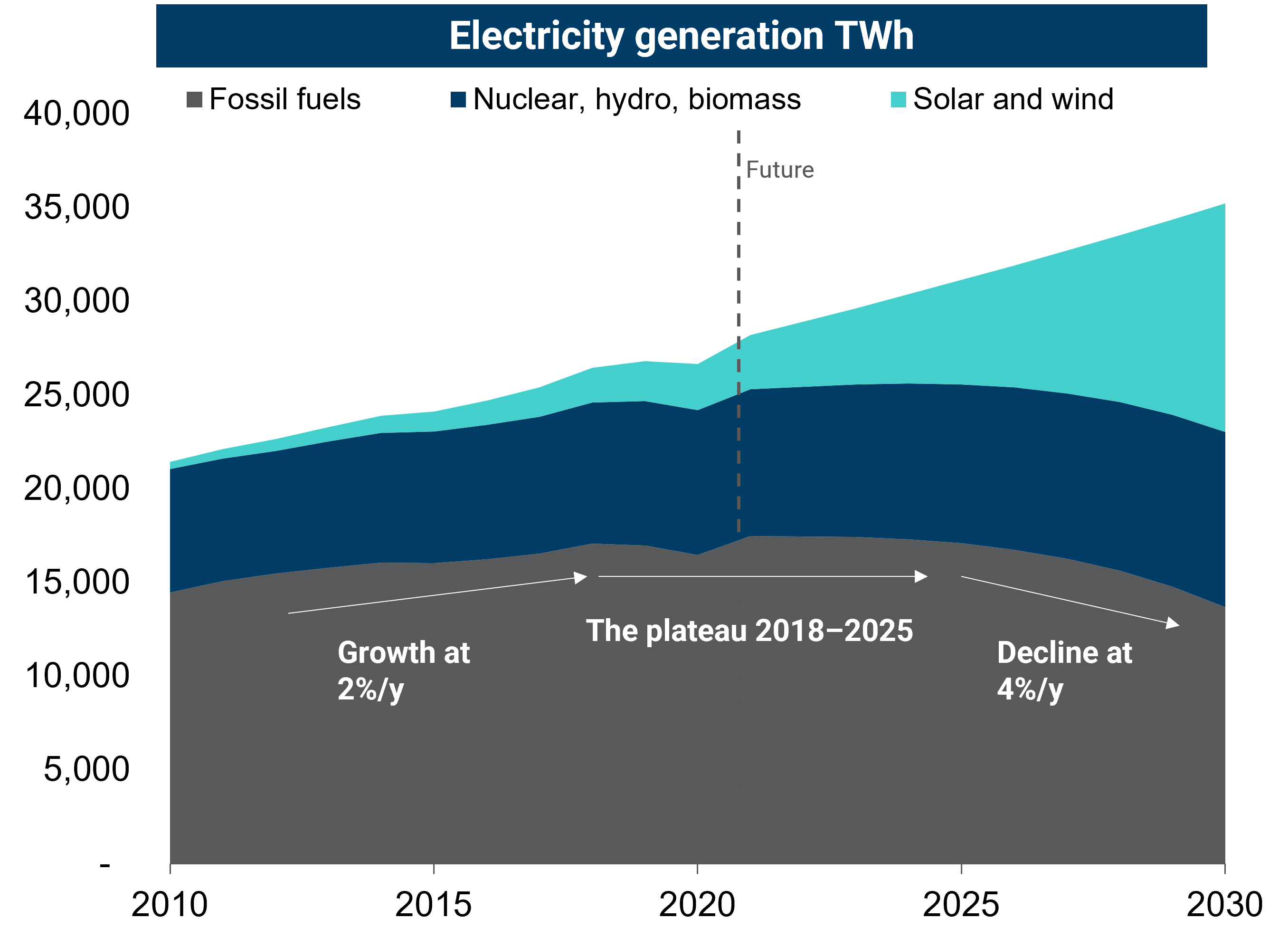
The latest installment of The Peaking Series shows demand for fossil fuels has peaked in the electricity sector. It will plateau for a few years and be in clear decline by the second half of the decade.

The key driver of change is the rapid growth of solar and wind electricity generation on typical S-curves, driven by low costs, a shift of global capital, and the rising ceiling of what is possible.

In 2022, solar and wind will produce 600–700 TWh of new electricity. Added to the 100–200 TWh from other clean sources makes it enough to meet projected global electricity demand growth of around 700 TWh.

The story just gets better and better as solar and wind advance further up the S-curve. Solar and wind generation will increase at least threefold by the end of the decade, pushing fossil fuel electricity into terminal decline.

Electricity generation in THw graph

This is a global phenomenon. Fossil fuel demand for electricity has peaked in 95 percent of the OECD countries and 31 percent of the non-OECD countries excluding China. Chinese demand is about to peak as the 2030 renewable deployment goals are hit before 2025. India is choosing its own path to development, based on growth from renewables. And renewables offer new solutions for Africa.

There are plenty of barriers to change, but none of them are insoluble, immediate, and universal so cannot maintain the status quo. The ceiling of change is far above our heads and disruption of the incumbent fossil fuel system is thus inevitable.

RMI

Outages during Christmas reflect poorly on utility forecasting and natural gas units. It’s past time for the states and their utilities to lead and not wait until the grid regulators Federal Energy Regulatory Commission and North American Electric Reliability Corporation conclude their joint investigation.

To ensure safety and reliability, utility leaders should pay consumers to reduce consumption, embrace distributed energy resources in their resource planning, and make interconnecting rooftop solar and residential storage easier.

The question is, however, will they?

Anticipating NERC’s response

FERC and NERC have announced a joint investigation into what happened in North Carolina during Winter Storm Elliot because of multiple outages during Christmas.

The economic and reliability regulators want to get in on regulation and standards after an event, but there is no focus or attention paid before. Maybe that’s just human tendency?

History has always told us, at least in the electric utility industry, that major regulations come after blackouts. The National Electric Reliability Council was formed after the 1965 blackout. Read about fascinating NERC history here (It’s only 177 pages!). NERC came out of regional councils such as Mid-Atlantic Area Coordination Group, which is now ReliabilityFirst.

The Council became a corporation —the North American Electric Reliability Corporation— after the Sep. 2003 blackout with the mandate to levy fines of up to $1 million per day if utilities violated reliability standards, including tree trimming regulations.

Incentivizing DERs before an event

Fast forward to Feb. 2021.

Did we learn anything from winter storm Uri in Texas? We have already forgotten that Texas went through a similar winter storm event a decade earlier, in 2011.

Yes, FERC and NERC jointly investigated and released a report back then. I am sure they will also release a report for Elliott, too. But the jury is still out on Uri’s lessons. A recent proposal in Texas to incentivize generators (not load) to ensure they show up during a grid emergency.

Look at what is happening right now in PJM

PJM just announced that it had more unit outages during the Christmas week than forecasted. If 23% of PJM’s total capacity was forced out, 87% was from natural gas and coal units. And we have executives from Duke Energy Carolinas apologizing for inconveniencing their customers during Christmas. These utilities and RTOs have not taken steps to incentivize demand response and distributed energy resources, yet they are the custodians of safety and reliability.

Why should they pay load to avoid blackouts? Because that’s how MISO avoided blackouts in Feb. 2021.

Utilities must speed up distributed resource interconnections via automation

Whenever the topic of distributed energy resources interconnection comes up, utilities always bring up the fact that they are responsible for the safety and reliability of the distribution grid. Never mind that those utilities have already studied these DER interconnections. They want to “screen” them again so that a solar project is not exporting more than it should when storage is added at the same site.

Solar interconnections can be severely limited on the distribution system due to capacity constraints that could be resolved without the cost and delay associated with major feeder upgrades. In some cases, voltage and current imbalance will limit the feeder capacity. This constraint exists even though capacity is available in other phases.

Companies like Switched Source offer a distribution automation solution, the Phase EQ, that will automatically balance the voltage and current to unlock the capacity of the feeder. In other cases, the ideal location to site a solar project may be served by a feeder at capacity; however, adjacent feeders have the capacity but are not tied together due to the risk of loop flows.

Switched Source also offers another distribution automation solution, the Tie Controller, that can enable adjacent feeders to be tied together and controls the power flow between them to balance the load on the feeders.

Utilities must embrace distribution automation solutions to identify feeders with phase imbalance issues or capacity constraints and deploy solutions to address the issues to enable more load and solar interconnections.

Utilities must reflect accurate modeling of distributed solar in resource plans

Whenever utilities have integrated resource plan (IRP) proceedings, renewable and environmental advocates must push the utilities to incorporate distributed solar in their future capacity expansion plans. It’s like pulling teeth.

The excuse utilities give for not including distributed solar in future resource plans is that they don’t have much capacity value compared to utility-scale solar or utility-scale natural gas plants.

But the recent Christmas event in PJM shows many more outages than forecasted on the system. Additionally, unanticipated outages led to capacity deficiencies in the New England region during Christmas. And the New England grid operator is levying non-performance penalties on non-performing units, but we won’t know who owns these units.

So why are the utilities and their regulators more focused on an antiquated integrated resource planning process that incentivizes more non-renewable generation and the transmission needed to interconnect, when we should be looking at more distributed options on the demand side?

To reduce the magnitude of a blackout or even the likelihood of entering into an emergency event, grid planners should be talking to policy professionals and educating them before it is too late. It is easy to think about policy during an emergency event. It is hard to think about the policy before an event.

It’s up to states to take action

Even after all these events in recent years and so many different slides and jazzy pictures from institutions like NOAA that show that multiple weather-related events are occurring more frequently, utilities are asking for rate recovery for generation and transmission but not interconnection of distributed resources and demand response compensation.

Policymakers and grid planners should gather once again in a workshop in each state and debate whether we are paying enough attention to demand and distributed resources and consumers generating their electricity.

Utilities should allow rooftop solar, residential batteries, and customer-sited storage solutions on the grid to avoid human loss during grid emergencies.

Renewable Energy World
KEY POINTS
  • Amazon, Facebook parent company Meta and Google, owned by parent company Alphabet, are the top three corporate purchasers of wind and solar energy, according to a report published Wednesday from the American Clean Power Association, an industry group.
  • In total, 326 companies contracted 77.4 gigawatts of wind and solar energy by the end of 2022, which is enough energy to power over a thousand data centers or 18 million American homes.
  • Texas is benefitting more than any other state. Companies have bought clean energy from 540 projects located in 49 states, Washington DC and Puerto Rico, but 35% of contracted capacity bought by companies is coming from Texas, the report finds.


Technology companies are leading the charge of companies buying wind and solar power.

Amazon, Facebook parent company Meta, and Google, owned by parent company Alphabet, are the top three corporate purchasers of wind and solar energy, according to a report published Wednesday from the American Clean Power Association, an industry group.

Amazon had contracted 12.4 gigawatts of clean wind and solar energy in the United States through September 2022, while Meta had contracted 8.7 gigawatts and Google had contracted 6.2 gigawatts, according to the report.

These procurement totals are since the first time these companies have announced they were buying wind and solar power last decade.

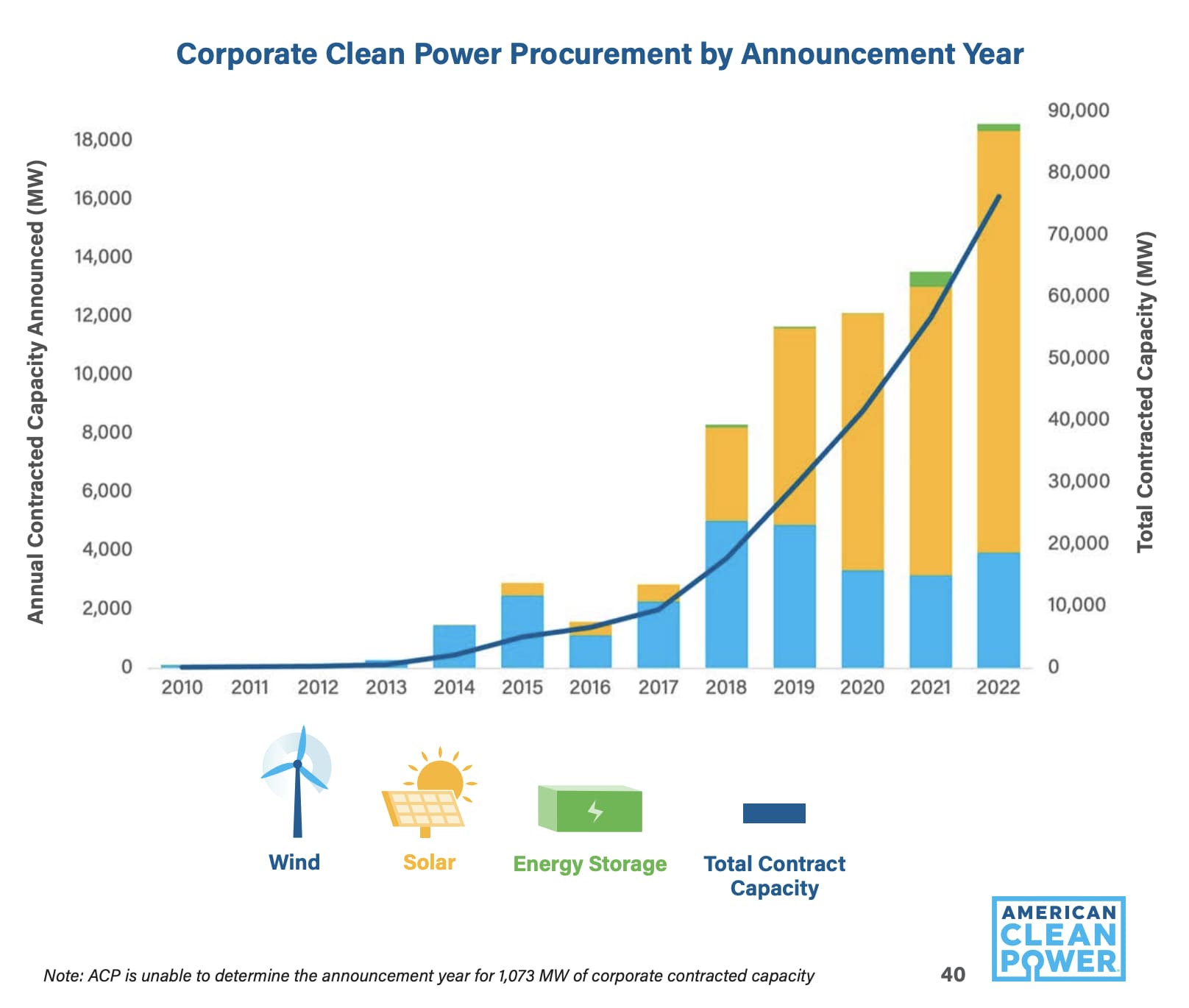
The technology sector is certainly outpacing other industries in buying clean power, but it’s been increasing across all industries. From 2012 to 2022, the amount of wind and solar energy bought by companies has increased by an average of 73 percent per year. It passed 1 gigawatt in 2015, 8 gigawatts in 2018, and nearly 20 gigawatts last year.

Wind and solar power procured by companies by year, according to the American Clean Power Association, an industry group.

The switch is not just driven by a desire to save the world from climate change. The price of clean power has been falling steadily. In the past decade, the cost has fallen 71 percent and 47 percent, respectively, according to the report.

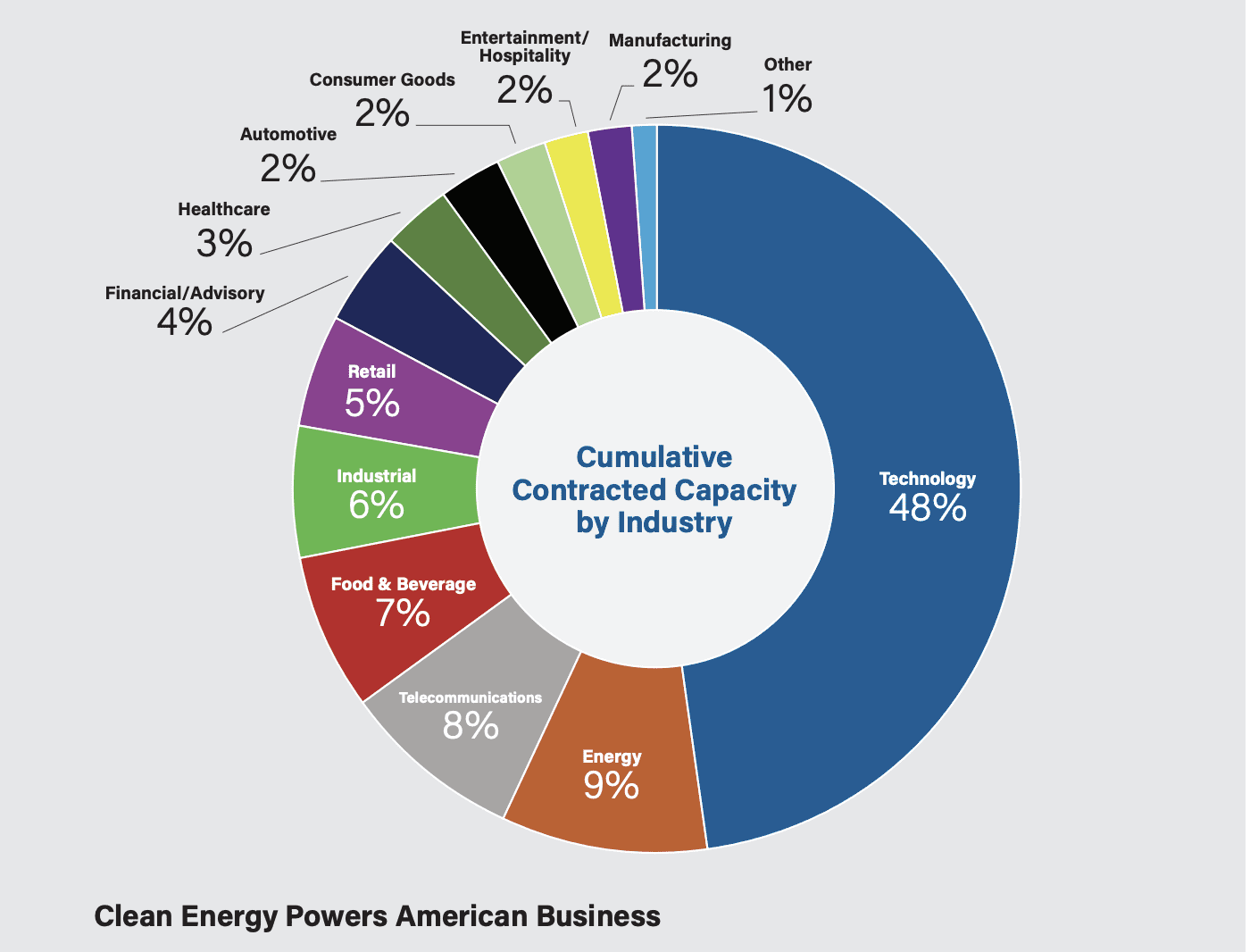
The technology sector is the clear leader when it comes to buying clean energy, and has contracted 48 percent of all wind and solar power. The energy, telecommunications and food and beverage sectors are the next largest corporate buyers and have contracted 9, 8 and 7 percent of total contracted wind and solar, respectively.

Total contracted wind and solar power by industry, according to the American Clean Power Association, an industry group.

In total, 326 companies contracted 77.4 gigawatts of wind and solar energy by the end of 2022, which is enough energy to power over a thousand data centers or 18 million American homes.

Of that 77 plus gigawatts of wind and solar power that has been contracted, 36 gigawatts or 47 percent is currently operating, meaning more than half still is still in development. The time it takes to go from a company buying wind or solar power and the project being online depends, but most of the procured projects are expected to come online in the next three years, a spokesperson for American Clean Power told CNBC.

Companies represent a significant piece of the total wind and solar landscape: 16 percent of wind and solar energy was headed towards corporations by the end of 2022. The remaining 84 percent goes to other energy purchasers, like utility companies.

As companies increase their purchasing of wind and solar power, Texas is benefitting more than any other state. Companies have bought clean energy from 540 projects located in 49 states, Washington DC and Puerto Rico, but 35% of contracted capacity bought by companies is coming from Texas, the report finds.

CNBC

Ricardo Case, director of engineering services at the Jamaica Public Service (JPS), is calling for the Government to act quicker as it relates to the implementation of policies and licensing for renewable energy.

Case noted that the Government has implemented some good policies that have been instrumental in the development of the sector, but a more aggressive approach is needed.

The JPS recently established 10 charging stations in Jamaica, with plans to double that amount by the end of 2023. However, a larger expansion of charging stations is pending government policy, said Case.

“We have to temper ourselves with where we see government policy going, so if there was a more aggressive government policy where the EV market was booming, we could act faster,” he told Our Today.

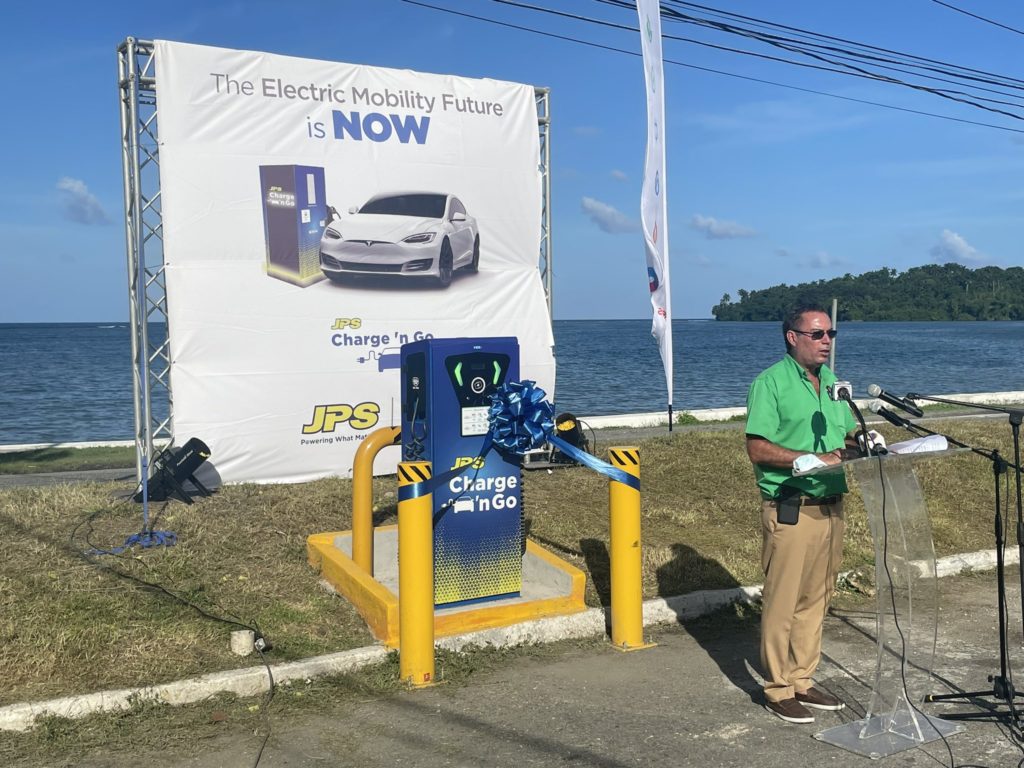
Energy Minister Daryl Vaz delivers his keynote address at the official commissioning ceremony for the Jamaica Public Service’s first electrical charging station in Port Antonio, Portland last November. (Photo: Twitter @myJPSOnline)

Case added that, though the Government has reduced taxes on electric vehicles, the age of the car that people can import is “practically new”, which means that they are expensive. In addition to this, most people charge their cars at home or at work. As such, he said the JPS is awaiting stronger signals from the Government before it invests in a larger scale of charging stations.

As it relates to the issue of licensing, he shared that it often takes up to six months or more for a licence to be approve and is recommending that the Government move faster in this regard.

He noted that “timing is everything in the industry”.

Case added: “So, if you’re gonna have something that is taking too long, it’s going to defeat the purpose for some people and it’s going to frustrate everybody else.”

Prime Minister Andrew Holness had stated that the Government plans to increase its target for use of renewable energy from 30 per cent to 50 per cent by 2030. But Case said proper planning in needed in relation to land space.

“To get 50 per cent of energy, it means that you have to have a whole lot more capacity on the grid to deliver that amount of energy because the nature of renewable energy facilities is not a 100 per cent relationship,” said Case.

He continued by sharing that the concern he has “is that, when you are looking at the expansion and the development of the system, it cannot be done in isolation of just JPS alone. When you are planning the whole energy eco system, everything comes into play”.

Case also pointed out that, often, the land on which solar parks are being developed is often not used for anything else and requires a large space.

“With the development of these solar parks, they are not using the land for anything else apart from the solar parks. So, we are going to get to a critical point where we are going to run out of land if we are not reusing the land for other purposes outside just generation because these solar facilities take up a lot of space.”

He then stated that, for engineers, this can cause an issue in the design process because, without the necessary information from the Government about future plans, they cannot create modular systems.

“We need to know the expansion plans that the Government has and where our new roads are going to be, because those are going to be your corridors and the right of way that you need to use to expand your system. It is a holistic partnership,” he stressed.

Our Today