
KEY POINTS
  • Amazon, Facebook parent company Meta and Google, owned by parent company Alphabet, are the top three corporate purchasers of wind and solar energy, according to a report published Wednesday from the American Clean Power Association, an industry group.
  • In total, 326 companies contracted 77.4 gigawatts of wind and solar energy by the end of 2022, which is enough energy to power over a thousand data centers or 18 million American homes.
  • Texas is benefitting more than any other state. Companies have bought clean energy from 540 projects located in 49 states, Washington DC and Puerto Rico, but 35% of contracted capacity bought by companies is coming from Texas, the report finds.


Technology companies are leading the charge of companies buying wind and solar power.

Amazon, Facebook parent company Meta, and Google, owned by parent company Alphabet, are the top three corporate purchasers of wind and solar energy, according to a report published Wednesday from the American Clean Power Association, an industry group.

Amazon had contracted 12.4 gigawatts of clean wind and solar energy in the United States through September 2022, while Meta had contracted 8.7 gigawatts and Google had contracted 6.2 gigawatts, according to the report.

These procurement totals are since the first time these companies have announced they were buying wind and solar power last decade.

The technology sector is certainly outpacing other industries in buying clean power, but it’s been increasing across all industries. From 2012 to 2022, the amount of wind and solar energy bought by companies has increased by an average of 73 percent per year. It passed 1 gigawatt in 2015, 8 gigawatts in 2018, and nearly 20 gigawatts last year.
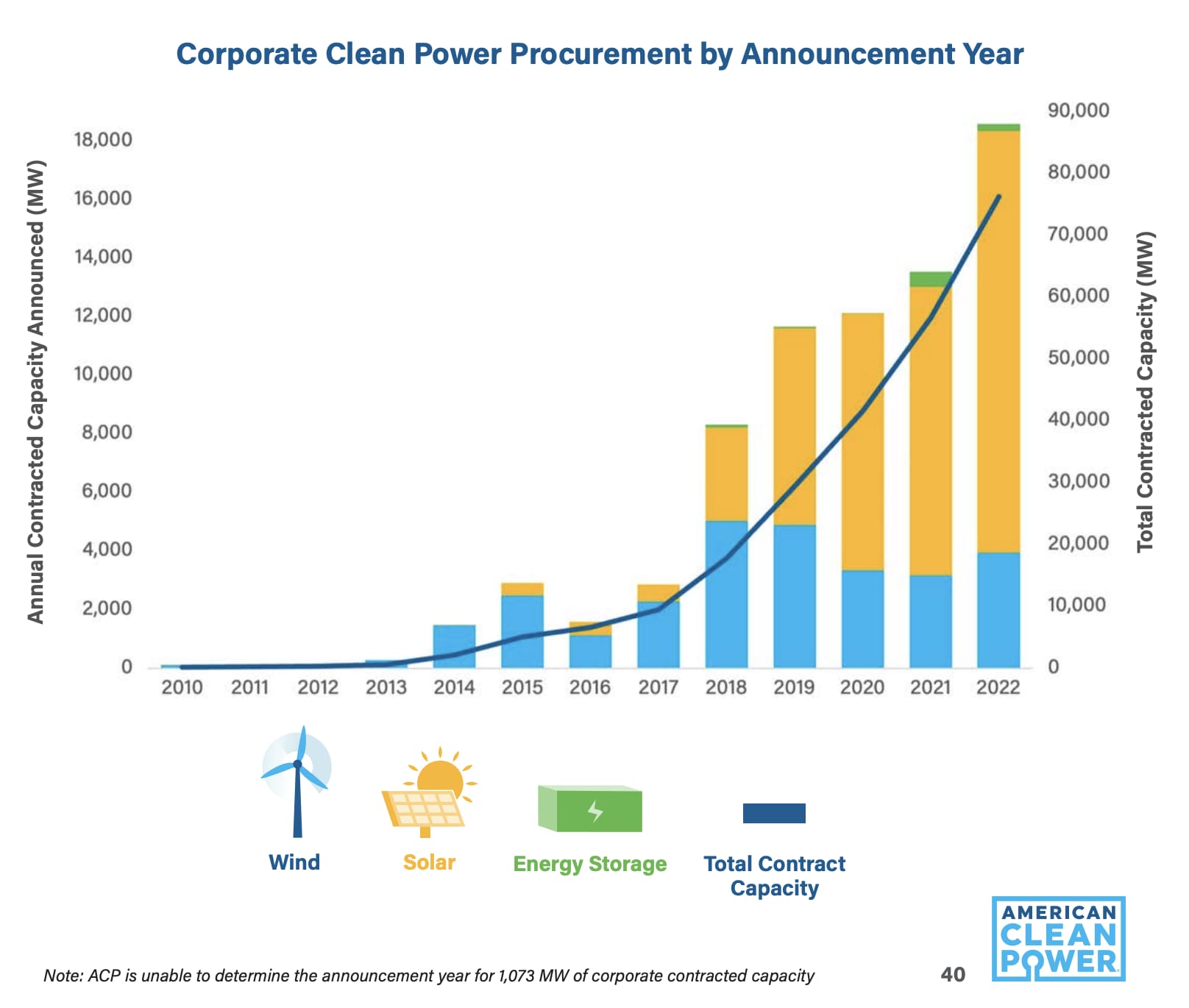
Wind and solar power procured by companies by year, according to the American Clean Power Association, an industry group.

The switch is not just driven by a desire to save the world from climate change. The price of clean power has been falling steadily. In the past decade, the cost has fallen 71 percent and 47 percent, respectively, according to the report.

The technology sector is the clear leader when it comes to buying clean energy, and has contracted 48 percent of all wind and solar power. The energy, telecommunications and food and beverage sectors are the next largest corporate buyers and have contracted 9, 8 and 7 percent of total contracted wind and solar, respectively.
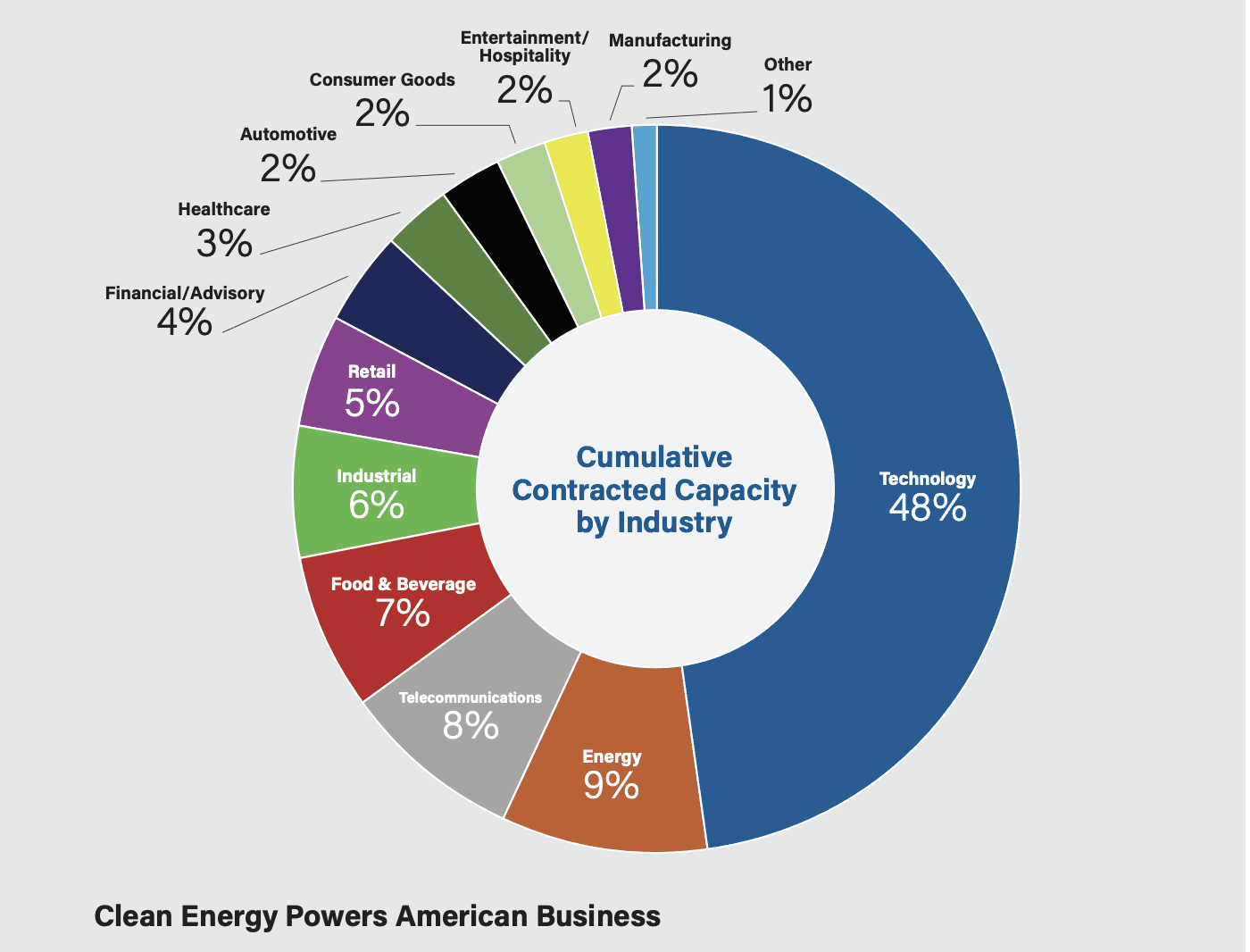
Total contracted wind and solar power by industry, according to the American Clean Power Association, an industry group.

In total, 326 companies contracted 77.4 gigawatts of wind and solar energy by the end of 2022, which is enough energy to power over a thousand data centers or 18 million American homes.

Of that 77 plus gigawatts of wind and solar power that has been contracted, 36 gigawatts or 47 percent is currently operating, meaning more than half still is still in development. The time it takes to go from a company buying wind or solar power and the project being online depends, but most of the procured projects are expected to come online in the next three years, a spokesperson for American Clean Power told CNBC.

Companies represent a significant piece of the total wind and solar landscape: 16 percent of wind and solar energy was headed towards corporations by the end of 2022. The remaining 84 percent goes to other energy purchasers, like utility companies.

As companies increase their purchasing of wind and solar power, Texas is benefitting more than any other state. Companies have bought clean energy from 540 projects located in 49 states, Washington DC and Puerto Rico, but 35% of contracted capacity bought by companies is coming from Texas, the report finds.
CNBC

Ricardo Case, director of engineering services at the Jamaica Public Service (JPS), is calling for the Government to act quicker as it relates to the implementation of policies and licensing for renewable energy.

Case noted that the Government has implemented some good policies that have been instrumental in the development of the sector, but a more aggressive approach is needed.

The JPS recently established 10 charging stations in Jamaica, with plans to double that amount by the end of 2023. However, a larger expansion of charging stations is pending government policy, said Case.

“We have to temper ourselves with where we see government policy going, so if there was a more aggressive government policy where the EV market was booming, we could act faster,” he told Our Today.

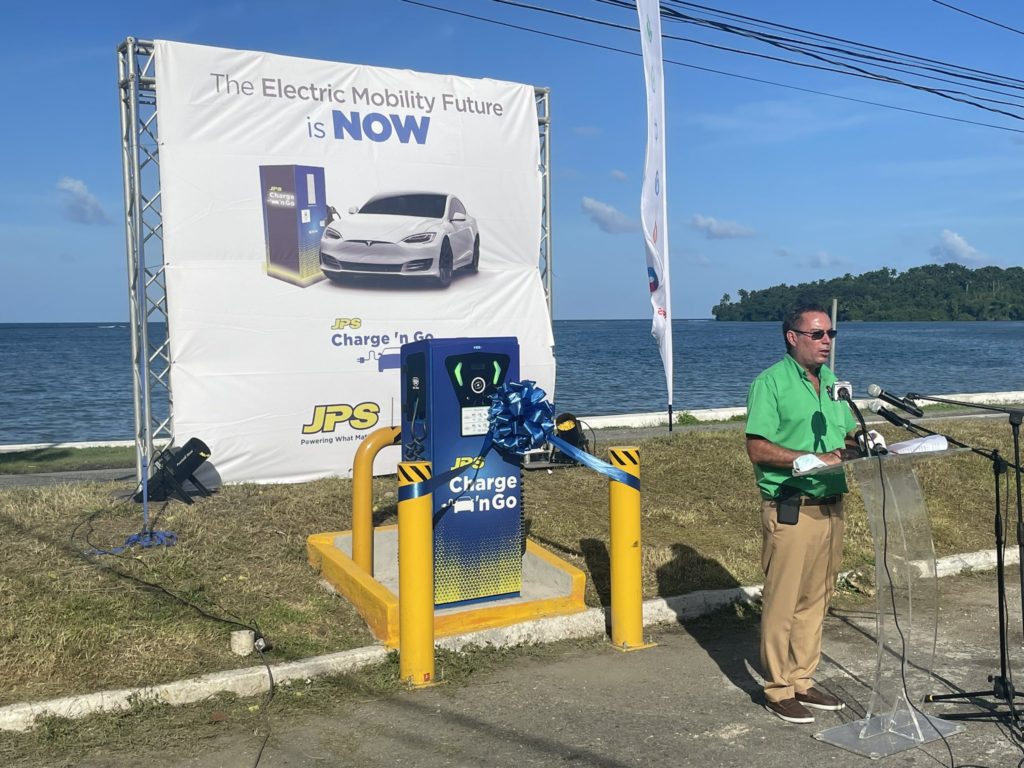
Energy Minister Daryl Vaz delivers his keynote address at the official commissioning ceremony for the Jamaica Public Service’s first electrical charging station in Port Antonio, Portland last November. (Photo: Twitter @myJPSOnline)

Case added that, though the Government has reduced taxes on electric vehicles, the age of the car that people can import is “practically new”, which means that they are expensive. In addition to this, most people charge their cars at home or at work. As such, he said the JPS is awaiting stronger signals from the Government before it invests in a larger scale of charging stations.

As it relates to the issue of licensing, he shared that it often takes up to six months or more for a licence to be approve and is recommending that the Government move faster in this regard.

He noted that “timing is everything in the industry”.

Case added: “So, if you’re gonna have something that is taking too long, it’s going to defeat the purpose for some people and it’s going to frustrate everybody else.”

Prime Minister Andrew Holness had stated that the Government plans to increase its target for use of renewable energy from 30 per cent to 50 per cent by 2030. But Case said proper planning in needed in relation to land space.

“To get 50 per cent of energy, it means that you have to have a whole lot more capacity on the grid to deliver that amount of energy because the nature of renewable energy facilities is not a 100 per cent relationship,” said Case.

He continued by sharing that the concern he has “is that, when you are looking at the expansion and the development of the system, it cannot be done in isolation of just JPS alone. When you are planning the whole energy eco system, everything comes into play”.

Case also pointed out that, often, the land on which solar parks are being developed is often not used for anything else and requires a large space.

“With the development of these solar parks, they are not using the land for anything else apart from the solar parks. So, we are going to get to a critical point where we are going to run out of land if we are not reusing the land for other purposes outside just generation because these solar facilities take up a lot of space.”

He then stated that, for engineers, this can cause an issue in the design process because, without the necessary information from the Government about future plans, they cannot create modular systems.

“We need to know the expansion plans that the Government has and where our new roads are going to be, because those are going to be your corridors and the right of way that you need to use to expand your system. It is a holistic partnership,” he stressed.

Our Today

‘Strange’


THE Jamaica Public Service (JPS) has expressed ‘surprise’ at Tuesday’s passing of a resolution by the Kingston and St Andrew Corporation that seeks to have Corporate Area residents pay for the repair and replacement of street lights.

According to the light and power company, a resolution of that nature warrants consultations with the company, as a number of issues would have to be resolved before any such change could be made.

“I find it strange that they would move a resolution without us doing the research and getting back to them. We don’t have an adversarial relationship, we are accessible to all the councillors, they have our cell numbers and we respond to all their complaints, including street lights,” Jennifer McKurdy, JPS parish manager for Kingston and St Andrew North, told the Jamaica Observer on Wednesday.

McKurdy said that both he and the manager for JPS Kingston and St Andrew South attended last week’s KSAC Roads and Works Committee meeting, and were asked if it would be possible for private citizens to fix their own street lights. She said that they had promised to research the issue and respond but, before they were able to do so, the resolution was passed.

Meanwhile, JPS communications boss Winsome Callum told the Observer Monday night that, currently, there is no restriction on people who live some distance away from the main, or where electricity is unavailable, to go into the JPS office and work out an arrangement.

The process is usually for a certified contractor to install a street light at their home or in their community, and have it passed by the JPS. The owner of the property then becomes responsible for the bills and the maintenance of that light. However, she said that private citizens being responsible for the service or repair of streets lights in areas for which the KSAC is responsible is a totally different matter, requiring intense discussions on how it can be approached.

The resolution is one of the most controversial to be passed by the current KSAC administration, led by Mayor Angela Brown Burke. It was opposed by minority Jamaica Labour Party (JLP) members of the council, as well as three People’s National Party (PNP) councillors who abstained from voting. The resolution was eventually passed by a 16-10 majority.

The Observer reported Tuesday that PNP councillor Ian Telfer (Hughenden) had tabled a motion in the Council, seeking to have the public contribute more to maintaining street lights by paying for the repairs.

This would be in addition to some $3.4 billion from recently increased property tax, which generates revenue the Government and the councils use to pay for the street lights and garbage collection. However, despite the heavy increase in property taxes in April, both services continue to suffer from underfunding.

In his motion, Telfer said that the KSAC has been having “major challenges” in keeping the street lights in the Corporate Area operational. He noted that some private citizens, on occasions, have paid for repairs and replaced defective lights with “lights of their own”, but that these were eventually removed by the JPS.

He admitted that neither the KSAC nor the JPS can allow private citizens to add street lights to the grid as this would create “greater problems of maintenance and accountability, in addition to increasing operational costs”, but insisted in his motion that the KSAC should “mandate” the JPS to accept payments from private citizens.

Telfer said that there were instances where citizens have paid to repair or replace street lights, but the JPS said that the practice is illegal.

JLP councillor Vernon McLeod (Havendale) said that the JPS should find cash flow “to fund its business if it wants to stay in business”.

“The KSAC should penalise the JPS, and don’t pay them if they don’t provide the service,” McLeod said.

Another JLP councillor, Duane Smith (Chancery Hall), said that the resolution would set a dangerous precedent, and could open the floodgates for citizens to be asked to pay for other public services for which they are already taxed.

“It is quite obvious that the councillor is trying to remove the burden and responsibility of maintaining the street lights from the KSAC, and placing them squarely on the shoulders of the public. And what is most unfortunate about it is that it seems to have the backing of members who should know better,” Smith said.

Councillor Delroy Williams (JLP, Seivright Gardens) said that support of the resolution would be a reward for negligence on the part of the JPS. He said the KSAC should move aggressively to get the JPS to carry out its responsibilities.

His PNP colleague, Councillor Karl Blake (Greenwich Town), who seconded the motion, said that it could not be illegal for citizens to help to secure their communities. But, PNP Councillor Eugene Kelly (Whitfield Town), who abstained, said that while the motion had a good intention, citizens were already paying property tax, out of which the JPS was paid by the KSAC for the street lights.

“The JPS is paid hundreds of millions of dollars for the street lights, and if they don’t meet their obligation they should be sued,” Kelly said.

Another PNP councillor, Kevin Taylor (Duhaney Park), who also abstained, said that if citizens were to pay for the repair of street lights, they should be able to have the payment deducted from their property tax.

Jamaica Observer;


Minister of Science, Technology, Energy and Mining, Phillip Paulwell, delivering the keynote address at the official opening of the Falmouth Youth Empowerment Computer Access Centre, in Trelawny, on July 25. – JIS Photo

Jamaica says it has been given an assurance by Venezuela that there would be no changes to the existing PetroCaribe agreement for the duration of its four-year programme with the International Monetary Fund (IMF).

Energy Minister Phillip Paulwell met with Venezuela officials in Haiti during the 11th meeting of the PetroCaribe Council of Ministers.

“We put to the government of Venezuela the fact we do have an IMF agreement with certain strictures, and that during the life of this agreement we have to ensure that we do not have any difficulties with other arrangements, and the life of the agreement does go through until 2017.

“So we have put to the Venezuelan government that there be no changes to the arrangement within the PetroCaribe and they have assured us as such,” Paulwell said.

Jamaica was one of the original signatories to the 2005 PetroCaribe initiative, under which Caracas provides oil and energy products to several Caribbean countries that are allowed a deferred financing mechanism, through which a percentage of the costs is made available to their governments as a long-term concessionary loan.

Last month, Caracas also gave the assurance that there would be no increase in interest rates.

In May 2013, the IMF approved Jamaica’s application for a four-year extended fund facility.

The agreement unlocked more than US$2 billion of loan support, including those from the World Bank and the Inter-American Development Bank.

Under the IMF agreement, PetroCaribe remains a critical funding arrangement for the Jamaican Government and Paulwell also disclosed that trade compensation mechanism must be fast-tracked and a major announcement would be made this week concerning a new arrangement for Jamaica to clear its PetroCaribe debts to Venezuela.

“We are also pleased that they have decided to fast-track the trade compensation mechanism that will allow us to trade our goods and services in lieu of payment of the debt in foreign currency,” said Paulwell.

“On Wednesday of this week, we have a very important announcement to make in relation to a hot commodity that will be traded,” he said.

Jamaica Gleaner;

Energy audits boast a multitude of benefits: in addition to providing a roadmap for greater energy efficiency, they help you understand how your house works.

An energy audit is a fundamental first step toward reducing utility bills in a big way. By analyzing a building’s major components including the building envelope, combustion equipment, chimneys, attics, crawlspaces and more, as well as the interrelationship of these various components, a comprehensive energy audit provides a big picture overview of how a building works.

This is effective for reducing utility bills, because sources or air leakage and heat transmission are located with precision so they can be eradicated cost-effectively.

But this isn’t the only benefit of a comprehensive energy audit. Additionally, an audit puts your home, residential property or commercial property, or business on the path to:

Greater Comfort.

Energy efficiency and comfort go hand in hand. Improving your building envelope by air sealing and increasing insulation; installing window films and shades and radiant barriers, and high efficiency heating and cooling systems means a more comfortable home for a lower operating cost. Improving the performance of your home with efficiency upgrades also means more evenly distributed heat throughout the home — so you don’t have to worry about drafts, or rooms that are hot or cold.

Improved Indoor Air Quality.

Poor indoor air quality can contribute to allergies, asthma, and more serious long term health problems. Caused by everything from pet dander to mold spores, from cigarette smoke to toxins from common building products, and compounded by insufficient ventilation, poor indoor air quality presents a potentially serious health threat. During a whole house energy audit, building science experts analyze your home’s ventilation to assess whether it’s adequate — and what can be done to increase the amount of fresh air entering your home, and improve your home’s air quality for you and your family.

Better Health & Safety.

Related to indoor air quality is the larger issue of health and safety in the home. Could your combustion equipment be backdrafting? Does your home have radon? Are dangerous carbon monoxide fumes from your attached garage entering your home through air leaks? These are all questions that a qualified whole-house energy auditor like those on the 1st Choice Energy team are trained to answer.

Greater Building Durability.

One of the core principles of the whole-house building science approach to energy efficiency is to promote building longevity and durability. After all, a building is neither energy efficient nor cost-effective if it’s constructed poorly and fails before its time. By controlling moisture infiltration from the outside of the home by improving the building envelope, and moisture build-up from the interior of the building by air sealing the building envelope and adding adequate ventilation and moisture control strategies, building science best practices can ensure greater durability. The audit is the first step in this process.

Higher Resale Value.

In an era of increasing energy prices, volatility in the energy markets and increasing concern about man-made climate change and the greenhouse gas emissions that contribute to it, energy efficient buildings are enjoying an increased demand in the otherwise slouching housing market. Investing in energy efficiency improvements will ensure that your home fetches a higher resale value down the road.

First Choice Energy;

The Office of Utilities Regulation (OUR) has halted the scheduled implementation of electricity wheeling to allow the Jamaica Public Service Company Limited (JPS) to make an application to the Electricity Appeal Tribunal.

This means that the OUR will not begin to process applications for wheeling this month, as was scheduled.

A statement from the OUR today said the JPS requested that the regulator put a stop the process, pending the hearing of its appeal.

The grounds of appeal have not been revealed.

In return for the OUR

Students from Ascot Primary in St Catherine take in a wind turbine during a tour of the Wigton Windfarm in Manchester.

JAMAICA can triple its electricity generated from wind if it uses up its full potential.

A recent wind resource assessment identified four locations suitable for energy development with a combined potential generating capacity of 212 million kilowatt-hours (kWh) annually (just over five per cent of total consumption).

The study, which assessed 24 prospective sites across the island, revealed that Rose Hill and Top Lincoln in Manchester, Winchester at the foot of the John Crow Mountains in St Thomas, and Kemps Hill in Clarendon could each yield more than 5.3 million kWh a year.

The Winchester site in St Thomas was described as “by far the best wind site surveyed so far”, according to a Petroleum Corporation of Jamaica (PCJ) press statement released yesterday.

PCJ-owned Wigton Windfarm has already picked the Rose Hill site to place a 24 megawatt (MW) wind farm facility, for which it made a submission to the Office of Utilities Regulation’s (OUR) in response to a Request for Proposals for 115 MW of electricity generation capacity from renewable energy sources.

Wigton, which currently produces 97 million kWh from its 38.7 MW of installed capacity, projected that it could generate 63 million kWh from the new site by 2015.

And if the other three sites are developed, total wind energy production in Jamaica could surpass 320 million kWh, after taking Jamaica Public Service Company’s (JPS’s) Munro Wind Farm output into account.

What’s more, when the four addtional sites are exploited, Jamaica stands to reduce national oil consumption by at least 124,000 barrels a year, which cost above $1.2 billion annually.

The wind resource assessment was carried out as part of a wind and solar development programme, which is being implemented by Wigton under a funding agreement between the Inter-American Development Bank (IDB) and the PCJ.

“The programme aims to increase Jamaica’s utilisation of renewables by developing photovoltaic and wind power plants to supply the national grid,” said the PCJ release.

The study was based on data collected between November 2011 and January 2012.

“With our current focus on utilising our natural resources to address our energy challenges, both the government and the private sector need credible information to make development and investment decisions about viable energy solutions,” said Earl Barrett, Wigton Windfarm’s general manager.

“The national wind resource assessment will be a great resource to the majority of interests in Jamaica’s energy Sector, but we hope it will be particularly useful for potential investors.”

Jamaica Observer;