Norman Grindley

A JPS technician works on power lines in this 2015 Gleaner file photo.

Power utility company Jamaica Public Service (JPS) has reassessed the cost of its smart metering programme, aimed at curtailing energy losses and possibly electricity theft, at US$52 million ($6.5 billion) to be spent over five years.

Concurrently, the JPS revealed that it conservatively estimates that 180,000 consumers are illegally connected to its grid. That number is equivalent to more than a third quarter of its customer base.

JPS previously told The Gleaner of plans to invest US$40 million over five years in smart meters. It upsized the plan in its latest annual tariff review submission to its regulator last week.

The utility plans to install 205,000 Smart Grid advanced meter infrastructure (AMI) units between 2016 and 2020 with an intended impact of 2.81 per cent reduction in losses.

“The average cost per customer is estimated at US$250 with a total investment of US$52 million for the planning period,” said JPS in its annual tariff review. It plans to spend US$6.8 million this year on residential AMI.

The Smart Grid AMI project involves the replacement of existing meters with smart meters for residential and small commercial or rate 20 customers. JPS would then install transformer meters and build out a “smart grid communication network” to support remote connectivity to these meters.

REVAMPED SOLUTION

“This revamped solution will revolutionise the way in which technology, human resources, systems, analytics and energy measurements are integrated towards realising both utility and customer expectations,” said JPS.

Over the last two years, the light and power company installed around 60,000 smart meters covering one-tenth of its 580,000 customers. All large commercial and industrial consumers, totalling around 5,000 accounts, were already on smart meters.

The JPS ultimately wants to reduce its system losses which hovers above 26 per cent, of which eight percentage points or 31 per cent are technical in nature. The bulk of its losses are due to theft.

“While theft through energy diversion continues to be a challenge, the evolution of smart grid technologies has brought about better ways to analyse and identify potential diversion in a more deliberate and sustainable way. Smart meters and grid devices provide the type of data that can be leveraged by back-office analytics and software techniques to detect theft and support the next steps of revenue protection prosecution and payment collection,” said JPS.

The utility estimates that around 180,000 households receive electricity illegally, but says the figure is likely higher. It said a comparison of its near 600,000 customer base with the estimated 800,000 households within the 2011 Census conducted by the Statistical Institute of Jamaica reveals a disparity.

“JPS’ Customer Information System indicates that over 200,000 households may be connected illegally to JPS’ grid. We recognise that a segment of the population resides in tenement housing facilities and therefore, we cannot say definitively, without further information, that all 200,000 households are illegally connected,” the power company said.

“Our conservative assessment indicates that there are approximately 180,000 illegal consumers.”

steven.jackson@gleanerjm.com

The Gleaner

Chief Executive Officer of the United Nations (UN) Sustainable Energy for All Rachel Kyte has said her organisation is ready to partner with Caribbean governments and institutions to secure a clean, affordable and reliable energy future.

She was delivering the William G. Demas Memorial Lecture at the Caribbean Development Bank’s (CDB) 46th annual Board of Governors Meeting at the Iberostar Resort in Lilliput, St James, on Tuesday.

Sustainable Energy for All is the brainchild of UN Secretary-General Ban Ki-moon. Its main objectives are ensuring universal access to modern energy services and doubling the global rate of improvement in energy efficiency and the share of renewables in the global energy mix.

Kyte said that energy demand is not only the dominant contributor to climate change, but is central to nearly every major challenge and opportunity the world faces today.

She noted that there are 1.1 billion people around the world who still have little or no access to energy, and three billion who rely on wood, coal, charcoal or animal waste for cooking and heating.

DESERVE ACCESS

“We the peoples of the UN want a planet and a future that’s not ravaged by climate change. We the peoples deserve access to affordable, clean and reliable energy and we the peoples know that the time for action is now,” she said.

Kyte noted that the impacts of climate change are being felt all around the world, particularly in the Caribbean. She added that rainfall patterns are changing, which have caused a number of islands to experience prolonged dry seasons and severely low reservoir levels.

“This severely impacts the ability of island nations to grow local crops,” she pointed out, citing loss of an estimated 2,190 hectares of crops valued at millions of dollars in Jamaica due to drought.

Kyte pointed out that the CDB has an essential role to play in providing financing for sustainable energy projects.


The Gleaner


Kelly Tomblin


Light and power company Jamaica Public Service (JPS) has asked the Office of Utilities Regulations (OUR) to approve an increase in its annual revenue target to $45.07 billion, up from a base year target of $40.6 billion, or a jump of 9.53 per cent.

“This increase includes fluctuations in the value of the Jamaican dollar against the United States dollar and the inflation in the cost of providing electricity products and services,” the Our said in a press statement.

The OUR is currently reviewing the JPS’s submission for its annual tariff adjustment for 2016. The request for tariff review was made on May 4, 2016, and the OUR is expected to complete its review and issue its determination by July 3, 2016, the regulator said.

“The adjustment will be the first under the provisions of the new Electricity Licence, 2016. On January 27, 2016, a modified licence was issued by the Government of Jamaica to JPS. The provisions of the new licence fundamentally changed the regulatory framework and the methodology for the calculation of the tariff,” the statement said.

If granted, the JPS’s submission for an adjustment, which is in keeping with the provisions of the Electricity Licence 2016, that allows it to make annual filings to the OUR, will require the OUR to apply the amended provisions of the licence in respect of such matters as adding a surcharge to the revenue requirement.

This includes a surcharge from foreign exchange, interest rate and revenue. JPS is proposing to add on $526.6 million which represents the foreign exchange and interest surcharge. As a result of the amendments to the licence, JPS is now allowed to include the total net interest expense or income which is paid or earned in the revenue requirement.

Additionally, the Kelly Tomblin-led JPS is now entitled to an adjustment on its revenue requirement for any foreign exchange loss which it may incur in the prior year in relation to working capital and debt service driven by Jamaican to US dollar exchange results.

The company is also entitled to adjustments to the 2014/2015 approved prepaid rates for the Residential Rate 10 and Commercial Rate 20 customers, and to introduce interests rates on outstanding balances owed by commercial and the Office of Utilities Regulation (OUR) is reviewing the Jamaica Public Service Company Limited (JPS) submission for its annual tariff adjustment for 2016. The request for tariff review was made on May 4, 2016, and the OUR is expected to complete its review and issue its determination within 60 days, that is, by July 3, 2016.


The Observer

 ExxonMobil and others pursued research into technologies, yet blocked government efforts to fight climate change for more than 50 years, findings show

Exxon Mobil
The patent records were among a new trove of documents published by the Center for International Environmental Law, and deepen the public relations challenge for Exxon. Photograph: Jessica Rinaldi/Reuters

Patent records reveal oil companies actively pursued research into technologies to cut carbon dioxide emissions that cause climate change from the 1960s – including early versions of the batteries now deployed to power electric cars such as the Tesla.

Scientists for the companies patented technologies to strip carbon dioxide out of exhaust pipes, and improve engine efficiency, as well as fuel cells. They also conducted research into countering the rise in carbon dioxide emissions – including manipulating the weather.

Esso, one of the precursors of ExxonMobil, obtained at least three fuel cell patents in the 1960s and another for a low-polluting vehicle in 1970, according to the records. Other oil companies such as Phillips and Shell also patented technologies for more efficient uses of fuel.

However, the American Petroleum Institute, the main oil lobby, opposed government funding of research into electric cars and low emissions vehicles, telling Congress in 1967: “We take exception to the basic assumption that clean air can be achieved only by finding an alternative to the internal combustion engine.”

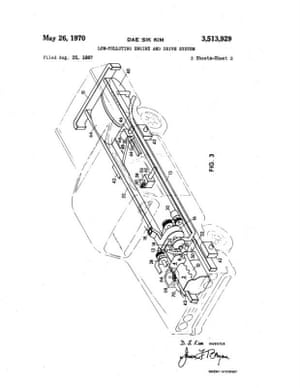
This 1970 patent, assigned to Esso (now ExxonMobil), is a design for a low-polluting engine system.
  This 1970 patent, assigned to Esso (now ExxonMobil), is a design for a low-polluting engine system. Photograph: Handout


And ExxonMobil funded a disinformation campaigned aimed at discrediting scientists and blocking government efforts to fight climate change for more than 50 years, beforepublicly disavowing climate denial in 2008.

The patent records were among a new trove of documents published on Thursday by the Center for International Environmental Law, and deepen the legal and public relations challenge for Exxon.

“What we saw was an array of patent technologies that demonstrated that these companies had the technologies they needed and could have commercialised to help address the problem of C02 pollution,” said Carroll Muffett, president of the Ciel. “They then turned to Congress and said you don’t need to invest in electrical vehicle research because the research is ongoing and it’s robust.”

The findings echo those in the documentary Who Killed the Electric Car?, which explored the deliberate destruction of GM’s first electric vehicles.

Alan Jeffers, an Exxon spokesman, insisted he could not comment directly on the documents as he was unable to access the Center for International Environmental law website on which they were published on Thursday morning.

In an emailed statement, Jeffers said: “The Guardian gave us only a few hours to comment on documents from four decades ago.”

Jeffers went on: “This further illustrates the Guardian’s well-established bias on climate change issues which has been demonstrated previously through its keep it in the ground campaign.”

He said the company believed the risks of climate change were real, was researching lower emission technologies, and engaged in “constructive dialogue” with policy makers about energy and climate change.

Researchers discovered more than 20 such patents filed by oil companies from as early as the 1940s for technologies that could help in the development of electric cars.

However, Ron Dunlop, president of Sun Oil and API chairman, told a joint hearing of the commerce committee in 1967 that government funding of research into electric cars would be misplaced – because the oil companies were so advanced in their research of cleaner cars. “We in the petroleum industry are convinced that by the time a practical electric car can be mass produced and marketed, it will not enjoy any meaningful advantage from an air pollution standpoint,” he told Congress. “Emissions from internal-combustion engines will have long since been controlled.”

Muffett said the findings were the result of three years of research and were not exhaustive.

“The question is what did they do to try to commercialise these technologies, knowing what they did about climate change,” he went on.

The revelations, the second set of documents released by Muffett’s organisation, reinforce charges by campaigners that Exxon was well aware that the burning of fossil fuels was a main driver of climate change – despite its public posture of doubt.

In addition to the technologies with potential for electric cars, Exxon and other oil companies were actively researching methods to cut emissions of carbon dioxide – the main greenhouse gas.

In another historic document that surfaced last month, a Canadian subsidiary of Exxon admitted the company had the technology to cut carbon emissions in half. However, the corporate memo dating from 1977 said it would be prohibitively expensive – doubling the cost of electricity generation, according to the documents obtained by Desmog blog.

New York and 17 other attorneys general, including DC and the US Virgin Islands, are investigating whether the oil company lied to investors and the public about the threat of climate change.

Campaigners plan to further turn up the heat on the company next week when Exxon holds its annual shareholder meeting in Dallas.

Campaigners have argued for more than a decade that Exxon bankrolled a network of front groups and conservative think tanks aimed at discrediting well-established science – confusing the public and delaying governments efforts to cut the greenhouse gas emissions responsible for warming.

Those efforts to put Exxon on the spot gathered pace after Inside Climate News and the Los Angeles Times reported that the company’s own scientists knew as early as the 1970s that greenhouse gases caused climate change.

The attorney general of the US Virgin Islands has subpoenaed Exxon to turn over email, documents and statements over the last decades.

Exxon has dismissed the investigations as politically motivated.

However, the company has reversed its opposition to fuel cell technology. Earlier this month, the company announced it had been conducting a joint research effort on fuel cell power plants with FuelCell.

The initiative, which got underway in 2011, aims to route the carbon dioxide from fossil fuel burning power plants into fuel cells, producing low emissions electricity. The company has estimated it can cut 90% of carbon dioxide emissions.

“At ExxonMobil, we share the view that the risks of climate change are serious and warrant thoughtful action,” Rex Tillerson, Exxon’s chief executive, told the US Energy Association after receiving its annual award.

The Guardian

WITH the launch of Caribbean Climate Trackers, the region’s youth now have the chance to become more vocal on climate change.

The youth-led writing initiative, as hub manager Dizzanne Billy describes it, is intended “to identify and support young climate actors from around the world”.

With its genesis as the Adopt-A-Negotiator initiative, the effort was rebranded in Paris in December and is looking to amplify the perspectives of youth on climate change.

To that end, Billy, who is also president of the Caribbean Youth Environment Network in Trinidad, said youths recently had two publishing windows April 5 to 22 and May 4 through 15 that have qualified them for writing fellowships.

The April 5 to 22 window saw them writing on why the world should be free from fossil fuels and the effects of fossil fuels on health and air pollution.

The May 4 to 15 window saw them writing on climate change, human rights and energy transition.

“Coming out of these two publishing windows, the goal was to select 15 young people to be a part of a paid writing fellowship, as well as to choose two persons to be a part of the Climate Trackers team to COP22 (the 22nd meeting of the Conference of the Parties to the United Nations Framework Convention on Climate Change, to be held later this year in Marrakech),” said Billy.

fellow selection

“So far, the 15 persons have been announced and we successfully have one person from the Caribbean Climate Trackers chosen to be a fellow.

“Her name is Amrita Dass and she’s from Trinidad and Tobago. The two persons for the team have not yet been announced, but should be this week,” she added.

The fellowships, which got underway earlier this month, covers subjects including:

• an introduction to the United Nations Framework Convention on Climate Change;

• the annual Conference of the Parties and what it means;

• climate change and health;

• climate change, water and biodiversity;

• climate change, human rights and gender; and

• climate change variability in the Caribbean.

With the start of their operations in the region in March, the first order of business has been to address visibility while prompting support for their work.

Caribbean Climate Trackers therefore joined the Earth Day 2016 InstaMeet event, which ran from April 22 to 24 on the social networking service Instagram.

“In Trinidad, we met at the Botanic Gardens in Port-of-Spain, with young, spoken-word artistes performing about earth and the environment and

conservation. We also did some networking and speaking about climate change, [as well as] exchanged ideas on the Paris Agreement,” Billy told The Gleaner.

Their activities at the Botanic Gardens were shared on Instagram, as well as on Facebook and Twitter.

Billy has urged Caribbean youth to join the movement.

“We need to stop operating in insularity. We need to find now the power that we have when we work together,” she said.

“Young people tend to feel that their opinion does not matter or that they are like a box that needs to be ticked off.

” Our opinion matter and the only way we can get it out there is by doing the work, and we will see the results after,” Billy added.

The Caribbean hub joins seven others from across the world Latin America, Brazil, Europe, South Asia, Southeast Asia, and the Balkans.

pwr.gleaner@gmail.com


The Gleaner

Chief Executive Officer of the United Nations (UN) Sustainable Energy for All Rachel Kyte has said her organisation is ready to partner with Caribbean governments and institutions to secure a clean, affordable and reliable energy future.

She was delivering the William G. Demas Memorial Lecture at the Caribbean Development Bank’s (CDB) 46th annual Board of Governors Meeting at the Iberostar Resort in Lilliput, St James, on Tuesday.

Sustainable Energy for All is the brainchild of UN Secretary-General Ban Ki-moon. Its main objectives are ensuring universal access to modern energy services and doubling the global rate of improvement in energy efficiency and the share of renewables in the global energy mix.

Kyte said that energy demand is not only the dominant contributor to climate change, but is central to nearly every major challenge and opportunity the world faces today.

She noted that there are 1.1 billion people around the world who still have little or no access to energy, and three billion who rely on wood, coal, charcoal or animal waste for cooking and heating.

DESERVE ACCESS

“We the peoples of the UN want a planet and a future that’s not ravaged by climate change. We the peoples deserve access to affordable, clean and reliable energy and we the peoples know that the time for action is now,” she said.

Kyte noted that the impacts of climate change are being felt all around the world, particularly in the Caribbean. She added that rainfall patterns are changing, which have caused a number of islands to experience prolonged dry seasons and severely low reservoir levels.

“This severely impacts the ability of island nations to grow local crops,” she pointed out, citing loss of an estimated 2,190 hectares of crops valued at millions of dollars in Jamaica due to drought.

Kyte pointed out that the CDB has an essential role to play in providing financing for sustainable energy projects.

The Gleaner 

The Office of Utilities Regulation (OUR) says it will ensure that power utility Jamaica Public Service Company does not increase bills to consumers based on the delay in the delivery of cheaper gas fuel.

The first delivery of liquefied natural gas – LNG – by JPS’ supplier was expected in April, but has been pushed back to August.

New Fortress Energy has developed a terminal in Montego Bay to feed gas to JPS’ Bogue plant, which has been converted to burn either LNG or automotive diesel oil.

“The OUR has moved to assure consumers that it will be vigilant in ensuring that the delay in the delivery of liquefied natural gas to the Bogue power plant will not result in an increase in the price of electricity,” said the regulator in a statement.

While welcoming the completion of the conversion of the 120-megawatt combined cycle plant, the OUR signalled disappointment with the “four-month delay” in the delivery of the overall project.

The gas supply agreement signed by JPS and New Fortress Energy on August 5, 2015, stipulated that gas delivery would commence April 2016, the OUR stated.

“Safeguards for customers were included in the agreement with New Fortress to ensure that any delay on its part would not result in negative cost implications for customers,” noted OUR Director General Albert Gordon. “The OUR has been monitoring the project closely and will continue to keep the public abreast of its progress.”

Project’s goal

The Bogue project’s goals, which are aligned to those in the National Energy Policy, were to reduce fuel cost, and lower the operations and maintenance expenditure of electricity generation. Gordon noted that the OUR’s involvement in the project began in 2008 and that the agency mandated that the plant be upgraded to burn gas in the 2014-2019 JPS tariff determination.

“To ensure this, the OUR also made provisions for the setting up of the Bogue Plant Reconfiguration Fund (BPRF), financed through the tariff, to facilitate the conversion cost,” the agency said.

The revenues for the BPRF – which totalled $15 million – were collected by the JPS through a line item in the monthly fuel rate calculation on customers’ bills, over a twelve-month period, between February 2015 and January 2016, the OUR said.

Requests to JPS for comment were unanswered up to press time.

The Gleaner

Zero emission milestone reached as country is powered by just wind, solar and hydro-generated electricity for 107 hours

Portugal’s clean energy surge has been spurred by the EU’s renewable targets for 2020.

Electricity consumption in the country was fully covered by solar, wind and hydro power in an extraordinary 107-hour run that lasted from 6.45am on Saturday 7 May until 5.45pm the following Wednesday, the analysis says.

News of the zero emissions landmark comes just days after Germany announced that clean energy had powered almost all its electricity needs on Sunday 15 May, with power prices turning negative at several times in the day – effectively paying consumers to use it.

James Watson, the CEO of SolarPower Europe said: “This is a significant achievement for a European country, but what seems extraordinary today will be commonplace in Europe in just a few years. The energy transition process is gathering momentum and records such as this will continue to be set and broken across Europe.”

As recently as 2013, Portugal generated half its electricity from combustible fuels, with 27% coming from nuclear, 13% from hydro, 7.5% from wind and 3% from solar, according to Eurostat figures.

By last year the figure had flipped, with wind providing 22% of electricity and all renewable sources together providing 48%, according to the Portuguese renewable energy association.

While Portugal’s clean energy surge has been spurred by the EU’s renewable targets for 2020, support schemes for new wind capacity were reduced in 2012.

Despite this, Portugal added 550MW of wind capacity between 2013 and 2016, and industry groups now have their sights firmly set on the green energy’s export potential, within Europe and without.

In 2015, wind power alone met 42% of electricity demand in Denmark, 20% in Spain, 13% in Germany and 11% in the UK.

In a move hailed as a “historic turning point” by clean energy supporters, UK citizens last week enjoyed their first ever week of coal-free electricity generation.

Watson said: “The age of inflexible and polluting technologies is drawing to an end and power will increasingly be provided from clean, renewable sources.”

The Guardian

United States (US) Vice-President Joe Biden has warned regional leaders that volatile oil prices will return. On this basis, he is urging them to use every opportunity to explore clean and alternative energy sources to bolster the prosperity of the Caribbean and Central America.

“This is a moment of opportunity to turn that progress into sustainable energy security that will endure when volatile oil prices return. And they will return,” Biden cautioned the heads of government during the US-Caribbean-Central American Energy Summit in Washington, DC, held earlier this month.

“The good news is that we’re at a nexus for transforming, with transformative opportunities here. Low oil prices mean more money this day is available for investment in new energy infrastructure,” said Biden.

“It’s equivalent to US$1 billion of stimulus just in the region [and] lower energy prices. Our abundance of natural gas provides a critical, clear transition fuel as we’re moving towards adopting renewable technologies.”

Biden said strengthening energy security was among the focus areas for himself and US President Barack Obama.

He noted that North America – Mexico, the US and Canada – is the epicentre of energy production in the world and pointed out that his country recently inaugurated a liquefied natural gas export terminal that has just sent its first cargo of gas to Latin America.

The US had also announced a deal to export natural gas to Jamaica during last year’s staging of the Summit.

“Here’s the truth. We want you to be energy secure so more people across this region can – your region can start businesses, connect to the Internet, generate opportunities, attract foreign investment, grow, grow. The more you grow, the more you prosper, the better off my country is. And it strengthens our security, as well as yours. And it opens up new opportunities for shared economic growth,” he said.

The Gleaner

When it comes to grabbing headlines with visions of the future, few can beat entrepreneur and inventor Elon Musk. He’s behind SpaceX, the rocket company that he sees as a vehicle to his dream of colonising Mars.

Better known, perhaps, are his Tesla electric cars, an increasingly common sight in the US and here in the UK.

While powerful rockets and fast cars might be the most exciting of Musk’s products, his hopes of changing the way we live are much more likely to be delivered by something much more prosaic – Tesla’s Powerwall. Much less glamorous than Musk’s other concepts, this plain white battery, intended to harness energy from renewable sources such as the wind and sun and make it available for household use or feed back into the power network, could have a far bigger impact than anything else the billionaire has dreamt up.

The concept behind these batteries in homes – which working together are known as a “distributed grid” – is that they will store up cheap electricity generated when demand is lower, then discharge it at peak times when energy from the traditional network supplied mainly by large power stations is expensive.

Not only do these batteries – known as “behind the meter” storage – raise the prospect of reducing households’ electricity costs by optimising the time they receive power, they could cut further bills by selling excess power back to the network at times of high demand. They could also provide an emergency back-up if the main grid fails.

There are other wider advantages to the system. Having batteries in every home solves the problem of solar and wind farms producing electricity when there is no demand for it and nowhere to store it, and they could also ease the current strain on the transmission grid as power is sent from large power stations. Perhaps most importantly, they could reduce the world’s reliance on fossil fuels by allowing green energy sources to be fully utilised without the worry of the wind dropping or the sun being hidden by clouds.

The whole idea might sound like a pipe dream, but it is becoming more a more real possibility. While Tesla is raising the profile of home energy storage, other less visible players are operating in the sector and already installing batteries in British houses.

However, last week just how seriously the concept is being taken was shown with a series of big moves in the sector. First came France, with oil giant Total on Monday announcing a £750m scheme to buy battery group Saft as it looked beyond the low oil price and to a future away from fossil fuels.

A day later, Engie, previously known as GDF Suez, revealed it had taken an 80pc stake in California start-up Green Charge Networks, a leading player in behind-the-meter batteries. But the most significant event came later the same day from automotive giant Nissan. As well as revealing it would begin using its Sunderland battery factory to start recycling the power packs from its Leaf electric cars for use as home power storage devices, the Japanese company said it had picked the UK for a much more important trial.

Under the title of Nissan Futures, it revealed a new vision for how electric cars will be used in the years ahead. A pilot project will see 100 Leaf cars plugging into the energy network and using their batteries as extra storage, in what it hopes could combine transport and energy in the future.

“As a company, we recognise there will be massive change in the future,” said Paul Willcox, Nissan’s European chairman. “There’s a revolution in the market and we need to think about how we evolve and what the car’s role is in society.”

The cost of power from solar is falling rapidly – down 40pc 2012, according to KPMG

Nissan’s plan is rather eloquent and effectively kills two birds with a single stone. The average Leaf uses only a quarter of its battery power before recharging, meaning there is a large capacity going spare for most of the time.  The Leaf’s 30 kilowatt hour (kWh) battery can store enough energy to supply the average home’s needs for two days according to Willcox, but under Nissan’s scheme, this capacity is put to much more practical use. By plugging in at home overnight, the cars charge up on cheap late-night electricity, but their batteries are available to feed into the network at times of peak demand.

Willcox says the trial envisages electric vehicles as “mobile power plants, energy hubs” with them plugging in to offer up their resources not just at homes overnight, but also at workplaces during the day.

A giant such as Nissan weighing into the sector shows just how seriously energy storage is being taken, and the fact that the former chief executive of National Grid, Steve Holliday, is on board only emphasises it.

Cynics might argue that the idea is fanciful at best, but Willcox is confident of its potential. “Oil may be cheap now, but that is not going to last forever and people are increasingly going to want electric vehicles – it makes sense to use them in this way,” he says, adding that while Tesla is a “credible company”, Nissan began making electric vehicles in the 1940s.

“Some may see this as blue sky thinking but it is real and tangible now,” Willcox adds. “Six or seven years ago, when we invested heavily in battery vehicles people laughed at us, but we have 230,000 Leafs on the road now.”

Holliday argues that moving to a distributed grid could that takes advantage of cheap energy makes sense. “In the future we could see a time when electrons are free,” he says. “On this island, we have times now when people effectively pay to use electricity because of the cost of having to shut down [existing power plants] when there is low demand.”

Nissan makes a convincing argument and is certainly planting its flag firmly in what is a land grab for a huge industry of the future, though Willcox concedes the whole car industry will need to work together for the potential of “vehicle to grid” to be realised.

However, for a distributed grid to work, there needs to be a major reform of legislation around the UK power market, according to industry body Energy Storage Network (ESN). “The current system of buying and selling electricity is not fit for purpose,” said ESN director Anthony Price. “The paradox is that almost everything except storing electricity is subsided.”

Almost 1m UK homes have solar panels and Price estimates that several tens of thousands of UK homes have battery systems. To get these figures closer to parity the process of storing electricity and selling it back to the grid needs to be overhauled. However, Price says that even without the benefits of these batteries being charged from renewable sources, the UK needs to invest in battery storage.

“We have a variable demand for energy because we are human,” he says. “We run generation to match demand and there is a lot of effort to meet the peaks – such as everyone switching on the kettle when Coronation  Street finishes – and that costs a lot, and the power is often from the dirtiest power plants which take time to be fired up.

Almost 1m UK homes have solar panels

“Battery storage – whether behind-the-meter or in community batteries at the end of the street – has the effect of taking out those peaks in demand and allows you to operate a much more efficient system.”

Cyrille Brisson, vice-president at global power management group Eaton, which is working with Nissan, agrees, saying that the present system requires large numbers of power stations ready to meet peak demands.

“At the moment we have to have massive over-capacity – which is expensive – to meet fluctuating demands, but with renewables you have unpredictable generation,” he says. “However, with storage in the middle you do not have to oversize everything. You get a ‘good load’ on the electricity grid where the spikes in generation and consumption are flattened out by the storage.”

Arguments that the wind might not blow or the sun won’t shine are false, argues Brisson, claiming that the “Sahara produces 100 times the wind and sun” to power the planet, and the technology for this “absolutely exists”.

He also warns against trying to subsidise the market to encourage the take-up of energy storage. “The worst thing you can do is subsidise it. The public think that renewables mean an extra tax on them, and regulation has got to make it clear it is not that. What is needed is a transparent market, so as the costs fall people will see it is cheaper.”

The cost of power from solar is falling rapidly – down 40pc 2012, according to KPMG – and Brisson argues that technological advances will soon make it as cheap as fossil fuels.

The Government also sees the potential in energy storage systems, having declared it one of eight “great technologies” it sees the UK as having the potential to become a world leader in. Nissan’s Willcox acknowledges this, noting the UK’s “encouraging” environment was a factor in picking Britain as the site for the global V2G pilot programme.

The public might find the idea of a battery in the home helping to solve complex problems about the UK’s energy needs hard to imagine. However, Joe Warren, chief executive of start-up Powervault, sees it a different way.

His company’s 4kWh batteries start at £2,500 and are capable of providing about a third of the needs of a typical British home, having charged themselves from roof mounted solar panels and Warren hopes to have 500 of them installed in Britain by the end of the year.

“There’s a massive transition away from centralised power generation,” he says, as news breaks that the cost of the long-delayed Hinkley Point nuclear power plant may rise by £3bn to £21bn. “It makes sense to decentralise when instead you can make small investments of £1m or £100m on wind farms or solar power stations.

“We hope to make a home battery as common as a dishwasher in every kitchen.”

Flipboard