Cheaper coal and gas will do nothing to derail the renewable energy revolution according to BNEF’s New Energy Outlook 2016.

Bloomberg New Energy Finance states 60% of installed capacity will be zero-emission energy sources by 2040 and wind and solar power will take the lion’s share of new power generation capacity added – 64%.

Solar power is forecast to be the cheapest generation technology in most countries by 2030 and account for 3.7TW, or 43%, of new capacity added in 2016-40. This will represent $3 trillion of new investment.

A very important point in the report is that around 2027, new wind and solar will be cheaper than running existing coal and gas generators, particularly where carbon pricing has been implemented. In just over a decade we may see a marked uptick in current fossil fuel generation plants being shuttered. The report says there will be a net closure of 286GW of coal in OECD economies by 2040.

By 2040, BNEF states Australia will have wind and solar penetration of more than 50%.

Another prediction will get electric vehicle supporters excited – BNEF’s modeling suggests EV’s will comprise a quarter of the global car fleet by 2040. This is also good news for the residentialand commercial solar sector as it will accelerate a reduction in battery costs through technology development, economies of scale and enhanced manufacturing know-how.

BNEF sees a very healthy future for small-scale solar power, with it accounting for 10% of global generating capacity by 2040. With regard to home battery systems, Bloomberg expects solar energy storage to be commonly deployed alongside rooftop solar panel systems by 2020.

Behind-the-meter energy storage generally will see a sharp rise from around 400MWh today to nearly 760GWh in 2040.

While the news is upbeat about renewables generally, forecasted additions won’t be enough to rein in carbon emissions to the required degree.

“Some $7.8 trillion will be invested globally in renewables between 2016 and 2040, two thirds of the investment in all power generating capacity, but it would require trillions more to bring world emissions onto a track compatible with the United Nations 2°C climate target,” said Seb Henbest, lead author of the report and head of Europe, Middle East and Africa for BNEF.

BNEF suggests approximately USD $5.3 trillion would need to be invested in zero-carbon power by 2040 to prevent carbon dioxide levels rising above 450 parts per million.

Bloomberg

Devon Gardner

THE CARIBBEAN is, within the next two or so years, to have an energy efficiency strategy that should serve the growth agenda of various islands.

To begin the work, the Caribbean Community (CARICOM) has secured the support of the European Union (EU).

“The EU will send a team in to work with us to identify the elements of the framework for the strategy. Having identified that framework, we will utilise a Technical Cooperation Facility (TCF) that we have with the IDB (Inter-American Development Bank) as well as support that we are already getting from the GIZ to do what I refer to as investment grade analysis to identify the energy efficiency options in the various sectors across countries in the CARICOM states,” said Dr Devon Gardner, programme manager for energy with the CARICOM secretariat.

He was speaking to the Gleaner at the energy and sustainable development forum hosted by the University of the West Indies in Kingston on Tuesday.

According to Gardner, the strategy – to be developed in line with CARICOM’s five-year strategic plan for 2015 through 2019 will take account of key productive sectors (tourism, agriculture, services and the public sector) together with the electricity and transport sectors.


MANY DELIVERABLES


In the end, he said it should deliver on:

• an energy efficient building code for the region;

• energy performance standards for certain types of appliances, including refrigerators, air conditioners, washing machines, and lights (LED and CFLs);

• energy labelling standards for appliances that provide consumers with information and operating cost of the various devices; and

• performance standards for a number of renewable energy devices, including solar water heaters.

“What are doing is not just to understand the amount of energy savings potential, but critically it is to understand the value of the energy savings to the economy and the investment package required to pursue those opportunities if we desire,” Gardner noted.

News of the regional energy efficiency strategy comes at a time when CARICOM countries are collectively using some 13,000 Btu of energy to produce one US dollar of gross domestic product (GDP) compared to 4,000 Btu of energy used by Japan, for example, to produce the same one US dollar of GDP and the global average of 10,000 Btu.

This is according to Gardner who said that “the region is perhaps the most inefficient in the world as regards energy efficiency.”

pwr.gleaner@gmail.com

The Gleaner

Devon Gardner

THE CARIBBEAN is, within the next two or so years, to have an energy efficiency strategy that should serve the growth agenda of various islands.

To begin the work, the Caribbean Community (CARICOM) has secured the support of the European Union (EU).

“The EU will send a team in to work with us to identify the elements of the framework for the strategy. Having identified that framework, we will utilise a Technical Cooperation Facility (TCF) that we have with the IDB (Inter-American Development Bank) as well as support that we are already getting from the GIZ to do what I refer to as investment grade analysis to identify the energy efficiency options in the various sectors across countries in the CARICOM states,” said Dr Devon Gardner, programme manager for energy with the CARICOM secretariat.

He was speaking to the Gleaner at the energy and sustainable development forum hosted by the University of the West Indies in Kingston on Tuesday.

According to Gardner, the strategy – to be developed in line with CARICOM’s five-year strategic plan for 2015 through 2019 will take account of key productive sectors (tourism, agriculture, services and the public sector) together with the electricity and transport sectors.


MANY DELIVERABLES


In the end, he said it should deliver on:

• an energy efficient building code for the region;

• energy performance standards for certain types of appliances, including refrigerators, air conditioners, washing machines, and lights (LED and CFLs);

• energy labelling standards for appliances that provide consumers with information and operating cost of the various devices; and

• performance standards for a number of renewable energy devices, including solar water heaters.

“What are doing is not just to understand the amount of energy savings potential, but critically it is to understand the value of the energy savings to the economy and the investment package required to pursue those opportunities if we desire,” Gardner noted.

News of the regional energy efficiency strategy comes at a time when CARICOM countries are collectively using some 13,000 Btu of energy to produce one US dollar of gross domestic product (GDP) compared to 4,000 Btu of energy used by Japan, for example, to produce the same one US dollar of GDP and the global average of 10,000 Btu.

This is according to Gardner who said that “the region is perhaps the most inefficient in the world as regards energy efficiency.”

pwr.gleaner@gmail.com


The Gleaner

Shaw                                                                                                 File

Reacting to concerns that the raising of taxes on fuel has resulted in the spike in electricity bills consumers will face this month, Finance Minister Audley Shaw is arguing that the increase in special consumption tax (SCT) on heavy fuel oil (HFO) is only a nominal percentage of the rate increase the Jamaica Public Service Company (JPS) announced last week.

In response to questions from The Gleaner, the minister said that of the 12.8 per cent increase the JPS intends to apply, the increase in the SCT on HFO “translates to a mere 2.3 percentage points” or 18 per cent.

“As estimated in the tax measures, the effect of the increase in the overall SCT (specific and ad valorem) on HFO and LNG is approximately J$1.35 billion (or approximately US$11 million) in fuel costs to JPS. This would then approximate to a cost of US0.36 cents per kWh,” the minister said.

“Given the US two-cent-per kWh increase by JPS to consumers and the impact of the increased SCT of US0.36 cents per kwH to JPS costs, the percentage contribution of the tax to the pending JPS electricity bill increase would be 18 per cent. Therefore, the increase in SCT on HFO translates to a mere 2.3 percentage points of the 12.8 per cent electricity bill increase.”

Additionally, Shaw said he at no point stated that the increase would not affect the rates of the JPS as no one specifically asked him about the SCT on HFO.

“With reference to the comments by the minister of finance and the public service at the post-Budget press conference, it should be noted that the minister spoke to a question posed on the impact of the J$7.0 increase in SCT on fuel used for the purposes of ground transportation,” the statement read.

“The minister’s comments were not geared towards the impact of LNG or HFO on electricity prices. There were no questions posed about the effect of the increase in the overall SCT (specific and ad-valorem) of HFO.”

The increase in SCT on HFO that was announced during Shaw’s May 12 Budget presentation was one of three reasons Jamaica’s only power distribution company attributed to this month’s increase.

During his post-Budget press conference on May 13, Shaw, in responding to concerns that the new tax measures would affect light bills, said: “The argument also is that JPS light bills will go up as a result. And I want to remind everyone that this tax (on fuel) does not apply to Jamaica Public Service at all. It is only related to SCT for fuel for road transport only.”

anastasia.cunningham@gleanerjm.com


The Gleaner

Diana McCaulay: “It is time we simply admit that we don’t have an environment regulator.”


FROM permit breaches at the Blue Diamond Royalton Hotel in Negril to the continued indecision over the Cockpit Country, environment sector actors appear largely unimpressed with the new Government after 100 days in office.

Still, at least some of them are prepared to give the new administration the benefit of the doubt as they look to the next 100 days and beyond.

“It’s difficult to assess as so little has happened on the ground, beyond the usual rhetoric. I believe that both Royalton hotels [in Negril and Coopers Pen], which were in repeated breach of their environmental permits, have been or will be regularised. If this is true, then that tells us all we need to know about the new government’s approach to the environment: a continuation of the reckless willingness to sacrifice it, regardless of words of commitment to sustainable development and environmental protection,” said Diana McCaulay, chief executive officer for the Jamaica Environment Trust.

Recent media reports are that the team investigating the collapse at the hotel’s Negril site had recommended the lifting of the stop order on buildings not affected by the incident, which left five people injured..

At the same time, developers have reportedly been asked to address a number of issues before the work can restart on the collapsed section of the project.

“If the Government is not going to insist its own environmental laws are adhered to, we effectively have no regulatory framework for our natural resources. I was also disturbed to read a comment attributed to Minister Mike Henry that the process for determining Cockpit Country boundaries is to begin. It was completed long ago,” she added.

Southern Trelawny Environmental Agency boss Hugh Dixon said he has not heard anything “that the Government has done differently from its predecessor”, such that the next 100 days will be critical.

“I would really want to be able to say I am giving them the benefit of the doubt to come up with a conscientious raft of actions that augur well for the environment and the economic growth activity that is to come on stream because there is no way they could be looking at a growth agenda that does not have at its nexus the environment and sustainable environmental management,” he said.

“If in the next 100 days the Government does not come forward with a raft of policy frameworks that illustrate its commitment to sustainable development and growth, then I would say that it would have been failing in its attempt to move its agenda forward,” Dixon added.

Dr. David Smith, coordinator for the Institute for Sustainable Development at the University of the West Indies, was of a similar mind on the importance of the coming months.

“I look at the first 100 days as them sort of finding their feet. But definitely we want to see now being addressed the broadening of the energy sector and reducing as much carbon emissions as is practical and looking very seriously at water because that is going to be one of the major problems over the next five years and beyond because of climate change,” he said.


Information Necessary


It will be important, too, Smith said, that players in the Ministry of Economic Growth and Job Creation be informed by their upcoming meeting with respected Professor Jeffrey Sachs.

“Professor Jeffrey Sachs will be in the country on Tuesday. He will have a meeting with the prime minister (PM) and Cabinet. It will give the PM and the two ministers in the job creation and growth ministry a chance to talk to someone who is a world leader in economic thought and adviser to the UN Secretary General Ban Ki-moon on sustainable development,” Smith said.

“Having him come to Jamaica and work with the PM and the other ministers will be very useful to get them to at least hear some of the newer ideas and talk about some of the sustainable development goals and how Jamaica can achieve them,” he added.

Independent blogger and social commentator Emma Lewis said: “I liked the talk of reducing plastic pollution. I think that is excellent but now needs to be translated into action. It is very good that we have signed some agreements on climate change adaptation and disaster preparedness … and hope that they will lead to some good work.

“I would also like to see the Government engage directly with stakeholders in communities that are concerned and already being impacted by environmental issues of various kinds like the residents of Cockpit Country [and] of Negril … . I would like to see a lot of that happening from now on,” Lewis added.

pwr.gleaner@gmail.com

The Gleaner


JAMAICA Public Service (JPS) customers will be asked to pay more for their electricity this month — partly due to the recent increase in the Special Consumption tax (SCT) on heavy fuel oil (HFO), the light and power company advised yesterday.

The company said the spike is also due to an increase in the cost of the fuel used for electricity generation, caused by rising oil prices on the international market, and the continued devaluation of the Jamaican dollar.

“This is definitely not the best news for us at JPS, or for our customers,” JPS President and CEO Kelly Tomblin said in a release.

The Government last month introduced the $7 per litre increase as part of the revenue package to help finance its $580-billion 2015/16 Budget, but Finance Minister Audley Shaw, at the time, assured the panicking public that the tax would only apply to fuel at the pumps.

“This tax doesn’t apply to JPS at all. It is only related to SCT for fuel for road transport,” Shaw said at a post-budget press conference. The SCT is expected to yield $6.4 billion for the Government’s coffers.

In announcing the 12.8 per cent increase yesterday, the JPS urged consumers to “conserve on their electricity usage, as the upward trend in oil prices has resulted in an increase in the cost of electricity”.

“The overall increase will result in residential customers paying US$0.21 per kWh on average for electricity in June, compared to US$0.19 in May. This means that the average residential customer using 165kWh of electricity for the month, will see a $500 increase in his or her June bill, which will move from $3,875 in May to approximately $4,372 this month,” the JPS said.

The JPS president stressed that, despite the increase, electricity bills are still 20 per cent lower than they were in June 2015 when customers were paying US0.27 per kWh. The company argued that Jamaica continues to enjoy one of the lowest electricity rates in the region, behind Belize and Trinidad.

Reacting to the news, Private Sector Organisation of Jamaica (PSOJ) President William Mahfood reiterated that the sector had recognised from the outset that the imposition of the tax on the HFO and Liquefied Natural Gas (LNG) would have an incremental increase in the cost of electricity of five per cent.

“As far as the price of oil goes, this is a matter that is beyond our control (but) we still feel there should be some amount of hedge put in place to mitigate against future increases in the price of oil,” he remarked, noting that the sector is in full support of the phasing out of older power plants which rely on HFO and diesel.

He said that, while the phasing out of JPS’ 190-megawatt facility at Old Harbour will take a couple more years, eventually more plants will convert to LNG.

Mahfood said also that, like rising oil prices, the devaluation of the dollar against the US currency is out of Jamaica’s hands and can only be militated against by economic growth.


The Observer

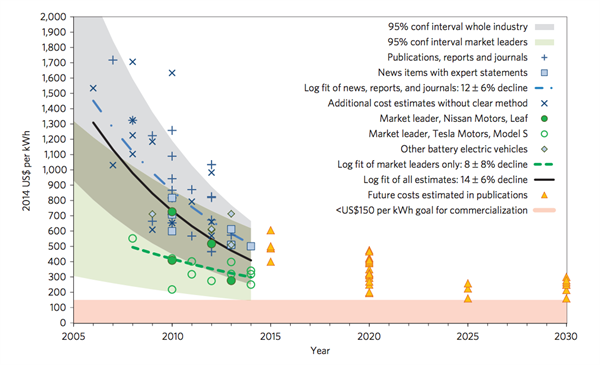
The most important piece of news on the energy front isn’t the plunge in oil prices, but the progress that is being made in battery technology. A new study in Nature Climate Change, by Bjorn Nykvist and Mans Nilsson of the Stockholm Environment Institute, shows that electric vehicle batteries have been getting cheaper much faster than expected. From 2007 to 2011, average battery costs for battery-powered electric vehicles fell by about 14 percent a year. For the leading electric vehicle makers, Tesla and Nissan, costs fell by 8 percent a year. This astounding decline puts battery costs right around the level that the International Energy Agency predicted they would reach in 2020. We are six years ahead of the curve. It’s a bit hard to read, but here is the graph from the paper:

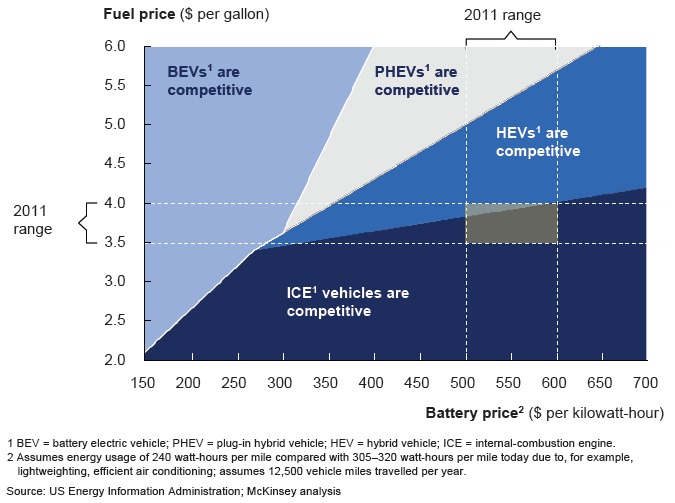
This puts the electric vehicle industry at a very interesting inflection point. Back in 2011, McKinsey & Co. made a chart showing which kind of vehicle would be the most economical at various prices for gasoline and batteries:

Looking at this graph, we can see the incredible progress made just since 2011. Battery prices per kilowatt-hour have fallen from about $550 when the graph was made to about $450 now. For Tesla and Nissan, the gray rectangle (which represents current prices) is even farther to the left, to about the $300 range, where the economics really starts to change and battery-powered vehicles become feasible.

But in the past year, the price of gasoline has fallen as well, and is now in the $2.50 range even in expensive markets. A glut of oil, and a possible thaw in U.S.-Iran relations, have moved the gray rectangle down into the dark blue area where internal combustion engines reign supreme.

Still, if battery prices keep falling, the gray rectangle will keep moving to the left. The Swedish researchers believe that Tesla’s new factories will be able to achieve the 30 percent cost reduction the company promises, simply from economies of scale and incremental improvements in the manufacturing process. That, combined with a rebound in gas prices to the $3 range, would be enough to make battery-powered vehicles an economic alternative to internal combustion vehicles in most regions.

But this isn’t the only piece of good energy news. Investment in renewable energy is powering ahead.

The United Nations Environment Programme recently released a report showing that global investment in renewable energy, which had dipped a bit between 2011 and 2013, rebounded in 2014 to a near all-time high of $270 billion. But the report also notes that since renewable costs — especially solar costs — are falling so fast, the amount of renewable energy capacity added in 2014 was easily an all-time high. China, the U.S. and Japan are leading the way in renewable investment. Renewables went from 8.5 percent to 9.1 percent of global electricity generation just in 2014.

That’s still fairly slow in an absolute sense. Adding 0.6 percentage point a year to the renewable share would mean the point where renewables take half of the electricity market wouldn’t come until after 2080. But as solar costs fall, we can expect that shift to accelerate. In particular, forecasts are for solar to become the cheapest source of energy — at least when the sun is shining — in many parts of the world in the 2020s.

Each of these trends — cheaper batteries and cheaper solar electricity — is good on its own, and on the margin will help to reduce our dependence on fossil fuels, with all the geopolitical drawbacks and climate harm they entail. But together, the two cost trends will add up to nothing less than a revolution in the way humankind interacts with the planet and powers civilization.

You see, the two trends reinforce each other. Cheaper batteries mean that cars can switch from gasoline to the electrical grid. But currently, much of the grid is powered by coal. With cheap solar replacing coal at a rapid clip, that will be less and less of an issue. As for solar, its main drawback is intermittency. But with battery costs dropping, innovative manufacturers such as Tesla will be able to make cheap batteries for home electricity use, allowing solar power to run your house 24 hours a day, 365 days a year.

So instead of thinking of solar and batteries as two independent things, we should think of them as one single unified technology package. Solar-plus-batteries is set to begin a dramatic transformation of human civilization. The transformation has already begun, but will really pick up steam during the next decade. That is great news, because cheap energy powers our economy, and because clean energy will help stop climate change.

Of course, skeptics and opponents of the renewable revolution continue to downplay these remarkable developments. The takeoff of solar-plus-batteries has only begun to ramp up the exponential curve, and market shares are still small. But it has begun, and it doesn’t look like we’re going back.

This column does not necessarily reflect the opinion of Bloomberg View’s editorial board or Bloomberg LP, its owners and investors.

To contact the author on this story:
Noah Smith at nsmith150@bloomberg.net

To contact the editor on this story:
James Greiff at jgreiff@bloomberg.net

Bloomsberg


The price of oil closed above US$50 a barrel for the first time in almost a year, pushing oil stocks higher.

The Dow Jones industrial average briefly flirted with the 18,000-point mark but eventually retreated.

Benchmark US crude oil added 67 cents, or 1.3 per cent, to close at US$50.36 a barrel in New York. Oil has not closed at US$50 a barrel or higher since July 21. Brent crude, which is used to price international oils, added 89 cents, or 1.8 per cent, to US$51.44 a barrel in London.

In other energy trading, heating oil added four cents to US$1.54 a gallon and natural gas gained one cent to US$2.47 per 1,000 cubic feet.

The Dow held on to a gain of 18 points to 17,938.28. Earlier, the Dow was up as much as 82 points and appeared to be on track for its highest close since last July.

The Gleaner

Golar LNG, the company which secured a two-year contract to ship liquefied natural gas (LNG) to Jamaica, posted huge net losses, has a working capital deficit and its chief executive officer resigned last month.

The shipping company continues to suffer from a slowdown of the LNG industry during a global oil price drop, symptomised by almost US$700 million of negative working capital.

The Jamaica contract is a bright spot for the company amid declining revenue.

“Partially mitigating the loss of this income was revenue earned by the Golar Arctic which commenced its two-year FSU service with New Fortress Energy, offshore Jamaica,” said Golar in financial results issued this week.

Golar also aims to refinance debt and launch new growth initiatives to adapt to the soft global LNG market.

New Fortress, an American company, is contracted by Jamaica Public Service Company to supply LNG to its Bogue plant. The pipeline and terminal have been developed but delivery of the gas, which should have started in April, has been pushed back to August.

On Wednesday, New Fortress promised responses on the implications of Golar’s finances for its contract, but had not followed through up to press time.

Golar reported net losses of US$80 million for its first quarter ending March. The loss was mainly due to its US$61.5 million in operating expenses towering over its US$18.6 million in revenues for the period.

Adjusted for exceptional items, losses would only have amounted to US$41.2 million.

Fundamentally, its revenue gap has defined the accounts since at least 2014. Consequently, Golar posted a US$197.6-million net loss for financial year 2015 and US$43 million in net losses for 2014.

Last month, CEO Gary Smith resigned and its former CEO, Oscar Spieler, retook control of the company. Golar cited restructuring as a necessary move to adapt to the new LNG reality, and the reason for the resignation.

Spieler, a naval architect, previously served as CEO of Golar between July 2009 and June 2011. He has a “successful track record of delivering complex offshore and shipping-related projects,” stated the financials. A release from the company indicated that both men previously traded the CEO position. Smith, who was promoted to CEO in January 2015, previously served as Golar CEO between March 2006 and July 2009.

Amid these changes, the company’s current assets

of US$530 million were overpowered by current liabilities of US$1.23 billion as at March 2016, resulting in negative working capital of US$670 million.

Burning through cash

Additionally, Golar has been burning though its cash holdings, which dropped from US$376 million to US$93 million in the space of one year.

The company still holds a strong US$1.8 billion in equity, but it fell from US$2.2 billion a year earlier.

Golar explained that the fast-growing LNG industry is going through a “rapid transformation” where monetisation of stranded gas, lowering the cost of LNG production and the opening of new markets are all critical success factors.

“An anticipated delinking of LNG prices from oil prices will also create additional demand for LNG. The traditional approach to executing LNG projects favoured by many oil majors may not cost effectively meet this new demand,” the company said.

Natural gas prices are reportedly at seven-year lows. The commodity is currently trading around US$2.40 per 1,000 cubic feet in the US.

At the same time, however, oil continues to trade below US$50 per barrel, which is still less than half the price crude was trading at two years ago.

The Gleaner 

KINGSTON, Jamaica –The Ministry of Industry, Commerce, Agriculture, & Fisheries (MICAF) has described Honey Bun’s newly-installed solar-energy system as a positive development for growth, job creation, and competitiveness.

Speaking on behalf of Minister Karl Samuda on Friday, at the official ribbon-cutting ceremony for the system at Retirement Road, Kingston, Director General in the ministry, Vivian Brown, noted that the first phase of the project, with an investment of US$250,000, has already yielded a 14 per cent decrease in the company’s electricity bill.

He pointed out that lower energy prices using solar energy will not only lower the costs of individual manufacturing operations, “but taken on a wider scale, will also reduce expenses for consumers and businesses, while increasing disposable income that can be spent in other ways”.

Brown stated that the high cost of energy has for a long time been placing a strain on the Jamaican economy, and encouraged other Jamaican manufacturers to use solar energy to reduce their costs.

He noted that more Jamaican manufacturers and householders are moving towards the use of solar energy, and that this is not just a Jamaican trend. Globally, he said, there is growing awareness that increased deployment of renewable energy is critical, not just for addressing climate change, but also for creating new economic opportunities.

“As a large user of electricity, Honey Bun has seen solar power as an effective solution to reduce costs, and I believe the steps that you are taking now will position you for a much brighter future,” Brown said.

The Observer