From left: Renford Smith, Marcus Grant and Alan Searchwell connecting the electrical components of a solar panel at the Wigton Renewable Energy Training Lab in Rose Hill, Manchester, recently.

As the debate intensifies over the possible rate increases which could face Jamaicans as more and more customers leave the Jamaica Public Service Company’s (JPS) grid, there are calls for a collaborative approach to the issue.

Manager of the Grid Performance Department at the JPS, Lincoy Small, says the various stakeholders must engage in dialogue to find an approach to provide the cheapest source of electricity to Jamaicans.

According to Small, it cannot be a matter of either renewable energy (RE) or staying on the JPS grid but a combination of the two.

“JPS is not telling people that renewable is not the way to go, because JPS even operates renewable facilities, but the key thing is to get them (grid and RE) working together in tandem to come up with the best synergy of what is best for the customer and what is best for the country,” said Small.

His comments came as Robert Wright, president of the Jamaica Solar Energy Association, told The Sunday Gleaner he has no desire for Jamaicans to leave the JPS grid.

Grid Stability

Wright said he strongly believes RE should be maximised and not just limited to large systems scattered across the island, but smaller systems distributed right across the country.

“When you have these smaller systems spread across the country it provides for better grid stability, and also it allows for more people to participate in clean energy as opposed to simply relying on large solar farms,” said Wright.

But Small said, based on experience due to the unpredictability of RE, the JPS sometimes has to resort to load shedding when customers jump on and off the grid.

He reiterated that JPS’s customers could face additional cost if the impact of RE on the grid is not handled carefully.

“So we are accepting solar power from the customers and as soon as something happens it drops off, and does so much quicker than the grid can even respond on some of those occasions, and as a result you have to be running expensive machines that are quicker to deal with those sun drop-offs or have to shed people’s light,” argued Small.

“And if you run these expensive machines or shed people’s light it means the overall cost to run the grid is going to be absorbed by the customer; you are going to have to pay for a more expensive energy source.”

The JPS executive said the company is actively seeking to incorporate new technology to deal with the loss of the intermittent renewable resources.

But Wright argued that the good news for Jamaicans is that the cost of RE is declining rapidly, enabling it to compete with traditional sources of energy.

“A system that a typical household would need in Jamaica two years ago would cost $1 million; that same system today cost $500,000, so we have seen a significant drop in prices,” said Wright.

“Also what is revolutionary is that the cost of batteries has gone down a lot, so now, even more than before, we will be able to offer that to residential customers at an affordable price.

“What is becoming more available now are systems called micro-inverters, and these allow you to install a very simple rooftop system which is cheaper, faster to install and is more appropriate for affordable housing developments, and so on.”

Batteries Expensive

But Small countered that with solar and wind on average only available for 20 and 35 per cent of the day, respectively, and the cost of buying and replacing batteries being expensive, it might be cheaper for customers to get their power from the JPS grid when RE is not available.

“It (solar) is a good thing to have, but it cannot be operated in isolation, and that is something a lot of people in the solar business not telling their customers,” said Small.

“Because even if you get a panel or a wind turbine and you get the battery, you are going to need a grid to at least charge up that battery for the 80 per cent of the time you are without solar or the 65 per cent of the time you are without wind.

“Plus, you will have to be replacing the battery every two to three years for full value, and batteries cost much more than solar panels.”

Small said the JPS is focused on supplying power as cheaply as possible so persons can take the cheap power from the grid rather than go buy a battery and use the solar power and the wind when it is available.

With Jamaica being a signatory to the Paris Climate Change Agreement, the utilisation of more RE forms part of the National Energy Policy which sees the country aiming to have 30 per cent RE penetration by 2030.

The country is currently at approximately 10 per cent of the quota, with roughly 300 net billing customers (those who have solar systems which allows them to consume energy and sell surplus) and around 10 larger customers.

Gleaner

KellyTomblinL20120417RB

For full article with audio clips click here

President of the Jamaica Public Service Company, JPS, Kelly Tomblin, is rejecting claims that she’s using scare tactics to keep businesses from turning to renewable sources of energy.

In an interview yesterday on Nationwide This Morning, Chief Executive Officer of Solar Buzz Jamaica, Jason Robinson, accused JPS of using ‘scare tactics’.

This was in response to comments attributed to Ms. Tomblin in a recent Gleaner report that the company could be forced to raise electricity rates if its top customers leave the grid.

But speaking with Nationwide News yesterday, Ms. Tomblin sought to clarify the comments she made to the Gleaner newspaper.

She’s insisting she’s not using a scare tactics.

Ms. Tomblin says she would prefer companies stay on the power grid.

This, as the intermittent use of the grid is more of a burden on JPS than if a company were to be removed completely.

And, Ms. Tomblin says the JPS doesn’t build LNG plants contrary to Mr Robinson’s claim.

He’d said the light and power company has been offering to set up small LNG plants for large companies, which would also take them off the grid.

She’s also refuting his claim that JPS’s rates are going up.

Nationwide

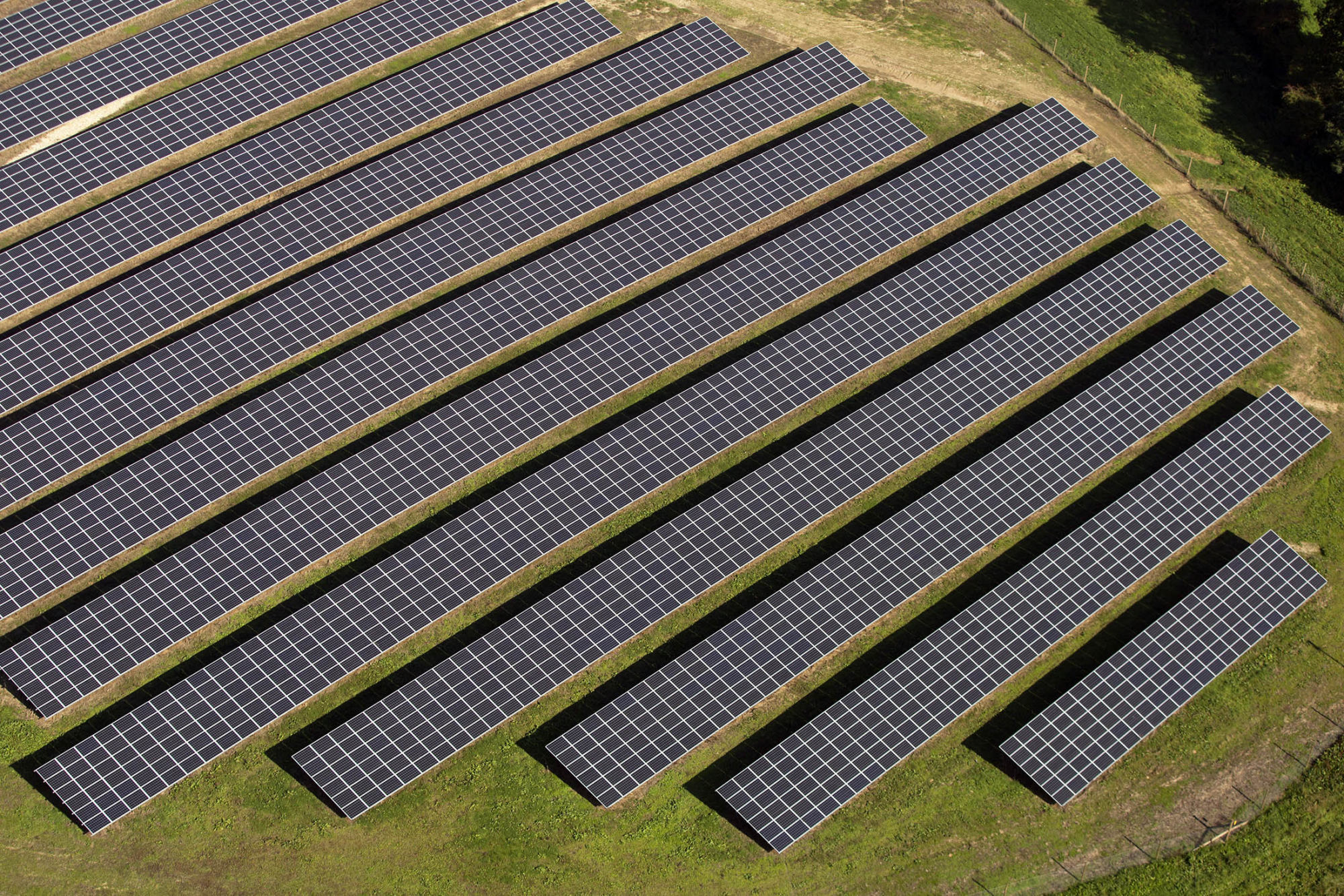
A field of photovoltaic solar panels providing alternative to the supply from the JPS.

With many local entities turning to solar systems or other renewable systems to reduce their reliance on more expensive energy supplied by the Jamaica Public Service Company (JPS), there is a another indication that persons who remain on the JPS grid could face the consequences.

“We all should be concerned and thoughtful. You don’t want everybody who can afford solar on their roof going off the grid because you would still have to pay for the grid,” CEO of the JPS, Kelly Tomblin, told The Sunday Gleaner during a recent interview.

“How do we take care of a particular company so that we also take care of the whole? How do we find a way to make it affordable for everybody and don’t just let people cherry-pick off the grid?” added Tomblin.

There is no official registry of the amount of renewable energy being utilised on the island, but it is estimated that approximately 35 megawatts of renewable energy has been installed between residential and business customers in recent years.

The target is to have 20 per cent of the country’s energy need being supplied by renewable sources by 2018, moving to 30 per cent by 2030.

Energy Sales

The JPS has recorded four years of decline in energy sales from 2010 to 2014, but has seen a turnaround in the last two years with a two per cent increase in 2015 and a four per cent increase in 2016.

“This could be due to the fact that the cost of electricity to customers has dropped by about 25 per cent over that time (usage tends to increase when the price of electricity is lower),” the JPS said in an emailed response to questions from our news team.

According to the JPS, while it has not yet seen any revenue fallout from renewable energy installations, it recognises “that energy sales could have been higher if some customers had not gone off the grid”.

If more paying customers move to renewables and leave the JPS, the company will be selling to a smaller group of paying customers and could be forced to find alternative ways to remain profitable, which could see electricity cost increase for some customers.

If Top Customers Left

Tomblin admitted that if the company’s top 50 customers were all to leave the grid it would cause a serious problem, but she argued that she is confident that these companies are cognisant of their responsibility to the Jamaican people.

“I am really encouraged, having been in meetings with our top 50 customers, and we are having a lot of meetings with the Private Sector Organisation of Jamaica (PSOJ) and the Energy Committee to say how we can balance personal and country interest,” said Tomblin.

“People who are adding solar are doing so during the day; that is not when Jamaica has a peak. So unless they have storage we have to maintain the same power plant and the same grid, because they come on the JPS system at nights, so they still have to pay and, therefore, it is not that much of an impact to the system,” said Tomblin.

But PSOJ President Paul Scott said the decision to remain on the grid or not is one entities will have to decide based on what is best for their business.

“I am aware of some members who have not come off the grid because of the impact it might have on residential users, while other members have come off the grid,” said Scott, who is a member of the Electricity Sector Enterprise Team.

“So one must make their own economic decision based upon their own situation. Serious companies would take that (impact on residential users) into consideration. I would encourage our members to make decisions that will impact the overall competitiveness of Jamaica. Different industries have different utility requirements and therefore, you can’t generalise.”

According to Scott, the use of the grid will change over time, as PSOJ members, and the private sector as a whole, are always going to calculate the cost of energy as a significant part of their business.

Hands-on training is a key element of Wigton courses. Here (from left) Renford Smith, Marcus Grant and Alan Searchwell connect the electrical components of a solar panel at the Wigton Renewable Energy Training Lab in Rose Hill, Manchester, recently.

“BY BEING natural and sincere, one often can create revolutions without having sought them.”

The Wigton Wind Farm team could be drawing inspiration from these words by French fashion designer Christian Dior, as it rolls out a training programme designed to fuel interest and inspire further action on renewable energy in Jamaica.

“It is open to anybody who has an interest. It is open to the general public,” said Sanja Simmonds, engineer and training coordinator at the wind farm, which is located at Rose Hill in Manchester where they began the renewable energy training courses this year.

In January, the farm trained 20 people from across sectors — private and public, and including students as young as 19 years old — in photovoltaics.

“Once you have an interest, it just goes from there,” Simmonds noted. “(The training) is how we can stimulate that interest and have greater interest for the technologies.”

The first training course ran for three days, as will the next one looking at solar thermal energy to be held in April.

The third training course, which will focus on wind energy and hydro, will be held in July. The final one for the year will be held in November and focus on bio-energy.

Up to now, Simmonds said they had been careful to avoid over saturation, with each course having a cap of 15 participants, with provisions for no more than an additional five.

“We don’t want anyone lost. If you have too many people, you may have persons sitting around and not paying attention. What we want is for participants to be fully engaged and hands on,” he said.

“The delivery of the first course was extremely effective, based the feedback we got. The training courses are not for you to you only to come and sit down before a PowerPoint. It is 50 per cent theory and 50 per cent practical. So we had participants (from the first training course) actually doing, for example, photovoltaic installation, sizing wires, sizing panels, etc.,” Simmonds added.

The training coordinator explained further the thinking behind Wigton’s efforts.

“Previously Wigton’s tagline was ‘Making renewables a breeze’. Now our tagline is ‘securing Jamaica’s energy future’. To secure the energy future, you could do it in multiple ways. You could do it from a commercial point of view, which is what Wigton is. So we harness clean energy from the wind,” he explained.

“You could also do it from a technical standpoint, which is where we train. So we are trying to create interest in renewable energy and ensure that people have a better appreciation for it. So it is two fold — the commercial side and the technical side,” the engineer added.

The plan, he said, is to have the programme be annual.

“The courses will develop as time goes on. We didn’t want to start it five days and then people wanted three. So we started it on a minimal scale to see what the feedback would be like and the feedback was really exceptional,” Simmonds said.

“So now we will look at expanding the courses. Maybe in the future we will have five days of courses or even two weeks,” he said.

They also have their sights set on having the courses accredited.

“Currently it is just a certificate of participation (that participants receive), but as we go along, we are trying to figure out how we can get the courses certified,” Simmonds noted.

He was, however, quick to emphacise: “We are not trying to compete against the other institutions providing the training. What we are trying to do is stimulate the interested among the general public and then grow that interest.”

“When we talk about the energy policy, one of the core parts of it is to increase renewable energy penetration into the grid. If you are to do so, you have to make people aware of the type of the technologies that you are pushing,” he added.

Gleaner

Electric avenues that can transmit the sun’s energy onto power grids may be coming to a city near you.

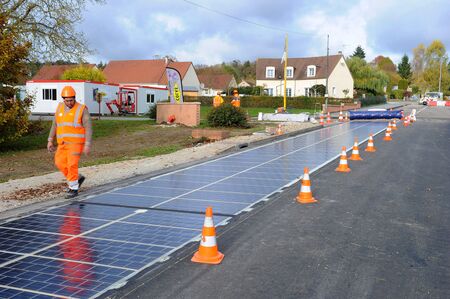
A subsidiary of Bouygues SA has designed rugged solar panels, capable of withstand the weight of an 18-wheeler truck, that they’re now building into road surfaces. After nearly five years of research and laboratory tests, they’re constructing 100 outdoor test sites and plan to commercialize the technology in early 2018.

Wattway’s solar road in Tourouvre

“We wanted to find a second life for a road,” said Philippe Harelle, the chief technology officer at Colas SA’s Wattway unit, owned by the French engineering group Bouygues. “Solar farms use land that could otherwise be for agriculture, while the roads are free.”

As solar costs plummet, panels are being increasingly integrated into everyday materials. Last month Tesla Motors Inc. surprised investors by unveiling roof shingles that double as solar panels. Other companies are integrating photovoltaics into building facades. Wattway joins groups including Sweden’s Scania and Solar Roadways in the U.S. seeking to integrate panels onto pavement.

To resist the weight of traffic, Wattway layers several types of plastics to create a clear and durable casing. The solar panel underneath is an ordinary model, similar to panels on rooftops. The electrical wiring is embedded in the road and the contraption is topped by an anti-slip surface made from crushed glass.

A kilometer-sized testing site began construction last month in the French village of Tourouvre in Normandy. The 2,800 square meters of solar panels are expected to generate 280 kilowatts at peak, with the installation generating enough to power all the public lighting in a town of 5,000 for a year, according to the company.

For now, the cost of the materials makes only demonstration projects sensible. A square meter of the solar road currently costs 2,000 ($2,126) and 2,500 euros. That includes monitoring, data collection and installation costs. Wattway says it can make the price competitive with traditional solar farms by 2020.

screen-shot-2016-11-27-at-21-44-24


The electricity generated by this stretch of solar road will feed directly into the grid. Another test site is being used to charge electric vehicles. A third will power a small hydrogen production plant. Wattway has also installed its panels to light electronic billboards and is working on links to street lights.

The next two sites will be in Calgary in Canada and in the U.S. state of Georgia. Wattway also plans to build them in Africa, Japan and throughout the European Union.

“We need to test for all kinds of different traffic and climate conditions,” Harelle said. “I want to find the limits of it. We think that maybe it will not be able to withstand a snow plow.”

The potential fragility joins cost as a potential hurdle.

“We’re seeing solar get integrated in a number of things, from windows in buildings to rooftops of cars, made possible by the falling cost of panels,” Bloomberg New Energy Finance analyst Pietro Radoia said. “On roads, I don’t think that it will really take off unless there’s a shortage of land sometime in the future.”’

Bloomberg


screen-shot-2016-10-28-at-6-20-33-pm

What will Donald Trump actually do?

It’s a question many Americans are asking themselves now that the U.S. has wrapped up one of its least policy-specific elections ever. The president-elect has offered only the loosest of legislative prescriptions, including whatever plans he may have for the energy industry.

The mystery hangs over turbine manufacturers like Vestas Wind Systems, which fell 12 percent since the election, and coal companies such as Peabody Energy Corp., which soared 73 percent. In his only major energy speech, Trump, 70, said he would rescind “job-destroying” environmental regulations within 100 days of taking office and revive U.S. coal. It’s terrible news for efforts to slow the pace of climate change, but the impact on the renewable energy revolution may be limited. Here’s what it could mean for America’s clean-energy darling, Tesla Motors Inc.:

1. Solar and wind subsidies are probably safe

Tesla is, first and foremost, an electric car company. But on Nov. 17 shareholders will vote on final approval of CEO Elon Musk’s $2.2 billion deal to buy SolarCity Corp. The acquisition would make Tesla the biggest U.S. rooftop solar installer and the first major manufacturer to integrate solar panels with battery backup to extend power into the night.

The swift spread of rooftop solar in the U.S. has been made possible by two government policies. First, most utilities are required to credit homeowners for the excess power they send back to the grid. Those requirements are state-level and shouldn’t be affected by Trump. Second is the 30 percent federal tax credit to offset the cost of installations. The credits were first signed into law under Republican President George W. Bush in 2005 and extended by a Republican Congress late last year. Given their broad support, the subsidies are unlikely to be repealed.

2. Even without incentives, renewables will get cheaper

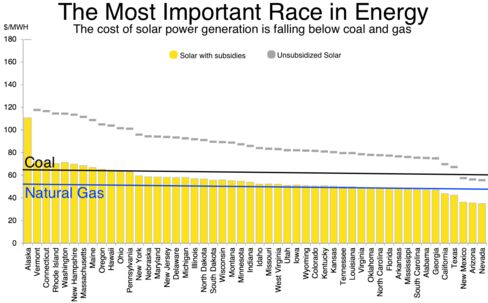
Solar panel prices have dropped, on average, more than 15 percent a year since 2013. On a utility scale, solar power is already cheaper than coal-fired grid electricity across most of the U.S., after subsidies. Even if the incentives were suddenly removed next year—an improbable and economically destructive scenario—the industry would eventually recover as prices continue to fall.

Incentives are designed to make superior new technologies initially affordable, but once those technologies take off, economies of scale take over.

Source: Bloomberg New Energy Finance

A loss of the federal tax credit could slow the rollout of Tesla’s unusual new rooftop solar shingles. Traditional rooftop panels, however, are almost ready to stand on their own. The payback period currently ranges from about 5 to 10 years, after subsidies and state rebates. If Tesla can achieve the cost savings it hopes for with the merger, it won’t be long before that’s the payback timeline without subsidies.

3. Gasoline fuel-efficiency targets could be dismantled

One of President Barack Obama’s most significant climate achievements was to push through ambitious fuel-economy regulations for U.S. vehicles. The Environmental Protection Agency is scheduled next year to re-asses rules intended to double the average efficiency of cars and trucks to almost 55 miles per gallon by 2025. Those goals could be delayed or dismantled under Trump, accelerating America’s shift to trucks and SUVs. Stocks of Detroit carmakers have predictably surged, while Tesla shares fell 4.9 percent in the two days after the election.

This is obviously bad news for human health and the environment, but it’s impact on Tesla won’t be catastrophic. The price of batteries is dropping rapidly, and by the early 2020s electric cars should be cheaper and better performing than their gasoline-powered equivalents across the board. Lowering efficiency standards will make gasoline cars a bit cheaper to manufacture, but it will also make them more costly to drive over the life of the vehicle.

4. Electric vehicle incentives will expire on their own

The U.S. push for electric cars was set in motion by a $7,500 federal tax break. The Trump administration could eliminate the subsidy, but the impact would be short-lived for electric pioneers including Nissan Motor Co., General Motors Co., and Tesla. That’s because the electric-vehicle subsidies were already designed to phase out after each automaker reaches its 200,000th domestic EV sale. Tesla may be first to cross that finish line, probably in the first half of 2018.

The incentives were intended to overcome steep startup costs and slow initial demand for new electric vehicles. Removing the tax break now would effectively pull the ladder up behind Tesla and make it more expensive for other automakers to transition to battery power, a result that wouldn’t be in anyone’s best interest.

5. States wield the power of their own incentives

Some of the biggest incentives in renewable energy are offered by states, not the federal government. Each state has authority over its own solar and wind rebates, credits for power sold back to the grid, renewable-mix requirements for utilities, and electric-car subsidies. These policies cross ideological borders into deeply Republican states. For example, Louisiana residents can get an additional tax credit of almost $10,000 for buying a long-range electric car. In Colorado, it’s an extra $5,000.

Under Trump, the role of cities and states in regulating pollution and expanding clean energy will increase. So will the disparity between states that prioritize the issue and those that don’t. But again, don’t expect the energy revolution to follow rigid red-state, blue-state definitions. The states producing the most wind power in the U.S. include Texas, Kansas, and Oklahoma. For solar, Arizona, North Carolina, and Nevada are among the top ten. Of those, Hillary Clinton won only Nevada.

6. Keystone’s resurrection won’t make gasoline cheaper

This election was great news for oil companies. Reviving the Keystone XL pipeline, which was rejected under Obama, is on Trump’s list of priorities for his first 100 days. He is also likely to support the beleaguered Dakota Access Pipeline. The company building it, Energy Transfer Partners LP, says business is “only going to get better” under Trump.

These pipelines are hugely symbolic for climate activists who say we can’t keep building infrastructure for oil we can’t afford to burn. But the impact of the pipelines themselves is open to debate. They increase profitability for oil companies, but as oil trades on a global market, the impact on U.S. gasoline prices and by extension demand for electric cars is negligible.

7. Trade barriers with Mexico would hurt Tesla’s rivals

Trump wants to scrap or renegotiate the North American Free Trade Agreement (NAFTA). That could be a dicey proposition for the car industry. Since 2010, nine automakers, including Ford Motor Co., GM and Fiat Chrysler have announced more than $24 billion in Mexican investments. They rely on Mexican plants to produce millions of vehicles and a high volume of parts.

By contrast, Tesla’s manufacturing and assembly are done almost entirely in California and Nevada. Tesla also plans to begin solar-panel production next year at SolarCity’s massive plant in Buffalo, N.Y. Tariffs on solar panels made outside the U.S. would make Tesla’s American-made products more competitive.

In the end, the confluence of all of these forces, but especially the precipitous decline of coal and increasing affordability of renewable sources of energy, is probably too strong to be reversed by the incoming Republican administration. That’s good news for Tesla, and a lot of other companies working to clean up the energy supply.

Bloomberg

The more efficient the solar panel, the less space used.

Solar giant SunPower announced on Monday that it can now make a solar panel that can convert 22.8% of the sunlight that hits it into electricity. According to SunPower, that’s a new world record.

The efficiency of solar panels is an important metric to both solar companies and to its customers. When panels are more efficient it mean that rooftops can be covered in fewer efficient panels, which use less materials, but that can generate the same amount of energy as more less-efficient panels.

SunPower says its highly efficient panels can generate 70% more energy in the same space over the first 25 years, compared to less efficient panels. Many solar panels are somewhere between 15% and 18% efficient. SunPower and others have been working to boost the efficiency of panels using material science and optics tech innovations.

Solar companies are in a battle to boost the efficiency of their panels and tout new records. SunPower SPWR -5.85% says its 22.8% solar panel was verified by the federal National Renewable Energy Laboratory.

Last year, SolarCity claimed that it had started making its own highly efficient panels, with an efficiency that “exceeded 22%,” verified by the Renewable Energy Test Center (which isn’t one of the more commonly used verification labs). But SolarCity’s SCTY -5.92% solar panels were also planned to be made in small volumes on a pilot solar panel manufacturing line in Fremont, Calif.

Creating solar panel efficiency breakthroughs in the lab or on a small scale, is far easier than making those efficient panels in very large volumes. But SunPower says the average efficiency of its solar cells (which make up panels) at the end of last year was close to 23%.

SunPower’s stock was up over 3% in morning trading to $21.84. Oil giant Total owns 66% of the Richmond, Calif.-based SunPower.

Last week SunPower announced fourth quarter and year 2015 earnings. SunPower says it generated $1.58 billion in revenue in 2015, with an annual loss of $299.44 million. The company was profitable on an annual basis in 2014 and 2013.

Check out Fortune’s recent interview with SunPower CEO Tom Werner.

Fortune.com

Screen Shot 2015-12-11 at 11.52.08

A solar panel on a thatch roof in Sub-saharan Africa is part of the Azuri PayGo Energy project, which provides eight hours of emission-free lighting each day and enough power to charge cellphones. Users pay a one-time installation fee and top-up as their needs demand.

PARIS, France (UNFCCC) – Sixteen game-changing initiatives from around the world were honoured as winners of a prestigious United Nations climate change award at a special ceremony at the United Nations Climate Change Conference in Paris, on yesterday evening.

“These ‘Lighthouse Activities’ shine a light on the groundswell of climate action around the world,” said UN Secretary-General Ban Ki-moon in a keynote address. “As the world moves toward a future built on low-emissions sustainable development, these bold ideas can inspire leaders to be more ambitious in their own policies and actions.”

The Momentum for Change initiative is spearheaded by the UN Climate Change Secretariat to shine a light on some of the most innovative, scalable and replicable examples of what people are doing to address climate change. This year’s winning activities range from a seriously cool smartphone that puts social values first, to an initiative that is enabling 40 Latin American cities to take concrete climate action.

“I am honoured to celebrate the leadership shown by the people, organisations, companies, and governments recognised as winners of the 2015 Momentum for Change Awards tonight,” UNFCCC Executive Secretary Christiana Figueres said.

“By showcasing these remarkable solutions and the people behind them we can strengthen efforts that must not only start with an agreement here in Paris, but must continue to build, as we accelerate the global transition to a low-carbon, highly resilient development path,” she said.

To help celebrate and recognise the achievements of the 2015 Lighthouse Activities, attendees at the gala event were treated to powerful photos, inspirational videos and a lively musical performance by Sean Paul.

M Sanjayan, a conservation scientist, writer and Emmy-nominated television news contributor, introduced Conservation International’s newest video in its critically acclaimed Nature for Speaking series, titled Home. Bertrand Piccard, Solar Impulse CEO and UNEP Goodwill Ambassador, served as the evening’s master of ceremonies.

“Modern clean technologies have transformed the expensive problem of climate change into a profitable opportunity,” said Dr Piccard. “A global economy that is powered by renewable energy, implements energy efficient and minimises waste will not only tackle climate change, but will also generate health, job creation and profit in the communities where they take place.”

Each of the 16 winning activities touches on one of Momentum for Change’s four focus areas: Urban Poor, Women for Results, Financing for Climate Friendly Investment, and ICT Solutions. All 16 were showcased at a series of special events during the UN Climate Change Conference.

They are:

Urban Poor

•E-waste: From Toxic to Green, India: Creating jobs to keep e-waste out of landfills

•Solvatten Solar Safe Water Heater — Kenya: Reducing emissions while securing access to safe drinking water

•Emerging and Sustainable Cities Initiative | Latin America & the Caribbean: Supporting sustainable growth in emerging cities

Women for Results

•Fostering Cleaner Production — Colombia: Reducing emissions in manufacturing

•Harvesting Geothermal Energy — El Salvador: Generating income with geothermal waste-heat

•Planting Trees to Save the Mangrove — Guinea: Establishing women-led groups that protect forests and generate income

•SELF’s Solar Market Gardens — Benin: Empowering women farmers through solar drip irrigation

Financing for Climate Friendly Investment

•Azuri PayGo Energy — Africa: Innovating pay-as-you-go energy systems for rural homes

•Deforestation-free Cocoa — Peru: Using a carbon-asset-backed loan to protect forests and produce cocoa

•Microsoft Global Carbon Fee — Global: Transforming corporate culture by putting a price on carbon

ICT Solutions

•ChargePoint Electric Vehicle Charging Corridors — United States of America: Building a network of electric vehicle express charging stations

•Enabling Farmers to Adapt to Climate Change — Uganda: Using ICT solutions to build resilience

•Fairphone — The Netherlands: Producing a phone that improves lives and the environment

•Lifelink Water Solutions — Kenya and Uganda: Using ICT tools to provide safe, sustainable and affordable water

•Mapping Exposure to Sea Level Rise — Tonga, Samoa, Vanuatu and Papua New Guinea: Preparing for risk with online spatial tools

•Mobisol Smart Solar Homes — Rwanda and Tanzania: Powering homes with solar energy

The 2015 Lighthouse Activities were selected by an international advisory panel as part of the secretariat’s Momentum for Change initiative, which is implemented with the support of the Bill & Melinda Gates Foundation and The Rockefeller Foundation, and operates in partnership with the World Economic Forum and the Global e-Sustainability Initiative.

Jamaica Observer

Indian Prime Minister Narendra Modi (L) and French President Francois Hollande (R) shake hands during a news conference at the Elysee Palace in Paris, April 10, 2015.      REUTERS/Charles Platiau

Thomson ReutersIndian Prime Minister Narendra Modi and French President Francois Hollande attend a news conference at the Elysee Palace in Paris


PARIS (Reuters) – French President Francois Hollande and India’s Prime Minister Narendra Modi will on Monday launch an international solar alliance aimed at eventually bringing clean and affordable solar energy within the reach of all.

The launch will coincide with a summit of world leaders at the start of two weeks of talks on the outskirts of Paris to seek a new global deal on curbing climate change, by shifting from fossil fuels towards renewable energy.

An Indian government statement on Sunday said there were well over 100 solar-rich countries in the tropics that could be members of the International Solar Alliance to develop clean and affordable solar energy.

“Solar energy is a practical and efficient way to reduce the greenhouse gas emissions,” it said.

Aware of the shadow cast by the failure of the 2009 Copenhagen summit, the last attempt to reach a global climate deal, the United Nations is placing as much weight on the efforts of individual governments as on an overarching U.N. agreement.

More than 180 nations have submitted national action plans, but they are not enough to achieve a goal of limiting global warming to 2 degrees Celsius (3.6 degrees Fahrenheit) above pre-industrial times — the cap scientists say is essential to prevent the most devastating consequences of global warming.

India’s national plan focuses on solar, saying it is expected to grow significantly. The aim is to reach capacity of 100 gigawatts by 2022, to be scaled up further in the future.

Firms such as Tata Power have invested heavily in solar as a reliable source capable of delivering power to some of India’s poorest people.

businessinsider.com

Apple will power all its operations in Singapore—including its first retail location in there–with renewable energy. The iPhone maker confirmed to Reuters on Sunday (Nov. 15) that Singapore-based solar developer Sunseap Group will provide it with 100% renewable electricity from solar energy systems built atop more than 800 buildings.
The systems will generate 50 megawatts of solar energy, enough to power the equivalent of 9,000 homes. Apple will receive 33 MW of the new project’s capacity, according to Reuters.
The news is the latest in a string of Apple announcements about renewable energy. In October it announced it would build 200 MW of solar power in China and push suppliers to make similar commitments. That came on top of two previously announced solar farms in the country producing a combined 4 MW of power.
Earlier this year Apple said it was partnering with First Solar to build a massive farm of solar panels to power its upcoming “Campus 2” headquarters in California. The “spaceship campus” will be powered entirely by renewable energy sources, the company has said.

“We’re doing this because it’s right to do,” Tim Cook said at the time to an audience at a Goldman Sachs event. “But you may also be interested to know that it’s good financially to do it.”
In any case, Apple can afford to make investments in renewable energy, however long they take to pay off.

Surprisingly, Apple does not yet have a retail store in Singapore, a major shopping hub in Southeast Asia. The city-state gets hordes of shoppers from nearby countries, especially Indonesia, the world’s fourth most populous nation. This year, Jakarta alone will send Singapore some 1.7 million visitors, who will spend about $2.7 billion, according to the MasterCard 2015 Global Destination Cities Index.
Apple products in Singapore are currently sold through third-party retailers, mobile carriers, and its online store. The company did not disclose the exact location of the upcoming store, but the Straits Times reported last month on a fitness chain moving out of a prime spot on Orchard Road—Singapore’s leafy, mall-lined shopping mecca—to “make way for Singapore’s first Apple store in 2016.”


Quartz