
Screen Shot 2016-03-29 at 12.58.21

ANGRA DOS REIS, Brazil — In this September 22, 2010 file photo, workers stand by the construction of Petrobras oil platforms in the BrasFels shipyard in Angra dos Reis, Brazil. Brazil’s State-run oil company reported on Monday a record quarterly loss due to a large reduction in some of its assets amid lower oil prices.

Energy stocks and energy-related bonds have had a rough ride over the past year and a half after outperforming considerably over the last decade.

The reason for the decline was simple: the sharp decline in oil prices from over US$100 a barrel to just above US$40 currently.

WTI crude, which was at a high of US$96 in June 2014, is currently trading at US$40 a barrel for a 58 per cent drop, while Brent crude which traded as high as US$107.75 in June 2014 fell 62 per cent to be trading around the US$41 level.

The slide began due to significantly increased supply of US oil production, as hydraulic fracturing was able to retrieve oil from previously difficult to get at locations, as a result of improved drilling technologies. The combination of high oil prices and low interest rates, emanating from Central Banks’ accommodative monetary policies, made such projects economically viable. Consequently, US oil production increased 80 per cent from 2008 through 2014, according to one estimate.

Crude oil inventories in storage at Cushing, Oklahoma, the largest storage hub in the US, increased from 20 million barrels in the middle of 2014 to just below 70 million presently. In addition, on the demand side, slower growth in demand from China seemingly played a significant role in prices declining.

Finally, there was quite a bit of feeling that the high price of oil merely reflected trading and speculation, and that the whole situation would unravel at some point as fundamentals declined. In this case, the catalyst was OPEC’s strategy to increase production in an already oversupplied market to protect market share and ultimately force production cuts from non-OPEC sources as the price plunge continued.

Oil prices fell in excess of 30 per cent in 2014, 40 per cent in 2015, and by mid-February 2016 had plunged by a further 30 per cent, trading in the mid-20s, but have since rallied some 50 per cent to around US$40 a barrel currently. So what’s next for oil? While it’s difficult to predict the future, a continued recovery or at least stability in oil prices, should persist as supply and demand dynamics come back into balance.

Oil slumped to a 12-year low this year on protracted excess supply concerns before rising on speculation that stronger demand and falling US output, coupled with talks of a production freeze between OPEC and Russia, would ease the global surplus. Additionally, there’s the potential for supply shocks in the future after energy companies from Chevron Corp to BP Plc cut billions of US dollars in spending amid the price crash, according to the International Energy Agency (IEA).

Support for oil on the demand side should come from the observation that oil demand tends to go up over time. Global demand for oil, according to an economic estimate, increased from 75.9 million barrels per day in 2000 to 94.2 million barrels per day in 2015 and is expected to rise to 95.6 million in 2016.

The IEA recently expressed the view that oil prices had reached their bottom, given recent developments on the supply side of the equation in particular and improving outlook on the demand side.

OPEC also is apparently anticipating average oil prices of US$50.00 for 2016. It has become increasingly apparent that given the difference fracking has made in increasing available supply to the United States, we will not see US$100 a barrel for a long time — perhaps never again as we begin a slow but likely definite transition to cleaner fuels.

As oil prices continue to rise, look out for more lucrative buying opportunities in some still beaten-down energy assets — but as usual be sure to consult with your investment advisor to ensure that your selections are right for you.

 

Jamaica Observer

Screen Shot 2016-02-25 at 17.08.42

RIYADH, Saudi Arabia (AFP) — The Nigerian and Saudi leaders yesterday supported efforts to stabilise the oil market but Africa’s top producer did not commit to a production freeze.

After talks in the Saudi capital Riyadh, Nigeria’s President Muhammadu Buhari and Saudi King Salman “committed themselves to doing all that is possible to stabilise the market and rebound the oil price,” Buhari’s office said in a statement.

Buhari was in Riyadh a week after Saudi Arabia, Russia, Venezuela and Qatar agreed at talks in Doha to freeze production at January levels in a bid to stem the dramatic fall in oil prices.

The agreement is conditional on other major producers joining in, as oil heavyweights seek to ensure others not to take advantage of output limits to win market share.

The statement after yesterday’s talks made no mention of Nigeria joining the freeze but analysts say the OPEC member is likely to eventually support the move.

The official

Saudi Press Agency also reported that talks between Prince Abdulaziz bin Salman, the Saudi deputy oil minister, and his Nigerian counterpart, junior oil minister Emmanuel Ibe Kachikwu, focused on “the best way for (market) stability” and “the cooperation of producing countries inside and outside OPEC” to achieve this.

Saudi Arabia and its gulf allies in the Organisation of Petroleum Exporting Countries had been refusing to limit or reduce production, leading to a supply glut that has seen prices fall by 70 per cent since mid-2014.

Poorer OPEC members, including Nigeria, have been hard hit by the price drop but even the wealthy Gulf states have been forced to adopt austerity measures to cope with falling oil revenues.

“I wouldn’t be surprised to see them voice their support to the freeze agreed in Doha,” Abhishek Deshpande, lead oil market analyst at Natixis in London, said of Nigeria.

But he said that unless Iraq and Iran also commit to limit production such talks “carry very little weight”.

The two countries are OPEC’s second- and third-largest producers.

Iran, returning to world markets as sanctions are lifted under its nuclear deal, has insisted on boosting production to pre-sanctions levels.

“Some neighbouring countries have increased their production over the years to 10 million barrels per day and export this amount, then say let’s all freeze our oil production,” Oil Minister Bijan Zanganeh said yesterday.

“They freeze production at 10 million bpd and we freeze at 1 million bpd. This is a very funny joke.”

Saxo Bank analyst Christopher Dembik told

AFP that Nigeria’s position is “a bit ambiguous,” supporting the mooted freeze but at the same time wanting to increase its production to respond to domestic market needs.

Nigeria could be crucial

“In the longer term, there is no reason why the country won’t align itself with the position of Saudi Arabia and Russia,” Dembik said.

Nigeria and Saudi Arabia would also discuss their position towards Iran and Iraq, he added.

“Nigeria could have a crucial role in this respect because of its measured position” that Iran and Iraq should elevate their production before envisaging freezes, Dembik said.

“It is probable, then, that Nigeria meanwhile establishes a bridge for negotiations, notably between Riyadh and Tehran.”

According to OPEC’s Monthly Oil Market Report, Iraq produces about 4.4 million barrels a day, followed by Iran at more than 2.9 million.

Saudi Arabia’s output is close to 10.1 million barrels a day, according to January data.

Kachikwu, who is head of Nigeria’s state-run oil firm, also discussed joint oil and gas investments during his meeting with Abdulaziz, SPA reported.

Oil prices nudged higher Tuesday as the two OPEC members met.

US benchmark West Texas Intermediate crude for delivery in April was up one cent at US$33.40 a barrel. Brent North Sea crude for April rose 18 cents to US$34.87 compared with Monday’s close.

After the Saudi visit, the Nigerian delegation was to travel to Qatar for more oil talks.

Jamaica Observer

Oil powerhouses Russia and Saudi Arabia joined Qatar and Venezuela in pledging Tuesday to cap their crude output if other producers do the same, aiming to halt a slide that has pushed oil prices to their lowest point in more than a decade.

The decision followed an unexpected closed-door meeting involving the four countries in the Qatari capital, Doha, and reflects growing concern among big producers about the effects the slump poses to their domestic economies.

Russian Energy Minister Alexander Novak said in a statement issued after the meeting that the four countries would be ready to cap production based on last month’s output levels if others join.

“We are ready to maintain, on average in 2016, the level of oil production of January 2016 and not exceed it,” he said in a subsequent statement.

Whether the plan is enough to put a floor under prices is uncertain. The proposal depends on cooperation from a range of producers with differing budget priorities all scrambling for market share since prices began falling in summer 2014.

Among the hardest to bring on board will likely be Iran. It was noticeably absent from Tuesday’s gathering even though it shares control of a major underwater natural gasfield with fellow OPEC member Qatar.

Iran is eager to ramp up its exports now that sanctions related to its nuclear programme have been lifted, saying recently it aims to put another 500,000 barrels a day on the market. Figures from the International Energy Agency show that it pumped 2.9 million barrels daily in December, before sanctions were lifted.

Iran’s petroleum minister, Bijar Namdar Zangeneh, signalLed the Islamic Republic has no intention of giving up its share of the market. He acknowledged that global markets are “oversupplied,” but said Iran “will not overlook its quota,” according to comments carried by his ministry’s Shana news service.

Venezuelan Oil Minister Eulogio Del Pino heads to Tehran next for talks with his Iranian and Iraqi counterparts today, Wednesday.

“The key OPEC members that need to take part are Iran and Iraq, where the big increases are likely this year, but there are big doubts over whether this can be achieved,” Barclays analysts Miswin Mahesh and Kevin Norrish said in a research note.

Efforts to make the plan work are complicated by deep levels of distrust between regional rivals Saudi Arabia and Iran, which has built close ties to Iraq’s government in the years since the 2003 US-led invasion.

The two countries are in opposing camps in regional disputes from Yemen to Syria. Last month, Sunni-ruled Saudi Arabia cut diplomatic ties with Shiite powerhouse Iran after the Saudi embassy and a consulate were torched by Iranian protesters angry over the kingdom’s execution of a prominent Shiite cleric.

Speaking to reporters after the meeting, Saudi Oil Minister Ali Naimi said producers would continue to assess the state of the market in the months ahead. He described freezing output at January levels as an “adequate” step for now.

All of the countries at Tuesday’s meeting, except Russia, are part of OPEC. Saudi Arabia dominates policymaking within the 13-member bloc of oil-producing countries, which has refused to cut its official production targets. Doing so could bolster faltering prices.

The aim of OPEC’s keep-pumping strategy has been to attempt to ride out the 12-year lows in prices and force higher-cost producers, including shale drillers in the US, out of the market.

The bloc collectively pumped 39 million barrels of crude and natural gas liquids a day in December, or about two out of every five barrels globally. Russia pumps around 11 million barrels a day.

After rising soon after the meeting, a barrel of benchmark New York crude was trading down 35 cents at US$29.09 by midmorning in New York. A barrel of Brent, the international standard, fell 59 cents to US$33.42.

The Gleaner

So much for even cheaper gas!

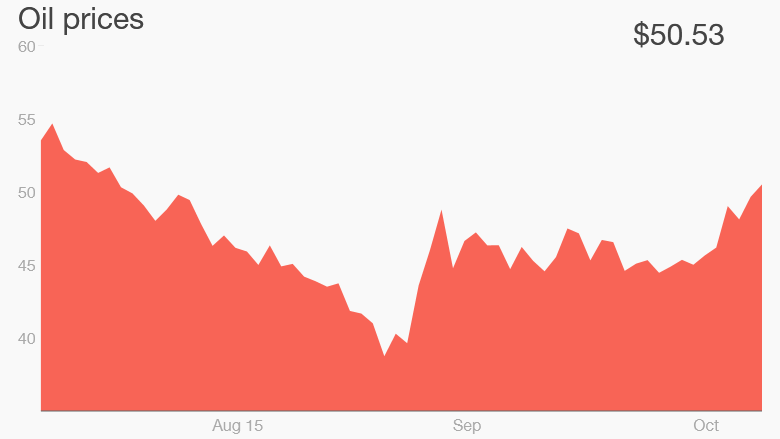
World oil prices have charged higher this week, breaking back above the psychological barrier of $50 a barrel for the first time since July.

U.S. crude futures were trading two percent higher at $50.50 early on Friday.

As recently as last month some analysts were warning of a risk that prices would collapse to $20 a barrel. What’s going on?

Here are three reasons for the bounce:

1. Geopolitical worries

Tensions in the Middle East, the biggest oil producing region, have pushed prices up.

Russia launched a military operation in Syria this week, marking the beginning of a new and closer cooperation between Moscow and the Syrian regime of President Bashar al-Assad. The West has criticized Russia for the move.

Investors are worried more violence in the region could impact production and transport. Reports of Russian cruise missiles falling short and landing in Iran haven’t helped settle their nerves.

oil friday

2. Dovish Fed minutes

Minutes of the most recent Federal Reserve meeting released Thursday showed the central bank is not in a rush to raise U.S. interest rates. The minutes weighed on the dollar — it was down 0.75% against the euro on Friday — which in turn supported global oil prices.

Oil and other commodities are priced in dollars, so a weaker dollar makes them more affordable meaning prices can rise to compensate.

3. Falling U.S. production

The U.S. Energy Information Administration said U.S. crude oil production declined by 120,000 barrels per day in September compared with August.

It said U.S. production will continue declining until the middle of next year, before growth returns in late 2016. The agency also said it expects global demand for oil in 2016 to grow at its fastest in six years — that’s also good for prices.

Oil has been under pressure in recent months, having crashed more than 50% since last summer. Prices fell to their lowest level in six and half years in August, trading below $42 a barrel.

This week’s rally has sparked hope that the market may have finally turned, but some analysts are still cautious.

“We do think that the price of oil will struggle to stay above the $60 level as this will bring on all the rigs which were switched off,” said Naeem Aslam, chief market analyst at Avatrade.

CNN