US Solar Market Sets New Record, Installing 7.3GW of Solar PV in 2015
For the first time ever, solar beat out natural-gas capacity additions.

In yet another record-breaking year, the solar industry in the United States installed 7,286 megawatts of solar PV in 2015. GTM Research and the Solar Energy Industries Association announced the historic figures today ahead of the March 9 release of the U.S. Solar Market Insight report.

FIGURE: U.S. Solar PV Installations, 2000-2015

For the first time ever, solar beat out natural-gas capacity additions, with solar supplying 29.5 percent of all new electric generating capacity in the U.S. in 2015.

Led by California, North Carolina, Nevada, Massachusetts and New York, the U.S. solar market experienced a year-over-year growth rate of 17 percent. Geographically, the market continues to diversify with 13 states installing more than 100 megawatts each in 2015. States that made major solar strides include Utah, which jumped in the rankings from 23rd to 7th place, and Georgia, which moved from 16th to 8th in the nation.

FIGURE: Ranking States by Annual PV Installations

The residential solar market grew 66 percent year-over-year and, for the first time in history, eclipsed the 2-gigawatt mark. The residential solar segment now represents 29 percent of the entire U.S. solar market — its largest share since 2009.

  • For the fourth year in a row, the non-residential market broke the 1-gigawatt mark, but remained roughly flat year-over-year.
  • The utility-scale sector, the mainstay of the U.S. solar market, grew 6 percent year-over-year and represented more than half of all solar PV installed in 2015.
  • Cumulative U.S. solar PV installations have now topped 25 gigawatts, up from just 2 gigawatts in 2010.

FIGURE: Share of U.S. PV Installations by Segment, 2000-2015

“Without a doubt, 2015 was a monumental year for the U.S. solar industry, and perhaps what’s most amazing is that we’re only getting started,” said SEIA president and CEO Rhone Resch. “Over the next few years, we’re going to see solar continue to reach unprecedented heights as our nation makes a shift toward a carbon-free source of energy that also serves as an economic job-creating engine.”

“The U.S. solar market remains concentrated in key states, with the top 10 states accounting for 87 percent of installed capacity in 2015,” said Shayle Kann, senior vice president of GTM Research. “But growth has been widespread, and 24 of the 35 states that we track saw market growth in 2015.”

On March 9, GTM Research and SEIA will release the complete U.S. Solar Market Insight2015 Year in Review with detailed market analysis and updated forecasts.

Key findings:

  • The U.S. installed 7,286 megawatts of solar photovoltaics (PV) in 2015, the largest total ever and 17 percent above 2014
  • The 7.3 gigawatts installed in 2015 is 8.6 times the capacity installed five years earlier in 2010
  • Residential was once again the fastest-growing sector, installing over 2 gigawatts for the first time and growing 66 percent over 2014
  • Utility solar PV also had a record year with over 4 gigawatts installed, up 6 percent over 2014
  • 110 megawatts (AC) of concentrating solar power (CSP) capacity came on-line in late 2015 when SolarReserve’s Crescent Dunes project began sending electricity to the grid
  • Non-residential solar was essentially flat for the third year in a row, installing just over 1 gigawatt
  • Cumulative solar PV installations reached over 25 gigawatts by the end of the year, up from just 2 gigawatts at the end of 2010

Greentech Media 

The more efficient the solar panel, the less space used.

Solar giant SunPower announced on Monday that it can now make a solar panel that can convert 22.8% of the sunlight that hits it into electricity. According to SunPower, that’s a new world record.

The efficiency of solar panels is an important metric to both solar companies and to its customers. When panels are more efficient it mean that rooftops can be covered in fewer efficient panels, which use less materials, but that can generate the same amount of energy as more less-efficient panels.

SunPower says its highly efficient panels can generate 70% more energy in the same space over the first 25 years, compared to less efficient panels. Many solar panels are somewhere between 15% and 18% efficient. SunPower and others have been working to boost the efficiency of panels using material science and optics tech innovations.

Solar companies are in a battle to boost the efficiency of their panels and tout new records. SunPower SPWR -5.85% says its 22.8% solar panel was verified by the federal National Renewable Energy Laboratory.

Last year, SolarCity claimed that it had started making its own highly efficient panels, with an efficiency that “exceeded 22%,” verified by the Renewable Energy Test Center (which isn’t one of the more commonly used verification labs). But SolarCity’s SCTY -5.92% solar panels were also planned to be made in small volumes on a pilot solar panel manufacturing line in Fremont, Calif.

Creating solar panel efficiency breakthroughs in the lab or on a small scale, is far easier than making those efficient panels in very large volumes. But SunPower says the average efficiency of its solar cells (which make up panels) at the end of last year was close to 23%.

SunPower’s stock was up over 3% in morning trading to $21.84. Oil giant Total owns 66% of the Richmond, Calif.-based SunPower.

Last week SunPower announced fourth quarter and year 2015 earnings. SunPower says it generated $1.58 billion in revenue in 2015, with an annual loss of $299.44 million. The company was profitable on an annual basis in 2014 and 2013.

Check out Fortune’s recent interview with SunPower CEO Tom Werner.

Fortune.com

power-lines
Getty Images

Solar’s threat to the utility industry is deeper than not having to purchase electricity

Now that solar power is reaching prime time, the fossil fuel industry is doing all that it can to stop its growth.

For many years solar was on the periphery, installed by early adopters and helped along by government subsidy. But over the last several years, solar has emphatically become mainstream. It is still growing from a low base, but it is now one of the most preferred sources of new electricity generation. The cost of residential solar have been cut in half since 2010, and utility-scale solar has achieved even greater cost declines.

In 2015, the U.S. saw 16 gigawatts of new renewable energy capacity installed, which accounted for two-thirds of the total. Solar alone accounted for about one-third of new capacity last year. Natural gas only captured 25 percent of the newly installed capacity despite several years of incredibly low prices. The banner year for clean energy occurred while 11 gigawatts of coal-fired electricity came offline as old plants were retired amid rising costs and stricter environmental regulation. The clean energy transition is very much underway.

TIME

image1.jpeg

The Jamaica Public Service Company (JPS) says it is unable to definitively state how the use of both automotive diesel oil and liquefied natural gas (LNG) at the Bogue power plant in St James will impact the price of electricity to consumers.

It said the power plant currently burns on automotive diesel oil “and we are doing a conversion that adds the capability to also burn natural gas. So we will end up with the ability to burn both fuels at no extra cost”.

Responding to Wednesday Business queries about the rationale for the dual-fuel facility, the JPS said natural gas will be the primary fuel on which the plant operates and automotive diesel oil will be a back-up fuel “in case we have any problems with receiving natural gas”.

It added that under normal conditions, the plant will effectively be a gas-fired power plant.

IMPACTON ELECTRICITY PRICES

As to how it will impact the price of electricity the JPS said in emailed responses that “we cannot speak to the likely impact on electricity prices given the uncertainty of prices in the future (for oil vs LNG)”.

However, it said that the impact is expected to be negligible given that Bogue only represents approximately 10 per cent of the company’s total costs.

“What we can say with fairly good certainty is that the cost of electricity today is 30 per cent lower than it was one year ago, and we expect that trend to continue throughout 2016, given that 80 per cent of our net generation (production) will still be based on oil, 10 per cent will be from natural gas, and we expect renewables to make up 10 per cent of our net generation once the three renewable energy projects currently under construction (for circa 80 megwatts) are completed before the end of 2016.”

The JPS, an integrated electric utility company and the sole distributor of electricity in Jamaica, added that “that means we continue doing a good job as a country of increasing the penetration of renewable, while also diversifying our fuel mix and reducing our overexposure to oil”.

It said that it is hoping to continue doing more of that through the 37 megawatts of renewables currently being pursued by the Office of Utilities Regulation through a request for proposal, as well as its 190 megawatt gas-fired power plant that will be commissioned in mid-2018.

IMPROVING COMPETITIVENESS

Reducing the cost of electricity is critical to improve competitiveness, according to the International Monetary Fund’s latest updated memorandum of economic and financial policies.

It said that the action plan prepared by the Electricity Sector Enterprise Team foresees replacing current oil-fired generation capacity with gas, coal and ethane-fired plants to achieve significant cost savings.

Next steps will include the conversion of the Bogue power station from oil to gas, a process which the JPS is currently undertaking.

In addition, said the memorandum, the Government has approved the construction of Jamaica’s first natural gas-fired power plant, a 190-megawatt facility to be built and operated by JPS, and to be completed by 2018. Several renewable energy projects are also under way.

The Government said it will prepare a plan to ensure that all public entities – central government, local government and public bodies – meet their financial obligations in a timely manner.

In the memorandum, the Government also pointed out that urgent actions will be taken to reduce the time needed for entrepreneurs to get an electricity connection. Plans foresee the automation of the work processes within the government electrical regulator and the acquisition of an Application Management and Data Automation (AMANDA) software to streamline procedures for scheduling, inspecting, approving and certifying electrical installations.

An action plan for implementation of the reforms and adoption of the AMANDA system are expected to be completed in fiscal year 2016/17, with support from the Inter-American Development Bank.

The Gleaner

Screen Shot 2016-02-01 at 10.24.56

Energy Minister Phillip Paulwell

ALMOST a year after net billing was suspended, there are indications that the programme is to resume, although Energy Minister Phillip Paulwell is yet to set a timeline.

He said recommendations have been made to the Office of Utilities Regulation (OUR) to resume processing licences. But, before that can happen, the Electricity Lighting Act must be amended and the Jamaica Solar Energy Association (SEA) raised concerns that nothing has been done to have the legislation amended.

At Wednesday’s national conference for the development of an energy services company industry in Jamaica, Paulwell said that the Government is committed to reopening net billing.

He, however, explained that while the law names the Energy Sector Enterprise Team (ESET) as the body responsible for regulating new generation capacity, it was felt that it (net billing) is not appropriately placed at ESET, and that the OUR is expected to resume processing net billing licences.

So far, more than 300 licences have been issued, but solar energy providers have not been able to interconnect to the JPS grid since May of last year.

David Barrett, president of SEA, says the association’s membership is still in a state of confusion.

“It’s static now (the sector) because people have no entity to get a licence from, they don’t know who to go to. Some persons have gone to the OUR or the JPS (Jamaica Public Service company) but they can’t do it because of the obvious reasons,” he told the Jamaica Observer last Thursday.

Over the months, entrepreneurs in the solar energy sector have complained bitterly of suffering millions in losses after the JPS stopped net billing to carry out an assessment of the pilot. The review was completed by the United States’ National Renewable Energy Laboratory and the report made public in June, but all grid interconnection for new net billing projects islandwide have still remained on hold.

Solar energy providers say the prolonged suspension has dealt their outfits a serious blow, arguing, too, that the JPS has too much power over the arrangement and that the Government needs to act decisively on the issue.

Barrett said the members are neither pleased with the pace of the process nor the new conditions that are being established.

“What has been decided is that the cap is to be five megawatts instead of 11 as it would have been in the previous phase, and that the cap for the individual locations will remain as they are. The association is not too happy about that because we feel that there is easy opportunity to increase potential for renewables in Jamaica without disturbing the grid in any way,” he told the Observer earlier this month.

Additionally, Barrett expressed disappointment that the association had not been invited to the table when the new cap was being set. “So we don’t have the information that fed into the decision-making process,” he stated.

Net billing permits JPS customers, who own renewable energy generators, to produce electricity for personal use and to sell excess energy to the light and power monopoly at wholesale prices, which are set by the OUR.

Jamaica Observer 

Ten companies submitted bids to build and operate renewable energy plants that run on solar, wind, water or waste, but two are in danger of being disqualified for non-payment of the bid security.

The Office of Utilities Regulation (OUR) received the bids for supply of up to 37 megawatt of renewable power to the grid on Wednesday and will determine the preferred bidders by April.

The bids included a 24.7MW waste-to-energy plant at US$110 million, by Green Waste Energy Inc; a 37MW wind plant at US$61 million by Wigton WindFarm Limited; a 20MW solar plant, at US$33.15 million, by WRB Enterprise Inc and a separate bid to build a 37MW solar plant at US$72.15 million, which contains three options.

Great Valley bid US$50 million to develop a 26.4MW wind farm; Tamarind Energy proposed a 36.3MW at US$76.96 million; and BMR Jamaica bid US$18.27 million for a 9.9MW wind farm to expand the existing wind farm that it is developing in central Jamaica.

The other four bids were a 37MW solar project at US$48.7 million with an alternative option by Eight Rivers Energy Company Limited; a 2MW hydropower project, at US$8.9 million, by Petroleum Corporation of Jamaica; a 37MW solar plant at US$77.14 million by Jamaica Energy Partners; and a 30MW biothermal energy plant, at US$93.8 million by Bio Energy Resources Limited.

“We are happy with the process. It was done in an orderly and professional manner,” said Angella Rainford of Eight Rivers Energy Company following the bid openings held at the OUR.

“The returns are attractive, but it’s also the right fit for the country as it mitigates against the reliance on oil,” said Rainford.

Eight Rivers took no chances and submitted a US$700,000 bid security.

Two of the 10 bidders – Green Waste Energy and Bio Energy Resources – did not put up the required security, OUR legal Chenee Rily disclosed at the bid opening.

The OUR required each bidder to submit security equivalent to one per cent of the project cost.

“The only two bids with firm capacity failed to offer a bid security it’s unfortunate,” said Cecil Gordon, the director of generation at Jamaica Energy Partners, in discussion with the Financial Gleaner at the OUR event. “Waste-to-energy gives a constant output so it’s firm capacity.”

Gordon explained that wind solar and hydro can fluctuate depending on external factors, including weather. He also indicated that waste-to-energy projects are more expensive to operate – “which means a lower return,” he added.

OUR said on Thursday that the decision on whether to disqualify the two waste-to-energy bids would be considered by the bid review committee when it convenes.

Last July, the OUR issued a Request for Proposals (RFP) from local and international interests to supply up to 37MW of electricity generation from renewable energy resources on a build, own and operate basis. Wednesday was the deadline for the receipt of bid documents.

This latest project is to complete an RFP process started in 2012 to identify interested entities to submit proposals for the supply of one or more plants of varying configurations greater than 100kW and up to 115MW of renewable energy. At that time, 78MW was identified from three successful bidders.

The Gleaner

A woman wears as mask while walking in a neighbourhood next to a coal-fired power plant on Nov. 26, 2015, in Shanxi, China.

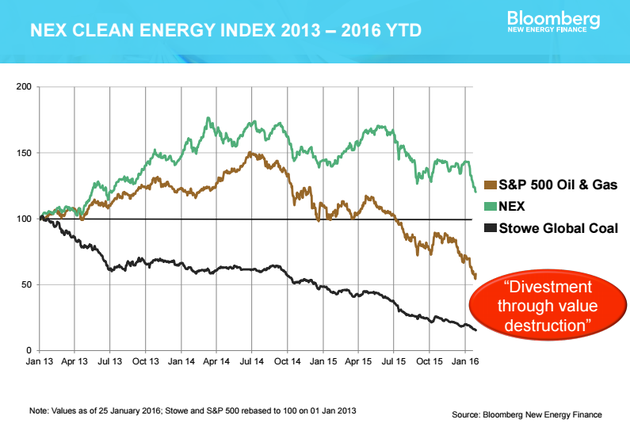
The market is encouraging pension funds and institutions to jettison fossil fuels from their portfolios, waving a clear warning flag to investors about the financial future of oil and coal companies.

Fossil fuel stocks are performing poorly compared to the market as a whole — and perhaps most importantly, compared to renewable energy stocks, said Michael Liebreich, chairman of Bloomberg New Energy Finance, at a summit on climate risk put on by the nonprofit sustainability advocacy group Ceres.

Referring to investors who won’t divest and continue to own fossil fuel stocks, Liebreich pointedly said that the market was “divesting through value destruction” — in other words, cutting their holdings in traditional, polluting energy companies by slashing their value.

Renewable energy stocks have dramatically outperformed fossil fuels.

Over the last 10 years, the S&P 500 index is up just over 50 percent. Yet energy stocks over the same time period have risen only 1.3 percent.

For big investors to simply allow their holdings in big energy companies to fall toward a vanishing point of worthlessness is deeply irresponsible, observers say.

Indeed, former Vice President Al Gore, who shared the Nobel Peace Prize in 2007 for his work on climate change, compared the risk that some fossil fuel companies’ assets will become worthless to the danger of mortgage-backed securities, whose collapse triggered the 2008 financial crisis.

The nonprofit research group Carbon Tracker estimates that if the world changes its energy sources to keep climate change below 2 degrees Celsius, $2 trillion in fossil fuel assets will be stranded — that is, unusable, far less valuable, and in some cases, liabilities.

Huffington Post

Jamaica is to reduce greenhouse gas emissions by the equivalent of 1.1 million metric tonnes of carbon dioxide per year by 2030, as part of its global commitment to take climate-change mitigation action.

To bring this about, the island – as reflected in its nine-page Intended Nationally Determined Contributions (INDCs) document to the United Nations Framework Convention on Climate Change – has undertaken to implement energy policies that ensure the island:

– uses energy wisely and aggressively to pursue opportunities for conservation and efficiency;

– has a modernised and expanded energy infrastructure that enhances energy generation capacity and ensures that energy supplies are safely, reliably and affordably transported to homes, communities and the productive sectors on a sustainable basis; and

– achieves its energy resource potential through the development of renewable energy sources by increasing their share in its primary energy mix of 20 per cent by 2030.

Such policies are also to ensure that government agencies and ministries are a model/leader in energy conservation and environmental stewardship, and that the island has a well-defined and established governance, institutional, legal, and regulatory framework.

Fully implemented energy polices need, too, to ensure that private industry embraces “efficiency and ecological stewardship to advance international competitiveness and to move towards a green economy”, the document said.

The Gleaner

The oil-fired JPS power plant in Old Harbour Bay, St Catherine is to be replaced with a gas-fired plant.

The announcement of an agreement between Jamaica Public Service Company (JPS) and a Chinese firm is expected this week for the construction of the new energy plant at Old Harbour.

JPS and American company New Fortress Energy are executing separate projects at Old Harbour – the Jamaican utility company is building a new 190 MW plant, while Fortress is financing and developing the gas infrastructure to supply the plant with LNG.

Together, the projects are estimated at around US$500 million.

JPS said it will have no ownership in the gas infrastructure project nor contribute to the cost of developing it, but will solely be a client of New Fortress, which will build its pipeline to connect to the JPS plant. The same arrangement applies to the gas infrastructure under development by New Fortress in Montego Bay, which will feed gas to JPS’ Bogue plant.

The utility company said previously that the 190 MW combined cycle plant at Old Harbour is expect to cost close to US$300 million.

The name of the Chinese contractor will be disclosed only after the deal to develop the plant is finalised, JPS said. The utilitycompany had previously chosen Abengoa to develop the plant only to be embarrassed when the Spanish firm filed for bankruptcy protection in its home country just days later.

JPS is also in final negotiations with General Electric (GE) as the primary equipment supplier for the Old Harbour plant.

“JPS is currently finalising the agreements with both GE and the ‘EPC’ contractor and coordinating the start of this new generation facility with the completion of an associated LNG facility that will be built to provide gas. These two projects will total over US$500 million and begin operation in early 2018 with full commercial operation by the middle of 2018,” said JPS via email.

EPC is a categorisation, which stands for ‘engineering, procurement and construction’ contractor.

The plant’s advance GE turbines will utilise cleaner burning natural gas, replacing the heavy fuel oil currently used at Old Harbour, and will be able to integrate increased solar, wind and hydro resources as Jamaica moves towards producing more electricity from renewable resources.

“GE will provide four turbines – three gas turbines and one steam turbine the three heat recovery steam generators, the four electrical generators and the major controls,” said JPS.

Once the new Old Harbour plant is built, the current structure will be dismantled, and the property will resort to brownfield status, according to JPS spokeswoman Winsome Callum.

New Fortress is negotiating separately with the Electricity Sector Enterprise Team regarding its gas project, Callum said.

JPS has spent some US$4 million so far in preparing for the upgrade over the past 24 months.

The  Gleaner

NCB Group headquarters, The Atrium, at Trafalgar Road, New Kingston. The banking group’s energy initatives have cuts its electricity bill by 20 per cent across its network.

National Commercial Bank Jamaica (NCB) has cut its energy consumption by 20 per cent over the past four years and is projecting half-billion dollars of new savings over the next four.

By tinting its windows, changing its light and air-conditioning units, and installing some solar photovoltaic (PV) systems, the bank hopes to cut its electricity bill by another eight per cent in 2016.

If it achieves its latest goal, NCB would spend $140 million less on energy this year than it would if it had not implemented any of the energy-saving initiatives that started in 2011.

Back then, the financial institution forked out over $600 million to keep the lights on. Air conditioning accounted for more than 60 per cent of the energy use while lighting accounted for another 20 per cent, so it was decided that light-emitting diode (LED) lights would be installed across its locations, while high efficiency air-condition units and solar systems have been put in place at select sites, such as NCB’s head office on Trafalgar Road.

Reflective tinting on windows, roof insulation, and automated light controls have also helped protect the bank’s buildings from heat infiltration and have enhanced the energy-saving process.

This year, NCB plans to “continue implementing projects to install high-efficiency air-conditioning systems at relevant locations and increase the use of LED and PV panels,” according to the latest annual report.

So far, it has spent $500 million to implement various energy-reduction initiatives.

“We have an energy portfolio that is continuously being assessed, and our expenditure is guided by our environmental policy and, therefore, is subject to variations,” said NCB in reply to Sunday Business queries.

With the energy-saving expenditure, the banking group has so far avoided some $300 million in energy cost over the past four years, and expects to save another $500 million over the next four, based on current energy rates.

NCB can also boast a positive contribution to the environment. By reducing its energy consumption by 2.7 million kilowatt-hours – which is equivalent to the electricity used by 1,350 homes in Jamaica – it has reduced its footprint by approximately 1,800 metric tonnes of carbon dioxide annually. That’s the equivalent of the emissions given off by a plane making 25 round trips to and from New York, or by 100 cars driving from Kingston to Mandeville and back every day for a year.