
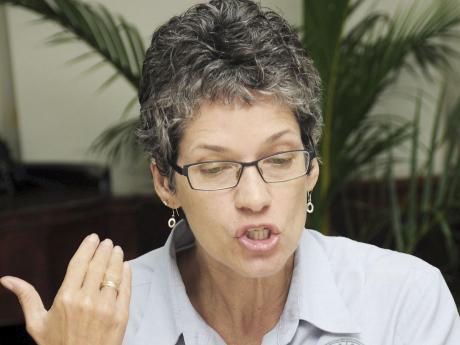
McCaulay … It appears the environment will be under the Office of the Prime Minister along with a lot of different, other important national areas and I fear the environment focus will be lost in the other priorities.

Prime Minister Andrew Holness has attracted the attention of environmentalists with the exclusion of the environment and climate change portfolio as a named ministry in his Cabinet.

For environmentalists, it does not send a positive signal.

“I am disappointed to see that there is no environment ministry and no environment minister. It appears the environment will be under the Office of the Prime Minister along with a lot of different, other important national areas and I fear the environment focus will be lost in the other priorities,” said Diana McCaulay, Chief Executive Officer of the Jamaica Environment Trust (JET).

“I don’t think this first signal is a very positive one. It used to be that the environment portfolio moved around from ministry to ministry. Now it would it seem to have disappeared entirely,” she added.

Only last week, JET, along with a number of other entities, including the Windsor Research Centre, urged the new Prime Minister to give priority to a host of environment issues, notably:

*climate Change
*Cockpit Country
*planning for sustainable development
*protected areas
*sanitation and public health
*enforcement of environmental laws

With the Jamaica Labour Party vowing in its manifesto to work with environment actors, McCaulay said she was eager to learn how the realities of the new Cabinet will gel with the identified priority areas.

“I would like to hear the details of how this would work sooner rather than later and I would like to hear a timeframe for doing some of the things stated in the manifesto,” she told The Gleaner.

Head of the South Trelawny Environment Agency Hugh Dixon was in agreement.

“I think with growth and prosperity being the sort of thrust of the new government, it seems to be an awful oversight as the issues that are at the forefront of development are predicated to a great extent on an awareness and sensitivity to [for example] climate change,” he said.

According to Dixon, the situation is will challenge civil society environment groups to gain traction in terms of the significance and value of climate change, and the environment.

“I would, with caution, say that I hope that wherever it has been dispensed to, it holds some order of priority consistent with its current standing globally and any sort of growth and development agenda,” he added.

Former Minister of Local Government and Community Development, and one-time Opposition spokesman on Environment Noel Arscott has himself questioned the rationale behind the lack of a designated ministry of environment and/or climate change.

“Jamaica and the Caribbean fall in one of the most vulnerable regions in the world affected by the vagaries of the weather. We certainly are victims of any kind of climate change impacts… So for a government not to put that on the front burner was really shortsighted…” he said.

The Gleaner

IN THE face of Energy World International’s (EWI) placement of its US$7-million security bond on the 360-megawatt power plant deal, it is opportune for the Government to take a hard look at the Office of Utilities Regulation (OUR) and take some serious decisions about the place. And they must be quick about it.

The first order of business is to find an obviously strong, competent and independent-minded head for the place, with a clear understanding that part of his or her mandate is cleaning shop, even as it gets on with the job of completing the energy project.

Putting this process in train lies squarely with Prime Minister Portia Simpson Miller. It is her obligation, under the OUR Act, to recommend the candidate for the post of director general of the regulatory body to the governor general. If, as we suspect, it was the case in the past that prime ministers allowed line ministers to effectively name the nominee, we recommend that Mrs Simpson Miller break with practice.

For ceding that responsibility, at this time, to Phillip Paulwell, would be to handicap the appointee, given the collapse of confidence in Mr Paulwell’s mining and energy ministry to get anything right, given the mess that has been made of the power plant issue.

To be fair, that is not all Mr Paulwell’s fault. Much, and perhaps most, of the blame rests with the OUR.

A CLUMSY HANDLING OF THE MATTER

That Jamaican consumers pay an unaffordable economic rent for electricity, which at US$0.42 per kilowatt-hour is among the highest in the region, is well known. Understand that it makes our firms uncompetitive, which, in turn, constrains economic growth.

Yet the OUR, which has been governing the responsibility for procurement of newer, and supposedly cheaper, generating capacity, has, at best, and perhaps charitably, been clumsy and bungling in its several attempts at the process. Its latest was the worse.

Delivering cheaper energy to Jamaica, which would be good for the economy, also coincides with Mr Paulwell’s political interest/ambition. It is understandable that when EWI declared an interest in Jamaica, with an apparently attractive proposal, that he would be keen to have that considered, notwithstanding that it was after the OUR’s initial deadline for unsolicited offers/expressions of interest.

THE OUR NEEDS A FIX

The response of those already engaged in the process, who might have felt they were in the most advantageous positions, was entirely predictable. The claim that the goalpost was being shifted was obvious.

But worse than Mr Paulwell was the OUR. The agency disagrees with the Office of the Contractor General that it breached the procurement rules; that EWI’s proposal should not have been entertained; and that if it was to be considered, the initial request for proposal abandoned and the process started anew. Beyond the technical issues of the procurement rules is the weak, or failed communication strategy on this issue, which has left the public uneasy about the basis of its decision.

The OUR is a critical regulatory agency. But it is need for an urgent fix. That is why we feel that a public-private sector oversight group should be part of the strategy for this energy project.

Mobile Jamaica Gleaner;