
Normal is not a homonym, but it could be. It means standardisation, but it also alludes to a range of typical occurrences.

In statistics, a normal distribution is a set of observations that occur around a mean. In common society, normal is an acceptable form of behaviour.

Whatever the case, it means a range of events that centre on an average. The problem with ‘normality’ is that averages move. For example, fashions change. Music styles evolve. Normal dress from a century ago is no longer acceptable.

The same occurs in markets. Shocks force occurrences to morph, leading to corresponding movements in price ranges. A few years ago, pundits began using the notion of ‘new normal’. This meant that the market had shifted to a different range that would now be considered typical. Three years ago, high commodities prices were considered normal. Last year, plunging commodity prices became the new normal.

However, we are again witnessing a movement to a different normality.

Most visible in oil sector

Last year’s massive reduction in commodity capex set the stage for an eventual spike in prices. The situation has been most visible in the oil sector. At the end of 2014, many Wall Street firms began cutting their oil forecasts, calling for a “new normal”.

They cited the slowdown of the Chinese economy and overproduction in the United States and the Middle East for their pessimistic outlook.

However, they seemed to have forgotten the natural depletion aspects of commodities. Oilfields, mines and farms are not eternal. Production decays as the resources are depleted. Oilfields run dry. Mineral deposits are depleted. Nutrients are taken out of the soil. That is why commodity producers constantly need to plough capital into exploring for new mineral deposits and replenishing farms. This makes the sector extremely capital intensive.

Each commodity product has a different decay schedule. Offshore oilfields, for example, have a natural depletion rate of about 20 per cent per year. Meanwhile, some onshore fields have an annual depletion rate of only two per cent. Analysts estimate that the average annual global depletion rate for the oil sector is about 4.5 per cent.

It takes time

The problem is that the oil industry slashed capex by US$380 billion since 2014, reaching half of total sector capital investment in 2016. This means that oil production will decline at some point, with the effect accelerating in the years to come. The typical gestation period for a new oil project is about seven years, from the start of exploration to full production.

It takes time to do the necessary seismic surveys. Most of the new oilfields are in remote areas, which require the construction of facilities for workers. Heavy equipment needs to be deployed. Plus, transportation infrastructure – including roads, pipelines and ports – needs to be put in place in order to bring the products to market.

Oil, as well as most of the other commodity products, cannot be switched on and off. They require a great deal of time and capital to bring them to market.

Unfortunately, the decline is already materialising. The net decline in United States oil production is estimated at about 600,000 barrels per day (bpd) in 2016 and another 400,000 bpd in Latin America.

At the same time, the global economy is growing at a pace of about two per cent y/y. Hence, total demand should rise by about a million bpd. As a result, the two million bpd glut that was estimated at the end of last year will evaporate in 2016. This should bring oil prices to a more neutral equilibrium price of about US$60 per barrel before the end of the year.

However, it also means that oil prices will continue to move higher in 2017 and beyond.

Until we see a meaningful increase in capex, output will continue to decline. Therefore, we can expect prices to overshoot on the upside.

The results of this scenario are a boom for oil-producing countries, such as Venezuela. With annual oil exports of about 640 million barrels, an oil price of about US$50 to US$60 will allow Venezuela to produce annual exports of about US$32 to US$38 billion.

Venezuela and PDVSA’s annual bond debt service is about US$9 billion, giving the country between US$23 billion to US$29 billion to pay for imports. This is more than twice the minimum import levels that are estimated to sustain the economy.

As a result, the government will not need to recur to its supplemental liquid and non-liquid assets, such as international reserves, gold holdings, offshore refineries and PetroCaribe, to meet their external obligations.

Of course, other large oil-producing countries, such as Russia, Mexico, Nigeria and Angola will also benefit from the looming changes in the international oil markets.

Therefore, we are now moving the parameters for a ‘new normal’ that will be much more conducive for the emerging world.

Dr Walter T. Molano is a managing partner and the head of research at BCP Securities LLC.
wmolano@bcpsecurities.com


The Gleaner

So much for even cheaper gas!

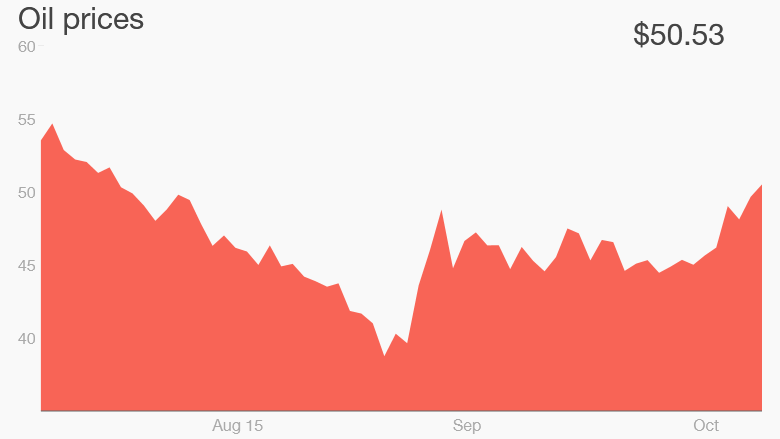
World oil prices have charged higher this week, breaking back above the psychological barrier of $50 a barrel for the first time since July.

U.S. crude futures were trading two percent higher at $50.50 early on Friday.

As recently as last month some analysts were warning of a risk that prices would collapse to $20 a barrel. What’s going on?

Here are three reasons for the bounce:

1. Geopolitical worries

Tensions in the Middle East, the biggest oil producing region, have pushed prices up.

Russia launched a military operation in Syria this week, marking the beginning of a new and closer cooperation between Moscow and the Syrian regime of President Bashar al-Assad. The West has criticized Russia for the move.

Investors are worried more violence in the region could impact production and transport. Reports of Russian cruise missiles falling short and landing in Iran haven’t helped settle their nerves.

oil friday

2. Dovish Fed minutes

Minutes of the most recent Federal Reserve meeting released Thursday showed the central bank is not in a rush to raise U.S. interest rates. The minutes weighed on the dollar — it was down 0.75% against the euro on Friday — which in turn supported global oil prices.

Oil and other commodities are priced in dollars, so a weaker dollar makes them more affordable meaning prices can rise to compensate.

3. Falling U.S. production

The U.S. Energy Information Administration said U.S. crude oil production declined by 120,000 barrels per day in September compared with August.

It said U.S. production will continue declining until the middle of next year, before growth returns in late 2016. The agency also said it expects global demand for oil in 2016 to grow at its fastest in six years — that’s also good for prices.

Oil has been under pressure in recent months, having crashed more than 50% since last summer. Prices fell to their lowest level in six and half years in August, trading below $42 a barrel.

This week’s rally has sparked hope that the market may have finally turned, but some analysts are still cautious.

“We do think that the price of oil will struggle to stay above the $60 level as this will bring on all the rigs which were switched off,” said Naeem Aslam, chief market analyst at Avatrade.

CNN

The price of oil edged higher Monday as tension increased between Syria and Israel.

The benchmark oil contract for June delivery rose 55 cents to close at $96.16 per barrel on the New York Mercantile Exchange. It was the third straight day of gains for oil, and the first close above $96 since April 2.

Prices rose early Monday on news of an Israeli military strike in Syria, raising concern of an expansion in conflict in the oil-rich Middle East. The price fell back below $95 before rising again late in the day.

Brent crude, which is the benchmark for international oil varieties and more susceptible to news from the Middle East, gained $1.27 to $105.46 per barrel on the ICE Futures exchange in London.

In other energy futures trading on the Nymex, wholesale gasolene rose 4 cents to $2.87 a gallon, heating oil rose 4 cents to $2.92 a gallon and natural gas fell 3 cents to $4.01 per 1,000 cubic feet.

– AP

Read more:

Oil prices rebounded today, from a two month low, to a two month high, as tensions between Syria and Turkey fanned concerns, that exports from the Middle East may be curtailed.

Lawmakers in Turkey gave their government a one year mandate for possible military incursion into Syria, after explosives from Syria killed Turkish citizens.

The tension saw prices jumping by 3 dollars 57 cents, erasing almost all of yesterday’s 3 dollars 75 cents loss.

It pushed the price of oil up, by 4 point 1 percent, to 91 dollars 71 cents a barrel.

It was the biggest increase in oil prices since August 3, and means prices are up 15 percent, since the start of the year.

Read more:

Oil prices fell on Wednesday for the third day in a row as traders realised that a recent run-up to $100 may have been overdone.

Oil ended at $91.98 on Wednesday, dropping $3.31, or 3.5 per cent. That was its lowest close since August 3. Oil has fallen 7 per cent this week.

Several things have been pushing prices down. Analysts said traders are taking profits after oil got above $100 per barrel on Friday for the first time since May. And there have more signs this week that the global economy is slowing down, which tends to push oil prices lower because people and businesses use less energy.

Also, crude inventories rose three times more than analysts had expected last week. Crude supplies grew by 8.5 million barrels to 367.6 million barrels. That’s 8.4 per cent higher than at the same time last year, according to the Energy Information Administration‘s weekly report.

Analysts expected a rise of 2.5 million barrels, according to Platts, the energy information arm of McGraw-Hill Cos.

There were also reports that Saudi Arabia is keeping production high to drive oil prices lower.

Oil’s decline came despite some news that might have pushed prices higher. The Bank of Japan said on Wednesday that it would buy more government bonds, which is intended to boost Japan’s economy. And ongoing tensions in the Middle East have tended to drive prices higher.

“Yet we continue to fall,” said Addison Armstrong, senior director for market research at Tradition Energy. “I think that has accelerated some profit-taking. After all, crude did have a pretty good run from $86 up to $100.”

Brent crude traded on the ICE Futures exchange in London fell $3.84, or 3.4 per cent, to $108.19 per barrel.

Traders were also keeping their eyes on oil supplies as US Gulf Coast refineries returned to production after shutting down due to Hurricane Isaac.

“We’re getting back a few more refineries post (Hurricane Isaac), but on the flip side a few refineries had some restart issues and a few are headed into maintenance,” said Carl Larry of Oil Outlooks and Opinions in a newsletter.

Regular gasolene at the pump fell a half a penny to an average of $3.854 per gallon.

– AP

http://jamaica-gleaner.com/gleaner/20120920/business/business1.html

Oil prices fell on Wednesday for the third day in a row as traders realised that a recent run-up to $100 may have been overdone.

Oil ended at $91.98 on Wednesday, dropping $3.31, or 3.5 per cent. That was its lowest close since August 3. Oil has fallen 7 per cent this week.

Several things have been pushing prices down. Analysts said traders are taking profits after oil got above $100 per barrel on Friday for the first time since May. And there have more signs this week that the global economy is slowing down, which tends to push oil prices lower because people and businesses use less energy.

Also, crude inventories rose three times more than analysts had expected last week. Crude supplies grew by 8.5 million barrels to 367.6 million barrels. That’s 8.4 per cent higher than at the same time last year, according to the Energy Information Administration‘s weekly report.

Analysts expected a rise of 2.5 million barrels, according to Platts, the energy information arm of McGraw-Hill Cos.

There were also reports that Saudi Arabia is keeping production high to drive oil prices lower.

Oil’s decline came despite some news that might have pushed prices higher. The Bank of Japan said on Wednesday that it would buy more government bonds, which is intended to boost Japan’s economy. And ongoing tensions in the Middle East have tended to drive prices higher.

“Yet we continue to fall,” said Addison Armstrong, senior director for market research at Tradition Energy. “I think that has accelerated some profit-taking. After all, crude did have a pretty good run from $86 up to $100.”

Brent crude traded on the ICE Futures exchange in London fell $3.84, or 3.4 per cent, to $108.19 per barrel.

Traders were also keeping their eyes on oil supplies as US Gulf Coast refineries returned to production after shutting down due to Hurricane Isaac.

“We’re getting back a few more refineries post (Hurricane Isaac), but on the flip side a few refineries had some restart issues and a few are headed into maintenance,” said Carl Larry of Oil Outlooks and Opinions in a newsletter.

Regular gasolene at the pump fell a half a penny to an average of $3.854 per gallon.

– AP

http://jamaica-gleaner.com/gleaner/20120920/business/business1.html

Oil declined to a two-week low as Saudi Arabia was said to be taking action to lower prices and increasing concern that an economic slowdown will curb demand.

Oil fell for a second day as a Persian Gulf official said Saudi Arabia is pumping about 10 million barrels a day and will produce more if customers demand it.

Prices tumbled 2.4 percent yesterday, at one point dropping 3 dollars in less than a minute on a surge in volume.

At the end of today the price was down 1 dollar 33 cents or 1.4 percent, to 95 dollars 29 cents a barrel on the New York Mercantile Exchange, the lowest settlement since August 30.

The two-day decline was 3.7 percent.

Prices are down 3.6 percent this year.

Read More:

Oil declined to a two-week low as Saudi Arabia was said to be taking action to lower prices and increasing concern that an economic slowdown will curb demand.

Oil fell for a second day as a Persian Gulf official said Saudi Arabia is pumping about 10 million barrels a day and will produce more if customers demand it.

Prices tumbled 2.4 percent yesterday, at one point dropping 3 dollars in less than a minute on a surge in volume.

At the end of today the price was down 1 dollar 33 cents or 1.4 percent, to 95 dollars 29 cents a barrel on the New York Mercantile Exchange, the lowest settlement since August 30.

The two-day decline was 3.7 percent.

Prices are down 3.6 percent this year.

Read More:

Oil rose for a second day on the back of the Federal Reserve‘s aggressive plan to boost the US economy. More gains are expected, but that might not translate into a spike in prices at the gas station.

After earlier topping US$100 for the first time since May, benchmark oil was up 72 cents to US$99.03 per barrel in midday trading in New York.

Analysts say the Fed’s plan to keep interest rates at extraordinarily low rates into 2015 gives investors the incentive to put their money into riskier assets like stocks and commodities. The expectation that the Fed’s moves will help the economy should also boost oil prices because demand for energy should pick up.

But the higher oil and other commodities rise, the greater the chance they’ll curtail consumer spending in an economy where unemployment is stuck above 8 per cent. That’s why analysts think the gains should be limited.

“Higher commodity prices are going to put a dent in spending as they give consumers pause when they’re spending more at the (grocery) store or the gas pump,” said Andrew Lipow of Lipow Oil Associates in Houston.

An increase in the price of oil usually means a rise in pump prices. But fundamentals favor a decline in the price of gasoline, said Tom Kloza, chief oil analyst at Oil Price Information Service. The end of summer driving season means less demand for gas. And refiners are about to switch to making winter blends, which are cheaper than summer blends formulated to cut down on pollutants.

Kloza thinks gas might rise a penny or two from its current average of US$3.87 per gallon, but should decline during the period between late September and Thanksgiving. He sees gasoline falling to between US$3.50 and US$3.75 per gallon in October.

The wild card for oil is the unfolding unrest in the oil-rich Middle East. Protesters angry over an anti-Muslim film ridiculing the Prophet Muhammad began assaulting a string of US embassies in the region four days ago.

Brent crude, which is used to price a number of international types of oil, rose 74 cents to US$116.62 in London. Kloza said an escalation in the Middle East situation could push Brent up as high as US$125 per barrel and the US benchmark as high as US$120. That would limit the decline in gasoline prices, he said.

Read more: