
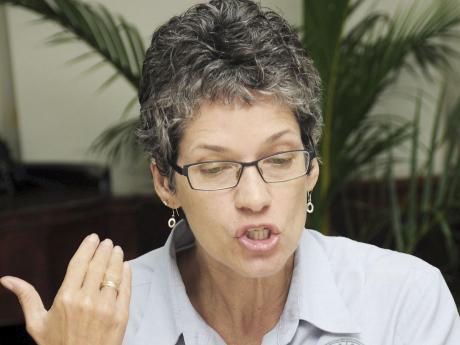
McCaulay … It appears the environment will be under the Office of the Prime Minister along with a lot of different, other important national areas and I fear the environment focus will be lost in the other priorities.
Prime Minister Andrew Holness has attracted the attention of environmentalists with the exclusion of the environment and climate change portfolio as a named ministry in his Cabinet.
For environmentalists, it does not send a positive signal.
“I am disappointed to see that there is no environment ministry and no environment minister. It appears the environment will be under the Office of the Prime Minister along with a lot of different, other important national areas and I fear the environment focus will be lost in the other priorities,” said Diana McCaulay, Chief Executive Officer of the Jamaica Environment Trust (JET).
“I don’t think this first signal is a very positive one. It used to be that the environment portfolio moved around from ministry to ministry. Now it would it seem to have disappeared entirely,” she added.
Only last week, JET, along with a number of other entities, including the Windsor Research Centre, urged the new Prime Minister to give priority to a host of environment issues, notably:
*climate Change
*Cockpit Country
*planning for sustainable development
*protected areas
*sanitation and public health
*enforcement of environmental laws
With the Jamaica Labour Party vowing in its manifesto to work with environment actors, McCaulay said she was eager to learn how the realities of the new Cabinet will gel with the identified priority areas.
“I would like to hear the details of how this would work sooner rather than later and I would like to hear a timeframe for doing some of the things stated in the manifesto,” she told The Gleaner.
Head of the South Trelawny Environment Agency Hugh Dixon was in agreement.
“I think with growth and prosperity being the sort of thrust of the new government, it seems to be an awful oversight as the issues that are at the forefront of development are predicated to a great extent on an awareness and sensitivity to [for example] climate change,” he said.
According to Dixon, the situation is will challenge civil society environment groups to gain traction in terms of the significance and value of climate change, and the environment.
“I would, with caution, say that I hope that wherever it has been dispensed to, it holds some order of priority consistent with its current standing globally and any sort of growth and development agenda,” he added.
Former Minister of Local Government and Community Development, and one-time Opposition spokesman on Environment Noel Arscott has himself questioned the rationale behind the lack of a designated ministry of environment and/or climate change.
“Jamaica and the Caribbean fall in one of the most vulnerable regions in the world affected by the vagaries of the weather. We certainly are victims of any kind of climate change impacts… So for a government not to put that on the front burner was really shortsighted…” he said.

