This is one of the 330 smart-ready street lights in New Kingston which the JPS has retrofitted to accommodate the addition of intelligent controls to the LED fixtures for the maintenance and controls of lights in the area. The smart street light initiative will be rolled out from 2017-2020.
The plan to transform Kingston into the Caribbean’s first smart city has inched closer to becoming a reality with the identification of two preferred vendors by the Jamaica Public Service Company (JPS) for its Smart LED street light project.

Petra Systems and FosRich Group of Companies in partnership with Philips Lighting, are the companies selected to spearhead the initiative, which the JPS plans to roll out across the country, starting this year.

Following the selection of the LED vendors, the next step for the energy company is to identify suitable entities for the installation of the lighting fixtures, as well as provision and management of the smart features. Its target is a total of 110,000 street lights, with consumers, the company and the entire country set to benefit.

SUPPORT CRIME FIGHTING

“In addition to lowering energy costs and improving energy efficiency, smart street lights can facilitate the smart technology to support crime fighting, through the use of image sensing (including allowing for closed-circuit television),” chief technology officer, JPS, Gary Barrow, explained in a press release, hinting also at positive environmental spin-offs. “Smart street lights will also reduce the carbon emissions from power consumption.”

Other benefits of the smart street light system include its ability to detect and report light failure per location; report maintenance and repairs of lights; as well as measure and report energy usage per lamp. The street light system will be managed by a control centre that will facilitate ease of monitoring and other aspects of management.

The JPS recently retrofitted 330 streetlights in the New Kingston area with LED lights, as part of its Smart City pilot. The next phase of the project involves the addition of intelligent controls to the LED fixtures for the maintenance and controls of the lights in the area. The smart street lights are the first phase of several technologies that will be deployed to make New Kingston one of the first smart cities in the Caribbean. The smart street light initiative is one of Jamaica’s largest energy efficiency projects and will be rolled out from 2017-2020.

Gleaner

Electric avenues that can transmit the sun’s energy onto power grids may be coming to a city near you.

A subsidiary of Bouygues SA has designed rugged solar panels, capable of withstand the weight of an 18-wheeler truck, that they’re now building into road surfaces. After nearly five years of research and laboratory tests, they’re constructing 100 outdoor test sites and plan to commercialize the technology in early 2018.

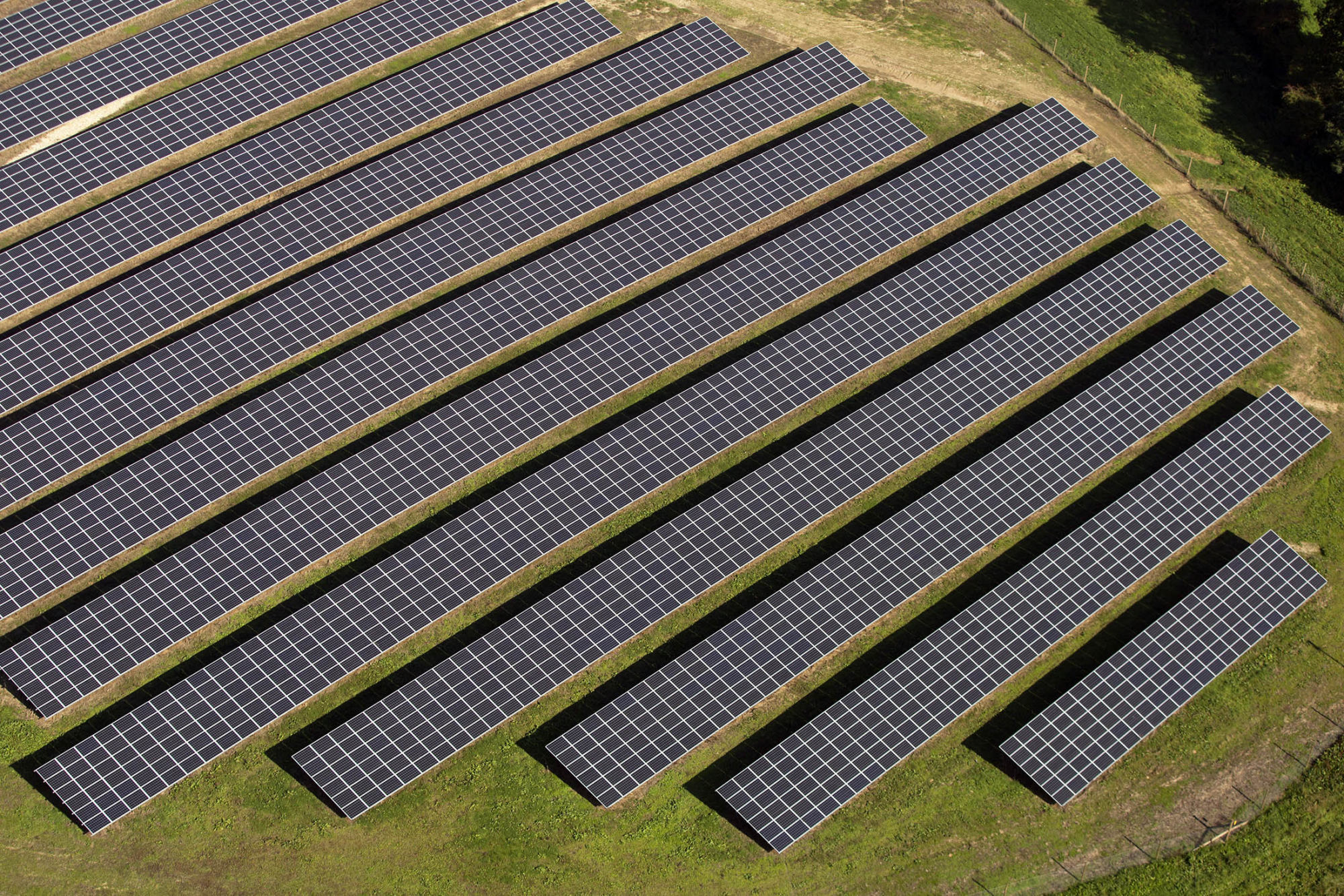
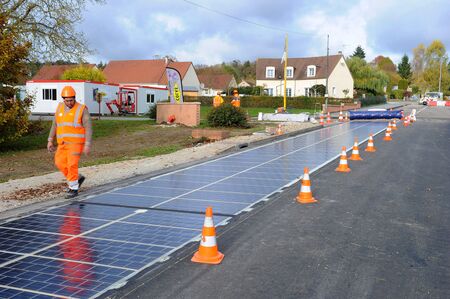
Wattway’s solar road in Tourouvre

“We wanted to find a second life for a road,” said Philippe Harelle, the chief technology officer at Colas SA’s Wattway unit, owned by the French engineering group Bouygues. “Solar farms use land that could otherwise be for agriculture, while the roads are free.”

As solar costs plummet, panels are being increasingly integrated into everyday materials. Last month Tesla Motors Inc. surprised investors by unveiling roof shingles that double as solar panels. Other companies are integrating photovoltaics into building facades. Wattway joins groups including Sweden’s Scania and Solar Roadways in the U.S. seeking to integrate panels onto pavement.

To resist the weight of traffic, Wattway layers several types of plastics to create a clear and durable casing. The solar panel underneath is an ordinary model, similar to panels on rooftops. The electrical wiring is embedded in the road and the contraption is topped by an anti-slip surface made from crushed glass.

A kilometer-sized testing site began construction last month in the French village of Tourouvre in Normandy. The 2,800 square meters of solar panels are expected to generate 280 kilowatts at peak, with the installation generating enough to power all the public lighting in a town of 5,000 for a year, according to the company.

For now, the cost of the materials makes only demonstration projects sensible. A square meter of the solar road currently costs 2,000 ($2,126) and 2,500 euros. That includes monitoring, data collection and installation costs. Wattway says it can make the price competitive with traditional solar farms by 2020.

screen-shot-2016-11-27-at-21-44-24


The electricity generated by this stretch of solar road will feed directly into the grid. Another test site is being used to charge electric vehicles. A third will power a small hydrogen production plant. Wattway has also installed its panels to light electronic billboards and is working on links to street lights.

The next two sites will be in Calgary in Canada and in the U.S. state of Georgia. Wattway also plans to build them in Africa, Japan and throughout the European Union.

“We need to test for all kinds of different traffic and climate conditions,” Harelle said. “I want to find the limits of it. We think that maybe it will not be able to withstand a snow plow.”

The potential fragility joins cost as a potential hurdle.

“We’re seeing solar get integrated in a number of things, from windows in buildings to rooftops of cars, made possible by the falling cost of panels,” Bloomberg New Energy Finance analyst Pietro Radoia said. “On roads, I don’t think that it will really take off unless there’s a shortage of land sometime in the future.”’

Bloomberg


The painting by Candice Henry of Trinidad and Tobago, which placed second in CARICOM Energy Week art and photo competition last year.

THE CARIBBEAN Community (CARICOM) Secretariat is this month drawing public attention to the energy realities of the region while helping individuals to identify how to better conserve while cutting costs.

They are doing it through a slew of activities, all of which are being celebrated as part of CARICOM Energy Month and under the theme “Sustainable Energy for Sustainable Development”.

“There are really two main things we are trying to do. One is to really build awareness among the general citizenry around energy matters so people understand what energy conservation means and what are some of the things they can do to take better control of their energy system,” said Dr Devon Gardner, programme Manager for Energy at the CARICOM secretariat.

“The second thing is for them to really understand the energy situation in the region and what is being done on the macro scale to provide the right-size solutions that can be used to support the sustainable development of the countries of CARICOM,” he added.

To make that happen, among other things, there are three knowledge webinars planned on the subject, all of which target the regional public and a number of key stakeholders.

There are, too, a number of competitions one of them a photo and art competition and another a regional news reporting competition intended to get people thinking through energy issues as they affect them and the likely solutions.

According to Gardner, the observation of CARICOM Energy Month which also takes account of national-level activities, including kilo walk events set for, for example, Guyana and St Lucia is important. And this, at a time when CARICOM countries are collectively using some 13,000 Btu of energy to produce one US dollar of gross domestic product (GDP) compared to 4,000 Btu of energy used by Japan, for example, to produce the same one US dollar of GDP and the global average of 10,000 Btu.

“We live in an age where there is great participation in energy; energy investments and energy solutions are no longer top down. Thirty years ago, the utility made the decisions about what kind of power plants to use, determined how to deliver the energy and a person took what was provided. If you did not have it, you simply waited for the utility to give it to you, which is why you heard of rural electricity programmes and so on,” Gardner noted.

“We are in an age now where technology has changed; there a lot of options available for or small, individualised power generation systems as well as energy services that can be provided directly and in a cost-effective ways, such as solar water heaters. There is also greater awareness of people around what is possible though they might not know what those solutions are. It is incumbent on us to give them the options,” he added.

“It is a part of good governance, it is a part of what modern society requires,” Gardner said further.

Critically, he said information and exchanges this month will afford Caribbean stakeholders the chance to shape their climate future.

“Over the last twenty years or so, the whole issue climate protection and of sustainable development practice has risen to the fore on the global agenda. There is recognition that the climate fight can be impacted by an aggregation of climate actions at the micro level,” he said.

“The role of each individual in being able to fight or mitigate various climate effects has drive a lot of what energy month wants to provide, which is that each individual, in their own space, can do something, which when aggregated with the global efforts, is part of significant tool,” he added.

Gleaner

In this 2012 file photo, an engineer installs traffic lights in Kingston. A new energy project aims to address traffic jams by synchronising stoplights across the Kingston Metropolitan Area.

A new energy-saving project costing US$30 million ($3.8 billion) will seek to reduce traffic jams in the Kingston Metropolitan Area (KMA) by synchronising 140 stop lights through a fibre-optic ring, while also cutting energy consumption at scores of government buildings.

The plan requires funding approval from donor agencies Inter-American Development Bank (IDB) and Japan International Cooperation Agency. Both are considering loans of up to US$15 million each to a project that has Petroleum Corporation of Jamaica acting as the executing agency.

The project, dubbed ‘Jamaica Energy Management and Efficiency Programme’, involves three components: it aims to fast-track Government’s National Energy Conservation and Efficiency Policy 2010-2030, target a 70 per cent reduction in energy “intensity”, and reduce greenhouse gas emissions by 10 per cent, said the IDB.

The traffic component aims to reduce the idle time that cars run on the road, which would reduce gas consumption. It would achieve this by implementing a more robust urban traffic management system – UTMS – which involves linking into the fibre-optic ring already developed by telecoms providers.

The IDB revealed the project late August and released documents on the project profile and environmental analysis. Both documents contain figures which vary slightly when breaking down each component, but the objectives remain consistent.

Regarding the road network, the government will upgrade or implement technologies for nine road segments, most of which are located in Kingston and one in Spanish Town.

39-50 Per Cent Growth

The IDB, utilising data from the National Works Agency (NWA), indicated that traffic growth along some of the KMA’s key corridors has increased 39-50 per cent over a decade, 2005-2015, without any associated improvements in road or intersection capacity.

Additionally, the absence of a complete UTMS to sync the operation of 140 traffic lights, with average spacing of 300 metres in between, remains a key factor causing congestion in the KMA.

“Most of the population commutes within urban centres, resulting in significant amount of congestion, lost time and wasted gasolene during idling or stalled traffic, especially the capital city Kingston,” stated the IDB.

Component I of the project amounts to US$24 million to finance energy efficiency and energy-conservation measures in government facilities, which could span 75 entities, with focus on educational and health facilities. Component II, at US$2.8 million, involves the financing of fuel efficiency in the transport sector. Component III, at US$1.8 million, will finance institutional strengthening for energy planning by developing information systems and training.

In 2015, public-sector facilities consumed some 7.4 per cent of all electricity generated in Jamaica, or approximately 393 gigawatt hours, costing the GOJ around US$36 million in oil imports, or an estimated US$102 million in electricity bills, the IDB said. Of this figure, roughly 22 per cent related to education and health facilities.

Gleaner

The more efficient the solar panel, the less space used.

Solar giant SunPower announced on Monday that it can now make a solar panel that can convert 22.8% of the sunlight that hits it into electricity. According to SunPower, that’s a new world record.

The efficiency of solar panels is an important metric to both solar companies and to its customers. When panels are more efficient it mean that rooftops can be covered in fewer efficient panels, which use less materials, but that can generate the same amount of energy as more less-efficient panels.

SunPower says its highly efficient panels can generate 70% more energy in the same space over the first 25 years, compared to less efficient panels. Many solar panels are somewhere between 15% and 18% efficient. SunPower and others have been working to boost the efficiency of panels using material science and optics tech innovations.

Solar companies are in a battle to boost the efficiency of their panels and tout new records. SunPower SPWR -5.85% says its 22.8% solar panel was verified by the federal National Renewable Energy Laboratory.

Last year, SolarCity claimed that it had started making its own highly efficient panels, with an efficiency that “exceeded 22%,” verified by the Renewable Energy Test Center (which isn’t one of the more commonly used verification labs). But SolarCity’s SCTY -5.92% solar panels were also planned to be made in small volumes on a pilot solar panel manufacturing line in Fremont, Calif.

Creating solar panel efficiency breakthroughs in the lab or on a small scale, is far easier than making those efficient panels in very large volumes. But SunPower says the average efficiency of its solar cells (which make up panels) at the end of last year was close to 23%.

SunPower’s stock was up over 3% in morning trading to $21.84. Oil giant Total owns 66% of the Richmond, Calif.-based SunPower.

Last week SunPower announced fourth quarter and year 2015 earnings. SunPower says it generated $1.58 billion in revenue in 2015, with an annual loss of $299.44 million. The company was profitable on an annual basis in 2014 and 2013.

Check out Fortune’s recent interview with SunPower CEO Tom Werner.

Fortune.com

In this 2013 photo, Minister of Science, Technology, Energy and Mining Phillip Paulwell (left) and Roy Lafayette, chief executive officer at Geddes Refrigeration Limited, signs a US$2.65-million contract with Geddes Refrigeration Limited for the design, supply and retrofitting of efficient air-conditioning solutions in four State entities.

The Jamaican Government has so far realised savings of $80 million over the past two years under an energy efficiency programme which has been implemented in 40 public-sector facilities.

Dubbed the Energy Efficiency and Conservation Programme (EECP), its general objective is to enhance Jamaica’s energy efficiency and energy conservation. Minister of Science, Technology, Energy and Mining Phillip Paulwell said that the State is now contemplating an expansion.

“We intend to take it much further, we are expanding it,” Paulwell said.

Among the methods employed to boost energy efficiency thus far is the use of film to reflect sunlight from windows, the painting of roofs with white paint to improve cooling, and the changing of lighting fixtures.

The Government has had to pay annual costs of almost $13 billion for electricity used by its entities, and the aim is to reduce the figure by $2 billion with the introduction of several key strategic energy-saving interventions.

The measures were recommended following an audit of the energy use by the public sector, with the overall objective to cut public-sector energy consumption by 30 per cent in 2017.

“The money is being absolutely well spent. I am very proud of this project,” Paulwell said.

This year, the Government is spending $379.8 million on the conservation programme, which is funded by a loan, up from the $310 million spent last year.

A total of $748.8 million is being spent on energy conservation and efficiency programmes this year, up from $599 million last year.

The targets set for this fiscal year include executing two contracts to replace inefficient air-conditioning systems in 11 state institutions at a cost of $254.9 million, and commencing the replacement of inefficient lighting in several public institutions ($77.3 million).

The Jamaica Information Service, which is among the entities that benefited from the programme, is reporting savings of 17.5 per cent per annum on its energy bill.

The Gleaner

Screen Shot 2015-12-11 at 11.52.08

A solar panel on a thatch roof in Sub-saharan Africa is part of the Azuri PayGo Energy project, which provides eight hours of emission-free lighting each day and enough power to charge cellphones. Users pay a one-time installation fee and top-up as their needs demand.

PARIS, France (UNFCCC) – Sixteen game-changing initiatives from around the world were honoured as winners of a prestigious United Nations climate change award at a special ceremony at the United Nations Climate Change Conference in Paris, on yesterday evening.

“These ‘Lighthouse Activities’ shine a light on the groundswell of climate action around the world,” said UN Secretary-General Ban Ki-moon in a keynote address. “As the world moves toward a future built on low-emissions sustainable development, these bold ideas can inspire leaders to be more ambitious in their own policies and actions.”

The Momentum for Change initiative is spearheaded by the UN Climate Change Secretariat to shine a light on some of the most innovative, scalable and replicable examples of what people are doing to address climate change. This year’s winning activities range from a seriously cool smartphone that puts social values first, to an initiative that is enabling 40 Latin American cities to take concrete climate action.

“I am honoured to celebrate the leadership shown by the people, organisations, companies, and governments recognised as winners of the 2015 Momentum for Change Awards tonight,” UNFCCC Executive Secretary Christiana Figueres said.

“By showcasing these remarkable solutions and the people behind them we can strengthen efforts that must not only start with an agreement here in Paris, but must continue to build, as we accelerate the global transition to a low-carbon, highly resilient development path,” she said.

To help celebrate and recognise the achievements of the 2015 Lighthouse Activities, attendees at the gala event were treated to powerful photos, inspirational videos and a lively musical performance by Sean Paul.

M Sanjayan, a conservation scientist, writer and Emmy-nominated television news contributor, introduced Conservation International’s newest video in its critically acclaimed Nature for Speaking series, titled Home. Bertrand Piccard, Solar Impulse CEO and UNEP Goodwill Ambassador, served as the evening’s master of ceremonies.

“Modern clean technologies have transformed the expensive problem of climate change into a profitable opportunity,” said Dr Piccard. “A global economy that is powered by renewable energy, implements energy efficient and minimises waste will not only tackle climate change, but will also generate health, job creation and profit in the communities where they take place.”

Each of the 16 winning activities touches on one of Momentum for Change’s four focus areas: Urban Poor, Women for Results, Financing for Climate Friendly Investment, and ICT Solutions. All 16 were showcased at a series of special events during the UN Climate Change Conference.

They are:

Urban Poor

•E-waste: From Toxic to Green, India: Creating jobs to keep e-waste out of landfills

•Solvatten Solar Safe Water Heater — Kenya: Reducing emissions while securing access to safe drinking water

•Emerging and Sustainable Cities Initiative | Latin America & the Caribbean: Supporting sustainable growth in emerging cities

Women for Results

•Fostering Cleaner Production — Colombia: Reducing emissions in manufacturing

•Harvesting Geothermal Energy — El Salvador: Generating income with geothermal waste-heat

•Planting Trees to Save the Mangrove — Guinea: Establishing women-led groups that protect forests and generate income

•SELF’s Solar Market Gardens — Benin: Empowering women farmers through solar drip irrigation

Financing for Climate Friendly Investment

•Azuri PayGo Energy — Africa: Innovating pay-as-you-go energy systems for rural homes

•Deforestation-free Cocoa — Peru: Using a carbon-asset-backed loan to protect forests and produce cocoa

•Microsoft Global Carbon Fee — Global: Transforming corporate culture by putting a price on carbon

ICT Solutions

•ChargePoint Electric Vehicle Charging Corridors — United States of America: Building a network of electric vehicle express charging stations

•Enabling Farmers to Adapt to Climate Change — Uganda: Using ICT solutions to build resilience

•Fairphone — The Netherlands: Producing a phone that improves lives and the environment

•Lifelink Water Solutions — Kenya and Uganda: Using ICT tools to provide safe, sustainable and affordable water

•Mapping Exposure to Sea Level Rise — Tonga, Samoa, Vanuatu and Papua New Guinea: Preparing for risk with online spatial tools

•Mobisol Smart Solar Homes — Rwanda and Tanzania: Powering homes with solar energy

The 2015 Lighthouse Activities were selected by an international advisory panel as part of the secretariat’s Momentum for Change initiative, which is implemented with the support of the Bill & Melinda Gates Foundation and The Rockefeller Foundation, and operates in partnership with the World Economic Forum and the Global e-Sustainability Initiative.

Jamaica Observer

St Kitts-Nevis PM makes impassioned plea at climate change conference

PARIS, France (CMC) – St Kitts-Nevis Prime Minister Dr Timothy Harris has called on the international community to “negotiate and agree a legally-binding agreement with ambitious emission reduction targets”.

Addressing the 21st Conference of the Parties of the UN Framework Convention on Climate Change (UNFCCC), Harris reiterated the seriousness and urgency of the threat posed by climate change and the need for an ambitious agreement to be reached during the two week conference.

“My delegation calls on all parties here to negotiate and agree a legally-binding agreement with ambitious emission reduction targets.  St Kitts and Nevis recommends that all parties subscribe to at least five-year commitment cycles with robust ex-ante review and ex-poste assessment processes.

“We also hope that developed country parties and other parties in a position to do so, would be encouraged to provide support to vulnerable countries, particularly to Small Island Developing States (SIDS).”

He told the conference which is being attended by more than 100 world leaders that his twin island Federation, like other SIDS “has been undergoing many climate related changes; namely sea level rise, extreme weather events, prolonged and severe droughts, and disruption to our reefs, coastlines and agriculture”

Harris said that the dangers of climate change are real and present and that the threat is also existential. He said greenhouse gas emissions from small island states like St Kitts and Nevis are negligible “yet our small island states continue to be adversely and disproportionately affected by the impacts of climate change.

“Nonetheless, as responsible global citizens, we in St Kitts and Nevis are already acting locally to reduce our national carbon footprint even further.  The pursuit of renewable energy solutions is now a critical and integral component of our national sustainable development strategy to transform St. Kitts and Nevis into a fully environmentally sustainable small island state.”

Harris said that hi new administration “is incentivizing behavioural changes through the facilitation of duty free concessions on renewable energy technologies.

“We are building strategic partnerships with countries and the private sector to develop geothermal, solar and wind energy solutions. Currently, we have solar farms operating on both St. Kitts and Nevis and are also exploring the potential geothermal capacity on the islands. These renewables will have a significant impact on our energy consumption patterns and reliance on fossil fuels.”

Jamaica Observer


Indian Prime Minister Narendra Modi (L) and French President Francois Hollande (R) shake hands during a news conference at the Elysee Palace in Paris, April 10, 2015.      REUTERS/Charles Platiau

Thomson ReutersIndian Prime Minister Narendra Modi and French President Francois Hollande attend a news conference at the Elysee Palace in Paris


PARIS (Reuters) – French President Francois Hollande and India’s Prime Minister Narendra Modi will on Monday launch an international solar alliance aimed at eventually bringing clean and affordable solar energy within the reach of all.

The launch will coincide with a summit of world leaders at the start of two weeks of talks on the outskirts of Paris to seek a new global deal on curbing climate change, by shifting from fossil fuels towards renewable energy.

An Indian government statement on Sunday said there were well over 100 solar-rich countries in the tropics that could be members of the International Solar Alliance to develop clean and affordable solar energy.

“Solar energy is a practical and efficient way to reduce the greenhouse gas emissions,” it said.

Aware of the shadow cast by the failure of the 2009 Copenhagen summit, the last attempt to reach a global climate deal, the United Nations is placing as much weight on the efforts of individual governments as on an overarching U.N. agreement.

More than 180 nations have submitted national action plans, but they are not enough to achieve a goal of limiting global warming to 2 degrees Celsius (3.6 degrees Fahrenheit) above pre-industrial times — the cap scientists say is essential to prevent the most devastating consequences of global warming.

India’s national plan focuses on solar, saying it is expected to grow significantly. The aim is to reach capacity of 100 gigawatts by 2022, to be scaled up further in the future.

Firms such as Tata Power have invested heavily in solar as a reliable source capable of delivering power to some of India’s poorest people.

businessinsider.com

WASHINGTON, United States (CMC) — Jamaica is the only Caribbean Community (CARICOM) country that will benefit from an Inter-American Development Bank (IDB) multimillion-dollar-funded regional Energy Efficiency Green Bond Facility.

The IDB said that it has approved financing to establish the facility and that the programme was selected to receive up to US$217 million in additional funding as one of eight projects worldwide in the first round of allocations announced by the Green Climate Fund (GCF) earlier this month.

“This private sector programme stands out for its innovative financial approach, involving small and medium enterprises and the potential mobilisation through capital markets of funds from different institutional investors such as pension funds and insurance companies,” said Gema Sacristan, IDB’s Financial Markets Division Chief.

Providing an alternative financing mechanism for energy efficiency projects through the issuance of green asset-backed securities (ABS), the programme will also contribute to the development of capital markets in the region.

The programme will introduce green ABS following the Green Bond Principles standards and will foster socially and environmentally responsible investments.

“The approval of this programme furthers our commitment to supporting Latin American and Caribbean countries in the implementation of their proposed Intended Nationally Determined Contributions (INDCs),” said Amal-Lee Amin, IDB’s Climate Change and Sustainability Division Chief.

“Tapping into domestic capital markets for refinancing of energy efficiency is key for increasing the scale of investment for de-carbonisation over the medium and longer-term.”

IDB said that Mexico will be the first country to implement this programme, followed by the Dominican Republic, Jamaica, and Colombia.

The IDB’s loan of up to US$400 million will be complemented by a loan of up to US$50 million from the China Co-Financing Fund, administered by the IDB, in connection with the first utilisation of the facility in Mexico.

Jamaica Observer