
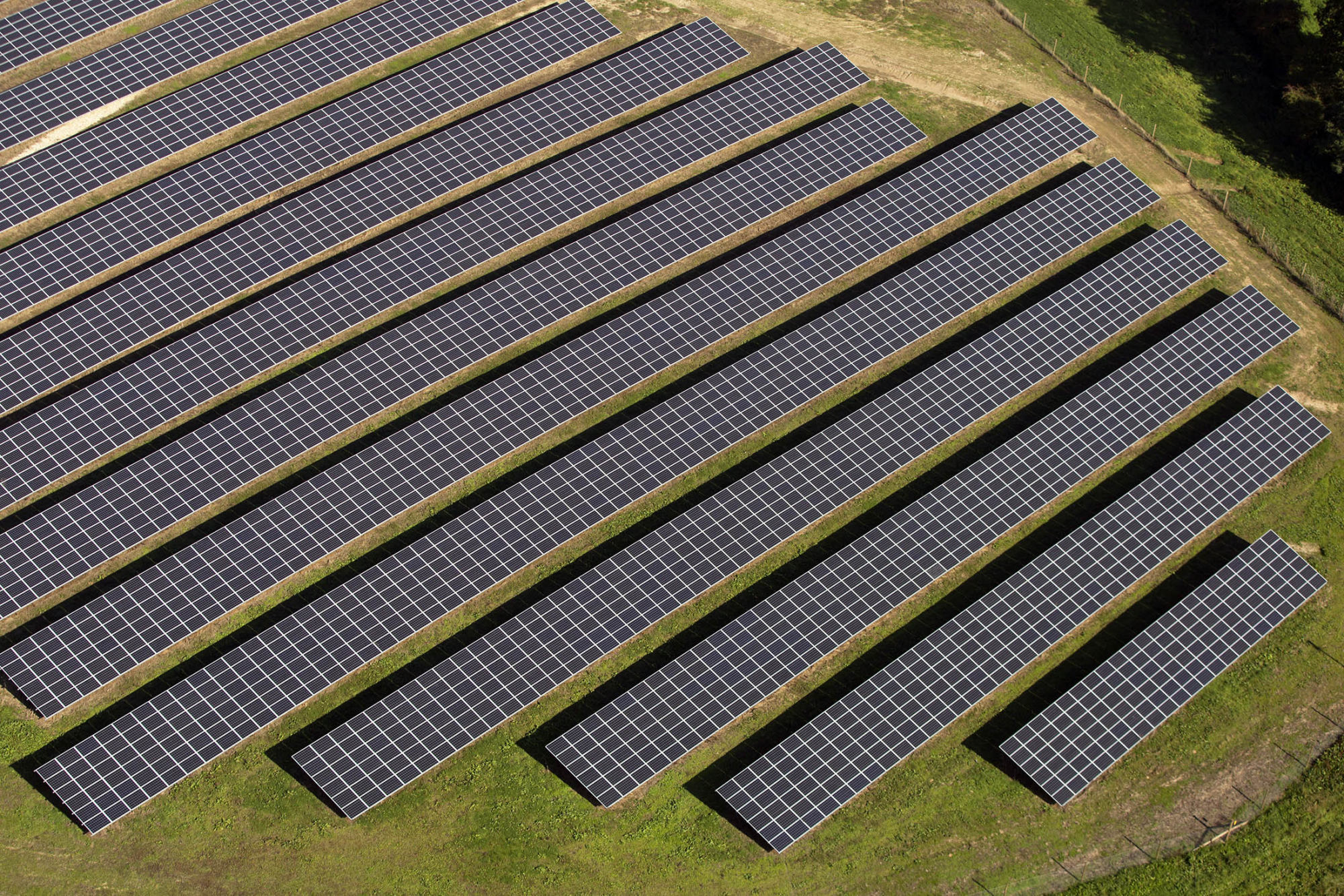
Electric avenues that can transmit the sun’s energy onto power grids may be coming to a city near you.

A subsidiary of Bouygues SA has designed rugged solar panels, capable of withstand the weight of an 18-wheeler truck, that they’re now building into road surfaces. After nearly five years of research and laboratory tests, they’re constructing 100 outdoor test sites and plan to commercialize the technology in early 2018.
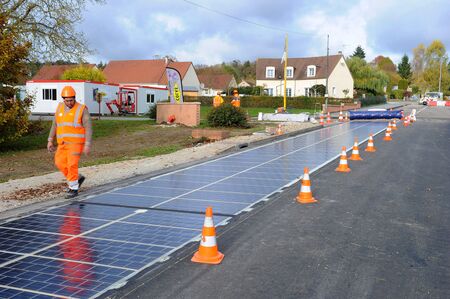
Wattway’s solar road in Tourouvre

“We wanted to find a second life for a road,” said Philippe Harelle, the chief technology officer at Colas SA’s Wattway unit, owned by the French engineering group Bouygues. “Solar farms use land that could otherwise be for agriculture, while the roads are free.”

As solar costs plummet, panels are being increasingly integrated into everyday materials. Last month Tesla Motors Inc. surprised investors by unveiling roof shingles that double as solar panels. Other companies are integrating photovoltaics into building facades. Wattway joins groups including Sweden’s Scania and Solar Roadways in the U.S. seeking to integrate panels onto pavement.

To resist the weight of traffic, Wattway layers several types of plastics to create a clear and durable casing. The solar panel underneath is an ordinary model, similar to panels on rooftops. The electrical wiring is embedded in the road and the contraption is topped by an anti-slip surface made from crushed glass.

A kilometer-sized testing site began construction last month in the French village of Tourouvre in Normandy. The 2,800 square meters of solar panels are expected to generate 280 kilowatts at peak, with the installation generating enough to power all the public lighting in a town of 5,000 for a year, according to the company.

For now, the cost of the materials makes only demonstration projects sensible. A square meter of the solar road currently costs 2,000 ($2,126) and 2,500 euros. That includes monitoring, data collection and installation costs. Wattway says it can make the price competitive with traditional solar farms by 2020.

screen-shot-2016-11-27-at-21-44-24


The electricity generated by this stretch of solar road will feed directly into the grid. Another test site is being used to charge electric vehicles. A third will power a small hydrogen production plant. Wattway has also installed its panels to light electronic billboards and is working on links to street lights.

The next two sites will be in Calgary in Canada and in the U.S. state of Georgia. Wattway also plans to build them in Africa, Japan and throughout the European Union.

“We need to test for all kinds of different traffic and climate conditions,” Harelle said. “I want to find the limits of it. We think that maybe it will not be able to withstand a snow plow.”

The potential fragility joins cost as a potential hurdle.

“We’re seeing solar get integrated in a number of things, from windows in buildings to rooftops of cars, made possible by the falling cost of panels,” Bloomberg New Energy Finance analyst Pietro Radoia said. “On roads, I don’t think that it will really take off unless there’s a shortage of land sometime in the future.”’

Bloomberg


Elon Musk’s Clean Energy Vision Includes a Strong Role for Utilities

The Canadian federal government has committed to powering all of its buildings and operations using renewable energy sources by 2025. The goal is in support of a broader target to reduce the government’s greenhouse-gas (GHG) emissions by 40% by 2030.

Catherine McKenna, the federal minister of environment and climate change, announced the new commitments while speaking at the Canadian Wind Energy Association conference in Calgary on Wednesday. In a press release from the government, McKenna commented, “We are taking action on climate change by greening our government’s activities and are doing our part to make further progress toward Canada’s emissions target. We will do more as we develop our pan-Canadian climate plan – a plan that will create good jobs for the benefit of Canadians, especially the middle class and those striving to join it.”

In its release, the government notes that although the GHG-reduction target is set for 2030, it aspires to meet the goal by as early as 2025. By that date, the government continues, Public Services and Procurement Canada – the government’s principal landlord – will be purchasing 100% of its electricity from clean energy sources. The government notes that its Department of National Defense will be buying a significant amount of renewable electricity for its installations in Alberta. This will meet most of the electricity requirements for installations in Calgary, Cold Lake, Edmonton, Wainwright and Suffield.

John Gorman, president and CEO of the Canadian Solar Industries Association (CanSIA), has lauded the government’s new initiatives.

“The federal government’s commitment to purchasing 100 percent renewable electricity from sources, such as solar energy, as early as 2025 makes a significant contribution to Canada’s innovation and environmental protection agenda in two ways,” said Gorman in a statement.

“Firstly, they have the purchasing power to make a difference. Not only will their actions directly displace significant levels of greenhouse gas emissions, it will also give rise to new businesses and infrastructure.

“Secondly,” he continued, “being a part of the global response to climate change will bring changes to the decisions that are made by all consumers for goods, products and services. By leading by example, the government of Canada is demonstrating that every one of us has a role to play in making the right decision for future generations.”

In addition to renewable energy procurement, the government says it will make strategic investments in vehicle fleets and infrastructure. For example, the government says it will invest in revitalizing the heating and cooling plants in the National Capital Region, which provide services to more than 85 buildings and facilities. That investment is expected to modernize six separate facilities and reduce their emissions by more than 45%, according to the government.

The announcement did not provide many details regarding planned renewable energy procurements, including solar’s potential role; however, the government says it is establishing a new team, called the Center for Greening Government, to track the government’s emissions centrally, coordinate efforts across agencies and drive results to ensure the objectives are met.

Notably, these new initiatives are just the latest signs of hope that the Canadian government has provided to the country’s fledgling solar industry, which had only about 2.5 GW of cumulative installed capacity by the end of 2015. Canadian Prime Minister Justin Trudeau has committed Canada to the Paris Agreement, and in June, he united with U.S. President Barack Obama and Mexican President Enrique Pena Nieto to set a goal of achieving 50% clean power generation in North America by 2025. Furthermore, in October, the government introduced a nationwide carbon pollution pricing plan.

Solar Industry  

In this August 2016 photo, New Fortress Energy (NFE) hosts a tour of its Montego Bay terminal. Walking the port are (from left) Brendan McElmurray of NFE, Minister without Portfolio in the Ministry of Economic Growth and Job Creation Dr Horace Chang, Attorney General and Member of Parliament for West Central St James, Marlene Malahoo Forte, Ed Marsh of the Port Authority of Jamaica, Johnathan Klion of NFE, and chairman of the Montego Bay Free Zone, Mark Hart.

The plan to build and operate a liquefied natural gas marine terminal and pipeline by American company New Fortress Energy (NFE) will place the facility five kilometres offshore within the Portland Bight area or close to the Goat Islands, according to the environmental impact assessment (EIA) released this month.

New Fortress will execute the marine terminal and pipeline project through affiliate NFE South Holdings Limited. A public consultation on the project is set for September 28 in Old Harbour.

The environmental report done by CL Environmental Consultants Limited on behalf of New Fortress also estimates that the project will provide nearly US$1 billion worth of value over its lifetime and create about 300 direct jobs in the process. Indirect jobs are estimated at 200 to 600.

“Based on this analysis, the final net present value of the project, after application of social cost benefit analysis, turns out to be US$953.4 million. Hence, the project should be undertaken as it has multiple social benefits which are reflected in the final positive NPV of the project,” the report stated.

In arriving at that final figure, the EIA considered the financial profitability measured at market prices; the net benefit of the project measured in terms of economic prices; then adjusted for the impact of the project on savings and investment, income distribution, the impact of the project on merit goods and demerit goods, and the environmental impact.

LNG plan

The project forms part of the wider plan to bring LNG to the national grid. The marine terminal will feed gas to the new 190MW plant that Jamaica Public Service Company is developing at Old Harbour. New Fortress is also supplying gas to JPS’ Bogue plant from a terminal developed in Montego Bay.

The marine terminal EIA report reasoned that consumers, but in particular the manufacturing sector, would benefit from the lower cost of electricity and the establishment of a more reliable power supply.

“This will lead to more possibility of manufacturing that will lead to creation of employment opportunities for unskilled and skilled workers. This is hard to quantify and hence the number are not adjusted for it. Which means that the social benefit stayed below is a lower bound,” the report stated.

The NFE project involves constructing a marine terminal comprising of a vessel berth and offshore offloading and regasification platform.

“The location will be up for approval by the Port Authority of Jamaica in the Portland Bight area of Jamaica,” said the environmental report.

It adds that the facility will accommodate a floating storage unit or FSU vessel for LNG storage and a LNG carrier delivering gas to the FSU. The platform would contain equipment to regasify LNG as well as related process and safety equipment.

“The liquid gas from the FSU would be carefully regasified and the gas would then be released into an undersea pipeline which will be mostly directionally drilled in basically a straight line from the platform to the vicinity of the JPS plant,” stated the EIA, which adds that the pipeline, at some five kilometres in length, would connect to the JPS gas power plant on shore.

“In addition, the project will construct a new, or refurbish an existing, automotive diesel oil line from storage tanks to the renovated power plant in order to enhance the reliability of the facility in case of LNG delivery interruptions.”

The marine terminal will be constructed offshore in the western side of Portland Bight, at a distance about 200 metres from the shipping channel to Port Esquivel in approximately 14 metre of water depth. “This location offers sufficient depth to berth the FSU and the LNG carrier vessels without the need for dredging, yet has sufficient protection from storm wave impacts as a result of the shape of the Bight,” stated the report.

Energy Policy

NFE is expected to supply JPS as well as potential future industrial users with natural gas. The main objective is to provide the Jamaica Public Service Company’s Old Harbour Plant with a cleaner and more cost-effective fuel in furtherance of the goals of the National Energy Policy.

NFE will conduct the project through its NFE South Holding and with the sponsorship of Fortress Investment Group, a global asset management firm with approximately US$70.64 billion of assets under management and an experienced investor in transportation, infrastructure and energy assets around the world, the environmental report said.

The annual fuel savings from the project is projected at US$74.2 million which represents a 38 per cent reduction in cost. The report adds that, assuming a 75 per cent pass-through to the consumer and a 25 per cent mixed of the generating capacity of the JPS, it will result in a seven per cent reduction is consumer prices. This figure matches the fuel savings published in a separate EIA report on the JPS Old Harbour plant upgrade released in April, as the projects are complementary.

JPS, which has a licence from the Jamaican Government to operate the national electricity grid, is constructing the 190MW plant adjacent to its existing Old Harbour facility in St Catherine, which has the capacity to generate 220MW of power. The current plant will be dismantled once the new one is commissioned.

Gleaner

Screen Shot 2016-09-01 at 14.41.59

THE Jamaica Public Service Company Limited (JPS) has been given until September 27 to provide a detailed report to the Office of Utilities Regulation (OUR) on Saturday’s islandwide blackout.

A release from the OUR said that,as stipulated in the Electricity Act, 2015, the light and power company is obliged to provide a report to the regulator within 30 days of the date of restoration of power.

The OUR said it will indicate the critical data and other necessary information which should be included in the detailed report on the incident. At the meeting between the OUR and the JPS on Tuesday to discuss the power provider’s preliminary report, the implications of the power outage and the way forward, the regulatory body expressed disappointment with the islandwide power outage, the frequency of such events, and the negative impact on customers.

The OUR urged the JPS to be thorough and rigorous in its investigation and analysis of the incident and requested that they outline corrective measures to safeguard against recurrences, the release said. It added that the JPS has agreed to be guided by the position outlined by the regulator regarding the conduct of its investigation.

Deputy director general of the OUR, Hopeton Heron, said: “Once we have received all the required information from the JPS, the OUR is committed to completing its review of the information as well as its own investigation of the outage, within 30 days. We recognise the significant impact that this islandwide outage has had on customers and so we are committed to exerting all efforts to ensure that we quickly and efficiently do our own analysis and make our recommendations.”

He said, too, that the OUR will be insisting on the conduct of a thorough review of the electricity system including their approach to grid planning, design, installation, operation and maintenance.

Jamaica Observer 

Early indications from the Jamaica Public Service (JPS) have pointed to a breakdown in its protection systems as the most likely cause of the islandwide power outage that occurred over the weekend.

While the company has said that more fulsome investigations into the issue will take time, it has confirmed that the outage was triggered during scheduled maintenance work at the Port Authority of Jamaica (PAJ) substation in Kingston.

“The scheduled work was part of ongoing system improvements being done by JPS to our power delivery (transmission and distribution) network,” Winsome Callum, director of corporate communications at the power company, said in an emailed response to The Gleaner.

Breakdown In Operating Procedures

According to Callum, initial investigations have revealed that there was a breakdown in the implementation of the established operating procedures for the work being done. This, she said, triggered a system fault that led to the outage.

“Preliminary indications are that the first level of the protection system did not operate as expected. As a result, several units at our power plants went offline. The network, in turn, shut down to protect itself from possible damage,” she said in explaining the failure on the protection system.

The protection system is a built-in mechanism on the national grid which is designed to safeguard against procedural errors.

“The protection system is designed to operate at different levels, ranging from isolating areas with a fault all the way up to the ultimate protection being to shut the entire electricity network down in the event of a major system fault,” the power company said.

The electricity supplier has indicated that in the coming days, its investigations will be focused on evaluating why the protection mechanism did not operate as expected.

The power company said it has already taken corrective measures and will be investing in system upgrades to create what it describes as a self-healing grid.

In the meantime, the Office of Utilities Regulation will today meet with executives of the JPS to discuss details of the ongoing investigations into the power outage.

The utility regulator wrote to the company yesterday requesting a preliminary report into the incident.

Callum confirmed that Energy Minister Dr Andrew Wheatley was provided with a preliminary overview on the outage and was to receive an initial report yesterday.

Gleaner

As investigations continue into the power outage that blanketed the entire island on Saturday evening, chief executive officer (CEO) of the Jamaica Public Service Company (JPS) Kelly Tomblin has promised to be open and transparent with the public about the findings of the probe.

“The only thing I know for sure is that the process was not followed one hundred per cent. I don’t know completely why that resulted in a system-wide outage. That is what my team is working on today, and that is what we are going to continue to talk to the press about. We have nothing to hide,” she said in an interview with The Gleaner yesterday.

Jamaica’s sole power distribution company said the outage was caused by a “procedural error, which resulted in a number of generating units going off-line simultaneously”.

In a release to the media, the electricity supplier said it has started its investigations and would provide further details on the cause of the outage today.

Minister of Science, Energy and Technology Dr Andrew Wheatley was swift in expressing displeasure with JPS because of the blackout.

“Let me categorically state that I am not at all happy with this latest incident and I find the inconvenience to the people of Jamaica and the many businesses affected totally unacceptable,” he said in a statement.

CATASTROPHIC FAILURE

Arguing that “islandwide power outages of this nature should not occur as there ought to be processes, procedures, and adequate redundancies in the grid to mitigate such a cascading set of events that would result in a catastrophic failure of this kind”, Wheatley said that he has requested that JPS submit a preliminary report on the cause of the blackout to his office today and a full report by Thursday.

Tomblin indicated that she was having numerous meetings with her technical team and was in the process of preparing a preliminary report to be submitted to Wheatley.

The JPS CEO was forthright in shedding light on the nature of the “procedural error”, which is believed to have caused the outage. She explained that the company’s technical team was still working to put together a more fulsome analysis of the outage.

“We know there was an operational error, but that does not explain something else, which will take some time to figure out. It looks as though there was a technical procedure done on the Hunts Bay station that was not completed one hundred per cent according to process, but that should not have resulted in the collapse of the system, so we have to look to see if it’s a design or engineering issue, but I don’t want to jump the gun and give inaccurate information at this stage,” she said.

In April, the country was also plunged into an islandwide power blackout. The light and power company later said that that outage was caused by problems because of work that was being done on two major power lines in the Three Miles area of Kingston.

Gleaner

Consulting engineer Howard Chin is making the case for the Alpart plant, which was recently acquired by Chinese firm Jiuquan Iron and Steel Company Ltd (JISCO), to be operated entirely using renewable energy.

JISCO has announced plans to invest US$2 billion to expand the plant which will see the addition of an aluminium smelter powered by a coal-fired plant.

Chin has, however, argued that the heat that would be generated from the coal-fired plant could be detrimental to aquatic, plant and animal life in and around the Black River area, and as such, renewable-energy sources should be considered.

“Cooling the power plant and running the bauxite refinery requires a lot of water. How hot would the Black River become downstream of Alpart? Hot enough to kill animal life? Certainly, NEPA (National Environment and Planning Agency) is not answering these questions which have to be answered. Nor do they have the technical capability to do so,” Chin said in an emailed response to The Gleaner.

STORAGE POWER PLANT

In recognition of the problem of storage capacity associated with renewables, Chin explained that a large pumped hydroelectric storage power plant could be used to power the alumina plant in the first instance.

“It could be done using a large renewable energy system backed up by a pumped storage system,” he said.

Pumped hydroelectric storage facilities store energy in the form of water in an upper reservoir, pumped from another reservoir at a lower elevation. During periods of high electricity demand, power is generated by releasing the stored water through turbines in the same manner as a conventional hydropower station. During periods of low demand, the upper reservoir is recharged by using lower-cost electricity from the grid to pump the water back to the upper reservoir.

Turning his attention to the Bayer Process, which would be used to produce aluminium should the Chinese go ahead with plans to build a smelter at Alpart, Chin observed that the heat given off could be transferred to the alumina refinery, which requires it in large quantities. According to the former Jamaica Institution of Engineers president, the smelter could also be powered by renewable energy.

“The alumina refinery needs a lot of heat. The aluminium smelter needs electricity and ends up giving off a lot of heat. Frankly, it might be possible to run the combined alumina and aluminium refining plant on a mostly very large renewable-energy system and a very large pumped storage system, and moving the heat from where it is produced to where it is needed,” he said.

Gleaner

JMMB Group Limited will spend US$420,000 ($53 million) on a solar energy system to power various offices across Jamaica this year.

The project forms part of a wider move by JMMB to reduce its carbon footprint.

“We plan to implement this on a location-by-location basis, with the first implementation taking place at one of our locations in Kingston, in the coming months. The cost is as stated, US$420,000,” the financial conglomerate told the Financial Gleaner.

JMMB estimates the project payback period will span just about five years based on expected energy savings.

The solar plant will generate up to 293,935 kilowatts, hours of electricity per year with the use of clean renewable energy.

“The system is expected to save the company US$90,000 annually, and reduce oil energy dependency by 34 per cent,” JMMB said in its newly released annual report for year ending March 2016.

Roughly three years ago, JMMB embarked on a company-wide initiative coined ‘Go Green’, with one of the primary objectives to change the group’s energy practices in a way that was more environmentally friendly and cost-efficient.

“This investment in a grid-tied solar system is just another step in the direction of making us even more efficient at how we use energy,” the company said via email.

A grid-tied solar system is one where the system itself is tied to the external electricity grid, as opposed to batteries.

“In other words, the system uses the sun to generate our electricity needs, with any unused electricity going back to the external grid, as opposed to being stored in batteries,” said JMMB.

JMMB expects the project to expand over time through exploration of other renewable resources to all JMMB Group locations, where possible.

JMMB Group made $2.3 billion profit off $10.42 billion of net revenue in FY2016.

Gleaner

BY AVIA COLLINDER Business reporter collindera@jamaicaobserver.com


LNG is coming to Jamaica


New Fortress Energy, the company which has won the contract to supply the island’s sole power distributor the Jamaica Public Service Company (JPS) with LNG for substations in Bogue, Montego Bay and another to be developed in Old Harbour, St Catherine, said it buys supplies from sources worldwide.

The company has declined to comment whether its suppliers include Trafigura Beheer, from which the Jamaica Observer understands it has sought to make buys.

Meanwhile, the Electricity Sector Enterprise Team (ESET) has indicated to theBusiness Observer that it does not matter where in the world the gas comes from.

Trafigura is the world’s third-largest private oil and metals trader. That company is also seeking to grow its market for LNG supply globally.


However, in 2011 the Dutch company was involved in controversy for a $31-million political donation to the the People’s National Party administration, which was then the governing party.

The company continues to sell supplies through third-party deals to the local market, including spot purchases made by Petrojam.

Describing the surge in LNG demand as an “LNG revolution”, Trafigura says on its wesbite that it plans to double supplies sold year over year from base year 2013 when the company transported one metric tonne (mt) of LNG globally.

The company has three full-time traders based in Geneva supported by its US Natural Gas team in Houston, Texas, and a European Natural Gas team, working with 27 LNG regional offices in key export and import countries across the globe.

However, as to sales programmed for Jamaica, the company said it has no comment.

“We don’t comment on our day-to-day commercial arrangements,” Victoria Dix, media liaison for Trafigura said when asked to channel questions about the Caribbean market, including Jamaica.

Bloomberg describes Trafigura Beheer as the world’s current largest LNG trader, reporting at year end December 2015 that the commodity trader “boosted the amount of LNG handled to 4.2 million metric tonnes in the financial year ended September 30, from 1.7 million a year earlier following a doubling in volumes… that made it the world’s biggest independent LNG trader.”

A source close to New Fortress Energy told the Business Observer that it is normal for ships to swap cargo and there may have been spot purchases, but that there is, however, no long-term relationship with Trafigura.


More directly, the company, through a spokesperson, said it sources LNG from all over the world.

“In addition to supplying our own gas from the United States, New Fortress Energy sources gas from all over the world. As a matter of policy, we cannot comment further,” New Fortress said.

He stated that in relation to Bogue, “we’re making significant progress and are excited to provide natural gas to help further Jamaica’s clean energy transition. We’re in close coordination with JPS on the process and timeline”.

Chairman of ESET Dr Vincent Lawrence told the Business Observer on Monday that the source of LNG was immaterial.

“ESET is not aware of any trades, swaps or short-term source arrangements that New Fortress Energy may make in satisfying its contractual arrangements with JPS.

“NFE under its Gas Supply Agreement arrangements can supply gas from any origin. However, in ESET granting approval of the Gas Supply Agreement between JPS and NFE, in order to ensure security of supply, NFE had to demonstrate as to its long-term ownership of and access to gas from the United States including the ability to obtain any required export permits.”

Lawrence added, “The contractual arrangements are private and between two private companies,” further adding that “the GOJ is not a party to the contractual nor day to day delivery arrangements”.

The island is moving towards the majority use of LNG as fuel for energy, with the aim of reducing dependence on oil which is subject to price volatility.

To that end, JPS has retrofitted its 115MW gas turbine plant in Montego Bay from automotive diesel oil to dual fuel use. The conversion, it was projected, will result in an approximate 40 per cent fuel price reduction.

New Fortress has also secured the supply contract for the JPS’s planned 195MW plant in Old Harbour which is being razed and will be rebuilt and expanded.

Start-up of LNG use at the JPS Bogue plant is due to begin in August, when construction of fuel lines and storage facilities are expected to be completed.

New Fortress is also slated to construct an expandable 100MW, natural, gas-fired, cogeneration plant for alumina producer, Jamalco, replacing a previous plan for a coal-fired alternative


The Observer