The Jamaica Public Service Company (JPS) is preparing for a battle with the Government over any attempt to review its operating licence.

The JPS was put on its guard last Friday when Government senator and chief technical adviser to the finance minister, Aubyn Hill, declared that the Andrew Holness-led administration is obliged to review the licence of the light and power company because of threats to the Jamaican economy.

Opening the State of the Nation Debate in the Senate, Hill called for a review of the modified licence issued to JPS last January, because it “seems to be quite opposed to the interest of Jamaicans”.

“We have to look at that licence carefully [and] as a new Government, we’re obliged to,” Hill told his parliamentary colleagues.

But Kelly Tomblin, the president and chief executive officer of the JPS, in a quick response, rejected Hill’s reasons for questioning the changes to the licence and expressed the hope that his comments would not suggest that Holness will shred the contract.

“I’m sure, similar to how the Government has continued on the framework for fuel diversity, that this Government certainly wouldn’t suggest that a licence negotiated in good faith, in which the JPS has made investments, would be negated by a subsequent government,” said Tomblin.

“Surely, he’s (Hill) not suggesting that,” added Tomblin.

In his Senate presentation, Hill argued that he was making the call from his position as a senator.

“Because I may have some influence on policy, I do not lose my right as a senator to bring up independent issues. My position is quite different from a recommendation, and if I gave a recommendation I probably would not be speaking on it publicly,” said Hill.

The international banker argued that the replacement of the price cap regime with the revenue cap in the licence “could dampen economic growth” because JPS’s growth is no longer tied to that of the economy.

“A good argument can be made that the revenue cap approach blunts any incentive on JPS’s part to support the expansion of renewable sources of energy or to improve efficiencies in their current business,” said Hill, who is the chairman of Innovative Renewable Energy & Electronics Limited.

He said giving the JPS the right of first refusal to replace generating plants due for retirement entrenches the company’s near-monopoly and is inconsistent with international standards and Jamaica’s national energy policy.

‘Inaccurate Conclusions’

Tomblin rejected those claims, arguing that Hill was making “inaccurate conclusions”.

“We negotiated with the Government for our licence amendments that we believe serve the country. We have about 31 guaranteed standards that are monitored by the Office of Utilities Regulation (OUR).

“Our overriding goal is to support economic growth. This (Hill’s arguments) requires a more fulsome discussion with the utility,” said Tomblin.

Hill’s call came days after the OUR announced new regulation which should give it more power to monitor the operations of the JPS and other entities which generate or supply electricity.

The regulation will govern the operational standards and established procedures for handling the generation, transmission, distribution, supply and dispatch of electricity across the island.

According to the OUR, the regulation adopts five grid codes, which are generation, transmission, distribution, supply, and dispatch.

“The codes, which were finalised in August 2016, have been developed in parallel, and are designed to be used in conjunction with each other,” said the OUR.

This is one of the 330 smart-ready street lights in New Kingston which the JPS has retrofitted to accommodate the addition of intelligent controls to the LED fixtures for the maintenance and controls of lights in the area. The smart street light initiative will be rolled out from 2017-2020.
The plan to transform Kingston into the Caribbean’s first smart city has inched closer to becoming a reality with the identification of two preferred vendors by the Jamaica Public Service Company (JPS) for its Smart LED street light project.

Petra Systems and FosRich Group of Companies in partnership with Philips Lighting, are the companies selected to spearhead the initiative, which the JPS plans to roll out across the country, starting this year.

Following the selection of the LED vendors, the next step for the energy company is to identify suitable entities for the installation of the lighting fixtures, as well as provision and management of the smart features. Its target is a total of 110,000 street lights, with consumers, the company and the entire country set to benefit.

SUPPORT CRIME FIGHTING

“In addition to lowering energy costs and improving energy efficiency, smart street lights can facilitate the smart technology to support crime fighting, through the use of image sensing (including allowing for closed-circuit television),” chief technology officer, JPS, Gary Barrow, explained in a press release, hinting also at positive environmental spin-offs. “Smart street lights will also reduce the carbon emissions from power consumption.”

Other benefits of the smart street light system include its ability to detect and report light failure per location; report maintenance and repairs of lights; as well as measure and report energy usage per lamp. The street light system will be managed by a control centre that will facilitate ease of monitoring and other aspects of management.

The JPS recently retrofitted 330 streetlights in the New Kingston area with LED lights, as part of its Smart City pilot. The next phase of the project involves the addition of intelligent controls to the LED fixtures for the maintenance and controls of the lights in the area. The smart street lights are the first phase of several technologies that will be deployed to make New Kingston one of the first smart cities in the Caribbean. The smart street light initiative is one of Jamaica’s largest energy efficiency projects and will be rolled out from 2017-2020.

Gleaner

The Jamaica Public Service Company (JPS) says at least 20,000 customers are still without power due to the impact of heavy winds across Jamaica.

The heavy winds are being caused by a Cold Front which is affecting the island.

Corporate Communications Officer at the JPS, Audrey Williams, says the restoration efforts by work crews are being hampered by the windy conditions.

Williams says the majority of the customers who are still without electricity are in Kingston, St Andrew and St Catherine.

 Noting that the company’s customer care centre has been inundated by telephone calls, Williams says the JPS is appealing to customers for patience as it works to restore electricity.

Electric avenues that can transmit the sun’s energy onto power grids may be coming to a city near you.

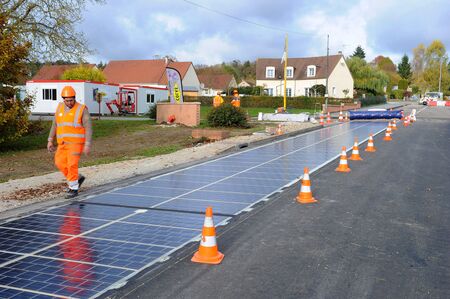
A subsidiary of Bouygues SA has designed rugged solar panels, capable of withstand the weight of an 18-wheeler truck, that they’re now building into road surfaces. After nearly five years of research and laboratory tests, they’re constructing 100 outdoor test sites and plan to commercialize the technology in early 2018.

Wattway’s solar road in Tourouvre

“We wanted to find a second life for a road,” said Philippe Harelle, the chief technology officer at Colas SA’s Wattway unit, owned by the French engineering group Bouygues. “Solar farms use land that could otherwise be for agriculture, while the roads are free.”

As solar costs plummet, panels are being increasingly integrated into everyday materials. Last month Tesla Motors Inc. surprised investors by unveiling roof shingles that double as solar panels. Other companies are integrating photovoltaics into building facades. Wattway joins groups including Sweden’s Scania and Solar Roadways in the U.S. seeking to integrate panels onto pavement.

To resist the weight of traffic, Wattway layers several types of plastics to create a clear and durable casing. The solar panel underneath is an ordinary model, similar to panels on rooftops. The electrical wiring is embedded in the road and the contraption is topped by an anti-slip surface made from crushed glass.

A kilometer-sized testing site began construction last month in the French village of Tourouvre in Normandy. The 2,800 square meters of solar panels are expected to generate 280 kilowatts at peak, with the installation generating enough to power all the public lighting in a town of 5,000 for a year, according to the company.

For now, the cost of the materials makes only demonstration projects sensible. A square meter of the solar road currently costs 2,000 ($2,126) and 2,500 euros. That includes monitoring, data collection and installation costs. Wattway says it can make the price competitive with traditional solar farms by 2020.

screen-shot-2016-11-27-at-21-44-24


The electricity generated by this stretch of solar road will feed directly into the grid. Another test site is being used to charge electric vehicles. A third will power a small hydrogen production plant. Wattway has also installed its panels to light electronic billboards and is working on links to street lights.

The next two sites will be in Calgary in Canada and in the U.S. state of Georgia. Wattway also plans to build them in Africa, Japan and throughout the European Union.

“We need to test for all kinds of different traffic and climate conditions,” Harelle said. “I want to find the limits of it. We think that maybe it will not be able to withstand a snow plow.”

The potential fragility joins cost as a potential hurdle.

“We’re seeing solar get integrated in a number of things, from windows in buildings to rooftops of cars, made possible by the falling cost of panels,” Bloomberg New Energy Finance analyst Pietro Radoia said. “On roads, I don’t think that it will really take off unless there’s a shortage of land sometime in the future.”’

Bloomberg


It’s the latest response to a fossil-fuel disaster.


JAMAICA Public Service (JPS) customers will be asked to pay more for their electricity this month — partly due to the recent increase in the Special Consumption tax (SCT) on heavy fuel oil (HFO), the light and power company advised yesterday.

The company said the spike is also due to an increase in the cost of the fuel used for electricity generation, caused by rising oil prices on the international market, and the continued devaluation of the Jamaican dollar.

“This is definitely not the best news for us at JPS, or for our customers,” JPS President and CEO Kelly Tomblin said in a release.

The Government last month introduced the $7 per litre increase as part of the revenue package to help finance its $580-billion 2015/16 Budget, but Finance Minister Audley Shaw, at the time, assured the panicking public that the tax would only apply to fuel at the pumps.

“This tax doesn’t apply to JPS at all. It is only related to SCT for fuel for road transport,” Shaw said at a post-budget press conference. The SCT is expected to yield $6.4 billion for the Government’s coffers.

In announcing the 12.8 per cent increase yesterday, the JPS urged consumers to “conserve on their electricity usage, as the upward trend in oil prices has resulted in an increase in the cost of electricity”.

“The overall increase will result in residential customers paying US$0.21 per kWh on average for electricity in June, compared to US$0.19 in May. This means that the average residential customer using 165kWh of electricity for the month, will see a $500 increase in his or her June bill, which will move from $3,875 in May to approximately $4,372 this month,” the JPS said.

The JPS president stressed that, despite the increase, electricity bills are still 20 per cent lower than they were in June 2015 when customers were paying US0.27 per kWh. The company argued that Jamaica continues to enjoy one of the lowest electricity rates in the region, behind Belize and Trinidad.

Reacting to the news, Private Sector Organisation of Jamaica (PSOJ) President William Mahfood reiterated that the sector had recognised from the outset that the imposition of the tax on the HFO and Liquefied Natural Gas (LNG) would have an incremental increase in the cost of electricity of five per cent.

“As far as the price of oil goes, this is a matter that is beyond our control (but) we still feel there should be some amount of hedge put in place to mitigate against future increases in the price of oil,” he remarked, noting that the sector is in full support of the phasing out of older power plants which rely on HFO and diesel.

He said that, while the phasing out of JPS’ 190-megawatt facility at Old Harbour will take a couple more years, eventually more plants will convert to LNG.

Mahfood said also that, like rising oil prices, the devaluation of the dollar against the US currency is out of Jamaica’s hands and can only be militated against by economic growth.


The Observer

The Office of Utilities Regulation (OUR) says it will ensure that power utility Jamaica Public Service Company does not increase bills to consumers based on the delay in the delivery of cheaper gas fuel.

The first delivery of liquefied natural gas – LNG – by JPS’ supplier was expected in April, but has been pushed back to August.

New Fortress Energy has developed a terminal in Montego Bay to feed gas to JPS’ Bogue plant, which has been converted to burn either LNG or automotive diesel oil.

“The OUR has moved to assure consumers that it will be vigilant in ensuring that the delay in the delivery of liquefied natural gas to the Bogue power plant will not result in an increase in the price of electricity,” said the regulator in a statement.

While welcoming the completion of the conversion of the 120-megawatt combined cycle plant, the OUR signalled disappointment with the “four-month delay” in the delivery of the overall project.

The gas supply agreement signed by JPS and New Fortress Energy on August 5, 2015, stipulated that gas delivery would commence April 2016, the OUR stated.

“Safeguards for customers were included in the agreement with New Fortress to ensure that any delay on its part would not result in negative cost implications for customers,” noted OUR Director General Albert Gordon. “The OUR has been monitoring the project closely and will continue to keep the public abreast of its progress.”

Project’s goal

The Bogue project’s goals, which are aligned to those in the National Energy Policy, were to reduce fuel cost, and lower the operations and maintenance expenditure of electricity generation. Gordon noted that the OUR’s involvement in the project began in 2008 and that the agency mandated that the plant be upgraded to burn gas in the 2014-2019 JPS tariff determination.

“To ensure this, the OUR also made provisions for the setting up of the Bogue Plant Reconfiguration Fund (BPRF), financed through the tariff, to facilitate the conversion cost,” the agency said.

The revenues for the BPRF – which totalled $15 million – were collected by the JPS through a line item in the monthly fuel rate calculation on customers’ bills, over a twelve-month period, between February 2015 and January 2016, the OUR said.

Requests to JPS for comment were unanswered up to press time.

The Gleaner

Former Energy Minister Phillip Paulwell says consumers who have been benefiting from reduced electricity rates from the Jamaica Public Service (JPS) over the last 12 months could see a hike in the cost of energy with the Government’s imposition of new taxes on heavy fuel oil and liquefied natural gas.

The JPS recently concluded work to convert its Bogue Power Plant in Montego Bay, St James, to dual-fuel capability.

United States-based New Fortress Energy is expected to bring liquefied natural gas into the island by August, at which point the newly converted Bogue power plant will begin to use the more environmentally friendly fuel.

Paulwell’s concerns came as he spoke with journalists yesterday at the end of Shaw’s opening contribution to the Budget Debate.

“Currently, the JPS does not pay taxes on heavy fuel oil. Government has now imposed a tax both on liquefied natural gas, which will arrive in August of this year, and on heavy fuel oil, so it means a significant increase in the price of electricity that has been trending down by almost 50 per cent over the last year.”

At the same time, Opposition Leader Portia Simpson Miller is taking the Government to task for “breaking its promise” by imposing new taxes to fund the tax-relief plan.

“All I can say is that they have broken their promise to the Jamaican people – no new tax – but, from all indication of what Minister Shaw said today (yesterday), it is the poor that will suffer,” she said.

Central Manchester MP Peter Bunting argued that the increased taxes would affect everyone, but have a more significant effect on those who earn under $600,000 per annum, and who will have to face increased transport and electricity costs.

He described the tax measures as regressive, noting that persons at the bottom of the society are being burdened to give relief to those earning at a higher level.

Jamaica Private Power Company (JPPC) saw its loss position double in 2015.

Its parent, Kenon Holdings, reported US$2 million ($234 million) net loss for last year compared with US$1 million the year before.

The private power producer, which sells electricity to all-island distributor, Jamaica Public Service Company (JPS), managed to increase its revenue by four per cent from year-earlier levels to US$45 million in 2015.

This was mainly due to the company increasing its electricity generation from 425 gigawatt hours, or 10 per cent of total national grid’s needs, to 445 GWh, of which well over 90 per cent was sold, likely because it has one of the most efficient fossil fuel, or thermal plants in Jamaica.

JPS’ system uses a dispatch application that determines the best combination of operating levels for each plant supplying the grid to ensure that energy is provided at the lowest total cost to the consumer.

Last year, JPPC improved the efficiency at its 60 megawatt plant, lowering the heat rate from 8,306 Btu/kWh in 2014 to 7,989 Btu/kWh in 2015.

In other words, it increased the amount of the energy stored in the heavy fuel oil (HFO) that was converted into electricity from 41 per cent to 43 per cent. That is, it used two percentage points more of the HFO’s energy to make electricity.

This helped the Rockfort, Kingston-based power producer lower its average fuel cost from US$137 per MWh to US$69 per MWh, albeit a dramatic fall in oil prices contributed more to this improvement. Average sales price, therefore, fell from US$182 per MWh (or J$20 a kWh) in 2014 to US$101 per MWh (or J$12 a kWh).

Indeed, the company’s earnings before interest, tax, depreciation and amortisation (EBITDA) improved from US$1 million to US$2 million, but this would not have been enough to cover staff cost, debt servicing and depreciation.

JPPC is the smallest of the power producers that use fossil fuel-based plants. Jamaica Energy Partners and its sister company West Kingston Power Plant, combined, generates about 30 per cent of Jamaica’s electricity requirements. JPS produces over 50 per cent.

Some six per cent of the country’s electrical energy is derived from hydro and wind, with another three to four percentage points expected to come from 78MW of wind and solar scheduled for commissioning by next year.

Kelly Tomblin, president and chief executive officer of the Jamaica Public Service Company (JPS), is arguing that the visit of United States President Barack Obama to Jamaica last year has improved the energy prospects for the island.

Tomblin, one of the participants in a Gleaner project ahead of Friday’s one-year anniversary of Obama’s visit, said: “Obama’s visit gave Jamaica greater strength in gas negotiations with gas suppliers by signalling support for US gas to Jamaica, thus increasing competition and the number of available suppliers and supporting greater optimisation of Jamaica’s renewable resource.”

During his two-day visit to the island, Obama announced the formation of an energy fund to finance clean-energy projects in the region. He made the announcement at the Caribbean Community (CARICOM)-US Summit.

“Caribbean countries have one of the highest energy costs in the world. Today, we are announcing new partnerships and a new fund to mobilise private-sector projects in clean energy for the Caribbean and Central America,” he said at the conclusion of the summit.

OPPORTUNITIES NEEDED

The energy fund now forms part of the Caribbean Energy Security Initiative, which aims to reduce the region’s reliance on fossil fuels.

According to Tomblin: “Obama’s visit created more opportunities throughout the energy sector by voicing confidence in Jamaica’s landscape and supporting US investment in Jamaica’s energy sector.”

She called for Jamaica to act fast in capitalising on the opportunities created in the energy sector by the initiatives announced by Obama.

“The only threat exposed during Obama’s visit was the truth that if we don’t act fast, other Caribbean countries will take advantage of the new open door in the energy market and secure the hub position,” she said.

In giving further reflections on the anniversary of the visit, Tomblin highlighted the need for Jamaica to position itself as the hub for the provision of gasolene as a cheaper source of energy.

“Let’s make sure we step fully into this moment he opened up by driving this gas-procurement process through quickly and position Jamaica as an obvious hub for that product which will be key for our neighbours to meet their overall environmental commitments,” she said.

“We cannot afford bureaucracy now.”

Gleaner