
When Blue Mountain Renewables (BMR) began operating its 36-megawatt wind farm in Potsdam, St Elizabeth, a few months ago, the facility became Jamaica’s largest private-sector renewable energy project.

Minister of Science, Energy and Technology Dr Andrew Wheatley, who gave the keynote address at the official opening on August 11, pointed out that the wind farm would help to diversify the country’s energy matrix and ease the dependence on imported fossil fuels.

“The wind farm is expected to reduce greenhouse gases by about 66,000 tons of carbon dioxide equivalent per year, roughly equivalent to taking 13,000 cars off the road,” he informed.

Wheatley also applauded the relationship and assistance the company has given to the neighbouring schools, Munro College and Hampton High, as well as the treatment of farmers in St Elizabeth who were affected during the construction phase.

Principal of Hampton High Heather Murray said that she could literally see the ‘wind of change’ with the advent of the BMR wind project.

She bemoans the fact that nearly a quarter of her school’s budget is spent on high electricity cost, money that could be spent on building a state-of-the-art science laboratory.

“BMR brings hope and we welcome them wholeheartedly. We are also excited about the efforts to go green and we are doing our part here at Hampton. Earlier this year, we swapped all fluorescent light bulbs for more environmentally friendly LED bulbs,” Murray stated.

She also informed that Hampton had installed about 12 solar panels to integrate renewable energy into their electric supply. The panels, combined with small wind turbines on the campus, now provide about one-fifth of the school’s energy needs, she noted.


TO SERVE THOUSANDS


The BMR Jamaica Wind project will serve thousands of customers annually. Power will be sold to the Jamaica Public Service (JPS) Company, under a 20-year power-purchase agreement. This electricity is expected to be among the lowest cost sources of power available on the JPS system.

Jamaica currently relies on oil imports to meet 90 per cent of its energy needs. This leaves the country vulnerable to fluctuating oil prices, which can make it difficult to budget and plan effectively.

To ease the dependence, the country has set a target to generate 30 per cent of its energy from local renewable sources such as hydro, wind and solar power by 2030.

President of BMR Bruce Levy said construction of the project was made easier by the cooperation of the Potsdam residents and the appreciation they showed for the work being done in their community.

“We made sure there was significant benefit to the local and wider community, with billions of dollars of direct spending and employment of hundreds of Jamaicans during construction. We say, without any fear of contradiction, that we are committed to community development,” he said.

Levy informed that the wind farm was made possible through a US$62.7 million financing package, including a US$42.7 million loan from the Overseas Private Investment Corporation (OPIC); a US$10 million loan from the International Finance Corporation (IFC), and a US$10 million loan from the IFC-Canada Climate Change Programme. BMR Energy provided an equity investment of US$26.9 million.
Gleaner

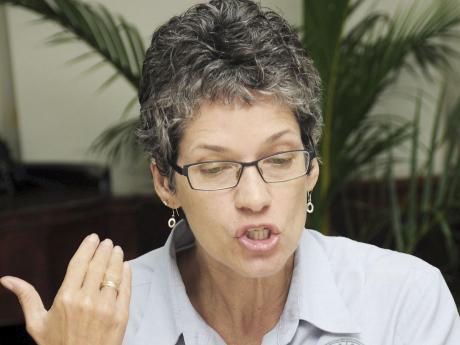
 McCaulay … It appears the environment will be under the Office of the Prime Minister along with a lot of different, other important national areas and I fear the environment focus will be lost in the other priorities.

Prime Minister Andrew Holness has attracted the attention of environmentalists with the exclusion of the environment and climate change portfolio as a named ministry in his Cabinet.

For environmentalists, it does not send a positive signal.

“I am disappointed to see that there is no environment ministry and no environment minister. It appears the environment will be under the Office of the Prime Minister along with a lot of different, other important national areas and I fear the environment focus will be lost in the other priorities,” said Diana McCaulay, Chief Executive Officer of the Jamaica Environment Trust (JET).

“I don’t think this first signal is a very positive one. It used to be that the environment portfolio moved around from ministry to ministry. Now it would it seem to have disappeared entirely,” she added.

Only last week, JET, along with a number of other entities, including the Windsor Research Centre, urged the new Prime Minister to give priority to a host of environment issues, notably:

*climate Change
*Cockpit Country
*planning for sustainable development
*protected areas
*sanitation and public health
*enforcement of environmental laws

With the Jamaica Labour Party vowing in its manifesto to work with environment actors, McCaulay said she was eager to learn how the realities of the new Cabinet will gel with the identified priority areas.

“I would like to hear the details of how this would work sooner rather than later and I would like to hear a timeframe for doing some of the things stated in the manifesto,” she told The Gleaner.

Head of the South Trelawny Environment Agency Hugh Dixon was in agreement.

“I think with growth and prosperity being the sort of thrust of the new government, it seems to be an awful oversight as the issues that are at the forefront of development are predicated to a great extent on an awareness and sensitivity to [for example] climate change,” he said.

According to Dixon, the situation is will challenge civil society environment groups to gain traction in terms of the significance and value of climate change, and the environment.

“I would, with caution, say that I hope that wherever it has been dispensed to, it holds some order of priority consistent with its current standing globally and any sort of growth and development agenda,” he added.

Former Minister of Local Government and Community Development, and one-time Opposition spokesman on Environment Noel Arscott has himself questioned the rationale behind the lack of a designated ministry of environment and/or climate change.

“Jamaica and the Caribbean fall in one of the most vulnerable regions in the world affected by the vagaries of the weather. We certainly are victims of any kind of climate change impacts… So for a government not to put that on the front burner was really shortsighted…” he said.

The Gleaner

OUR wants JPS to say why power being cut in some communities

How comes

THE Office of Utilities Regulation (OUR) has summoned Jamaica Public Service Company (JPS) officials to a meeting today as public anger grows over the company’s decision to cut the number of hours that power is provided to some communities in an effort to combat electricity theft.

The regulator said it requested the meeting after being alerted about the matter by its Consumer Affairs Unit, which received complaints from the public, as well as JPS’s own news release on the issue yesterday.

According to the JPS, it took the decision as part of a strategy to get more persons in communities where more than 70 per cent of the power is stolen to pay for the electricity they use, and reduce the overall cost to paying customers.

“The communities to be affected in the initial phase of this curtailment strategy are Jones Town, Seaward Drive, Trench Town, Denham Town, Rema, Maxfield Avenue, Central Village, and Spanish Town Road,” JPS said, adding that it “has been working with these communities for some time, with limited success, and continues to encourage illegal users to take immediate steps to have their service regularised”.

“We have tried everything to reduce electricity theft,” the JPS release quoted Gary Barrow, the company’s senior vice-president for energy delivery.

“Our efforts have included a combination of initiatives, such as the removal of illegal ‘throw up’ lines, account audits and meter investigations, arrests in collaboration with the police, community intervention, and the installation of costly technology solutions. The company also has more than 200 employees working to reduce losses,” Barrow said.

The company, which some years ago launched a compliance campaign with the tag line ‘How Come?’, explained that in 2013 it removed more than 197,000 illegal lines, carried out more than 113,000 account audits and meter investigations, and facilitated the arrest of more than 1,200 persons for electricity theft.

It also said that it has installed more 7,600 Residential Automated Metering Infrastructure meters, but most of the potential customers targeted have not signed up for legal service.

According to the power company, its efforts to serve paying customers in communities with high levels of theft continue to be hampered by extensive damage to its equipment and ongoing power outages caused by illegal connections.

“Customers also suffer significant damage to their appliances and equipment as a result of the system overload caused by illegal connections,” JPS said.

As such, the company said that it “will make an effort to provide electricity for not less than 12 hours per day, and will remain sensitive to the safety concerns of the residents”.

The firm added that it “was also making every effort to minimise the impact on businesses, hospitals, and schools in these communities”.

In a letter to the JPS yesterday, the OUR asked for “critical information, such as the number of paying residential and commercial customers in the affected areas, and the alleged level of damage done to JPS equipment as a result of electricity theft in these communities”.

The OUR said it was treating this issue with the highest priority, given the impact on legitimate customers in these communities.

Jamaica Observer;