
screen-shot-2016-10-28-at-6-20-33-pm

What will Donald Trump actually do?

It’s a question many Americans are asking themselves now that the U.S. has wrapped up one of its least policy-specific elections ever. The president-elect has offered only the loosest of legislative prescriptions, including whatever plans he may have for the energy industry.

The mystery hangs over turbine manufacturers like Vestas Wind Systems, which fell 12 percent since the election, and coal companies such as Peabody Energy Corp., which soared 73 percent. In his only major energy speech, Trump, 70, said he would rescind “job-destroying” environmental regulations within 100 days of taking office and revive U.S. coal. It’s terrible news for efforts to slow the pace of climate change, but the impact on the renewable energy revolution may be limited. Here’s what it could mean for America’s clean-energy darling, Tesla Motors Inc.:

1. Solar and wind subsidies are probably safe

Tesla is, first and foremost, an electric car company. But on Nov. 17 shareholders will vote on final approval of CEO Elon Musk’s $2.2 billion deal to buy SolarCity Corp. The acquisition would make Tesla the biggest U.S. rooftop solar installer and the first major manufacturer to integrate solar panels with battery backup to extend power into the night.

The swift spread of rooftop solar in the U.S. has been made possible by two government policies. First, most utilities are required to credit homeowners for the excess power they send back to the grid. Those requirements are state-level and shouldn’t be affected by Trump. Second is the 30 percent federal tax credit to offset the cost of installations. The credits were first signed into law under Republican President George W. Bush in 2005 and extended by a Republican Congress late last year. Given their broad support, the subsidies are unlikely to be repealed.

2. Even without incentives, renewables will get cheaper

Solar panel prices have dropped, on average, more than 15 percent a year since 2013. On a utility scale, solar power is already cheaper than coal-fired grid electricity across most of the U.S., after subsidies. Even if the incentives were suddenly removed next year—an improbable and economically destructive scenario—the industry would eventually recover as prices continue to fall.

Incentives are designed to make superior new technologies initially affordable, but once those technologies take off, economies of scale take over.
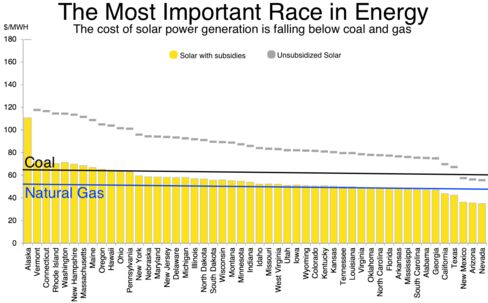
Source: Bloomberg New Energy Finance

A loss of the federal tax credit could slow the rollout of Tesla’s unusual new rooftop solar shingles. Traditional rooftop panels, however, are almost ready to stand on their own. The payback period currently ranges from about 5 to 10 years, after subsidies and state rebates. If Tesla can achieve the cost savings it hopes for with the merger, it won’t be long before that’s the payback timeline without subsidies.

3. Gasoline fuel-efficiency targets could be dismantled

One of President Barack Obama’s most significant climate achievements was to push through ambitious fuel-economy regulations for U.S. vehicles. The Environmental Protection Agency is scheduled next year to re-asses rules intended to double the average efficiency of cars and trucks to almost 55 miles per gallon by 2025. Those goals could be delayed or dismantled under Trump, accelerating America’s shift to trucks and SUVs. Stocks of Detroit carmakers have predictably surged, while Tesla shares fell 4.9 percent in the two days after the election.

This is obviously bad news for human health and the environment, but it’s impact on Tesla won’t be catastrophic. The price of batteries is dropping rapidly, and by the early 2020s electric cars should be cheaper and better performing than their gasoline-powered equivalents across the board. Lowering efficiency standards will make gasoline cars a bit cheaper to manufacture, but it will also make them more costly to drive over the life of the vehicle.

4. Electric vehicle incentives will expire on their own

The U.S. push for electric cars was set in motion by a $7,500 federal tax break. The Trump administration could eliminate the subsidy, but the impact would be short-lived for electric pioneers including Nissan Motor Co., General Motors Co., and Tesla. That’s because the electric-vehicle subsidies were already designed to phase out after each automaker reaches its 200,000th domestic EV sale. Tesla may be first to cross that finish line, probably in the first half of 2018.

The incentives were intended to overcome steep startup costs and slow initial demand for new electric vehicles. Removing the tax break now would effectively pull the ladder up behind Tesla and make it more expensive for other automakers to transition to battery power, a result that wouldn’t be in anyone’s best interest.

5. States wield the power of their own incentives

Some of the biggest incentives in renewable energy are offered by states, not the federal government. Each state has authority over its own solar and wind rebates, credits for power sold back to the grid, renewable-mix requirements for utilities, and electric-car subsidies. These policies cross ideological borders into deeply Republican states. For example, Louisiana residents can get an additional tax credit of almost $10,000 for buying a long-range electric car. In Colorado, it’s an extra $5,000.

Under Trump, the role of cities and states in regulating pollution and expanding clean energy will increase. So will the disparity between states that prioritize the issue and those that don’t. But again, don’t expect the energy revolution to follow rigid red-state, blue-state definitions. The states producing the most wind power in the U.S. include Texas, Kansas, and Oklahoma. For solar, Arizona, North Carolina, and Nevada are among the top ten. Of those, Hillary Clinton won only Nevada.

6. Keystone’s resurrection won’t make gasoline cheaper

This election was great news for oil companies. Reviving the Keystone XL pipeline, which was rejected under Obama, is on Trump’s list of priorities for his first 100 days. He is also likely to support the beleaguered Dakota Access Pipeline. The company building it, Energy Transfer Partners LP, says business is “only going to get better” under Trump.

These pipelines are hugely symbolic for climate activists who say we can’t keep building infrastructure for oil we can’t afford to burn. But the impact of the pipelines themselves is open to debate. They increase profitability for oil companies, but as oil trades on a global market, the impact on U.S. gasoline prices and by extension demand for electric cars is negligible.

7. Trade barriers with Mexico would hurt Tesla’s rivals

Trump wants to scrap or renegotiate the North American Free Trade Agreement (NAFTA). That could be a dicey proposition for the car industry. Since 2010, nine automakers, including Ford Motor Co., GM and Fiat Chrysler have announced more than $24 billion in Mexican investments. They rely on Mexican plants to produce millions of vehicles and a high volume of parts.

By contrast, Tesla’s manufacturing and assembly are done almost entirely in California and Nevada. Tesla also plans to begin solar-panel production next year at SolarCity’s massive plant in Buffalo, N.Y. Tariffs on solar panels made outside the U.S. would make Tesla’s American-made products more competitive.

In the end, the confluence of all of these forces, but especially the precipitous decline of coal and increasing affordability of renewable sources of energy, is probably too strong to be reversed by the incoming Republican administration. That’s good news for Tesla, and a lot of other companies working to clean up the energy supply.

Bloomberg

At least one local environmentalist has hit back at Sally Porteous, custos of Manchester, over her arguments urging the Government’s authorisation of a coal plant for a US multibillion-dollar investment into the Alpart alumina plant in St Elizabeth.

The Chinese-owned Jiuquan Iron and Steel Company (JISCO) is planning to spend US$3 billion or J$387 billion for the upgrade of Alpart’s alumina plant in Nain and expansion into a special economic zone. More than 3,000 people are expected to be employed over the six-year period of initial investment.

However, a proposal to use a coal-fired plant has angered environmentalists, forcing the Government to come out declaring that any decision on whether to use coal is almost two years away.

Speaking last week at a Gleaner Jobs & Growth Forum in Manchester, Porteous did not hold back.

“While I listen to, and respect, the environmentalists, I sincerely hope that it is not going to be a case of crying wolf and preventing an enormous opportunity for Jamaicans to get work.

“From what I understand, they will not be using coal from China, they will be using coal from Colombia. The Alpart plant itself would be run on oil, and the coal they are going to be using for the coal plant will not emit any worst emissions than oil,” she added, noting that she recently met with Chen Chunming, the JISCO chairman.

But Diana McCaulay, chief executive officer of the Jamaica Environment Trust (JET), said Porteous’ analysis is not deep enough, and so, too, is her view that coal is cleaner than oil.

“People are entitled to their views. But coal is a 19th-Century technology. It is time for us to move forward, and it is time for us to take the position that we want development and we want industry and we want business and we want jobs for our people, but not at the expense of public health and the climate.”

She added: “Jamaica is incredibly vulnerable to climate change. To say that you’re willing to take this risk for some short-term jobs, I find mystifying.”

Jamaica has been going through decades of low growth, double-digit unemployment and crippling debt levels that have created the circumstances for a loan agreement with the International Monetary Fund.”

NOT FIRST TIME

It is not the first time a local official has waded into controversy over securing needed investment for the country. Last year January, in the face of a hotel investment being derail over breaches, Robert Pickersgill, then environment minister, in lifting a cessation order remarked that he took note of the “the substantial value of the project to the Jamaican economy, which outweighs all other consideration”.

In September, Mining Minister Mike Henry said a decision on the coal proposal was at least 18 months away.

Global environmental advocacy group Greenpeace has said constructing the plant would violate the Paris climate agreement aimed at limiting global warming.

Porteous maintained that the Chinese investment represents an opportunity to bring well-needed economic growth to central Jamaica.

“This is the centre of the island’s only chance for revival. We have nothing else. We’re not near a beach, the north coast is taking care of itself very, very well, and I can see very great business going into Kingston.

“We have the opportunity of a lifetime with JISCO coming to take over that plant,” she said.

The Manchester Chamber of Commerce said it is already taking steps to get the parish ready to claim some of the spinoff benefits.

“We’re currently in discussions with investors to try and lure them and encourage them to come into the development of the parish to aid in the development of the parish, especially as it related to three main areas,” said Michael Gottshalk, the chamber’s manager of communications and public affairs.

He said housing to accommodate the expected influx of workers, entertainment and parking are at the top of the list.

Gleaner

The United Nations (UN) climate change secretariat has added its voice to concerns being raised about a proposal made by China’s Jiuquan Iron and Steel Company (JISCO) for the construction of a coal-fired plant in St Elizabeth.

The proposal was announced after JISCO completed a deal to acquire the Alpart alumina factory from Russian company, UC Rusal. The new Chinese owners plan to upgrade the plant with an aluminum smelter that would be powered by a 1,000-megawatt coal-fired plant.

Based on calculations provided by the CoalSwarm Global Plant Tracker, a 1,000 megawatt coal plant would produce 5.6-5.8 million tonnes of CO2 annually, increasing Jamaica’s emissions of CO2 by 79-82 per cent. Greenpeace campaigner Lauri Myllyvirta has said that the construction of the plant would violate the Paris Agreement signed under the UN Framework Convention on Climate Change (UNFCCC).

Commenting on the possible impact of the proposed coal plant on Jamaica’s UNFCCC standing, Nick Nuttall, UNFCCC spokesperson, pointed out that Jamaica had submitted an ambitious national climate action plan to the UN aimed at achieving a nearly eight per cent emission reduction by 2030. He also argued that the action plan promised commitments of greater investment in greener sources of homegrown energy such as wind and solar power rather than increases in oft-imported fossil fuels.

He argued that economic growth and job creation were not antithetical to environmental protection.

“Many complex choices will be made by governments over the years and decades to come, including with regard to energy sources, but today, there is an ever clearer consensus that overcoming poverty and growing GDP, which are critical for developing countries, can go hand in hand with generating new kinds of high-tech jobs; creating healthier, less polluted societies and a transition to a low carbon economy …,” he said in an email response to The Gleaner.

Prime Minister Andrew Holness has said that the Government is committed to balancing its economic-growth aspirations with its environmental and international commitments.

Comments solicited from Jamaica’s mission to the UN and the Ministry of Foreign Affairs were not forthcoming up to press time.

Gleaner

An explosion that killed at least 21 people and injured five others last Thursday at a coal-fired plant in central China has not gone unnoticed by consulting mechanical engineer Howard Chin.

He has argued that the incident should give the Jamaican authorities cause for pause with regard to a proposal from the Chinese to build a 1,000-megawatt coal-fired plant at the Alpart alumina refinery which has been acquired by Chinese firm Jindal Iron and Steel Company Ltd (JISCO).

“China has a reputation for explosions at its coal-fired plants because the safety standards are not very well regulated, so Jamaica could face that risk … . If you look at the North-South Highway, the Chinese did a quick slab job on that one. They didn’t do proper studies for that project, if you ask me. So I think these coal plant explosions in China should be instructive for Jamaica,” he said in an interview with The Gleaner.

Chin, who is a former president of the Jamaica Institution of Engineers (JIE), explained that explosions in coal-fired plants are generally caused by improper welding.

According to Chin, the fact that the Chinese do not adhere to international welding standards, for the boiler and pressure vessels that would be used in the coal-fired plant, established by the American Society of Mechanical Engineers (ASME) that could result in improper welding. And improper welding could lead to deadly explosions, similar to those that occur in China. A lack of sufficient ASME certified welders in Jamaica is also seen as problematic.


CAUSE OF THE FIRE


Last Thursday’s explosion at the coal-fired plant in the Hubei Province of China was caused by a faulty high-pressure steam pipe which went bust. The Dangyang-based plant was still under construction when the explosion occurred.

The former JIE president raised further questions about what he described as a number of defects that would be associated with the proposed coal-fired plant.

“There is the matter of the ash. Where are you going to put all the ash? It’s possible you can put it all in cement, but that would require a cement plant to be built to take all that ash, because of lot of ash will be generated. There is also cooling water that will be needed, and the only water source that is near there is the Black River and if you cool the plant using the Black River, you are going to kill the fish in that river with all the heat, so I don’t think that is a good idea,” he said.

andre.poyser@gleanerjm.com


The Gleaner