Minister without portfolio with responsibility for water, works and housing Dr Horace Chang says the housing sector must be governed by regulations and practices that are sustainable, climate-resilient and will ensure the safety and security of Jamaicans.

He made the comments ahead of the regional housing conference to be hosted by the Ministry of Economic Growth and Job Creation, October 18-20 at the Iberostar Rose Hall Suites Hotel, Montego Bay.

The inaugural conference, themed ‘Providing Safe, Legal and Affordable Housing for All: From Policy to Implementation’, is expected to expose some of the issues and, where possible, bring solutions to the housing market. It will also identify best practices that can be used to improve service delivery and innovative approaches to housing.

Areas to be discussed include housing costs and financing, building technology within a changing environment, housing and land tenure, and housing sector management.

“The conference comes at an opportune time given the need to ensure that our houses are built with the best quality materials, which are environmentally friendly, structurally sound and climate-resilient,” stated Minister Chang.

He said these considerations are even more important considering recent devastating hurricanes which have impacted several islands in the Caribbean.

“This need is even more urgent in the face of climate change as our construction industry must adapt to the new realities, and must ensure that our buildings are robust and can withstand the more intense impacts of climate change, with its extreme weather events,” he explained.

In the meantime, Chief Technical Director at the MEGJC with responsibility for water, works and housing Doreen Prendergast said the regional conference has received overwhelming local and international support.

She indicated that representatives from St Lucia, Barbados, Guyana, World Bank, IDB, Cities Alliance, Habitat for Humanity and a representative from the US Department of Housing and Urban Development are scheduled to attend, and in some instances make presentations.

“There is a great need for this type of forum because of the challenges within the housing sector,” said Prendergast. “Challenges pertaining to governance, security of tenure, and housing need and demand that are not being satisfied.”

The ministry has received 26 abstracts from academia for the conference, which are intended to provide an avenue for academia to help chart the policy and planning of the sector.

Jamaica Observer

Thera Edwards with a copy of the book ‘Global Change and the Caribbean: Adaptation and Resilience’.

A NEW book on resilience building in the Caribbean, forced by the changing climate and driven by globalisation and population growth, has hit local shelves, with the goal to lend insight into regional realities and help inform future action.

Called ‘Global Change and the Caribbean: Adaptation and Resilience‘, the book’s chapters are selected from among 37 papers presented at the sixth British-Caribbean Geography Seminar Series, held at the University of the West Indies (UWI), Mona, in 2014.

It is edited by David Barker, Duncan McGregor, Kevon Rhiney, and Thera Edward, and published by the UWI Press.

The official launch took place on May 25.

For Edwards, it is a timely publication, one that comes as the Caribbean ramps up research into climate change, which has seen temperature increases in and outside of the region, rising sea levels, and threats of more extreme weather events and the related negative implications for the health of the region’s population and their livelihoods.

“One of the important things is that it doesn’t just look at Jamaica. A lot of times people talk about the separateness of some of the Caribbean states, so looking at different islands and countries in a comprehensive volume is important. It shows where there might be some differences in terms of contexts but also commonalities in terms of what we are facing regionally,” Edwards told The Gleaner.

Among the islands looked at are St Kitts, Dominica, Guyana, Saint Lucia, St Vincent, and Suriname.

“We are also moving beyond the talk of SIDS (small island developing states) and their vulnerability to adaptation how and what we are changing about our approach and the resilience of the region. So we are not just looking at the ‘poor us, woe is we’; we are looking at how are we holding up,” the editor added.

An additional benefit, she said, is that it draws on the experience and diversity of people in scholarship young and old, in and outside of the Caribbean.

Among the specific issues looked at are Caribbean tourism and urban development; the 2014 Jamaica drought; banana farming in Dominica after Hurricane Hugo; social capital and rural resilience among the Carib communities in northeastern St Vincent; and local knowledge and community resilience.

“We want people to use this book to look at what is happening. It is a sort of follow-on from some of the previous volumes so just to look at how things have changed (is important),” the editor said.

Double Exposure

“We want people to look at things like double exposure, where you look at not only the process of global change, but also climate change, both of which have an impact on the environment and the social system. We want this complete look at things in terms of what is happening in terms of world processes like globalisation and climate change and how together they have influences on the region,” the editor said.

“We also want persons who are in policymaking and developers to look at what is emerging from some of the research. There are also some other things we can (all) look forward to like environmental justice, which looks at the fair treatment and inclusion of communities in the enforcement of environmental laws and policy. Similarly, there is climate justice, which sort of intersects with what is going on with environmental degradation and some of the inequalities that come out of it,” Edwards added.

The book is available at the UWI Bookshop in Kingston, as well as at all branches of Kingston Bookshop and Sangster’s Book Store.

Supporters gather to listen to speakers after marching in support of science, Saturday, April 22, 2017, in Pullman, Wash. People around the globe have turned out in huge numbers to celebrate Earth Day and support scientific research and funding. Rallies in more than 600 cities put scientists alongside advocates of politics-free scientific pursuits.


Play from the local scientific community have given the nod to the recent science marches, staged globally for Earth Day 2017.

The April 22 marches, they say, have helped to draw attention to valuing research, particularly in the struggle to build resilience to climate change.

For Dr Orville Grey, who has responsibility for adaptation in the Climate Change Division of the Ministry of Economic Growth and Job Creation, they also demonstrate the shift in the modus operandi of scientists who now increasingly engage with policymakers and other stakeholders on their work.

“We have seen a time when scientists only spoke to scientists. There is now dialogue between scientists and policymakers, including politicians. We look at the scientific reports coming out and one of the things you recognise is that the volumes coming out now include a summary for policymakers,” said the man whose PhD is in environmental biology with a focus on climate change.

“There is a need to bridge the gap between the scientists and policymakers, including politicians, to ensure there is greater awareness and understanding and that the policies that are being presented are based on the best available science and as such that decisions are informed,” added the University of the West Indies and Northern Caribbean University part-time lecturer.

Professor Michael Taylor, head of the Mona Climate Studies Group Mona, said simply: “They were a good thing to bring attention to science and its importance in development.”

Meteorologist and long-time climate change negotiator for Jamaica Clifford Mahlung said the marches would perhaps have been especially instructive for the United States.

“The whole notion of climate change is based on scientific evidence. There were large turnouts in the US and I think that is where the message should be sent,” he told The Gleaner.

The Guardian, in an Earth Day-published report on the marches, reveals that they had seen the participation of “climate researchers, oceanographers, bird watchers and other supporters of science” from around the world whose intent was “to bolster scientists’ increasingly precarious status with politicians”.

SCIENCE CRITICAL

On that list of politicians is US President Donald Trump, whose Earth Day message nonetheless declared support for science.

“Rigorous science is critical to my Administration’s efforts to achieve the twin goals of economic growth and environmental protection,” he said in the statement published on the White House website.

“My Administration is committed to advancing scientific research that leads to a better understanding of our environment and of environmental risks. As we do so, we should remember that rigorous science depends not on ideology, but on a spirit of honest inquiry and robust debate,” he added.

The president’s statement comes in the wake of his executive order, signed in March, which rolls back a number of policies that had been put in place by former president Barack Obama to counter climate change. They reportedly include the Clean Power Plan and the repeal of guidance for factoring climate change into National Environmental Policy Act reviews.

Gleaner


BEGINNING FEBRUARY 7, the USAID-funded Jamaica Rural Economy and Ecosystems Adapting to Climate Change II (Ja REEACH II) project, in collaboration with the Meteorological Service of Jamaica and the Rural Agricultural Development Authority will host a series of agrometeorology farmers’ fora.

The fora are geared at equipping farmers and other stakeholders with climate-smart risk management strategies. The series will explore common terminologies used by weather experts in delivering the weather news, enabling farmers to interpret and use this information. The workshop will also feature presentations on climate outlook for the upcoming six months and how to prepare for any unexpected changes in the weather to reduce exposure of livelihoods.

“The farmers will also benefit from awareness sessions focused on the impact of climate change and variability on agri-business enterprises, the role of insurance products in the management of climate risks, and planning for climate risks at the farm or community level using the participatory integrated climate services for agriculture tool. This will be complemented by an interactive demonstration of the risk associated with disasters and early warning climate service (flooding or drought) by the MSJ,” Ja REEACH II said in a release to the media.

INSURANCE POLICY

GraceKennedy Insurance has partnered with the Ja REEACH II project to provide Livelihood Protection Policy coverage valued at $300,000 which will be presented to selected farmers during the series. The Livelihood Protection Policy offered by GK Insurance is a trigger-based insurance policy which is designed to help especially non-salary income earners to cope with severe impacts on their livelihood following extreme weather events (rain and wind).

This is the third staging of the agrometeorology fora which builds on the engagement of some 575 farmers, extension officers and other stakeholders who have participated.

The Ja REEACH II project is a four-year initiative funded by the USAID and implemented by ACDI/VOCA. Through a range of interventions, Ja REEACH II works with government, private sector, civil society and community- based organisations to increase awareness and application of practical actions that help Jamaicans to become more resilient to the impacts of climate change.

Gleaner

HEAD OF the Intergovernmental Panel on Climate Change (IPCC) Hoesung Lee has urged attention and focus on the science and not politics in decision-making about climate change.

“One common question (at the Marrakech climate talks held recently in Morocco) was whether political developments in some countries could hinder the global community in providing a science-based response to climate change. My view, the scientists’ view, is that values and political beliefs may vary, but science is the common ground where these conflicting views can find a common understanding,” he said.

Lee was speaking in Jamaica recently where the IPCC the international body that assesses the science related to climate change held its most recent outreach event for the region and which formed a part of Climate Change Awareness Week celebrations on the island.

His comments come even as the world waits to see what the new United States (US) President and climate sceptic, Donald Trump, will do.

The US, up to now, has been one of the more significant contributors to the work of the IPCC, for example, and has done much to bolster global adaptation and mitigation efforts.


Urgent Action

According to Lee, the science has so far revealed the need for urgent action on climate change.

“Responding to climate change is not an either/or choice for a country, it’s part of its development strategy. You all know that,” he said, while referencing the IPCC’s Fifth Assessment Report (AR5).

The synthesis report of the AR5 points, among other things, to ongoing and exacerbated warming of the planet due to human actions.

“Emissions of carbon dioxide from fossil fuel combustion and industrial processes contributed about 78 per cent of the total GHG emissions increase from 1970 to 2010, with a similar percentage contribution for the increase during the period 2000 to 2010,” reads a section of the report.

“Globally, economic and population growth continued to be the most important drivers of increases in carbon dioxide emissions from fossil fuel combustion,” it added.


Population Growth

“The contribution of population growth between 2000 and 2010 remained roughly identical to the previous three decades while the contribution of economic growth has risen sharply,” the document said further.

In the wake of those findings, the IPCC and its team of scientists from across the globe, is to contribute more to the existing body of knowledge on the subject.

Among other things, they are to prepare a special report on the impacts of warming of 1.5 degrees Celsius and related emissions pathways.

“Earlier this year, we brought experts together to scope out that report, and we signed off the outline the table of contents and structure in October. We are now recruiting authors to write the report, which will be delivered in 2018,” Lee said.

All this, while seeking to make their work more accessible.

“We are looking at how to work with our new authors to encourage them to produce their summaries for policymakers in clear, accessible language for non-specialists, and with academies to help them develop educational materials based on our reports,” Lee said to an audience of not only NGOs and policymakers, but also students.

Gleaner

screen-shot-2016-11-19-at-13-24-28

The earth has warmed barely a single degree Celsius, and yet virtually no place on the planet is unaffected by climate change. That’s the conclusion of both a new study published in the journal Science and a popular-science book out this week, The Unnatural World, by David Biello, the science curator at TED and a Scientific Americancontributing editor.

“This new age is not just climate change,” Biello writes, “it is everything change: the sky, the sea, the land, the rocks, life itself.”

The Science article reviews dozens of field studies and assembles them into a mosaic of ubiquitous change, from the genes of organisms to entire regions. More than 80 percent of the 94 biological and ecological systems surveyed show signs of the changing climate. Led by Brett Scheffers of the University of Florida, a team of 17 scientists trawled academic journals and enumerated observed changes across terrestrial, marine, and freshwater environments. The study’s seven pages are a dense catalog of pervasive, dynamic weirdness that paint a picture of changing ecosystems.

No particular item should strike fear in the hearts of readers but, taken together, the data portray a living world that’s trying to cope. Some highlights: Pink salmon are migrating about two weeks earlier in the summer than they did 40 years ago, spawning in ever-warmer waters and causing the fish’s genome to change. Southern flying squirrels, native to the eastern U.S., are becoming northern flying squirrels, now native to the Pacific Northwest, Canada, and Alaska. Colors—which help determine an animal’s sensitivity to light and consequently its ability to thrive in unfamiliar conditions—are shifting in butterflies, dragonflies, and birds. Some places have new diseases, and old diseases have arrived in new places.

The changes, large and small, illuminate the overarching global and regional changes that scientists have warned about, and now documented, for decades. The chemical and physical stability of many ecosystems, and therefore biodiversity, are under assault. The consequences for human society are both foreseen and unforeseen. “Losing genetic resources in nature may undermine future development of novel crop varieties and compromise key strategies that humans use to adapt to climate change,” the Science authors write.

They also suggest where to start: “It is now up to national governments to make good on the promises they made in Paris” to cut emissions and keep ecosystems safe. President-elect Donald Trump has vowed to leave the historic climate accord, backed by almost 200 countries.

Change is so pervasive that geologists, keepers of the earth’s chronology, are considering the dramatic gesture of creating a new epoch, called the Anthropocene, to mark humanity’s influence.

The Anthropocene is the frame through which Biello peers in The Unnatural World. Read together, the book and the Science article demonstrate the astounding scale of human influence on the natural systems that sustain our planet.

“One of the longest-lived impacts of this new people’s epoch, longer lasting even than all the CO₂ piling up in the atmosphere,” Biello said about the Science paper, “will be our impact on evolution. The question now is: Will the Anthropocene be a blip in the rock record, like an asteroid impact, or can people learn to ameliorate our impacts and lengthen the span of this new epoch?”

Bloomberg

CARICOM Secretary General Ambassador Irwin LaRocque (left) with Dr James Fletcher, who led CARICOM negotiators, in discussion with regional heads of government and ministers at the Paris Climate Talks last year.

With the Marrakech climate change talks now only weeks away, the few CARICOM member states that have not yet ratified the Paris Agreement – Jamaica among them – have been urged to do so.

The appeal has come from Dr James Fletcher, former head of the CARICOM Task Force on Sustainable Development.

He predicted that the failure to ratify will see those islands running the risk of not having a say in the first meeting of the parties to the global deal next month.

“Given that the Paris Agreement will enter into force in the Marrakech meeting … if you haven’t ratified the Paris Agreement, then really you cannot be at the table determining rules and procedures and everything else,” he cautioned.

“If you have not ratified the agreement, then you don’t have a voice at the meeting. There will be CARICOM countries there (who share similar challenges) and who will speak on your behalf, but I don’t think it is a position you want to be in because you cannot articulate your own concerns,” added Fletcher, also the former minister of sustainable development for St Lucia.

Ten CARICOM countries have so far ratified the agreement. They include Antigua and Barbuda, Barbados, The Bahamas, Belize, Dominica, Grenada, Guyana, St Kitts and Nevis, St Lucia, and St Vincent and the Grenadines.

They are among the 81 countries to have ratified the agreement, which prescribes the way forward for the planet in its battle against the changing climate.

Caribbean islands and other small-island developing states (SIDS) are counted among those most vulnerable to climate threats.

Those threats include extreme weather events, the likes of Hurricane Matthew, which barrelled across the region recently, leaving in its wake death and destruction in places such as Haiti, Cuba and The Bahamas.

In Haiti alone, the death toll is registered at more than 900, with millions of dollars in loss and damage to infrastructure.

Meanwhile, Fletcher – a respected regional statesman reputed for his work in climate change and other development issues, including energy – is buoyed with the progress on the Paris Agreement. Still, he cautions that there are still miles to go to where the region needs to get in its readiness for climate change.

“We are very encouraged by how quickly this agreement has come into force … It really is awesome for me that the community has rallied to this cause and there seems to be an urgency that, at least philosophically, we need to move in a particular direction,” he said.

LACK OF URGENCY

“What is worrying to me is that there does not seem to be an urgency where climate action is concerned. If you look at the level of ambition for the level of greenhouse gases, it is still not taking us below 2.7 degrees Celsius. Nobody has come out and said, for example, that they will reduce their emissions by another 25 per cent,” Fletcher added.

This, he noted, is what is required if the world is to realise one of the objectives of the Paris Agreement, to hold “the increase in the global average temperature to well below 2 degrees Celsius above pre-industrial levels and to pursue efforts to limit the temperature increase to 1.5 degrees Celsius above pre-industrial levels, recognising that this would significantly reduce the risks and impacts of climate change”.

“I would like to see greater pledges from major emitters to reduce their emissions and more pledges where finance is concerned,” the former minister noted.

“There is a lot that has to be done where SIDS are concerned. (We are in a time when we) have hurricanes hitting multiple countries and travelling in pairs. So the situation is ominous; the projections are all showing that our area will be one of the hardest hit by climate change, and we don’t have the funds to adapt,” he said.

“We are really are saying to our residents that they are in for a very bleak future when we should be saying, having signed the agreement, we can now assure that the climate finance is going to flow and action is going to be taken to reduce greenhouse gases to get us close to 1.5,” added Fletcher, who will be in Marrakech next month to support CARICOM.

“We are not in a good place where bending that temperature curve is concerned, and making finance more readily available to SIDS is one way to get there,” he said.

Gleaner

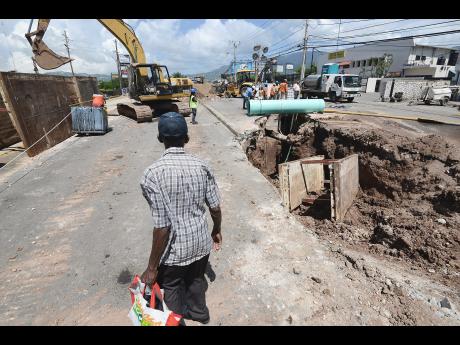
A man walks along a construction site on Constant Spring Road, St Andrew on Friday, October 7. The roadway in the vicinity of the Marketplace commercial complex is being repaired following its collapse from rains associated with Hurricane Matthew.

After a period of uncertainty, it has been confirmed that the Paris Agreement on Climate Change will enter into force on November 4.

This is good news for the Caribbean, one of the parts of the world most at risk from sea level change and severe climatic events.

By global treaty standards, formal agreement has been achieved remarkably quickly, especially as the solutions that the treaty proposes remain politically controversial in many of the nations that agreed last December to the final text.

Normally, ratification takes years to achieve. However, faced with evidence that the planet continues to warm and the possibility that Donald Trump could become the next US president and may pick apart the hard-won agreement, the world’s largest carbon emitters – China, the United States, Brazil, the European Union, and India, but not so far Japan or Russia – have agreed to ratify, thereby reaching the agreed target of 56.87 per cent of all global emissions, for the treaty to come into force.

In many respects, this is a victory for the Caribbean, for CARICOM in particular, and the African, Caribbean and Pacific Group of States (ACP) and other small-island developing states, which in Paris last December made clear that a positive outcome was existential.

In outline, the 31-page agreement proposes that a balance between greenhouse gas emissions and the sinks for ameliorating them is achieved in the second half of this century.

It emphasises the need to hold the increase in the global average temperature well below 2 degrees Celsius (36 degrees Fahrenheit) above pre-industrial levels; proposes “pursuing efforts to limit the temperature increase to 1.5 degrees Celsius (35 degrees Fahrenheit)”; and recommends that a peak in global greenhouse gas emissions be achieved as soon as possible. It allows for an asymmetrical approach, enabling all developing countries – including large industrialising carbon emitters like China, India and Brazil – to have more time to adapt.

In a section that addresses loss and damage, the agreement establishes funding at the minimum annual rate of US$100 billion up to 2030 to enable support for mitigation and adaptation in developing nations. However, it does not set a timescale for reaching greenhouse gas emission neutrality.

Unlike the earlier Kyoto Protocol of 2005, which required major carbon emitters to agree to binding emissions reductions, but failed when the US decided not to ratify because of exclusion of nations like China, the Paris agreement requires all countries to devise their own climate action plans and then improve on them at regular intervals.

What comes next is likely to be difficult, requiring all of the diplomatic and political skills that the Caribbean and other small-island developing states have.

ACCESS TO RESOURCES

While Hurricane Matthew and the damage that it wreaked in Haiti, The Bahamas, and Cuba was a salutary global reminder of the risk that low-lying states with limited resources face, CARICOM, as its Secretary General, Irwin LaRocque, noted earlier this year, now faces the challenge of being able to access the resources the agreement promises.

An important recent development in this respect has been the establishment by the Commonwealth Secretariat, with Australian finance, of a new facility intended to assist governments obtain available funding.

The idea is that a Commonwealth Climate Finance Access Hub will locate national climate-finance advisers in countries for two-year periods to help access climate change support. Among the first countries likely to receive such support are Antigua, Barbados, Dominica, Guyana, Jamaica, and St Kitts, as well as other small island states in the Indian Ocean and the Pacific.

Other funding options are also being considered. Recently, Jamaica’s Prime Minister Andrew Holness indicated that Jamaica is to work with its international development partners to pursue debt for climate-change swaps. Such an approach, he says, has the potential to provide fiscal relief while helping to unlock climate financing to fund adaptation and mitigation initiatives.

What is clear is that when it comes to funding, the treaty agreement as is so far little more than an aspirational framework.

For this reason, at the forthcoming climate change conference in Marrakesh in November, CARICOM will need – together with its Alliance of Small-Island States – the global grouping which brings together small island and low-lying coastal countries that share similar development concerns – to hold the world to account for what has been agreed.

This will not just be a test of the Caribbean’s staying power and the willingness of regional governments to fund and support a continuing focus. It will also require the Caribbean to remind the countries that it supported during the negotiations, and which expressed concern about the implications of climate change for the region, of their commitments.

Put more bluntly, it is now the time for China and Brazil, as much as the US and Europe, to ensure that the support for adaptation that the region needs, now materialises.

In this, both CARICOM and the CARICOM Climate Change Centre will continue to have a critical role in coordinating the regional effort. But it will also be up to individual governments to maintain the political momentum, demonstrate a unity of purpose, and be determined to address the Caribbean’s implementation deficit.

CLOSE TO THE SEA

Climate change is an issue on which the Caribbean has had every reason to have its voice heard and be taken very seriously. Fifty per cent of its population and the majority of the region’s productive enterprise and infrastructure lie within 1.2 miles of the sea. Its low-lying nature, its fragile ecosystems, and extreme weather events demonstrate that it is a prime candidate to benefit from what has been agreed.

While countries in the region are often accused of allowing mendacity to drive their foreign policy, here is an example where the Caribbean deserves a transfer of resources if it quite literally is not to disappear beneath the sea.

Climate change also has a strategic importance. It enables the Caribbean to demonstrate an approach that owes more to the future than to the past; it is an issue on which it has a better chance to exert leverage; and one that can deliver national and regional development objectives. It is an issue on which the region occupies the moral high ground and has popular international support.

Gleaner