Supporters gather to listen to speakers after marching in support of science, Saturday, April 22, 2017, in Pullman, Wash. People around the globe have turned out in huge numbers to celebrate Earth Day and support scientific research and funding. Rallies in more than 600 cities put scientists alongside advocates of politics-free scientific pursuits.


Play from the local scientific community have given the nod to the recent science marches, staged globally for Earth Day 2017.

The April 22 marches, they say, have helped to draw attention to valuing research, particularly in the struggle to build resilience to climate change.

For Dr Orville Grey, who has responsibility for adaptation in the Climate Change Division of the Ministry of Economic Growth and Job Creation, they also demonstrate the shift in the modus operandi of scientists who now increasingly engage with policymakers and other stakeholders on their work.

“We have seen a time when scientists only spoke to scientists. There is now dialogue between scientists and policymakers, including politicians. We look at the scientific reports coming out and one of the things you recognise is that the volumes coming out now include a summary for policymakers,” said the man whose PhD is in environmental biology with a focus on climate change.

“There is a need to bridge the gap between the scientists and policymakers, including politicians, to ensure there is greater awareness and understanding and that the policies that are being presented are based on the best available science and as such that decisions are informed,” added the University of the West Indies and Northern Caribbean University part-time lecturer.

Professor Michael Taylor, head of the Mona Climate Studies Group Mona, said simply: “They were a good thing to bring attention to science and its importance in development.”

Meteorologist and long-time climate change negotiator for Jamaica Clifford Mahlung said the marches would perhaps have been especially instructive for the United States.

“The whole notion of climate change is based on scientific evidence. There were large turnouts in the US and I think that is where the message should be sent,” he told The Gleaner.

The Guardian, in an Earth Day-published report on the marches, reveals that they had seen the participation of “climate researchers, oceanographers, bird watchers and other supporters of science” from around the world whose intent was “to bolster scientists’ increasingly precarious status with politicians”.

SCIENCE CRITICAL

On that list of politicians is US President Donald Trump, whose Earth Day message nonetheless declared support for science.

“Rigorous science is critical to my Administration’s efforts to achieve the twin goals of economic growth and environmental protection,” he said in the statement published on the White House website.

“My Administration is committed to advancing scientific research that leads to a better understanding of our environment and of environmental risks. As we do so, we should remember that rigorous science depends not on ideology, but on a spirit of honest inquiry and robust debate,” he added.

The president’s statement comes in the wake of his executive order, signed in March, which rolls back a number of policies that had been put in place by former president Barack Obama to counter climate change. They reportedly include the Clean Power Plan and the repeal of guidance for factoring climate change into National Environmental Policy Act reviews.

Gleaner


ENERGY MINISTER Andrew Wheatley has sought to quiet ongoing concerns over reports that the new Chinese owners of ALPART, Jiuguan Iron and Steel, are looking to set up a 1,000-megawatt coal plant in Jamaica to support their operations.

“Where we are right now, we have not received any application, any proposal, as it relates to a coal-fired plant at ALPART. What we know for a fact is that the new owners are rehabilitating, retrofitting the old ALPART facility,” he told The Gleaner on the sidelines of the Caribbean Sustainable Energy Forum (CSEF) in The Bahamas on Tuesday.

“The plan is for them to use the traditional source of fuel – HFO – to drive that bauxite facility. We expect that facility to be up and running in another 16 to 18 months, starting to produce bauxite and employing Jamaicans,” he added.

“I don’t want to speak for them, but I know they are exploring other sources of energy, separate and apart from coal,” Wheatley said further.

At the same time, the minister suggested that this ministry would not readily entertain any such application.

“The truth is that coal is a part of our energy policy, a part of that mix. But if we are to embark on such a direction, it would have to be after serious consultation. We would have to ensure that there is some technology that would, more or less, mitigate against the negative environmental impacts associated with coal in the past,” he noted.


CLEAN TECHNOLOGY


“So there is a clean-coal technology being mooted. That is something that we would have to explore. But we would never engage or embark on the use of coal – at least that capacity of producing 1,000 megawatts – without our having the necessary consultations with the different stakeholders,” he said.

News of the 1,000-megawatt plant accompanied the sale of ALPART to Jiuguan last year. The construction of such a plant would exceed Jamaica’s current generating capacity of some 800 megawatts while threatening to undermine efforts to treat with climate change, which prompted outcry from among civil society actors.

The minister’s statements on what would need to happen regarding any coal project, meanwhile, are in line with what the Council of the Jamaica Institute of Environmental Professionals called for last August.

“We look forward to seeing the holistic analysis on the full economic costs and benefits for the chosen source of energy, including the lifetime costs of energy production, the cost of treatment of pollutant emissions and effluent, the cost of any investment or operation costs for ensuring compliance with all relevant national environmental and working standards,” the entity said.

“This analysis should include critical factors such as the economic cost of health effects and medical treatment from exposure to plant emissions and effluent on workers and communities surrounding the plant,” the council added.

Ultimately, like a number of other civil society actors, it concluded: “It is our position that a coal-fired plant is counter-productive to Jamaica’s own Vision 2030 and our other commitments on energy, sustainable development, and climate change,” it said.

“We hasten to point out that there is a cost associated with sourcing and transportation of coal from overseas; the potential impact on human health, including long-term treatment; and the cost of ensuring that all relevant national standards are met,” they added.

Gleaner

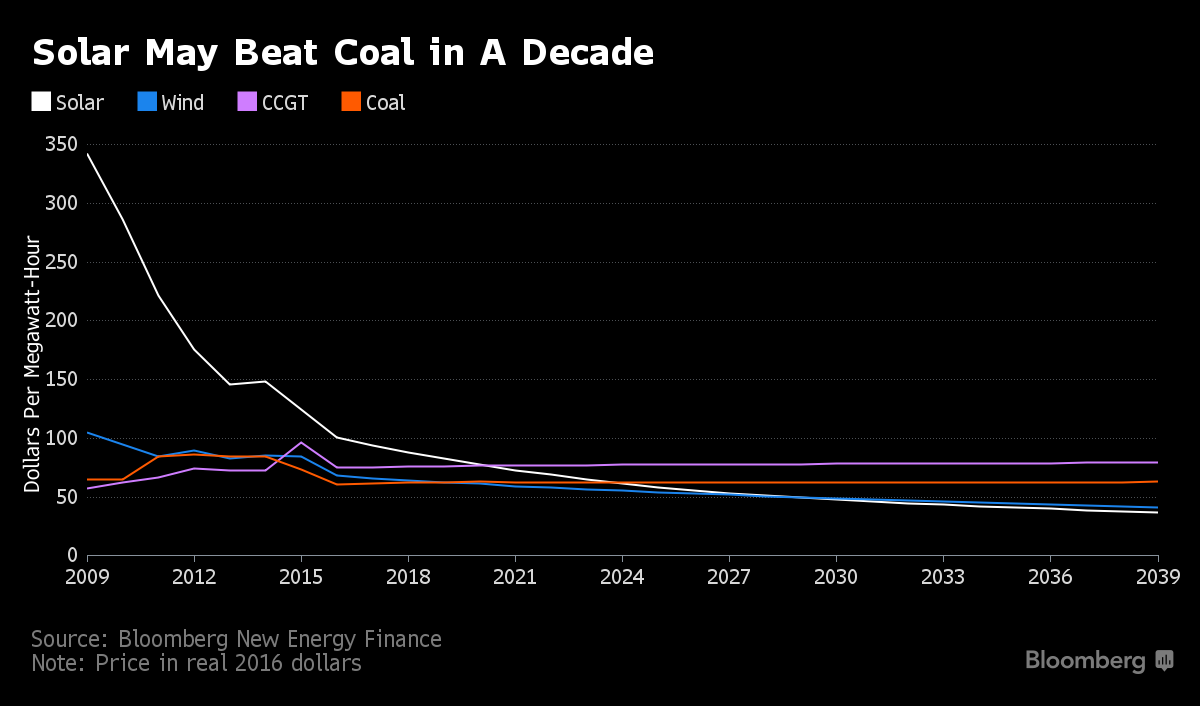
Solar power is now cheaper than coal in some parts of the world. In less than a decade, it’s likely to be the lowest-cost option almost everywhere.

In 2016, countries from Chile to the United Arab Emirates broke records with deals to generate electricity from sunshine for less than 3 cents a kilowatt-hour, half the average global cost of coal power. Now, Saudi Arabia, Jordan and Mexico are planning auctions and tenders for this year, aiming to drop prices even further. Taking advantage: Companies such as Italy’s Enel SpA and Dublin’s Mainstream Renewable Power, who gained experienced in Europe and now seek new markets abroad as subsidies dry up at home.

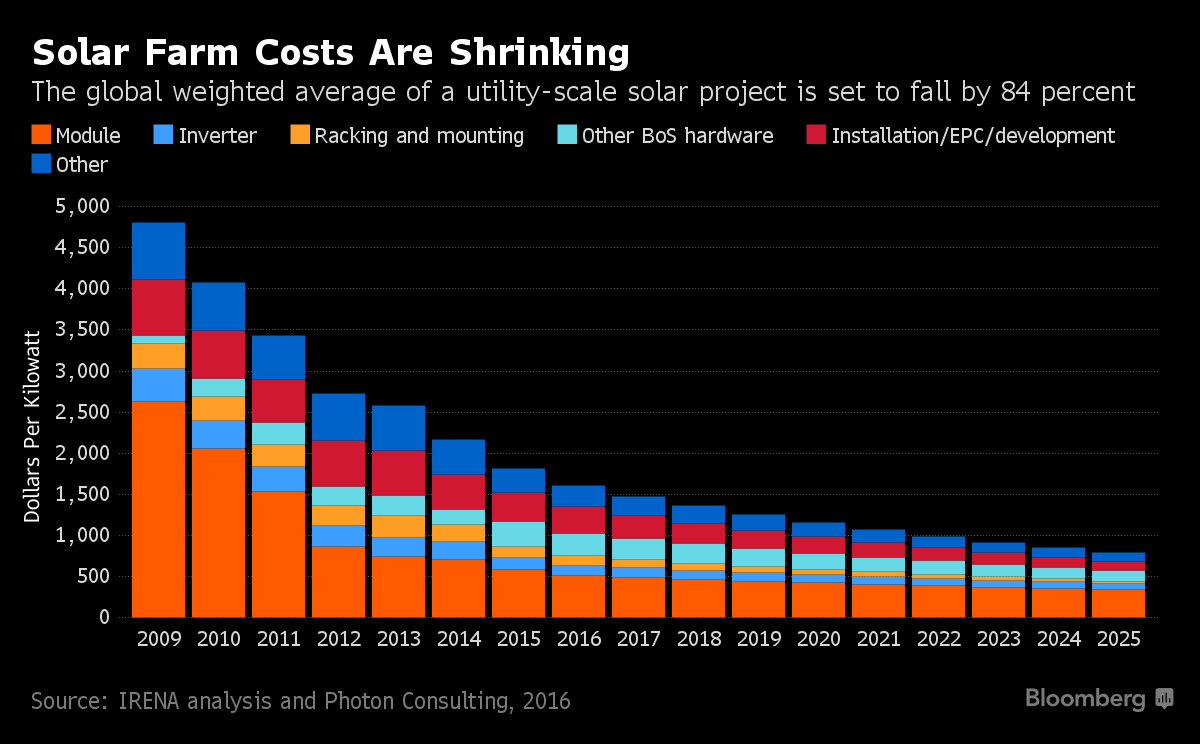
Since 2009, solar prices are down 62 percent, with every part of the supply chain trimming costs. That’s help cut risk premiums on bank loans, and pushed manufacturing capacity to record levels. By 2025, solar may be cheaper than using coal on average globally, according to Bloomberg New Energy Finance.

“These are game-changing numbers, and it’s becoming normal in more and more markets,” said Adnan Amin, International Renewable Energy Agency ’s director general, an Abu Dhabi-based intergovernmental group. “Every time you double capacity, you reduce the price by 20 percent.”

Better technology has been key in boosting the industry, from the use of diamond-wire saws that more efficiently cut wafers to better cells that provide more spark from the same amount of sun. It’s also driven by economies of scale and manufacturing experience since the solar boom started more than a decade ago, giving the industry an increasing edge in the competition with fossil fuels.

The average 1 megawatt-plus ground mounted solar system will cost 73 cents a watt by 2025 compared with $1.14 now, a 36 percent drop, said Jenny Chase, head of solar analysis for New Energy Finance.

That’s in step with other forecasts.

  • GTM Research expects some parts of the U.S. Southwest approaching $1 a watt today, and may drop as low as 75 cents in 2021, according to its analyst MJ Shiao.
  • The U.S. Energy Department’s National Renewable Energy Lab expects costs of about $1.20 a watt now declining to $1 by 2020. By 2030, current technology will squeeze out most potential savings, said Donald Chung, a senior project leader.
  • The International Energy Agency expects utility-scale generation costs to fall by another 25 percent on average in the next five years.
  • The International Renewable Energy Agency anticipates a further drop of 43 percent to 65 percent for solar costs by 2025. That would bring to 84 percent the cumulative decline since 2009.

The solar supply chain is experiencing “a Wal-Mart effect” from higher volumes and lower margins, according to Sami Khoreibi, founder and chief executive officer of Enviromena Power Systems, an Abu Dhabi-based developer.

The speed at which the price of solar will drop below coal varies in each country. Places that import coal or tax polluters with a carbon price, such as Europe and Brazil, will see a crossover in the 2020s, if not before. Countries with large domestic coal reserves such as India and China will probably take longer.

Coal’s Rebuttal

Coal industry officials point out that cost comparisons involving renewables don’t take into account the need to maintain backup supplies that can work when the sun doesn’t shine or wind doesn’t blow. When those other expenses are included, coal looks more economical, even around 2035, said Benjamin Sporton, chief executive officer of the World Coal Association.

“All advanced economies demand full-time electricity,” Sporton said. “Wind and solar can only generate part-time, intermittent electricity. While some renewable technologies have achieved significant cost reductions in recent years, it’s important to look at total system costs.”

Even so, solar’s plunge in price is starting to make the technology a plausible competitor.

In China, the biggest solar market, will see costs falling below coal by 2030, according to New Energy Finance. The country has surpassed Germany as the nation with the most installed solar capacity as the government seeks to increase use to cut carbon emissions and boost home consumption of clean energy. Yet curtailment remains a problem, particularly in sunnier parts of the country as congestion on the grid forces some solar plants to switch off.

Sunbelt countries are leading the way in cutting costs, though there’s more to it than just the weather. The use of auctions to award power-purchase contracts is forcing energy companies to compete with each other to lower costs.

An August auction in Chile yielded a contract for 2.91 cents a kilowatt-hour. In September, a United Arab Emirates auction grabbed headlines with a bid of 2.42 cents a kilowatt-hour. Developers have been emboldened to submit lower bids by expectations that the cost of the technology will continue to fall.

“We’re seeing a new reality where solar is the lowest-cost source of energy, and I don’t see an end in sight in terms of the decline in costs,” said Enviromena’s Khoreibi.

Bloomberg

Screen Shot 2015-12-11 at 11.52.08

A solar panel on a thatch roof in Sub-saharan Africa is part of the Azuri PayGo Energy project, which provides eight hours of emission-free lighting each day and enough power to charge cellphones. Users pay a one-time installation fee and top-up as their needs demand.

PARIS, France (UNFCCC) – Sixteen game-changing initiatives from around the world were honoured as winners of a prestigious United Nations climate change award at a special ceremony at the United Nations Climate Change Conference in Paris, on yesterday evening.

“These ‘Lighthouse Activities’ shine a light on the groundswell of climate action around the world,” said UN Secretary-General Ban Ki-moon in a keynote address. “As the world moves toward a future built on low-emissions sustainable development, these bold ideas can inspire leaders to be more ambitious in their own policies and actions.”

The Momentum for Change initiative is spearheaded by the UN Climate Change Secretariat to shine a light on some of the most innovative, scalable and replicable examples of what people are doing to address climate change. This year’s winning activities range from a seriously cool smartphone that puts social values first, to an initiative that is enabling 40 Latin American cities to take concrete climate action.

“I am honoured to celebrate the leadership shown by the people, organisations, companies, and governments recognised as winners of the 2015 Momentum for Change Awards tonight,” UNFCCC Executive Secretary Christiana Figueres said.

“By showcasing these remarkable solutions and the people behind them we can strengthen efforts that must not only start with an agreement here in Paris, but must continue to build, as we accelerate the global transition to a low-carbon, highly resilient development path,” she said.

To help celebrate and recognise the achievements of the 2015 Lighthouse Activities, attendees at the gala event were treated to powerful photos, inspirational videos and a lively musical performance by Sean Paul.

M Sanjayan, a conservation scientist, writer and Emmy-nominated television news contributor, introduced Conservation International’s newest video in its critically acclaimed Nature for Speaking series, titled Home. Bertrand Piccard, Solar Impulse CEO and UNEP Goodwill Ambassador, served as the evening’s master of ceremonies.

“Modern clean technologies have transformed the expensive problem of climate change into a profitable opportunity,” said Dr Piccard. “A global economy that is powered by renewable energy, implements energy efficient and minimises waste will not only tackle climate change, but will also generate health, job creation and profit in the communities where they take place.”

Each of the 16 winning activities touches on one of Momentum for Change’s four focus areas: Urban Poor, Women for Results, Financing for Climate Friendly Investment, and ICT Solutions. All 16 were showcased at a series of special events during the UN Climate Change Conference.

They are:

Urban Poor

•E-waste: From Toxic to Green, India: Creating jobs to keep e-waste out of landfills

•Solvatten Solar Safe Water Heater — Kenya: Reducing emissions while securing access to safe drinking water

•Emerging and Sustainable Cities Initiative | Latin America & the Caribbean: Supporting sustainable growth in emerging cities

Women for Results

•Fostering Cleaner Production — Colombia: Reducing emissions in manufacturing

•Harvesting Geothermal Energy — El Salvador: Generating income with geothermal waste-heat

•Planting Trees to Save the Mangrove — Guinea: Establishing women-led groups that protect forests and generate income

•SELF’s Solar Market Gardens — Benin: Empowering women farmers through solar drip irrigation

Financing for Climate Friendly Investment

•Azuri PayGo Energy — Africa: Innovating pay-as-you-go energy systems for rural homes

•Deforestation-free Cocoa — Peru: Using a carbon-asset-backed loan to protect forests and produce cocoa

•Microsoft Global Carbon Fee — Global: Transforming corporate culture by putting a price on carbon

ICT Solutions

•ChargePoint Electric Vehicle Charging Corridors — United States of America: Building a network of electric vehicle express charging stations

•Enabling Farmers to Adapt to Climate Change — Uganda: Using ICT solutions to build resilience

•Fairphone — The Netherlands: Producing a phone that improves lives and the environment

•Lifelink Water Solutions — Kenya and Uganda: Using ICT tools to provide safe, sustainable and affordable water

•Mapping Exposure to Sea Level Rise — Tonga, Samoa, Vanuatu and Papua New Guinea: Preparing for risk with online spatial tools

•Mobisol Smart Solar Homes — Rwanda and Tanzania: Powering homes with solar energy

The 2015 Lighthouse Activities were selected by an international advisory panel as part of the secretariat’s Momentum for Change initiative, which is implemented with the support of the Bill & Melinda Gates Foundation and The Rockefeller Foundation, and operates in partnership with the World Economic Forum and the Global e-Sustainability Initiative.

Jamaica Observer