The more efficient the solar panel, the less space used.

Solar giant SunPower announced on Monday that it can now make a solar panel that can convert 22.8% of the sunlight that hits it into electricity. According to SunPower, that’s a new world record.

The efficiency of solar panels is an important metric to both solar companies and to its customers. When panels are more efficient it mean that rooftops can be covered in fewer efficient panels, which use less materials, but that can generate the same amount of energy as more less-efficient panels.

SunPower says its highly efficient panels can generate 70% more energy in the same space over the first 25 years, compared to less efficient panels. Many solar panels are somewhere between 15% and 18% efficient. SunPower and others have been working to boost the efficiency of panels using material science and optics tech innovations.

Solar companies are in a battle to boost the efficiency of their panels and tout new records. SunPower SPWR -5.85% says its 22.8% solar panel was verified by the federal National Renewable Energy Laboratory.

Last year, SolarCity claimed that it had started making its own highly efficient panels, with an efficiency that “exceeded 22%,” verified by the Renewable Energy Test Center (which isn’t one of the more commonly used verification labs). But SolarCity’s SCTY -5.92% solar panels were also planned to be made in small volumes on a pilot solar panel manufacturing line in Fremont, Calif.

Creating solar panel efficiency breakthroughs in the lab or on a small scale, is far easier than making those efficient panels in very large volumes. But SunPower says the average efficiency of its solar cells (which make up panels) at the end of last year was close to 23%.

SunPower’s stock was up over 3% in morning trading to $21.84. Oil giant Total owns 66% of the Richmond, Calif.-based SunPower.

Last week SunPower announced fourth quarter and year 2015 earnings. SunPower says it generated $1.58 billion in revenue in 2015, with an annual loss of $299.44 million. The company was profitable on an annual basis in 2014 and 2013.

Check out Fortune’s recent interview with SunPower CEO Tom Werner.

Fortune.com

power-lines
Getty Images

Solar’s threat to the utility industry is deeper than not having to purchase electricity

Now that solar power is reaching prime time, the fossil fuel industry is doing all that it can to stop its growth.

For many years solar was on the periphery, installed by early adopters and helped along by government subsidy. But over the last several years, solar has emphatically become mainstream. It is still growing from a low base, but it is now one of the most preferred sources of new electricity generation. The cost of residential solar have been cut in half since 2010, and utility-scale solar has achieved even greater cost declines.

In 2015, the U.S. saw 16 gigawatts of new renewable energy capacity installed, which accounted for two-thirds of the total. Solar alone accounted for about one-third of new capacity last year. Natural gas only captured 25 percent of the newly installed capacity despite several years of incredibly low prices. The banner year for clean energy occurred while 11 gigawatts of coal-fired electricity came offline as old plants were retired amid rising costs and stricter environmental regulation. The clean energy transition is very much underway.

TIME

A woman wears as mask while walking in a neighbourhood next to a coal-fired power plant on Nov. 26, 2015, in Shanxi, China.

The market is encouraging pension funds and institutions to jettison fossil fuels from their portfolios, waving a clear warning flag to investors about the financial future of oil and coal companies.

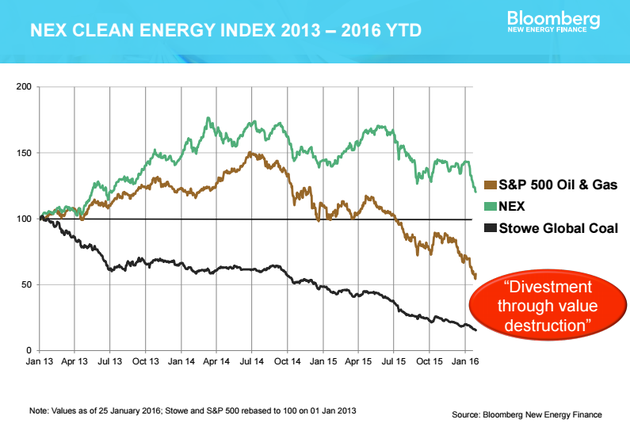
Fossil fuel stocks are performing poorly compared to the market as a whole — and perhaps most importantly, compared to renewable energy stocks, said Michael Liebreich, chairman of Bloomberg New Energy Finance, at a summit on climate risk put on by the nonprofit sustainability advocacy group Ceres.

Referring to investors who won’t divest and continue to own fossil fuel stocks, Liebreich pointedly said that the market was “divesting through value destruction” — in other words, cutting their holdings in traditional, polluting energy companies by slashing their value.

Renewable energy stocks have dramatically outperformed fossil fuels.

Over the last 10 years, the S&P 500 index is up just over 50 percent. Yet energy stocks over the same time period have risen only 1.3 percent.

For big investors to simply allow their holdings in big energy companies to fall toward a vanishing point of worthlessness is deeply irresponsible, observers say.

Indeed, former Vice President Al Gore, who shared the Nobel Peace Prize in 2007 for his work on climate change, compared the risk that some fossil fuel companies’ assets will become worthless to the danger of mortgage-backed securities, whose collapse triggered the 2008 financial crisis.

The nonprofit research group Carbon Tracker estimates that if the world changes its energy sources to keep climate change below 2 degrees Celsius, $2 trillion in fossil fuel assets will be stranded — that is, unusable, far less valuable, and in some cases, liabilities.

Huffington Post