WITH ECONOMIES under threat due to climate change and prevailing high production costs, the recent Caribbean Sustainable Energy Forum (CSEF) served as a call to urgent action to realise energy efficiency and energy sustainability within CARICOM.

Kim Osborne of the Executive Secretariat for Integral Development at the Organisation of American States, said it is past time that talk be translated into action.

“There is always the challenge of maintaining a healthy balance between dialogue and implementation. Several studies and reports have noted that our region faces an ‘implementation deficit’, but I would venture to say that the region also suffers from a ‘dialogue surplus’,” she noted.

She was addressing participants at the Caribbean Sustainable Energy Forum (CSEF), held in The Bahamas last week.

“There is a serious mismatch between meetings and results in our region. My point here is twofold: that dialogue is not an end to itself, and that dialogue that does not lead to action and to results is meaningless,” Osborne added.

At the same time, she said that energy must not be looked at in isolation, but rather in the context of sustainable development.

“In the normal course of things, energy is not provided in a vacuum. It impacts and is impacted by several factors, such as poverty, water availability, disaster risk, climate change, health, education and human resource development, human rights, and coastal and marine management,” Osborne said.

“I am proposing that to the fullest extent possible, an integrated approach should be adopted towards the goal of sustainable energy management,” she added.

For his part, Dr Devon Gardner, programme manager for energy with the CARICOM Secretariat, emphasised three things – partnership, integration and action.

“The partnerships are not just for the CSEF, but with the World Bank and the United States Government, we are able to implement the Caribbean Sustainable Energy Road Map ad Strategy (C-SERMS) platform … . Because of partnerships, we have been able to work with the member states,” he said.

UNITY MAKES SENSE

On integration, he noted: “The CARICOM secretariat is really there to serve the member states. We do what the member states require to get the job done. The CARICOM is a group of countries within the Caribbean that we want to do some things together because it makes sense for us to work together to achieve mutual and shared objectives. And the role of the secretariat is to help the member states to realise this objective.”

Added Gardner: “We believe that all that CARICOM desires – from economic development to climate resilience to social resilience to security – is underpinned by having a strong energy sector … . We see energy as a critical part of the regional integration tool.”

In the end, Gardner said there was no question of realising C-SERMS energy targets that include 47 per cent renewable power capacity by 2027 without urgent action.

A number of regional leaders – among them Dr Regilio Dodson, Minister of Natural Resources in Suriname – have noted their support for an integrated and unified approach to the energy efficiency and sustainability in the region.

“We should work together … . We have to actively promote success stories … and learn from each other and go together and try to determine what is for our region the best way forward,” he said.

“If we work together to get this going and get the cooperation between CARICOM countries going, then we will have our energy security in our own hands, ” he added.

Among the topics explored over the three days of discussions at CSEF 2017 were ‘The CARICOM Energy Policy Road Map and Strategy: Shifting the C-SERMS from Concept to Action’; ‘The Regulator Within the Integrated Resource Planning Process’; and ‘The CARICOM Energy Transition: Lessons from the Last Five Years’.

The forum also saw the meeting of regional working groups on key thematic areas, including information and knowledge management, finance, capacity building and research, as well as policy and regulations.

Gleaner


The effort to mainstream gender in climate change considerations while cementing the place of women in decision-making in that arena has a supporter in Dr James Fletcher, recent head of the CARICOM Task Force on Sustainable Development.

“Women are disproportionately affected by climate change, particularly in small-island developing states. Anytime here in Saint Lucia, if there is a drought, the people you see going miles to collect water are not the men, it is the women because they are the ones who, unfortunately, have the children on their hands and the household on their hands,” he noted.

“So women are always the ones who are disproportionately affected by natural disasters, and I think there must be some sensitivity in funding to the fact that there is a gender imbalance in the impacts of climate change and other natural disasters,” Fletcher added.

He was speaking with journalists at the Marrakech Climate Talks in November last year on the issue of a lack of funding to support the gender work programme that emerged from the Lima Climate Talks two years earlier.

Decisions in that work programme include:

– To enhance the implementation of the decision to promote gender balance and improve the participation of women in United Nations Framework Convention on Climate Change (UNFCCC) negotiations and in the representation of parties in bodies established in line with the Convention or the Kyoto Protocol; and

– that additional efforts be made by parties to the convention to improve the participation of women in their delegations and in all of the bodies established under the convention.

Among other things, it also invites parties to advance gender balance and promote gender sensitivity in developing and implementing climate policy and achieve gender-responsive climate policy in all relevant activities under the UNFCCC.

However, in Marrakech – as in Lima – it emerged that financing to achieve the provisions of the work programme is a challenge.

Fletcher’s advice to the women and gender constituency is to press ahead with their efforts.

“The thing with some of these discussions is it takes a while for common sense to prevail. So things you think people would get immediately, they don’t, and you must have a lot of back and forth. But I think that is the nature of the multilateral process. People come with different agendas, different perspectives,” he said.

CONTINUING THE PROCESS

“It really speaks to the need to continue having faith in the process, to continue pressing the line, and continue developing a coalition and seeking out allies and seeing how you can get support,” added Fletcher, who is also the former sustainable development minister for Saint Lucia.

He revealed that this is what had happened in the small island developing states’ effort to have the world take up the issue of loss and damage associated with climate change.

“When we started out with loss and damage, loss and damage was quintessentially a small-island state issue, and then suddenly, other people realised ok, there is a lot of merit in this, and we started developing allies and having more people come and support our cause,” he said.

“It is unfortunate that on a gender issue you need to go in that way because you figure anybody should realise that is an issue. But I think, probably, it is one of these areas where we need to do more work and where we need to do more sensitisation and make people understand the imperative of making sure that the funding is gender sensitive,” Fletcher noted.

Gleaner

The painting by Candice Henry of Trinidad and Tobago, which placed second in CARICOM Energy Week art and photo competition last year.

THE CARIBBEAN Community (CARICOM) Secretariat is this month drawing public attention to the energy realities of the region while helping individuals to identify how to better conserve while cutting costs.

They are doing it through a slew of activities, all of which are being celebrated as part of CARICOM Energy Month and under the theme “Sustainable Energy for Sustainable Development”.

“There are really two main things we are trying to do. One is to really build awareness among the general citizenry around energy matters so people understand what energy conservation means and what are some of the things they can do to take better control of their energy system,” said Dr Devon Gardner, programme Manager for Energy at the CARICOM secretariat.

“The second thing is for them to really understand the energy situation in the region and what is being done on the macro scale to provide the right-size solutions that can be used to support the sustainable development of the countries of CARICOM,” he added.

To make that happen, among other things, there are three knowledge webinars planned on the subject, all of which target the regional public and a number of key stakeholders.

There are, too, a number of competitions one of them a photo and art competition and another a regional news reporting competition intended to get people thinking through energy issues as they affect them and the likely solutions.

According to Gardner, the observation of CARICOM Energy Month which also takes account of national-level activities, including kilo walk events set for, for example, Guyana and St Lucia is important. And this, at a time when CARICOM countries are collectively using some 13,000 Btu of energy to produce one US dollar of gross domestic product (GDP) compared to 4,000 Btu of energy used by Japan, for example, to produce the same one US dollar of GDP and the global average of 10,000 Btu.

“We live in an age where there is great participation in energy; energy investments and energy solutions are no longer top down. Thirty years ago, the utility made the decisions about what kind of power plants to use, determined how to deliver the energy and a person took what was provided. If you did not have it, you simply waited for the utility to give it to you, which is why you heard of rural electricity programmes and so on,” Gardner noted.

“We are in an age now where technology has changed; there a lot of options available for or small, individualised power generation systems as well as energy services that can be provided directly and in a cost-effective ways, such as solar water heaters. There is also greater awareness of people around what is possible though they might not know what those solutions are. It is incumbent on us to give them the options,” he added.

“It is a part of good governance, it is a part of what modern society requires,” Gardner said further.

Critically, he said information and exchanges this month will afford Caribbean stakeholders the chance to shape their climate future.

“Over the last twenty years or so, the whole issue climate protection and of sustainable development practice has risen to the fore on the global agenda. There is recognition that the climate fight can be impacted by an aggregation of climate actions at the micro level,” he said.

“The role of each individual in being able to fight or mitigate various climate effects has drive a lot of what energy month wants to provide, which is that each individual, in their own space, can do something, which when aggregated with the global efforts, is part of significant tool,” he added.

Gleaner

Prime Minister Andrew Holness addresses the opening ceremony of the Organisation of Caribbean Utility Regulators Conference in Montego Bay, St James, yesterday.

Asserting that “we must get it right”, Prime Minister Andrew Holness has urged utility regulators to take seriously their role in helping the Caribbean ease its dependence on oil and embrace technologies and renewables key to energy diversification.

The regulators’ role, he said, is linked to the creation of partnerships with investors who want returns, consumers and governments pushing for the economic development of their countries.

Holness was addressing the opening ceremony for the 14 Organisation Of Caribbean Utility Regulators (OOCUR) conference at the Secrets Resorts & Spa in Montego Bay, St James.

A variety of issues are set for discussion over three days by the more than 160 regional and international experts.

However, Holness, noting the importance of energy to the region’s development and the current high levels of dependence on oil, made it clear that the issue should be at the top of the agenda.

“Energy is clearly the mission-critical frontier,” he said, pointing to the role of Jamaica’s Office of Utilities Regulation (OUR) in helping Jamaica introduce liquefied natural gas (LNG) as part of the energy mix.

“The OUR approved the funding for the conversion of the Jamaica Public Service Bogue plant to enable the move from heavy dependence on oil to diversifying to LNG. I applaud the OUR in this regard for being a strong regulator and helping to make this move a reality – to take Jamaica on this new platform. This is a great example of collaboration among Government, regulator, and utility,” Holness added.

A shipment of LNG supplies arrived in Jamaica last week Saturday, and in two weeks, is expected to be in full use.

TAKE ROLE SERIOUSLY

The prime minister emphasised that regulators have to take seriously their role in helping the Caribbean Community implement the Caribbean energy policy that was approved in 2013.

That policy promotes a shift in sustainable energy through increased use of renewable energy sources and energy efficiency, among other things.

“OOCUR, you have your work cut out for you as not only is Jamaica focused on diversifying its energy mix, so, too, is CARICOM, and we must get it right in the region. Access to affordable energy is a necessary requirement for addressing sustainable development in the region,” Holness said.

He also argued that while there is need for partnership with all stakeholders in the provision of utilities, the providers must insist on self-regulation to ensure that standards are upheld and service delivery is at a high quality.

Earlier, Albert Gordon, chairman of OOCUR, said the conference was happening at a time when regulation was becoming more important for sustainable development.

The conference schedule has placed heavy emphasis on renewable energy and investment.

Jamaica and many other small-island states of the Caribbean are heavy importers of oil, which increases their vulnerabilities to external shocks such as sharp oil price rises. Except for Trinidad and Tobago, the only net exporter of oil and natural gas, all other Caribbean countries are net oil importers.

“For importers other than Suriname, around 87 per cent of primary energy consumed is in the form of imported petroleum products. Imports are mostly diesel fuel for electricity generation, gasolene for transportation, and liquefied petroleum gas used as cooking gas in households,” experts noted in a paper titled ‘Caribbean Energy: Macro-Related Challenges’ released in March by the International Monetary Fund.

This, they said, has led to consistently high electricity rates, which affects the competitiveness and development of CARICOM nations.

Gleaner

CARICOM Secretary General Ambassador Irwin LaRocque (left) with Dr James Fletcher, who led CARICOM negotiators, in discussion with regional heads of government and ministers at the Paris Climate Talks last year.

With the Marrakech climate change talks now only weeks away, the few CARICOM member states that have not yet ratified the Paris Agreement – Jamaica among them – have been urged to do so.

The appeal has come from Dr James Fletcher, former head of the CARICOM Task Force on Sustainable Development.

He predicted that the failure to ratify will see those islands running the risk of not having a say in the first meeting of the parties to the global deal next month.

“Given that the Paris Agreement will enter into force in the Marrakech meeting … if you haven’t ratified the Paris Agreement, then really you cannot be at the table determining rules and procedures and everything else,” he cautioned.

“If you have not ratified the agreement, then you don’t have a voice at the meeting. There will be CARICOM countries there (who share similar challenges) and who will speak on your behalf, but I don’t think it is a position you want to be in because you cannot articulate your own concerns,” added Fletcher, also the former minister of sustainable development for St Lucia.

Ten CARICOM countries have so far ratified the agreement. They include Antigua and Barbuda, Barbados, The Bahamas, Belize, Dominica, Grenada, Guyana, St Kitts and Nevis, St Lucia, and St Vincent and the Grenadines.

They are among the 81 countries to have ratified the agreement, which prescribes the way forward for the planet in its battle against the changing climate.

Caribbean islands and other small-island developing states (SIDS) are counted among those most vulnerable to climate threats.

Those threats include extreme weather events, the likes of Hurricane Matthew, which barrelled across the region recently, leaving in its wake death and destruction in places such as Haiti, Cuba and The Bahamas.

In Haiti alone, the death toll is registered at more than 900, with millions of dollars in loss and damage to infrastructure.

Meanwhile, Fletcher – a respected regional statesman reputed for his work in climate change and other development issues, including energy – is buoyed with the progress on the Paris Agreement. Still, he cautions that there are still miles to go to where the region needs to get in its readiness for climate change.

“We are very encouraged by how quickly this agreement has come into force … It really is awesome for me that the community has rallied to this cause and there seems to be an urgency that, at least philosophically, we need to move in a particular direction,” he said.

LACK OF URGENCY

“What is worrying to me is that there does not seem to be an urgency where climate action is concerned. If you look at the level of ambition for the level of greenhouse gases, it is still not taking us below 2.7 degrees Celsius. Nobody has come out and said, for example, that they will reduce their emissions by another 25 per cent,” Fletcher added.

This, he noted, is what is required if the world is to realise one of the objectives of the Paris Agreement, to hold “the increase in the global average temperature to well below 2 degrees Celsius above pre-industrial levels and to pursue efforts to limit the temperature increase to 1.5 degrees Celsius above pre-industrial levels, recognising that this would significantly reduce the risks and impacts of climate change”.

“I would like to see greater pledges from major emitters to reduce their emissions and more pledges where finance is concerned,” the former minister noted.

“There is a lot that has to be done where SIDS are concerned. (We are in a time when we) have hurricanes hitting multiple countries and travelling in pairs. So the situation is ominous; the projections are all showing that our area will be one of the hardest hit by climate change, and we don’t have the funds to adapt,” he said.

“We are really are saying to our residents that they are in for a very bleak future when we should be saying, having signed the agreement, we can now assure that the climate finance is going to flow and action is going to be taken to reduce greenhouse gases to get us close to 1.5,” added Fletcher, who will be in Marrakech next month to support CARICOM.

“We are not in a good place where bending that temperature curve is concerned, and making finance more readily available to SIDS is one way to get there,” he said.

Gleaner

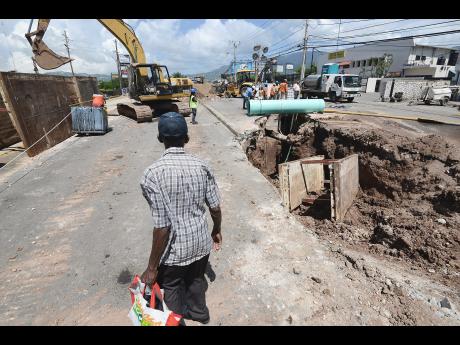
A man walks along a construction site on Constant Spring Road, St Andrew on Friday, October 7. The roadway in the vicinity of the Marketplace commercial complex is being repaired following its collapse from rains associated with Hurricane Matthew.

After a period of uncertainty, it has been confirmed that the Paris Agreement on Climate Change will enter into force on November 4.

This is good news for the Caribbean, one of the parts of the world most at risk from sea level change and severe climatic events.

By global treaty standards, formal agreement has been achieved remarkably quickly, especially as the solutions that the treaty proposes remain politically controversial in many of the nations that agreed last December to the final text.

Normally, ratification takes years to achieve. However, faced with evidence that the planet continues to warm and the possibility that Donald Trump could become the next US president and may pick apart the hard-won agreement, the world’s largest carbon emitters – China, the United States, Brazil, the European Union, and India, but not so far Japan or Russia – have agreed to ratify, thereby reaching the agreed target of 56.87 per cent of all global emissions, for the treaty to come into force.

In many respects, this is a victory for the Caribbean, for CARICOM in particular, and the African, Caribbean and Pacific Group of States (ACP) and other small-island developing states, which in Paris last December made clear that a positive outcome was existential.

In outline, the 31-page agreement proposes that a balance between greenhouse gas emissions and the sinks for ameliorating them is achieved in the second half of this century.

It emphasises the need to hold the increase in the global average temperature well below 2 degrees Celsius (36 degrees Fahrenheit) above pre-industrial levels; proposes “pursuing efforts to limit the temperature increase to 1.5 degrees Celsius (35 degrees Fahrenheit)”; and recommends that a peak in global greenhouse gas emissions be achieved as soon as possible. It allows for an asymmetrical approach, enabling all developing countries – including large industrialising carbon emitters like China, India and Brazil – to have more time to adapt.

In a section that addresses loss and damage, the agreement establishes funding at the minimum annual rate of US$100 billion up to 2030 to enable support for mitigation and adaptation in developing nations. However, it does not set a timescale for reaching greenhouse gas emission neutrality.

Unlike the earlier Kyoto Protocol of 2005, which required major carbon emitters to agree to binding emissions reductions, but failed when the US decided not to ratify because of exclusion of nations like China, the Paris agreement requires all countries to devise their own climate action plans and then improve on them at regular intervals.

What comes next is likely to be difficult, requiring all of the diplomatic and political skills that the Caribbean and other small-island developing states have.

ACCESS TO RESOURCES

While Hurricane Matthew and the damage that it wreaked in Haiti, The Bahamas, and Cuba was a salutary global reminder of the risk that low-lying states with limited resources face, CARICOM, as its Secretary General, Irwin LaRocque, noted earlier this year, now faces the challenge of being able to access the resources the agreement promises.

An important recent development in this respect has been the establishment by the Commonwealth Secretariat, with Australian finance, of a new facility intended to assist governments obtain available funding.

The idea is that a Commonwealth Climate Finance Access Hub will locate national climate-finance advisers in countries for two-year periods to help access climate change support. Among the first countries likely to receive such support are Antigua, Barbados, Dominica, Guyana, Jamaica, and St Kitts, as well as other small island states in the Indian Ocean and the Pacific.

Other funding options are also being considered. Recently, Jamaica’s Prime Minister Andrew Holness indicated that Jamaica is to work with its international development partners to pursue debt for climate-change swaps. Such an approach, he says, has the potential to provide fiscal relief while helping to unlock climate financing to fund adaptation and mitigation initiatives.

What is clear is that when it comes to funding, the treaty agreement as is so far little more than an aspirational framework.

For this reason, at the forthcoming climate change conference in Marrakesh in November, CARICOM will need – together with its Alliance of Small-Island States – the global grouping which brings together small island and low-lying coastal countries that share similar development concerns – to hold the world to account for what has been agreed.

This will not just be a test of the Caribbean’s staying power and the willingness of regional governments to fund and support a continuing focus. It will also require the Caribbean to remind the countries that it supported during the negotiations, and which expressed concern about the implications of climate change for the region, of their commitments.

Put more bluntly, it is now the time for China and Brazil, as much as the US and Europe, to ensure that the support for adaptation that the region needs, now materialises.

In this, both CARICOM and the CARICOM Climate Change Centre will continue to have a critical role in coordinating the regional effort. But it will also be up to individual governments to maintain the political momentum, demonstrate a unity of purpose, and be determined to address the Caribbean’s implementation deficit.

CLOSE TO THE SEA

Climate change is an issue on which the Caribbean has had every reason to have its voice heard and be taken very seriously. Fifty per cent of its population and the majority of the region’s productive enterprise and infrastructure lie within 1.2 miles of the sea. Its low-lying nature, its fragile ecosystems, and extreme weather events demonstrate that it is a prime candidate to benefit from what has been agreed.

While countries in the region are often accused of allowing mendacity to drive their foreign policy, here is an example where the Caribbean deserves a transfer of resources if it quite literally is not to disappear beneath the sea.

Climate change also has a strategic importance. It enables the Caribbean to demonstrate an approach that owes more to the future than to the past; it is an issue on which it has a better chance to exert leverage; and one that can deliver national and regional development objectives. It is an issue on which the region occupies the moral high ground and has popular international support.

Gleaner

Caribbean waters have been disturbed by Hurricane Matthew, which has left a trail of death and destruction in its wake this past week.


While Jamaica was spared the full wrath of Hurricane Matthew, others in the Caribbean were not, making well the case for holding global temperatures at 1.5 degrees Celsius in the face of a changing climate.

So says respected meteorologist and former climate change negotiator for Jamaica, Clifford Mahlung.

For him, the experience of Matthew – leaving in its wake a trail of bodies and extensive infrastructure damage in not only Haiti, which took a severe battering, but also the Dominican Republic and Cuba – is chock-full of takeaways.

“The lessons that we gather from Matthew are numerous. It certainly strengthens the argument that we keep our global temperatures as close as we can to 1.5 degrees, because anything above 1.5 will result in many such systems like the one we just experienced with this hurricane,” Mahlung told The Gleaner.

In the run up to and during the international climate change talks held in France last year, the Caribbean aggressively lobbied for and ultimately secured the inclusion of 1.5 degrees Celsius as a target referenced in the new climate deal.

Dubbed ‘The Paris Agreement’, it has as its goal to hold “the increase in the global average temperature to well below 2 degrees Celsius above pre-industrial levels, and to pursue efforts to limit the temperature increase to 1.5 degrees Celsius above pre-industrial levels, recognising that this would significantly reduce the risks and impacts of climate change”.

The agreement will come into force next month following reports of endorsement from European nations yesterday, which sent the accord across a crucial threshold. “European nations raised backing for the 2015 Paris Agreement to countries representing 56.75 per cent of world greenhouse gas emissions, above the 55 per cent needed for implementation,” a Reuters news report said, quoting from a United Nations website.

With this year’s global climate change talks, to be held in Marrakesh, now only weeks away, Mahlung said Hurricane Matthew lends significance to the coming into force of the agreement. It also underscores, he said, the need for global financial and other support for climate change adaptation and loss and damage associated with extreme weather events in small-island developing states (SIDS).


HURRICANE CATEGORIES


“Hurricane Matthew was able to maintain category three or higher for several days. It shows that we can get a category five hurricane in a matter of hours,” Mahlung said.

“It shows the difficulties of even doing some of the predictions, as we saw how the projected tracks changed considerably over time; and this is not because the models are not good, but that the kind of conditions we now face with respect to tropical cyclone development have changed significantly from the good old days of, say, a Gilbert or Ivan,” he added.

According to the meteorologist, SIDS have to remain vigilant.

“You can appreciate that there were times when the people in Haiti and Dominican Republic would have thought that the system would not have come to Hispaniola. We saw where, in the final analysis, Jamaica was spared and the track was changed, resulting in grave devastation in Hispaniola and particularly Haiti,” Mahlung noted.

“So when we make the case with respect to adaptation in Marrakesh in a few weeks time, and also loss and damage, we will go into those negotiations with first-hand experiences of just what severe weather events such as a tropical cyclone, can do to small-island states,” he emphasised.

Former head of the Meteorological Service, Jeffrey Spooner, for his part, said there was no question of the need to continue the push for a climate-secure Caribbean.

“My real wish is that Marrakesh continues the work to ensure that we get to the point where we can really seal this deal to cap the increase in global temperatures at 1.5 degrees Celsius. Jamaica, CARICOM and SIDS need to continue to press for that,” he said.

pwr.gleaner@gmail.com

The Gleaner 

Devon Gardner

THE CARIBBEAN is, within the next two or so years, to have an energy efficiency strategy that should serve the growth agenda of various islands.

To begin the work, the Caribbean Community (CARICOM) has secured the support of the European Union (EU).

“The EU will send a team in to work with us to identify the elements of the framework for the strategy. Having identified that framework, we will utilise a Technical Cooperation Facility (TCF) that we have with the IDB (Inter-American Development Bank) as well as support that we are already getting from the GIZ to do what I refer to as investment grade analysis to identify the energy efficiency options in the various sectors across countries in the CARICOM states,” said Dr Devon Gardner, programme manager for energy with the CARICOM secretariat.

He was speaking to the Gleaner at the energy and sustainable development forum hosted by the University of the West Indies in Kingston on Tuesday.

According to Gardner, the strategy – to be developed in line with CARICOM’s five-year strategic plan for 2015 through 2019 will take account of key productive sectors (tourism, agriculture, services and the public sector) together with the electricity and transport sectors.


MANY DELIVERABLES


In the end, he said it should deliver on:

• an energy efficient building code for the region;

• energy performance standards for certain types of appliances, including refrigerators, air conditioners, washing machines, and lights (LED and CFLs);

• energy labelling standards for appliances that provide consumers with information and operating cost of the various devices; and

• performance standards for a number of renewable energy devices, including solar water heaters.

“What are doing is not just to understand the amount of energy savings potential, but critically it is to understand the value of the energy savings to the economy and the investment package required to pursue those opportunities if we desire,” Gardner noted.

News of the regional energy efficiency strategy comes at a time when CARICOM countries are collectively using some 13,000 Btu of energy to produce one US dollar of gross domestic product (GDP) compared to 4,000 Btu of energy used by Japan, for example, to produce the same one US dollar of GDP and the global average of 10,000 Btu.

This is according to Gardner who said that “the region is perhaps the most inefficient in the world as regards energy efficiency.”

pwr.gleaner@gmail.com

The Gleaner

Devon Gardner

THE CARIBBEAN is, within the next two or so years, to have an energy efficiency strategy that should serve the growth agenda of various islands.

To begin the work, the Caribbean Community (CARICOM) has secured the support of the European Union (EU).

“The EU will send a team in to work with us to identify the elements of the framework for the strategy. Having identified that framework, we will utilise a Technical Cooperation Facility (TCF) that we have with the IDB (Inter-American Development Bank) as well as support that we are already getting from the GIZ to do what I refer to as investment grade analysis to identify the energy efficiency options in the various sectors across countries in the CARICOM states,” said Dr Devon Gardner, programme manager for energy with the CARICOM secretariat.

He was speaking to the Gleaner at the energy and sustainable development forum hosted by the University of the West Indies in Kingston on Tuesday.

According to Gardner, the strategy – to be developed in line with CARICOM’s five-year strategic plan for 2015 through 2019 will take account of key productive sectors (tourism, agriculture, services and the public sector) together with the electricity and transport sectors.


MANY DELIVERABLES


In the end, he said it should deliver on:

• an energy efficient building code for the region;

• energy performance standards for certain types of appliances, including refrigerators, air conditioners, washing machines, and lights (LED and CFLs);

• energy labelling standards for appliances that provide consumers with information and operating cost of the various devices; and

• performance standards for a number of renewable energy devices, including solar water heaters.

“What are doing is not just to understand the amount of energy savings potential, but critically it is to understand the value of the energy savings to the economy and the investment package required to pursue those opportunities if we desire,” Gardner noted.

News of the regional energy efficiency strategy comes at a time when CARICOM countries are collectively using some 13,000 Btu of energy to produce one US dollar of gross domestic product (GDP) compared to 4,000 Btu of energy used by Japan, for example, to produce the same one US dollar of GDP and the global average of 10,000 Btu.

This is according to Gardner who said that “the region is perhaps the most inefficient in the world as regards energy efficiency.”

pwr.gleaner@gmail.com


The Gleaner

The wind farm at Wigton, in St Elizabeth


Caribbean countries have quietly started a green revolution and are now leading the way for other small island developing states in the global effort to limit the rise of global temperature to 1.5 degrees Celsius. While challenges remain, five months after the historic climate agreement in Paris, they remain committed to saving energy and investing in renewables.

Some may argue that at a time when oil prices are low, there are incentives to slow this effort down. But, on the contrary, this is the time to take advantage of the savings and move further on their ambitious vision for the future. And that is precisely what they hope to do at this week’s US-Caribbean-Central American Energy Summit, hosted by US Vice-President Joe Biden.

The Caribbean finds itself at a turning point. The road ahead won’t be short: despite a substantial push for clean energy, renewables still contribute less than 10 per cent of electricity production in the Caribbean.

Ever since last year’s first summit, commitments have translated into concrete actions from leaders. They have played a major role in promoting clean energy development, energy efficiency and climate resilience throughout the region. With the support of regional and international institutions, such as Caricon and the World Bank, Caribbean countries have started a transition to clean-energy alternatives.

Solar power continues to expand as technology improves and production costs plummet. Wind energy is also growing as production has become more commercially viable and technology can now better manage the unpredictability of wind and solar resources.

Eastern Caribbean countries are breaking down barriers to all renewables and are even actively exploring geothermal energy as a way to power their country in a reliable, clean and cost-effective manner. Exploratory drilling and preparatory work is happening in Dominica, Grenada, Monserrat, St Lucia, St Kitts and Nevis, and St Vincent and the Grenadines.

It is important that these transitions to renewable energy go hand in hand with efforts to improve efficiency and reduce cost. Caribbean governments know the importance of reducing inefficiencies by modernising electricity distribution companies and grid systems, and through simple measures such as making buildings more energy efficient and using high-efficiency air conditioners and LED light bulbs.

This is particularly crucial in the Caribbean, where many countries spend more than five per cent of their income in oil imports but still cannot fully satisfy demand. The uncertainty around the future for oil prices and of concessional oil financing make it even more important for small Caribbean economies to diversify their sources of energy.

Gains in energy efficiency help the private sector develop and become more competitive. Even with current low oil prices, electricity prices around the region average over US$ 0.25 per kWh – about three to four times more than what is paid in the US or other developed countries.

For small, tourism-dependent islands like Barbados, where air conditioning alone accounts for 48 per cent of hotel electricity consumption, continued gains in energy efficiency will help businesses cut costs and make the hotel industry more competitive.

At a time of global economic slowdown, this is a powerful example of how green energy can strengthen budgets, stimulate economies and unleash sustainable growth.

The private sector can also play an important role in developing the energy sector, through public-private partnerships (PPP). In Dominica and St Lucia, the World Bank is working with the government in helping de-risk power generation investments, develop bankable PPP deals and attract qualified private sector developers. In Jamaica, a 36-megawatt wind farm has received US$63 million in funding from the World Bank’s International Finance Corporation and other donors.

Increasingly, small island states are being confronted with extreme weather events and with the rise in sea level, it makes it more and more important to invest in energy resilience to ensure that infrastructure and systems are robust and well protected when natural disasters occur.

Caricom, together with the World Bank Group, the United States and others, have been working on establishing a regional one-stop shop to provide greater access to information on technical resources, streamline financing, and improve coordination and transparency.

At this year’s summit, leaders have an important opportunity to build on the momentum. Progress on this front holds great promise for the region. By transforming into a model of renewable energy, the Caribbean can show the world how to generate green growth that is sustainable and supportive of the poor and vulnerable.

Jorge Familiar is World Bank Vice-President for Latin America and the Caribbean


The Jamaica Observer