
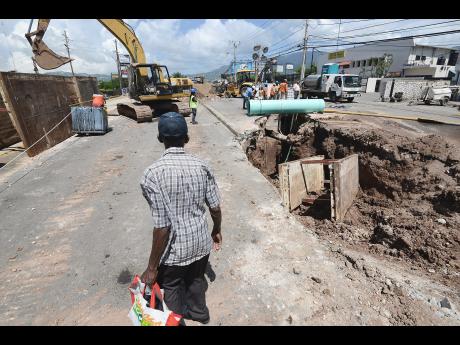

Caribbean waters have been disturbed by Hurricane Matthew, which has left a trail of death and destruction in its wake this past week.
While Jamaica was spared the full wrath of Hurricane Matthew, others in the Caribbean were not, making well the case for holding global temperatures at 1.5 degrees Celsius in the face of a changing climate.
So says respected meteorologist and former climate change negotiator for Jamaica, Clifford Mahlung.
For him, the experience of Matthew – leaving in its wake a trail of bodies and extensive infrastructure damage in not only Haiti, which took a severe battering, but also the Dominican Republic and Cuba – is chock-full of takeaways.
“The lessons that we gather from Matthew are numerous. It certainly strengthens the argument that we keep our global temperatures as close as we can to 1.5 degrees, because anything above 1.5 will result in many such systems like the one we just experienced with this hurricane,” Mahlung told The Gleaner.
In the run up to and during the international climate change talks held in France last year, the Caribbean aggressively lobbied for and ultimately secured the inclusion of 1.5 degrees Celsius as a target referenced in the new climate deal.
Dubbed ‘The Paris Agreement’, it has as its goal to hold “the increase in the global average temperature to well below 2 degrees Celsius above pre-industrial levels, and to pursue efforts to limit the temperature increase to 1.5 degrees Celsius above pre-industrial levels, recognising that this would significantly reduce the risks and impacts of climate change”.
The agreement will come into force next month following reports of endorsement from European nations yesterday, which sent the accord across a crucial threshold. “European nations raised backing for the 2015 Paris Agreement to countries representing 56.75 per cent of world greenhouse gas emissions, above the 55 per cent needed for implementation,” a Reuters news report said, quoting from a United Nations website.
With this year’s global climate change talks, to be held in Marrakesh, now only weeks away, Mahlung said Hurricane Matthew lends significance to the coming into force of the agreement. It also underscores, he said, the need for global financial and other support for climate change adaptation and loss and damage associated with extreme weather events in small-island developing states (SIDS).
“Hurricane Matthew was able to maintain category three or higher for several days. It shows that we can get a category five hurricane in a matter of hours,” Mahlung said.
“It shows the difficulties of even doing some of the predictions, as we saw how the projected tracks changed considerably over time; and this is not because the models are not good, but that the kind of conditions we now face with respect to tropical cyclone development have changed significantly from the good old days of, say, a Gilbert or Ivan,” he added.
According to the meteorologist, SIDS have to remain vigilant.
“You can appreciate that there were times when the people in Haiti and Dominican Republic would have thought that the system would not have come to Hispaniola. We saw where, in the final analysis, Jamaica was spared and the track was changed, resulting in grave devastation in Hispaniola and particularly Haiti,” Mahlung noted.
“So when we make the case with respect to adaptation in Marrakesh in a few weeks time, and also loss and damage, we will go into those negotiations with first-hand experiences of just what severe weather events such as a tropical cyclone, can do to small-island states,” he emphasised.
Former head of the Meteorological Service, Jeffrey Spooner, for his part, said there was no question of the need to continue the push for a climate-secure Caribbean.
“My real wish is that Marrakesh continues the work to ensure that we get to the point where we can really seal this deal to cap the increase in global temperatures at 1.5 degrees Celsius. Jamaica, CARICOM and SIDS need to continue to press for that,” he said.

To take better strategic advantage of climate finance opportunities while continuing the courtship of local business interests, Jamaica is looking to have private sector representation on its team to Marrakesh in November.
“In this COP (Conference of the Parties to the United Nations Framework Convention on Climate Change), we would want even one private sector representative – and probably, more specifically, from the financial sector – accompanying the delegation,” said head of the Climate Change Division.
“I am going to shamelessly and aggressively pursue that to see if it will happen,” she added.
According to Gordon, who recently assumed leadership of the division, it is critical to have the private sector fully sold on and involved in Jamaica’s climate change response efforts.
“When we have a weather event, then people suffer, but the private sector’s bottom line is [also] impacted severely. So we want the private sector to have a higher profile in this round,” Gordon noted.
Among the climate change impacts facing Jamaica and other small-island developing states of the Caribbean are extreme weather events, including hurricanes and droughts.
Both types of events have seriously affected the performance of the Jamaican economy in the past.
For example, data compiled by the Planning Institute of Jamaica on nine hurricanes impacting the island between 2001 and 2010 put the estimated cost at more than $111 billion.
The infrastructure sector is said to have accounted for $51.7 billion of that sum, while the transport sector, including roads and bridges, accounted for $44.4 billion.
Climate threats to Jamaica extend beyond extreme weather events to rising sea levels and the associated negative impact on coastal livelihoods. They also include warmer global temperatures and the negative health implications that flow from that, including an increase in diseases such as dengue.
THE Inter-American Development Bank (IDB) has launched ‘Rise Up’, a free multimedia tool for primary and secondary schools in Latin America and the Caribbean to empower students, parents and teachers to address climate change and improve their quality of life through creative, viable and long-term solutions.
“The solution to climate change is very complex. So we created an innovative knowledge tool in a multimedia format, to address part of the problem,” said Emma Näslund-Hadley, project co-ordinator and lead specialist in the Education Division of the IDB.
Rise Up encourages teachers and students to be part of the solution. Instead of teaching science in a traditional way, Rise Up transforms learning at both school and home to harness the potential of youth and adults to mitigate and reverse climate change.
According to the World Wide Fund for Nature (WWF Spain), if we continue at this pace, the “excessive” consumption of natural resources would force humanity to have 1.6 planets to meet demand globally.
To help counter climate change, Rise Up provides instructional videos, lesson plans, video games and a green kit in English and Spanish at no cost on the initiative’s website.
Rise Up is part of the efforts of the IDB and the Inter-American Investment Corporation to combat the effects of climate change facing the region. Last year, the IDB Group announced the goal of increasing to 30 per cent the volume of loan approvals for operations related to climate change by the end of 2020.

A powerful line-up of speakers will address next month’s Organisation of Caribbean Utility Regulators (OOCUR) 14th annual conference in Montego Bay, St James.
Prime Minister Andrew Holness is among those confirmed for the conference, set for the Secrets Resorts and Spa, under the theme, “Regulation: Creating a Spectrum of Opportunities in the Caribbean”. It will run over three days – October 26 to 28.
OOCUR, a non-profit organisation, was established in 2002 by the signatories of six utility regulators across the Caribbean, including Jamaica’s Office of Utilities Regulation (OUR). It was established to assist in the improvement of utility regulation, facilitate understanding of regulation issues and undertake research, training and development.
Officials of the OUR will be featured heavily in the conference’s proceedings. Among those expected to participate are Albert Gordon, director general, and Joseph Matalon, the chairman. Also expected to address participants from across the Caribbean is Dr Andrew Wheatley, minister of science, energy, technology. This will be his first major conference in Jamaica as portfolio minister in the Holness administration.
The conference should be fully energised when Andrew Thorington, from the Caribbean Electric Utility Services Corporation, presents on the electric utility-regulator relations in the Caribbean. With raging debate in recent times about the need for cleaner energy, there will be a four-member panel discussion on the issue. The participants include Dan Potash, representing the United States Agency for International Development (USAID); Winston Robotham of the OUR; David Cooke of the Jamaica Public Service; and Dr Xavier Lemaire of University College, London Energy Institute.
The telecommunications regulators are expected to take centre stage on the second day of the conference. Professor Hopeton Dunn, chairman of the Broadcasting Commission, and Julian Wilkins of Caribbean Focus, Global Perspective, are among those expected to make presentations. The day will end with the meeting of the general assembly and then a meeting of OOCUR’s executive council.
Horace Chang, the minister with responsibility for water and housing, will make his presentation on the final day. His ministry has taken on much of the regulatory responsibilities for much of the country’s public bodies and agencies.
There will also be presentations from Skeeta Carasco, regulatory economist at the National Utilities Regulatory Commission, and Dwight DaCosta, deputy chief of party, USAID.
From getting acquainted with how government does business to informing and reassuring partners and planning for the Marrakesh negotiations next month, it’s been a whirlwind of activities for the new captain at the helm of the Climate Change Division.
But no neophyte to work and management in the development arena, UnaMay Gordon, 58, has been handling things with aplomb.
The first order of business has been to get the lay of the land and to make some decisions as to direction.
“I took over the division in the middle of the year. It means, therefore, that an operational plan would already be in place. I am looking at it now to see what was done, what was achieved and spending time tying up loose ends. Most of that is completed now,” Gordon, who has been in the position for just a month, told The Gleaner.
She comes to the division following two years of work as an environmental consultant and having served in various capacities with organisations such as the Inter-American Institute for Cooperation on Agriculture and GraceKennedy Limited.
Partners have been written to on the change in leadership and the necessary steps taken to settle Jamaica’s representation and/or participation in various climate change processes and events.
Meanwhile, work at the division – tasked to coordinate, facilitate and support climate change mainstreaming in Jamaica, from adaptation to mitigation, together with finance – goes on.
Cabinet recently gave the nod for a Climate Change Advisory Board to replace what was the Climate Change Advisory Committee headed by Dr Conrad Douglas. The division is now seeing to it that that is operationalised.
“We are (also) looking at what is going on with the climate change focal point and how we are going to use them to assist with the work of the division. There will be increased focus on the network to ensure we can deliver on the mandate,” revealed Gordon, who compiled Jamaica’ First National Communication on Climate Change to the United Nations Framework Convention on Climate Change and is the principal author for the island’s national biodiversity strategy.
There are currently some 27 designated focal points inside various ministries and agencies of government to advance the integration of climate change considerations into the planning for and operations of each entity.
Also on the agenda, Gordon said, is attention to the Climate Change Policy Framework.
“The policy framework is set within (Jamaica’s national development plan) Vision 2030. I would want to ensure that we are implementing the policy, which is the guide for the Government’s work and to ensure that there is a monitoring framework in place to track the progress,” said the woman, who founded the Institute for Sustainable Livelihood Leadership and Exchange that promotes entrepreneurship as a vehicle for sustained livelihood among youth and women in the Americas.
Ongoing stakeholder engagement is another crucial element of the work of the division now and in the future- as is growing the small staff.
Two years ago, the division got going with a secretary, a principal director (Albert Daley) and two senior technical officers – one with responsibility for adaptation (Dr Orville Gray) and the other for mitigation (Gerald Lindo).
In the last two months, both Daley and Lindo have left.
With Gordon in as Daley’s replacement, she said efforts are under way to have a new mitigation officer join the team. Recruitment of a public relations officer and consultant behaviour change specialist is also underway.
There are, too, efforts to take advantage of available support for climate change financing personnel.
“The plan is to make modifications and to ensure that we manage, especially with our international partners, the gap that was left by the transition and to ensure that the representation to the international community is maintained seamlessly,” said Gordon, the holder of a masters in environmental sciences from Wageningen Agriculture University in Holland and recipient of the honorary degree of Doctorate of Philosophy in Humanities from the United Graduate College and Seminary International.
“Jamaica has been a leader. We have led a number of the international processes, so just to ensure there is no gap, that is very important for me,” she added.

Malvern, St Elizabeth — Eighteen months after ground was broken, the 36.3-megawatt wind farm run by BMR Jamaica Wind at Potsdam, Malvern, high in the Santa Cruz Mountains, was formally commissioned in mid-August.
Priced at US$89.9 million, the wind project, located across the road from another wind farm run by light and power company Jamaica Public Service Company (JPS), is being described as the single largest investment in St Elizabeth since construction of the Alpart alumina plant at Nain in the late 1960s.
The BMR project includes eleven wind turbines, which will provide energy to JPS’s national grid at US12.9 cents per kilowatt-hour.
BMR Jamaica Wind is a subsidiary of US-based BMR Energy. Guests at the recent formal commissioning were told that billionaire British investor, Sir Richard Branson — who turned up for the commissioning — was in the process of acquiring BMR through his wide- ranging and far-flung Virgin Group.
Branson, who triggered laughter by ripping up and throwing away what he said were his speaking notes, told his audience that his motive for the acquisition was to promote a clean energy revolution.
“I decided recently that we needed to get one or two core (clean energy) companies under our belt so that we can actually get out there and speed up this revolution …” he said.
“ We were delighted to acquire BMR and we will be out there trying to hustle and bustle governments all over the Caribbean and other countries to hurry up towards carbon neutrality by 2050. Personally, I don’t need to make money out of it, if it makes a bit of money, fine; if it doesn’t, fine. I just want to get the wind out there get the solar out there, … be powered by sun, wind, sea… a green energy revolution and bring the cost of energy down for everybody; get rid of the dangers of coal and oil and the dirty energies that we are using today… ” said Branson, founder of the Virgin Group.
Funding for the BMR project in Malvern was sourced through a package including a US$42-million loan from the US quasi-government investment agency Overseas Private Investment Corporation (OPIC), which pushes US overseas investment globally; US$10 million from the International Finance Corporation (IFC), which promotes private sector development; US$10 million from the IFC-Canada Climate Change Programme and equity investment of US$26.9 million from BMR Energy.
Jamaica’s energy minister Andrew Wheatley said the BMR wind farm formed part of the government’s drive to significantly reduce reliance on fossil fuels and reduce the current annual oil bill of about US$2 billion. Ninety-two per cent of Jamaica’s energy needs are currently met by oil imports, he said.
The project was in line with the target of 30 per cent renewables in the national energy mix by 2030, as stated in the National Energy Policy, and in keeping with Vision 2030 Jamaica, the minister said.
“Projects like BMR continue to establish Jamaica as a clear renewables market leader within the Caribbean. By the end of this year, we would have added 80 MW of renewable energy to the national grid, through Wigton III (a wind farm at Rose Hill in southern Manchester), Content Solar (solar plant in Clarendon), and this facility,” Wheatley said.
Bruce Levy, president of BMR Energy, said the company had plans to expand the wind farm at Malvern by an additional three wind turbines. Small farmers would co-exist with the energy-generating operations, he said.

Devon Gardner
THE CARIBBEAN is, within the next two or so years, to have an energy efficiency strategy that should serve the growth agenda of various islands.
To begin the work, the Caribbean Community (CARICOM) has secured the support of the European Union (EU).
“The EU will send a team in to work with us to identify the elements of the framework for the strategy. Having identified that framework, we will utilise a Technical Cooperation Facility (TCF) that we have with the IDB (Inter-American Development Bank) as well as support that we are already getting from the GIZ to do what I refer to as investment grade analysis to identify the energy efficiency options in the various sectors across countries in the CARICOM states,” said Dr Devon Gardner, programme manager for energy with the CARICOM secretariat.
He was speaking to the Gleaner at the energy and sustainable development forum hosted by the University of the West Indies in Kingston on Tuesday.
According to Gardner, the strategy – to be developed in line with CARICOM’s five-year strategic plan for 2015 through 2019 will take account of key productive sectors (tourism, agriculture, services and the public sector) together with the electricity and transport sectors.
In the end, he said it should deliver on:
• an energy efficient building code for the region;
• energy performance standards for certain types of appliances, including refrigerators, air conditioners, washing machines, and lights (LED and CFLs);
• energy labelling standards for appliances that provide consumers with information and operating cost of the various devices; and
• performance standards for a number of renewable energy devices, including solar water heaters.
“What are doing is not just to understand the amount of energy savings potential, but critically it is to understand the value of the energy savings to the economy and the investment package required to pursue those opportunities if we desire,” Gardner noted.
News of the regional energy efficiency strategy comes at a time when CARICOM countries are collectively using some 13,000 Btu of energy to produce one US dollar of gross domestic product (GDP) compared to 4,000 Btu of energy used by Japan, for example, to produce the same one US dollar of GDP and the global average of 10,000 Btu.
This is according to Gardner who said that “the region is perhaps the most inefficient in the world as regards energy efficiency.”
Chief Executive Officer of the United Nations (UN) Sustainable Energy for All Rachel Kyte has said her organisation is ready to partner with Caribbean governments and institutions to secure a clean, affordable and reliable energy future.
She was delivering the William G. Demas Memorial Lecture at the Caribbean Development Bank’s (CDB) 46th annual Board of Governors Meeting at the Iberostar Resort in Lilliput, St James, on Tuesday.
Sustainable Energy for All is the brainchild of UN Secretary-General Ban Ki-moon. Its main objectives are ensuring universal access to modern energy services and doubling the global rate of improvement in energy efficiency and the share of renewables in the global energy mix.
Kyte said that energy demand is not only the dominant contributor to climate change, but is central to nearly every major challenge and opportunity the world faces today.
She noted that there are 1.1 billion people around the world who still have little or no access to energy, and three billion who rely on wood, coal, charcoal or animal waste for cooking and heating.
“We the peoples of the UN want a planet and a future that’s not ravaged by climate change. We the peoples deserve access to affordable, clean and reliable energy and we the peoples know that the time for action is now,” she said.
Kyte noted that the impacts of climate change are being felt all around the world, particularly in the Caribbean. She added that rainfall patterns are changing, which have caused a number of islands to experience prolonged dry seasons and severely low reservoir levels.
“This severely impacts the ability of island nations to grow local crops,” she pointed out, citing loss of an estimated 2,190 hectares of crops valued at millions of dollars in Jamaica due to drought.
Kyte pointed out that the CDB has an essential role to play in providing financing for sustainable energy projects.
Chief Executive Officer of the United Nations (UN) Sustainable Energy for All Rachel Kyte has said her organisation is ready to partner with Caribbean governments and institutions to secure a clean, affordable and reliable energy future.
She was delivering the William G. Demas Memorial Lecture at the Caribbean Development Bank’s (CDB) 46th annual Board of Governors Meeting at the Iberostar Resort in Lilliput, St James, on Tuesday.
Sustainable Energy for All is the brainchild of UN Secretary-General Ban Ki-moon. Its main objectives are ensuring universal access to modern energy services and doubling the global rate of improvement in energy efficiency and the share of renewables in the global energy mix.
Kyte said that energy demand is not only the dominant contributor to climate change, but is central to nearly every major challenge and opportunity the world faces today.
She noted that there are 1.1 billion people around the world who still have little or no access to energy, and three billion who rely on wood, coal, charcoal or animal waste for cooking and heating.
“We the peoples of the UN want a planet and a future that’s not ravaged by climate change. We the peoples deserve access to affordable, clean and reliable energy and we the peoples know that the time for action is now,” she said.
Kyte noted that the impacts of climate change are being felt all around the world, particularly in the Caribbean. She added that rainfall patterns are changing, which have caused a number of islands to experience prolonged dry seasons and severely low reservoir levels.
“This severely impacts the ability of island nations to grow local crops,” she pointed out, citing loss of an estimated 2,190 hectares of crops valued at millions of dollars in Jamaica due to drought.
Kyte pointed out that the CDB has an essential role to play in providing financing for sustainable energy projects.