
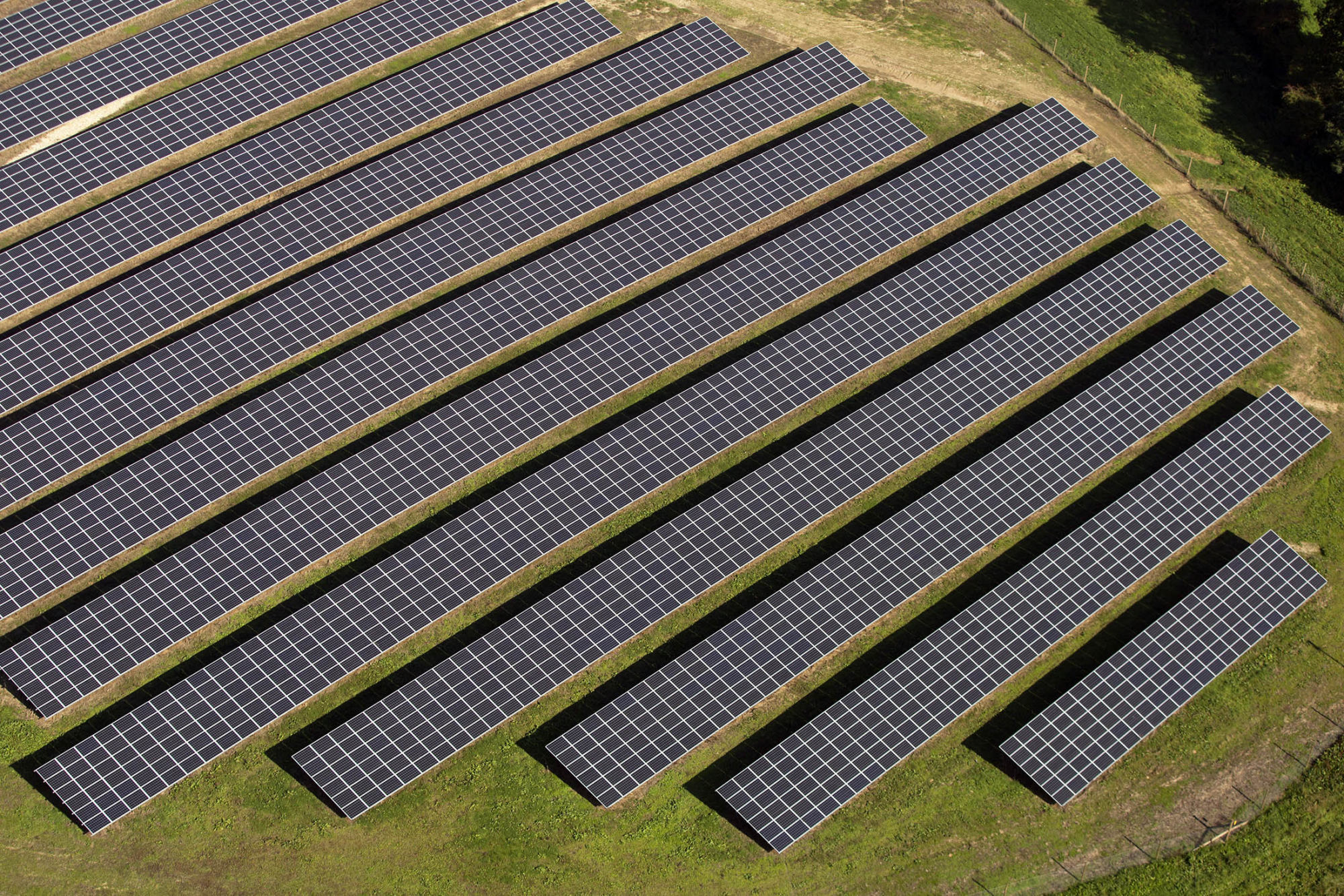
Electric avenues that can transmit the sun’s energy onto power grids may be coming to a city near you.

A subsidiary of Bouygues SA has designed rugged solar panels, capable of withstand the weight of an 18-wheeler truck, that they’re now building into road surfaces. After nearly five years of research and laboratory tests, they’re constructing 100 outdoor test sites and plan to commercialize the technology in early 2018.
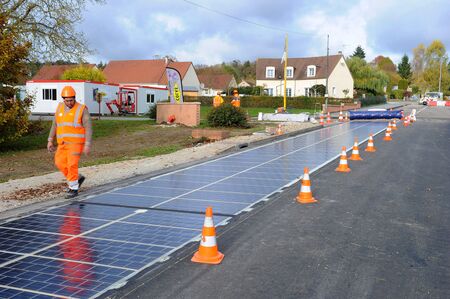
Wattway’s solar road in Tourouvre

“We wanted to find a second life for a road,” said Philippe Harelle, the chief technology officer at Colas SA’s Wattway unit, owned by the French engineering group Bouygues. “Solar farms use land that could otherwise be for agriculture, while the roads are free.”

As solar costs plummet, panels are being increasingly integrated into everyday materials. Last month Tesla Motors Inc. surprised investors by unveiling roof shingles that double as solar panels. Other companies are integrating photovoltaics into building facades. Wattway joins groups including Sweden’s Scania and Solar Roadways in the U.S. seeking to integrate panels onto pavement.

To resist the weight of traffic, Wattway layers several types of plastics to create a clear and durable casing. The solar panel underneath is an ordinary model, similar to panels on rooftops. The electrical wiring is embedded in the road and the contraption is topped by an anti-slip surface made from crushed glass.

A kilometer-sized testing site began construction last month in the French village of Tourouvre in Normandy. The 2,800 square meters of solar panels are expected to generate 280 kilowatts at peak, with the installation generating enough to power all the public lighting in a town of 5,000 for a year, according to the company.

For now, the cost of the materials makes only demonstration projects sensible. A square meter of the solar road currently costs 2,000 ($2,126) and 2,500 euros. That includes monitoring, data collection and installation costs. Wattway says it can make the price competitive with traditional solar farms by 2020.

screen-shot-2016-11-27-at-21-44-24


The electricity generated by this stretch of solar road will feed directly into the grid. Another test site is being used to charge electric vehicles. A third will power a small hydrogen production plant. Wattway has also installed its panels to light electronic billboards and is working on links to street lights.

The next two sites will be in Calgary in Canada and in the U.S. state of Georgia. Wattway also plans to build them in Africa, Japan and throughout the European Union.

“We need to test for all kinds of different traffic and climate conditions,” Harelle said. “I want to find the limits of it. We think that maybe it will not be able to withstand a snow plow.”

The potential fragility joins cost as a potential hurdle.

“We’re seeing solar get integrated in a number of things, from windows in buildings to rooftops of cars, made possible by the falling cost of panels,” Bloomberg New Energy Finance analyst Pietro Radoia said. “On roads, I don’t think that it will really take off unless there’s a shortage of land sometime in the future.”’

Bloomberg


screen-shot-2016-11-19-at-13-31-23

China couldn’t have invented global warming as a hoax to harm U.S. competitiveness because it was Donald Trump’s Republican predecessors who started climate negotiations in the 1980s, China’s Vice Foreign Minister Liu Zhenmin said.

U.S. Presidents Ronald Reagan and George H.W. Bush supported the Intergovernmental Panel on Climate Change in initiating global warming talks even before China knew that negotiations to cut pollution were starting, Liu told reporters at United Nations talks on Wednesday in Marrakech, Morocco.

Ministers and government officials from almost 200 countries gathered in Marrakech this week are awaiting a decision by President-elect Trump on whether he’ll pull the U.S. out of the Paris Agreement to tackle climate change. The tycoon tweeted in 2012that the concept of global warming “was created by and for the Chinese in order to make U.S. manufacturing non-competitive.” China’s envoy rejected that view.

“If you look at the history of climate change negotiations, actually it was initiated by the IPCC with the support of the Republicans during the Reagan and senior Bush administration during the late 1980s,” Liu told reporters during an hour-long briefing.

Reagan’s Legacy

While Reagan died in 2004, George Schulz, who served as his secretary of state, has become one of the most prominent Republicans voicing concern about climate change and urging action.

“The potential results are catastrophic,” said Schulz, 95, in an interview with Bloomberg in 2014. “So let’s take out an insurance policy.”

Increased U.S. efforts to curb emissions through investing in new cleaner technologies and manufacturing could actually boost U.S. competitiveness, Liu countered. “That’s why I hope the Republican’s administration will continue to support this process.”

A fortnight of discussions in Marrakech were thrust into the spotlight last week by Trump’s victory. The negotiating texts being drafted by delegates and officials in north African country were suddenly overshadowed by a uncertain political future cast by Trump’s shadow over the two-decade-old process.

Outgoing U.S. Secretary of State John Kerry, who helped secure the Paris Agreement last year, said the majority of U.S. citizens back action on climate change and tried to assuage concern.

“No one has a right to make decisions for billions of people based solely on ideology,” he said. “Climate change shouldn’t be a partisan issue. It isn’t a partisan issue for our military. It isn’t a partisan issue for our intelligence community.”

China’s President Xi Jinping underlined the importance of cooperation between the two largest economies when he spoke to Trump on Monday, said Liu, who added China will continue its fight against climate change “whatever the circumstances.”

He added that richer nations should take more responsibility than poor countries for financing the fight against climate change, in line with the UN’s Framework Convention on Climate Change. “Of course we’re still expecting developed countries including the United States will continue to take the lead on mitigating climate change,” he said.

Bloomberg

It’s the latest response to a fossil-fuel disaster.

The clean-energy boom is about to be transformed. In a surprise move, U.S. lawmakers agreed to extend tax credits for solar and wind for another five years. This will give an unprecedented boost to the industry and change the course of deployment in the U.S.

The extension will add an extra 20 gigawatts of solar power—more than every panel ever installed in the U.S. prior to 2015, according to Bloomberg New Energy Finance (BNEF). The U.S. was already one of the world’s biggest clean-energy investors. This deal is like adding another America of solar power into the mix.

The wind credit will contribute another 19 gigawatts over five years. Combined, the extensions will spur more than $73 billion of investment and supply enough electricity to power 8 million U.S. homes, according to BNEF.

 “This is massive,” said Ethan Zindler, head of U.S. policy analysis at BNEF. In the short term, the deal will speed up the shift from fossil fuels more than the global climate deal struck this month in Paris and more than Barack Obama’s Clean Power Plan that regulates coal plants, Zindler said.
Data Source: Bloomberg New Energy Finance

This is exactly the sort of bridge the industry needed. The costs of installing wind and solar power have dropped precipitously—by more than 90 percent since the original tax credits took effect—but in most places coal and natural gas are still cheaper than unsubsidized renewables. By the time the new tax credit expires, solar and wind will be the cheapest forms of new electricity in many states across the U.S.

The tax credits, valued at about $25 billion over five years, will drive $38 billion of investment in solar and $35 billion in wind through 2021, according to BNEF. The scale of the new projects will help push costs down further and will stimulate new investment that lasts beyond the extension of the credits.

Data Source: Bloomberg New Energy Finance

Few people in the industry expected a five-year extension. Stocks soared. SolarCity, the biggest rooftop installer, surged 34 percent yesterday. SunEdison, the largest renewable-energy developer, climbed 25 percent, and panelmaker SunPower increased 14 percent.

Congress is expected to vote by the end of this week on the tax credits as part of a broader budget deal that also lifts the 40-year-old ban on U.S. oil exports. Oil producers have lobbied for years to lift the ban, but it isn’t likely to significantly affect either consumption of oil or deployment of renewables. Leaders from both parties reached an agreement on the bill late Tuesday.

The 30 percent solar tax credit was set to expire next year and will now extend through 2019 before tapering to 10 percent in 2022. The wind credit had expired at the end of 2014, and the extension will be retroactively applied from the start of 2015 through 2019, declining in value each year.

Wind power has had an especially tumultuous relationship with U.S. lawmakers, who have kept the industry’s credits alive through a disruptive ping-pong game of short-term extensions every year or two. “You open manufacturing plants and then you close them. And then you open them and you close them,” BNEF’s Zindler said. “It’s economically inefficient. This will give them a good five-year line of sight on what the market will look like, and that’s really important.”

Bloomberg