Elon Musk’s Clean Energy Vision Includes a Strong Role for Utilities

Cheaper coal and gas will do nothing to derail the renewable energy revolution according to BNEF’s New Energy Outlook 2016.

Bloomberg New Energy Finance states 60% of installed capacity will be zero-emission energy sources by 2040 and wind and solar power will take the lion’s share of new power generation capacity added – 64%.

Solar power is forecast to be the cheapest generation technology in most countries by 2030 and account for 3.7TW, or 43%, of new capacity added in 2016-40. This will represent $3 trillion of new investment.

A very important point in the report is that around 2027, new wind and solar will be cheaper than running existing coal and gas generators, particularly where carbon pricing has been implemented. In just over a decade we may see a marked uptick in current fossil fuel generation plants being shuttered. The report says there will be a net closure of 286GW of coal in OECD economies by 2040.

By 2040, BNEF states Australia will have wind and solar penetration of more than 50%.

Another prediction will get electric vehicle supporters excited – BNEF’s modeling suggests EV’s will comprise a quarter of the global car fleet by 2040. This is also good news for the residentialand commercial solar sector as it will accelerate a reduction in battery costs through technology development, economies of scale and enhanced manufacturing know-how.

BNEF sees a very healthy future for small-scale solar power, with it accounting for 10% of global generating capacity by 2040. With regard to home battery systems, Bloomberg expects solar energy storage to be commonly deployed alongside rooftop solar panel systems by 2020.

Behind-the-meter energy storage generally will see a sharp rise from around 400MWh today to nearly 760GWh in 2040.

While the news is upbeat about renewables generally, forecasted additions won’t be enough to rein in carbon emissions to the required degree.

“Some $7.8 trillion will be invested globally in renewables between 2016 and 2040, two thirds of the investment in all power generating capacity, but it would require trillions more to bring world emissions onto a track compatible with the United Nations 2°C climate target,” said Seb Henbest, lead author of the report and head of Europe, Middle East and Africa for BNEF.

BNEF suggests approximately USD $5.3 trillion would need to be invested in zero-carbon power by 2040 to prevent carbon dioxide levels rising above 450 parts per million.

Bloomberg

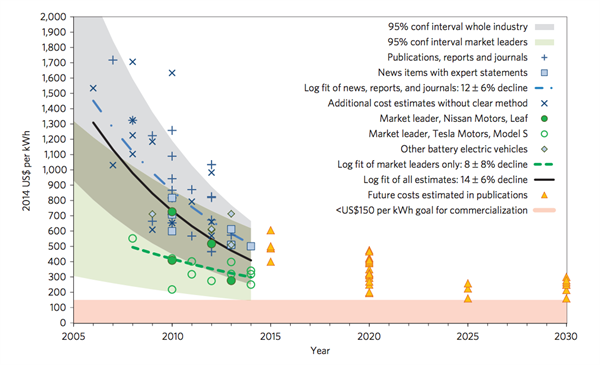
The most important piece of news on the energy front isn’t the plunge in oil prices, but the progress that is being made in battery technology. A new study in Nature Climate Change, by Bjorn Nykvist and Mans Nilsson of the Stockholm Environment Institute, shows that electric vehicle batteries have been getting cheaper much faster than expected. From 2007 to 2011, average battery costs for battery-powered electric vehicles fell by about 14 percent a year. For the leading electric vehicle makers, Tesla and Nissan, costs fell by 8 percent a year. This astounding decline puts battery costs right around the level that the International Energy Agency predicted they would reach in 2020. We are six years ahead of the curve. It’s a bit hard to read, but here is the graph from the paper:

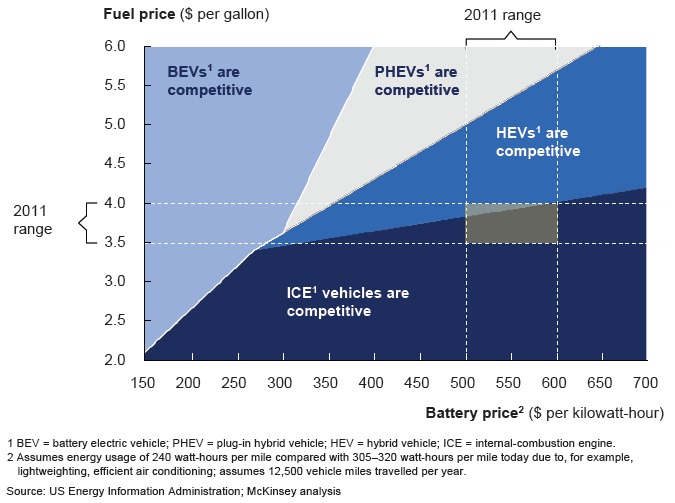
This puts the electric vehicle industry at a very interesting inflection point. Back in 2011, McKinsey & Co. made a chart showing which kind of vehicle would be the most economical at various prices for gasoline and batteries:

Looking at this graph, we can see the incredible progress made just since 2011. Battery prices per kilowatt-hour have fallen from about $550 when the graph was made to about $450 now. For Tesla and Nissan, the gray rectangle (which represents current prices) is even farther to the left, to about the $300 range, where the economics really starts to change and battery-powered vehicles become feasible.

But in the past year, the price of gasoline has fallen as well, and is now in the $2.50 range even in expensive markets. A glut of oil, and a possible thaw in U.S.-Iran relations, have moved the gray rectangle down into the dark blue area where internal combustion engines reign supreme.

Still, if battery prices keep falling, the gray rectangle will keep moving to the left. The Swedish researchers believe that Tesla’s new factories will be able to achieve the 30 percent cost reduction the company promises, simply from economies of scale and incremental improvements in the manufacturing process. That, combined with a rebound in gas prices to the $3 range, would be enough to make battery-powered vehicles an economic alternative to internal combustion vehicles in most regions.

But this isn’t the only piece of good energy news. Investment in renewable energy is powering ahead.

The United Nations Environment Programme recently released a report showing that global investment in renewable energy, which had dipped a bit between 2011 and 2013, rebounded in 2014 to a near all-time high of $270 billion. But the report also notes that since renewable costs — especially solar costs — are falling so fast, the amount of renewable energy capacity added in 2014 was easily an all-time high. China, the U.S. and Japan are leading the way in renewable investment. Renewables went from 8.5 percent to 9.1 percent of global electricity generation just in 2014.

That’s still fairly slow in an absolute sense. Adding 0.6 percentage point a year to the renewable share would mean the point where renewables take half of the electricity market wouldn’t come until after 2080. But as solar costs fall, we can expect that shift to accelerate. In particular, forecasts are for solar to become the cheapest source of energy — at least when the sun is shining — in many parts of the world in the 2020s.

Each of these trends — cheaper batteries and cheaper solar electricity — is good on its own, and on the margin will help to reduce our dependence on fossil fuels, with all the geopolitical drawbacks and climate harm they entail. But together, the two cost trends will add up to nothing less than a revolution in the way humankind interacts with the planet and powers civilization.

You see, the two trends reinforce each other. Cheaper batteries mean that cars can switch from gasoline to the electrical grid. But currently, much of the grid is powered by coal. With cheap solar replacing coal at a rapid clip, that will be less and less of an issue. As for solar, its main drawback is intermittency. But with battery costs dropping, innovative manufacturers such as Tesla will be able to make cheap batteries for home electricity use, allowing solar power to run your house 24 hours a day, 365 days a year.

So instead of thinking of solar and batteries as two independent things, we should think of them as one single unified technology package. Solar-plus-batteries is set to begin a dramatic transformation of human civilization. The transformation has already begun, but will really pick up steam during the next decade. That is great news, because cheap energy powers our economy, and because clean energy will help stop climate change.

Of course, skeptics and opponents of the renewable revolution continue to downplay these remarkable developments. The takeoff of solar-plus-batteries has only begun to ramp up the exponential curve, and market shares are still small. But it has begun, and it doesn’t look like we’re going back.

This column does not necessarily reflect the opinion of Bloomberg View’s editorial board or Bloomberg LP, its owners and investors.

To contact the author on this story:
Noah Smith at nsmith150@bloomberg.net

To contact the editor on this story:
James Greiff at jgreiff@bloomberg.net

Bloomsberg


When it comes to grabbing headlines with visions of the future, few can beat entrepreneur and inventor Elon Musk. He’s behind SpaceX, the rocket company that he sees as a vehicle to his dream of colonising Mars.

Better known, perhaps, are his Tesla electric cars, an increasingly common sight in the US and here in the UK.

While powerful rockets and fast cars might be the most exciting of Musk’s products, his hopes of changing the way we live are much more likely to be delivered by something much more prosaic – Tesla’s Powerwall. Much less glamorous than Musk’s other concepts, this plain white battery, intended to harness energy from renewable sources such as the wind and sun and make it available for household use or feed back into the power network, could have a far bigger impact than anything else the billionaire has dreamt up.

The concept behind these batteries in homes – which working together are known as a “distributed grid” – is that they will store up cheap electricity generated when demand is lower, then discharge it at peak times when energy from the traditional network supplied mainly by large power stations is expensive.

Not only do these batteries – known as “behind the meter” storage – raise the prospect of reducing households’ electricity costs by optimising the time they receive power, they could cut further bills by selling excess power back to the network at times of high demand. They could also provide an emergency back-up if the main grid fails.

There are other wider advantages to the system. Having batteries in every home solves the problem of solar and wind farms producing electricity when there is no demand for it and nowhere to store it, and they could also ease the current strain on the transmission grid as power is sent from large power stations. Perhaps most importantly, they could reduce the world’s reliance on fossil fuels by allowing green energy sources to be fully utilised without the worry of the wind dropping or the sun being hidden by clouds.

The whole idea might sound like a pipe dream, but it is becoming more a more real possibility. While Tesla is raising the profile of home energy storage, other less visible players are operating in the sector and already installing batteries in British houses.

However, last week just how seriously the concept is being taken was shown with a series of big moves in the sector. First came France, with oil giant Total on Monday announcing a £750m scheme to buy battery group Saft as it looked beyond the low oil price and to a future away from fossil fuels.

A day later, Engie, previously known as GDF Suez, revealed it had taken an 80pc stake in California start-up Green Charge Networks, a leading player in behind-the-meter batteries. But the most significant event came later the same day from automotive giant Nissan. As well as revealing it would begin using its Sunderland battery factory to start recycling the power packs from its Leaf electric cars for use as home power storage devices, the Japanese company said it had picked the UK for a much more important trial.

Under the title of Nissan Futures, it revealed a new vision for how electric cars will be used in the years ahead. A pilot project will see 100 Leaf cars plugging into the energy network and using their batteries as extra storage, in what it hopes could combine transport and energy in the future.

“As a company, we recognise there will be massive change in the future,” said Paul Willcox, Nissan’s European chairman. “There’s a revolution in the market and we need to think about how we evolve and what the car’s role is in society.”

The cost of power from solar is falling rapidly – down 40pc 2012, according to KPMG

Nissan’s plan is rather eloquent and effectively kills two birds with a single stone. The average Leaf uses only a quarter of its battery power before recharging, meaning there is a large capacity going spare for most of the time.  The Leaf’s 30 kilowatt hour (kWh) battery can store enough energy to supply the average home’s needs for two days according to Willcox, but under Nissan’s scheme, this capacity is put to much more practical use. By plugging in at home overnight, the cars charge up on cheap late-night electricity, but their batteries are available to feed into the network at times of peak demand.

Willcox says the trial envisages electric vehicles as “mobile power plants, energy hubs” with them plugging in to offer up their resources not just at homes overnight, but also at workplaces during the day.

A giant such as Nissan weighing into the sector shows just how seriously energy storage is being taken, and the fact that the former chief executive of National Grid, Steve Holliday, is on board only emphasises it.

Cynics might argue that the idea is fanciful at best, but Willcox is confident of its potential. “Oil may be cheap now, but that is not going to last forever and people are increasingly going to want electric vehicles – it makes sense to use them in this way,” he says, adding that while Tesla is a “credible company”, Nissan began making electric vehicles in the 1940s.

“Some may see this as blue sky thinking but it is real and tangible now,” Willcox adds. “Six or seven years ago, when we invested heavily in battery vehicles people laughed at us, but we have 230,000 Leafs on the road now.”

Holliday argues that moving to a distributed grid could that takes advantage of cheap energy makes sense. “In the future we could see a time when electrons are free,” he says. “On this island, we have times now when people effectively pay to use electricity because of the cost of having to shut down [existing power plants] when there is low demand.”

Nissan makes a convincing argument and is certainly planting its flag firmly in what is a land grab for a huge industry of the future, though Willcox concedes the whole car industry will need to work together for the potential of “vehicle to grid” to be realised.

However, for a distributed grid to work, there needs to be a major reform of legislation around the UK power market, according to industry body Energy Storage Network (ESN). “The current system of buying and selling electricity is not fit for purpose,” said ESN director Anthony Price. “The paradox is that almost everything except storing electricity is subsided.”

Almost 1m UK homes have solar panels and Price estimates that several tens of thousands of UK homes have battery systems. To get these figures closer to parity the process of storing electricity and selling it back to the grid needs to be overhauled. However, Price says that even without the benefits of these batteries being charged from renewable sources, the UK needs to invest in battery storage.

“We have a variable demand for energy because we are human,” he says. “We run generation to match demand and there is a lot of effort to meet the peaks – such as everyone switching on the kettle when Coronation  Street finishes – and that costs a lot, and the power is often from the dirtiest power plants which take time to be fired up.

Almost 1m UK homes have solar panels

“Battery storage – whether behind-the-meter or in community batteries at the end of the street – has the effect of taking out those peaks in demand and allows you to operate a much more efficient system.”

Cyrille Brisson, vice-president at global power management group Eaton, which is working with Nissan, agrees, saying that the present system requires large numbers of power stations ready to meet peak demands.

“At the moment we have to have massive over-capacity – which is expensive – to meet fluctuating demands, but with renewables you have unpredictable generation,” he says. “However, with storage in the middle you do not have to oversize everything. You get a ‘good load’ on the electricity grid where the spikes in generation and consumption are flattened out by the storage.”

Arguments that the wind might not blow or the sun won’t shine are false, argues Brisson, claiming that the “Sahara produces 100 times the wind and sun” to power the planet, and the technology for this “absolutely exists”.

He also warns against trying to subsidise the market to encourage the take-up of energy storage. “The worst thing you can do is subsidise it. The public think that renewables mean an extra tax on them, and regulation has got to make it clear it is not that. What is needed is a transparent market, so as the costs fall people will see it is cheaper.”

The cost of power from solar is falling rapidly – down 40pc 2012, according to KPMG – and Brisson argues that technological advances will soon make it as cheap as fossil fuels.

The Government also sees the potential in energy storage systems, having declared it one of eight “great technologies” it sees the UK as having the potential to become a world leader in. Nissan’s Willcox acknowledges this, noting the UK’s “encouraging” environment was a factor in picking Britain as the site for the global V2G pilot programme.

The public might find the idea of a battery in the home helping to solve complex problems about the UK’s energy needs hard to imagine. However, Joe Warren, chief executive of start-up Powervault, sees it a different way.

His company’s 4kWh batteries start at £2,500 and are capable of providing about a third of the needs of a typical British home, having charged themselves from roof mounted solar panels and Warren hopes to have 500 of them installed in Britain by the end of the year.

“There’s a massive transition away from centralised power generation,” he says, as news breaks that the cost of the long-delayed Hinkley Point nuclear power plant may rise by £3bn to £21bn. “It makes sense to decentralise when instead you can make small investments of £1m or £100m on wind farms or solar power stations.

“We hope to make a home battery as common as a dishwasher in every kitchen.”

Flipboard