JPS to open discussions with other renewable vendors

The Jamaica Public Service (JPS) yesterday announced that it will be engaging in discussions with other renewable vendors to ensure execution of the planned energy 190 MW Power Plant in Old Harbour, St. Catherine.

Chief Executive Officer, Kelly Tomblin in a press release advised the public that Spanish renewable energy and engineering firm Abengoa has filed for protection from creditors – an initial step towards filing for bankruptcy. The company was recently announced as the preferred bidder to construct the combined-cycle plant in Old Harbour.

“While JPS notes the development with regret, it is fully prepared to activate its alternative plans to ensure the execution of the project, which will replace the present Old Harbour Bay Power Station, while adding more Liquefied Natural Gas to the country’s energy mix,” Tomblin stated.

“We will be having dialogue with Abengoa — but JPS remains undaunted by the news. As a responsible corporate entity, our company has been in full preparation mode for any type of challenge regarding the completion of this project. We will not be derailed from our mission to bring real change to the energy sector and by extension, to Jamaica,” she continued.

The CEO reportedly stated that JPS has been eyeing other vendors since the announcement of the Abengoa’s financial situation.

Abengoa, which reported debt of ¤8.9-billion in its third quarter financials, began bankruptcy protection proceedings to avoid what could be one of Spain’s largest insolvencies.

The figure could be doubled when including ¤2.1 billion in funds it owed to suppliers and ¤5.9 billion of debt the company has in subsidiaries it said could potentially be sold. According to reports, the company has filed for protection from creditors with hopes of reaching a deal on its debts by March.

According to Tomblin, Abengoa was selected based on its wide ranging and impressive technical expertise. The company has been touted as one of the world’s top builders of power lines transporting energy across Latin America and a top engineering and construction business, making massive renewable-energy power plant.

The light and power company also had the understanding that Abengoa’s financiers were committed to the company for the long term.

“JPS wishes to assure its customers and all stakeholders that the 190 MW project remains on track for the plant’s commissioning in 2018.The Company will keep stakeholders informed as events unfold,” she said.

Jamaica Observer

* Abengoa has 4 months to reach deal with creditors

* Shares plummet 54 pct, bonds virtually worthless

* Abengoa’s bankruptcy would be Spain’s largest on record (Adds Abengoa removed from Ibex, details on company)

MADRID, Nov 25 Spain’s Abengoa started insolvency proceedings on Wednesday after a potential investor said it would not inject fresh capital into the energy firm, sending its share price tumbling by 54 percent.

Under Spanish law, companies can enter into pre-insolvency proceedings, giving them up to four months to reach an agreement with creditors to avoid a full-blown insolvency process and a potential bankruptcy.

Failure by Abengoa to reach such a deal could lead to Spain’s largest bankruptcy on record. The company employs around 24,000 people worldwide.

Spanish and international banks’ total exposure to Abengoa stands at around 20.2 billion euros ($21.4 billion), including financing for projects, a source familiar with the matter said at the end of September.

The Seville-based engineering and renewable energy firm, which has biofuel and solar-heated power plants in the United States, has been struggling for a year with high debts but the situation became unsustainable in July. It first cut its 2015 targets and stepped up an asset sales plan on July 31, only to announce a share issue days later.

Since then, the company’s market value has tumbled by around 85 percent, hit by uncertainties over whether creditor banks would agree to back the issue.

The shares plummeted by 69 percent when trading resumed following a more than three-hour suspension on Wednesday morning. They closed down 54 percent, wiping out around 470 million euros in market value on the day.

The stock market operator said Abengoa would be removed from Spain’s blue-chip index Ibex as of Nov. 27.

Bonds also lost most of their value.

Abengoa earlier confirmed that Gonvarri, a unit of privately-held industrial group Gestamp, had backed away from a plan to inject around 350 million euros into the firm.

“The company will begin the negotiating process with its creditors with the aim to reach an accord to guarantee the financial viability under the Article 5 of the Bankruptcy act, which the company intends to request as soon as possible,” Abengoa said in a statement.

Abengoa has been trying to find new investors since early August, when it announced a 650 million euro rights issue of new shares to cut gross debt of some 8.9 billion euros.

Gonvarri’s interest was conditional on banks underwriting the issue and it had asked the banks to inject 1.5 billion euros in to the company, sources told Reuters late on Tuesday.

Earlier this month, Abengoa’s auditor Deloitte said the group faced significant risks and its future depended heavily on the proposed investment deal with Gonvarri.

https://solarbuzzjamaica.com/jps-announces-preferred-bidder-for-old-harbour-plant/

Reuters.com


WEST Texas intermediate benchmark pricing for crude was a low of US$42.63 per barrel yesterday and Wall Street analysts continue to predict a further slump into the new year. But the Bank of Jamaica (BOJ) is convinced otherwise.

The bank said in its latest quarterly monetary policy report (QMPR) that prices of international commodities, particularly crude oil, are projected to reflect some modest increases, starting in the December 2015 quarter, contributing to an increase in domestic inflation over the near term; a consequence of gradual improvement in global demand conditions as well as a reduction in shale production by the United States of America.

The BOJ indicates that it expects inflation to pick up in both the December 2015 and March 2016 quarters to end fiscal FY2015/16 within the target range of 5.5 per cent to 7.5 per cent, a forecast mainly based on a projected surge in food and oil prices.

Price declines in electricity and fuel resulted in deflation in energy and transport for the September 2015 quarter, largely reflecting the impact of the reduction in crude oil prices.

Headline inflation at the end of the September quarter fell to 1.8 per cent compared to 4.4 per cent at the end of the preceding quarter.

“The reduction largely reflected declines in the cost associated with energy and transport, while agriculture and processed foods prices increased at a slower pace,” the BOJ stated.

However, the BOJ thinks oil price increases will change the trajectory. It is the bank’s assessment that there will be an uptick in the price of crude oil in the last quarter of the fiscal year.

Additionally, year-end inflation will also be affected by prices of domestic agricultural commodities which the bank expects to increase in December due to the recent dry conditions.

Meanwhile, the bank is also predicting that inflation from agricultural commodities will be reduced in the latter part of the December 2015 quarter as drought conditions improve with concurrent price reversals in the March 2016 quarter.

Jamaica Observer


The Jamaica Public Service Company Limited (JPS) has announced the selection of Spanish firm Abengoa as the preferred bidder to build the 190 megawatt Combined Cycle plant in Old Harbor, St Catherine. 

The announcement follows the approval by the Electricity Sector Enterprise Team for the company to start negotiations with US-based New Fortress Energy for the supply of natural gas to the plant.

The JPS says once contracted, Abengoa will be responsible for the design, engineering and construction work on the plant.

It will be built close to company’s existing power station in Old Harbour Bay.

The JPS says it is in the process of procuring the necessary permits for the construction of the plant.

It says as part of its public education, it has shared the Environmental Impact Assessment on its website and will host a public consultation meeting next Tuesday in Old Harbour Bay.

The JPS says the gas terminal and the new gas-fired power plant will allow it to retire 220 megawatts of existing oil-fired steam generation units at Old Harbour and Hunts Bay in 2018.

It says this will ultimately result in a reduction of over 1.2 million barrels of oil per year and allow for power generation below 13 United States cents per kilowatt hours.

The Gleaner


HERO BX, one of the largest biodiesel producers in the US, is currently exploring possibilities to develop Jamaica’s first commercialscale biodiesel plant.

The firm’s representatives have been visiting the island since Jampro’s “Jamaica Investment Forum” earlier this year, and have been meeting with various government and private sector stakeholders with serious interest in confirming the project.

The plant would boost Jamaica’s renewable energy programme and would also impact a number of industries, since biodiesel uses feedstock such as waste oils from the hospitality industry and plant feedstock from the agricultural industry.

The investment would also be a significant source of employment and could empower the Government to benefit from the sale of biodiesel produced here on the island, which would operate as the hub of HERO BX’s Caribbean operations.

HERO BX produces 50 million gallons of fuel per year from multiple raw materials and has achieved the highest quality accreditation available. The company is investigating expanding into the Caribbean region, as the growing global renewable energy market is estimated to grow to US$614.92 billion by the end of 2015.

Glen F Garth, executive vice-president of US consulting firm Garth Solutions Inc, and representative of HERO BX, stated that Jamaica has received top billing for the development of the plant due to the country’s strategic location, amongst other factors.

“The location of Jamaica strategically in the Caribbean basin, the access to a quality, educated labour force, the access to all of the benefits that are available due to commitments made by the Jamaican government to encourage foreign direct investment, are all factors.

Those attributes are what first attracted our attention and have further strengthened our interest in establishing a biodiesel hub in Jamaica.” Garth also commended the country’s strong national energy policy and renewable energy sub-policy, saying those components were seen as favourable, and increased the company’s interest in Jamaica.

Minister of Industry, Investment and Commerce Anthony Hylton noted that Jamaica continues to receive more investment interest.

“This robust investment climate and investment in a variety of sectors in the economy is the result of work across Government to improve the business environment, facilitate economic growth and create opportunities for job creation,” Hylton said.

Jampro President Diane Edwards is pleased that the country’s strides to promote its renewable energy strategy have been bearing fruit. She stated that following on the Ministry of Industry, Investment and Commerce’s mandate, the agency has been campaigning for more investments in newer sectors to diversify Jamaica’s economy.

“We are seeing more interest in sectors such as energy and technology as the Government makes moves to improve the business atmosphere and the country’s readiness for investments. Jampro will monitor the progress of this and other projects closely as we try to bring more significant, sustainable investments to Jamaica,” she said.


The Observer

Venezuela announced Saturday that its state-owned oil company will buy a 25 per cent stake in West Indies Oil Company and that it will establish a regional bank with the Antigua & Barbuda government to fund a new resort.

The announcement came during a visit to Antigua by Venezuelan President Nicolas Maduro, who was on a whirlwind weekend Caribbean tour that included stops at three other nations – Suriname, St Lucia and Grenada. He was meeting with their leaders to discuss economic and social development initiatives.

Venezuelan officials said the regional bank would finance the new Simon Bolivar Resort Hotel and other development projects using resources generated by the PetroCaribe program, which provides low-cost oil financing to Caribbean and Central American countries and invests in social development projects.

Just The Beginning

Executives at Venezuela’s state oil company, Petroleos de Venezuela SA, said the purchase of a stake in West Indies Oil Company was just the beginning of “joint investments” between the countries.

The Caribbean nations visited by Maduro are members of the PetroCaribe programme, which critics say has lost effectiveness with the drop in oil prices. Last March, Barclays analysts estimated Venezuela had cut the program’s daily oil shipments in half, to 200,000 barrels from 400,000.

Maduro defended the programme Saturday, saying Venezuela is looking to increase cooperation with its Caribbean neighbours.

“PetroCaribe is a reality and it is our starting point, our foundation to build a powerful economic zone,” Maduro said.

Antigua & Barbuda Prime Minister Gaston Browne said that he and Maduro “agreed to work in various areas of cooperation”.


The Gleaner

So much for even cheaper gas!

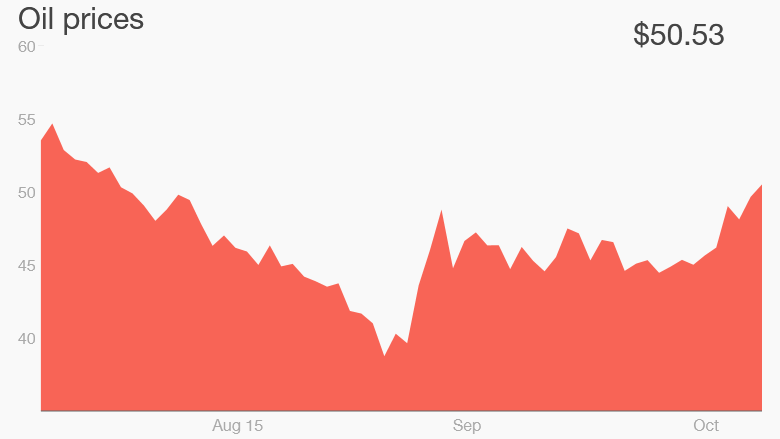
World oil prices have charged higher this week, breaking back above the psychological barrier of $50 a barrel for the first time since July.

U.S. crude futures were trading two percent higher at $50.50 early on Friday.

As recently as last month some analysts were warning of a risk that prices would collapse to $20 a barrel. What’s going on?

Here are three reasons for the bounce:

1. Geopolitical worries

Tensions in the Middle East, the biggest oil producing region, have pushed prices up.

Russia launched a military operation in Syria this week, marking the beginning of a new and closer cooperation between Moscow and the Syrian regime of President Bashar al-Assad. The West has criticized Russia for the move.

Investors are worried more violence in the region could impact production and transport. Reports of Russian cruise missiles falling short and landing in Iran haven’t helped settle their nerves.

oil friday

2. Dovish Fed minutes

Minutes of the most recent Federal Reserve meeting released Thursday showed the central bank is not in a rush to raise U.S. interest rates. The minutes weighed on the dollar — it was down 0.75% against the euro on Friday — which in turn supported global oil prices.

Oil and other commodities are priced in dollars, so a weaker dollar makes them more affordable meaning prices can rise to compensate.

3. Falling U.S. production

The U.S. Energy Information Administration said U.S. crude oil production declined by 120,000 barrels per day in September compared with August.

It said U.S. production will continue declining until the middle of next year, before growth returns in late 2016. The agency also said it expects global demand for oil in 2016 to grow at its fastest in six years — that’s also good for prices.

Oil has been under pressure in recent months, having crashed more than 50% since last summer. Prices fell to their lowest level in six and half years in August, trading below $42 a barrel.

This week’s rally has sparked hope that the market may have finally turned, but some analysts are still cautious.

“We do think that the price of oil will struggle to stay above the $60 level as this will bring on all the rigs which were switched off,” said Naeem Aslam, chief market analyst at Avatrade.

CNN

Enjoying those prices at the pump? You might not want to get used to them. A former top oil executive says the price of gas at the pump could double by the end of the year.

In an interview with CNBC, former Shell Oil President John Hofmeister predicts that U.S. oil could skyrocket from the current levels under $48 a barrel to $80 by this fall, just as consumers are getting used to the windfall from lower gas prices. That would force gas prices to double, from the current $2 to a whopping $4 by next winter.

The reason, he says, is the oil companies are masters of the simple economics of supply and demand.

“The industry is the best in the world at cutting costs when they have to reduce spending. What’s happening is we’re shutting down drilling rigs,” Hofmeister said. “Not completing the wells that have just been drilled. And we’re going to eat off the surplus oil out there probably by mid-year.”

Read MoreFuel is cheaper, so let’s hike gas tax: Former governor

Hofmeister, who ran Shell Oil USA from 2005-08, retired and foundedCitizens for Affordable Energy. The non-profit organization seeks the growth of natural gas as a transportation fuel alternative to oil.

He says U.S. producers have idled 500 rigs over the past four months as oil prices plunged. He says the result of that production slowdown eventually will be felt at the pump. This month, Baker Hughes reported that U.S. drillers had taken a record number of oil rigs out of serviceamid the price slump. Last week alone, oil rig counts tumbled by 55 to 1,366.

Five dollar a gallon gas?

A gas station advertises gasoline for $1.68 a gallon in Dellwood, Mo., Jan. 20, 2015.

Hofmeister predicts gas prices could pass the $3-a-gallon range in September and October. By December and next January, he says, gas prices will be nearing $4 a gallon.

Looking further into the future, the former oil exec sees prices rising to “$5 gasoline in the U.S. as we approach the end of the decade.”

Although the Republican-controlled Senate passed the Keystone XL pipeline this week, Washington observers say President Barack Obama is certain to veto it.

Read MoreSenate passes final Keystone bill: measure faces Obama veto

Hofmeister says the Keystone XL pipeline will have no impact on fuel prices in the near term. And he tells CNBC he doesn’t expect it to pass during Obama’s tenure.

“Whoever is the next president, Democratic or Republican, must look at the needs of the nation 20 to 30 years down the road,” he added.

While still a fossil fuel, natural gas has half of the carbon in the molecule that an oil molecule has, Hofmeister explained. “It’s a reduction in fossil fuel emissions, or carbon emissions, by switching to natural gas.”

Hofmeister sees natural gas being turned into four types of alternative fuels. “You can have ethanol and methanol for passenger cars,” he said. “CNG (compressed natural gas) and LNG (liquefied natural gas) for trucks and trains. Natgas “takes the pressure off oil. And it also ends the need for the U.S. to import oil.”

Hofmeister says that unless the U.S. reduces oil consumption, “we will face inevitable and perpetual volatility in oil, especially as we approach the end of the decade.”

CNBC
On the Money airs on CNBC Sundays at 7:30 pm, or check listings for air times in local markets.

The latest measurements confirm that the world’s oil and natural gas supplies are running out too fast. At some time between 2010 and 2020 the world’s supply of oil and gas will fall below the level required to meet international demand.

The US government is aware that we are about to endure a disastrous international energy shortage. According to Dr James McKenzie, a senior member of the climate change programme at the World Resources Institute in Washington, USA: “That’s why we went to war in Iraq.”

We always knew the world’s oil reserves would run out eventually. The oil was formed by natural geological processes which occurred over millions of years. Oil consumption presently exceeds 25 billion barrels a year and demand continues to spiral upward, out of control. The outcome is inevitable.

In the 21st Century we rely on oil (petrol) and gas for transport – cars, lorries, ships, aircraft – as well as electrical power. We cannot survive without oil and gas, and when the supply runs out the great engine of Western civilization will finally grind to a halt. We are heading for an event that will be remembered as one of the great disasters of human history, and life is going to get harder for everybody as the day of reckoning draws nearer.

In the years ahead, wars will be fought over oil and fuel as the oil-dependent superpowers struggle in vein to preserve our unsustainable way of life. We are entering a period of great change and there are be difficult times ahead. The process has already begun. Students of prophecy will be familiar with certain relevant verses from Christian scripture concerning the signs of the end times (Matt. 24.8; Mk 13.8, Rom. 8.22; Rev. 12.03, 21.1-4). As it was translated in 1961 in the New English Bible: “With these things, the birth pangs of the new age begin” (Mt.24:8; Mk.13:8). Whether you are religious or secular, you should be aware that the tide of history is turning.

In North America, where we use far more oil than anywhere else on Earth, the vast majority (71%) of electrical power generation is entirely dependent on fossil fuels – coal (52%), gas (16%), and oil (3%). The world’s natural gas is running out along with the oil, and the coal supply is not unlimited either. Nuclear energy contributes only one-fifth to the US power network, and 7% of power is hydroelectric. Only 2% of US electricity production is from renewable sources. As we continue to burning up the world’s dwindling fossil energy sources at a terrifying rate, we simultaneously unleash catastrophic damage to the natural environment.

The Insider recently reported a wave of four major electrical power outages which struck the US; then the UK; followed by Denmark and Sweden; and then Italy, Switzerland, Austria and France. The effects only lasted a few hours, but each case was the biggest power failure in the history of the affected country. These massive power cuts were separated by a matter of days. The governments were only practicing this time. This is just the beginning.

It would be prudent to pursue alternative energy sources before it is too late, but the oil corporations will never allow this to happen. So important is oil as a resource that it brings great wealth and power to those who control it. Consequently, our corrupt politicians, whose power is lavishly funded with oil money, prefer to serve the short-term interests of greedy oil executives than the long-term interests of ordinary people like you. But as long as we have food in our bellies and entertainment to keep us busy, why should we care? Thus, it is the immorality and indifference of our species that ultimately leads to our own demise.

Nothing lasts forever. Like all the great civilizations in the past, ours has a limited life-span. A few years from now the Westernized world will reach the point where there is no longer enough fuel to sustain civilization in its present form. This will literally be the end of civilization as we know it.

The Insider;

The cost of electricity has risen to a new record this month on continued slide in the value of the dollar and higher cost of fuel.

Higher fuel and IPP charges have pushed the cost of electricity up by 3.5 per cent this month after a four per cent increase in September. Together both increases mean the cost per kilowatt hour of electricity is at its highest level ever for households.

RJR News;