IT APPEARS that the Electricity Sector Enterprise Team (ESET) has identified a preferred bidder for the supply of gas to a 190-megawatt plant, which the Jamaica Public Service Company (JPS) is to build by the fourth quarter of 2017.

A member of the Portia Simpson Miller-chaired Cabinet said on Friday that the amendments being made to the Office of Utilities Regulations (OUR) Act was part of a move to ensure Jamaica is able to attract significant investment capital.

“Jamaica has found it difficult to attract investment in the baseload capacity over many years,” Mark Golding said in the Senate.

He noted that with Jamaica becoming the first non-North American Free Trade Agreement (NAFTA) country to benefit from the grant of a licence for the export of liquefied natural gas (LNG) from the United States, consideration is now being given to establish a gas hub in the country.

“It has given us a strategic advantage in establishing this regional hub, and we have gone through a process of seeking investor interest. We have had significant investor interest for the establishment of the gas terminal to supply gas to the new 190-megawatt plant that JPS will be building and also to possibly provide gas from that terminal to other users in the country and, indeed, in the region. I believe a preferred bidder has been identified,” Golding said.

He lamented the fact that despite many attempts to get LNG to Jamaica, the country has been unable to do so mainly because of uncertainty about regulation of the electricity sector.

Yesterday, Phillip Paulwell, the country’s energy minister, said an announcement is to be made shortly by ESET about the selection of two bidders – one to construct the new generation plant and the other to build the infrastructure and deliver LNG to the facility.

“It is fundamentally part of the diversification that is taking place. The price of electricity has gone down by 30 per cent already, but what we want to achieve is diversification, and we would never get back to the state where when the price of crude oil goes up, we are affected by severely high prices,” Paulwell said.

Meanwhile, Golding said in the Senate that the amended OUR Act will lead to improved investor interest. He argued that it would benefit Jamaica “by ensuring that our baseload capacity can be transformed and that we can get the investments needed”.

According to the Cabinet minister, investment in providing baseload energy requires significant spending, and investors are “not prepared to invest in this market where their pricing is set in a totally arbitrary manner by persons who are not accountable to anyone”.

Undermining Regulator’s Independence

Among the amendments set out in the new OUR bill, which has now been passed by both Houses of Parliament, are for the OUR to use certain factors in determining the rates to be paid to a utility company for the generation, transmission and distribution of electricity. Those factors include observing policy directions of the Cabinet and examining the licence of the utility provider, specifically as it relates to determining the appropriate rate of return for investment.

But opposition senators opposed the amendment, saying it was guaranteeing profit to investors and that it would undermine the independence of the regulator.

“The OUR will no longer be able to call itself independent,” Kamina Johnson Smith said, as she raised concerns about a possible overreach of the executive.

“We will no longer be able to truthfully state, as a fact, that we can boast of having an independent regulator,” she added.

“It is anti-transparency, anti-investor and anti-people of Jamaica,” Johnson Smith charged.

But Golding said she has misunderstood the intent of the bill and said further that getting cheaper energy for Jamaica hinges, in part, on the provisions in the bill. He argued also that Cabinet has a most important role in the process and thus it “cannot totally drop its hands in the face of a dysfunctional regulatory system that is denying the country effective” solutions to lower energy prices.

“We cannot divest, in the name of independence, to unaccountable bureaucrats, the ability to stymie investment through either their own incompetence or whatever may be the problem. We have suffered under that system,” Golding added.


The Gleaner 

EXTREME weather events associated with climate change have cost the country in excess of $128 billion in damage over the decade between 2002 and 2012.

Minister of Land, Water, Environment and Climate Change Robert Pickersgill made the startling revelation at the launch of the Adaptation Programme and Financing Mechanism at the Four Seasons Hotel in New Kingston recently.

“This covers a range of damage ranging from social dislocation and loss of property and lives, to which a dollar value could not be affixed,” said Pickersgill.

The adaptation programme, which falls under the Pilot Programme for Climate Resilience (PPCR), and which is funded by the InterAmerican Development Bank (IDB) to the tune of US$7.8 million under the global Climate Investment Funds (CIF), will increase the country’s resilience to climate change by enhancing the island’s adaptive capacity across priority sectors.

He said it was common knowledge that Jamaica is among the most vulnerable nations to the impacts of climate change. He noted, however, that with the relevant training, policies and national education, the phenomenon which threatens hotter temperatures, rising sea levels, longer, drier droughts and more extreme weather events, will become less of a challenge. The goal, Pickersgill said, is a Jamiaca that is climate change resilient and focused on its sustainability.

“We envision a future that is climate resilient; one where economic development and environmental sustainability are parallel outcomes, and one in which every Jamaican man, woman and child can enjoy the benefits of this,” the minister said.

“What the PPCR will provide, therefore, is an opportunity to build our capacity, and to look beyond weather and hydrological information to a focus on climate information for decision-making,” he continued.

The technical co-operation project valued at over US$19 million will include the mainstreaming of climate change adaptation in local sectorial and national plans.

IDB Country Reperesentative Therese Turner-Jones said Jamaica could access up to US$10 million as the facility allows for a concessional loan-financing window.

“The three-component programme will include mainstreaming climate change into development planning, supporting climate change resiliency efforts in the upper Rio Minho watershed area, and implementing innovative climate financing, particularly in the agribusiness and tourism sectors across island for SMES [small and medium-sized enterprises]. The lessons learned from these adaptation interventions will be disseminated throughout the island,” Turner-Jones said at the launch.

The Planning Institute of Jamaica (PIOJ), which is the national implementing organisation, reiterated the government’s pleasure that the island was selected among six Caribbean regional PPCR and pilot countries.

Deputy Director General Claire Bernard said the pilot programme could fulfil outcome 14 of Vision 2030, which speaks to effecting strategic objectives to addressing issues of climate change, adaptation and disaster risk production.

In terms of integrating climate change as a subject and policy objective across all ministries of government, minister Pickersgill pointed out that training for policy-makers and climate change focal points across all ministries has already begun.

Jamaica Observer

Venezuela announced Saturday that its state-owned oil company will buy a 25 per cent stake in West Indies Oil Company and that it will establish a regional bank with the Antigua & Barbuda government to fund a new resort.

The announcement came during a visit to Antigua by Venezuelan President Nicolas Maduro, who was on a whirlwind weekend Caribbean tour that included stops at three other nations – Suriname, St Lucia and Grenada. He was meeting with their leaders to discuss economic and social development initiatives.

Venezuelan officials said the regional bank would finance the new Simon Bolivar Resort Hotel and other development projects using resources generated by the PetroCaribe program, which provides low-cost oil financing to Caribbean and Central American countries and invests in social development projects.

Just The Beginning

Executives at Venezuela’s state oil company, Petroleos de Venezuela SA, said the purchase of a stake in West Indies Oil Company was just the beginning of “joint investments” between the countries.

The Caribbean nations visited by Maduro are members of the PetroCaribe programme, which critics say has lost effectiveness with the drop in oil prices. Last March, Barclays analysts estimated Venezuela had cut the program’s daily oil shipments in half, to 200,000 barrels from 400,000.

Maduro defended the programme Saturday, saying Venezuela is looking to increase cooperation with its Caribbean neighbours.

“PetroCaribe is a reality and it is our starting point, our foundation to build a powerful economic zone,” Maduro said.

Antigua & Barbuda Prime Minister Gaston Browne said that he and Maduro “agreed to work in various areas of cooperation”.


The Gleaner

A new law recently passed in France mandates that all new buildings that are built in commercial zones in France must be partially covered in either plants or solar panels.

Green roofs, as they are called, have an isolating effect which helps to reduce the amount of energy needed to heat a building during the winter or cool it in the summer. They are capable of retaining rainwater and reducing problems with runoff, and also offer birds a place to call home in the urban jungle.

French environmental activists originally wanted to pass a law that would make the green roofs cover the entire surface of all new roofs.

However, partially covered roofs make for a great start, and are still a huge step in the right direction.

Some say the law that was passed is actually better, as it gives the business owners a chance to install solar panels to help provide the buildings with renewable energy, thereby leaving even less of a footprint.

Green roofs are already very popular in Germany and Australia, as well as Canada’s city of Toronto! This  by-law was adopted in 2009, by the city of Toronto which mandated green roofs on all new industrial and residential buildings.

Benefits of Green Roofs

There are so many benefits to green roofs. Here are just a few:

  • Adding natural beauty and major aesthetic improvement to buildings, which in turn increases the investment opportunity.
  • Helping contribute to landfill diversion by prolonging the life of waterproofing membranes, using recycled materials, and prolonging the service of heating, ventilation, and HVAC systems through decreased use.
  • Green roofs assist with storm water management because water is stored by the substrate, then taken up by plants, and thus returned to the atmosphere through transpiration and evaporation. They also retain rainwater and moderate the temperature of the water and act as natural filters for the water that does run off. They delay the time at which runoff occurs, which results in decreased stress on sewer systems during peak periods.
  • The plants on green roofs do a great job of capturing airborne pollutants and other atmospheric deposition. They can also filter noxious gasses.
  • They open up new areas for community gardens, commercial and recreational space in busy cities where this space is generally quite limited.

France is definitely on the right track, but it should be a mandate that all new buildings being built in North America, and even worldwide, adopt this amazing idea to reap all of the potential benefits.


CS Globe

So much for even cheaper gas!

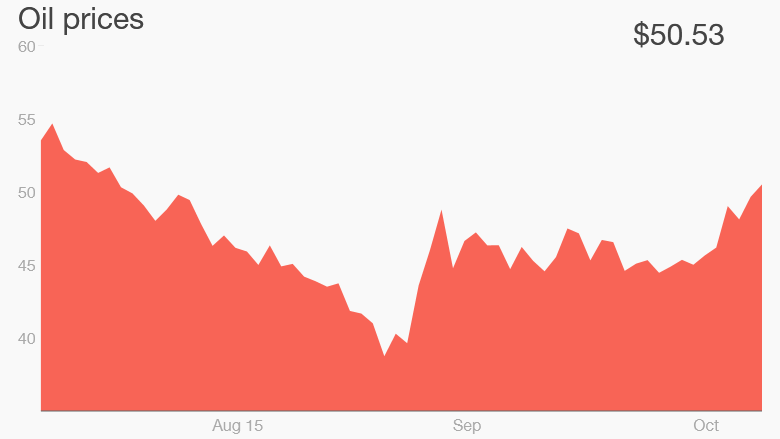
World oil prices have charged higher this week, breaking back above the psychological barrier of $50 a barrel for the first time since July.

U.S. crude futures were trading two percent higher at $50.50 early on Friday.

As recently as last month some analysts were warning of a risk that prices would collapse to $20 a barrel. What’s going on?

Here are three reasons for the bounce:

1. Geopolitical worries

Tensions in the Middle East, the biggest oil producing region, have pushed prices up.

Russia launched a military operation in Syria this week, marking the beginning of a new and closer cooperation between Moscow and the Syrian regime of President Bashar al-Assad. The West has criticized Russia for the move.

Investors are worried more violence in the region could impact production and transport. Reports of Russian cruise missiles falling short and landing in Iran haven’t helped settle their nerves.

oil friday

2. Dovish Fed minutes

Minutes of the most recent Federal Reserve meeting released Thursday showed the central bank is not in a rush to raise U.S. interest rates. The minutes weighed on the dollar — it was down 0.75% against the euro on Friday — which in turn supported global oil prices.

Oil and other commodities are priced in dollars, so a weaker dollar makes them more affordable meaning prices can rise to compensate.

3. Falling U.S. production

The U.S. Energy Information Administration said U.S. crude oil production declined by 120,000 barrels per day in September compared with August.

It said U.S. production will continue declining until the middle of next year, before growth returns in late 2016. The agency also said it expects global demand for oil in 2016 to grow at its fastest in six years — that’s also good for prices.

Oil has been under pressure in recent months, having crashed more than 50% since last summer. Prices fell to their lowest level in six and half years in August, trading below $42 a barrel.

This week’s rally has sparked hope that the market may have finally turned, but some analysts are still cautious.

“We do think that the price of oil will struggle to stay above the $60 level as this will bring on all the rigs which were switched off,” said Naeem Aslam, chief market analyst at Avatrade.

CNN

With the emergence of what he calls ‘a new climate regime’, physicist Dr Michael Taylor has painted a picture of a Jamaica and Caribbean region that supports the case for an ambitious deal at the international climate talks set for Paris in December.

“The number of warm days everywhere in the Caribbean is increasing. Over the last 50 years, we have been steadily having more warm days. And we are having more warm nights. This is the kind of new regime we are entering into,” he told a workshop on the Third National Communication and Biennial Update Report to the United Nations Framework Convention on Climate Change (UNFCCC), held at the Mona Visitors’ Lodge last Tuesday.

Taylor noted that what was also indicative of the new regime and would become entrenched is rainfall variability and a drying trend resulting in a reduction of seven to eight per cent in the length of the rainy season and an increase of six to eight per cent in the length of the dry season.

“When we look at the future climate for Jamaica, temperatures keep going up and, from the best case scenario to the worst case scenario, the present research suggests it’s between one and 3.6 degrees Celsius by end of century. Thirty to 98 per cent of days annually will be considered ‘hot’ by the 2090s and only two per cent ‘cool’ by the 2080s,” revealed Taylor, the head of the Climate Studies Group Mona.

At the same time, he said there would be even higher sea levels, alluding to the Intergovernmental Panel on Climate Change’s Fourth Assessment Report (2007), which projects an increase of up to 59 centimetres by 2100.

Key Things To Know

The situation, the physicist said, is one where there are three key things to know – the first is that “our sensitivity is being exposed”.

At the same time, Taylor added, “our vulnerability is being expanded” with the “vulnerability of sectors and areas of Caribbean life, which were veiled because of their secondary linkages also emerging and at a faster pace. New vulnerable groupings are also emerging as a result of an expanded exposure to the climate threat”.

Those vulnerable groupings include flora and fauna, outdoor workers, asthma sufferers, the elderly and the young, as well as those physically challenged, in addition to cultural assets and small-business owners.

“And that will continue,” he predicted.

Ultimately, Taylor said, “our viability is being endangered” and one needs look no further than the impact of the hurricane events of the last decade”.

In 2004, for example, Hurricane Ivan cost some eight per cent of gross domestic product (GDP) while Hurricane Dean cost the island some 3.5 per cent of GDP in 2007.

“You can’t have an impact of eight per cent in GDP and a recurring impact on your economy, and your capacity to continue developing as a nation not be impacted,” Taylor cautioned.

The situation is one, he said, that warrants “urgent, decisive, inclusive and considerate” action at the national level.

The island’s climate negotiators to the United Nations are intent on such action at the international level, as efforts to eke out a favourable deal in Paris get into high gear.

Among other things, Jamaica has joined the Alliance of Small Island States (AOSIS) in calling for a limit on global warming to 1.5 degrees Celsius above pre-industrial levels and not the two degrees currently on the table.

Steep Emission Cuts

This negotiating position is one that would require steep greenhouse gas-emission cuts from developed as well as fast-developing countries. But Jamaica and AOSIS negotiators say this is critical for the “survival of small island states”, according to a document circulated by the Climate Change Division (CCD), at a recent journalist workshop hosted by Friedrich Ebert Stiftung.

Jamaica also wants universal participation in the climate deal, “along with robust means of ensuring transparency of action and support”.

It wants, too, to ensure that a framework exists to deal with loss and damage.

“There are limits to the impacts that we can adapt to, so loss and damage must be included as a central element of the 2015 agreement – one that is distinct and separate from climate change as it represents irreversible and permanent damage”, the document noted.


The Gleaner

While the Pan Caribbean Sugar Company (PCSC)-owned Monymusk and Frome sugar factories are now ready to supply electricity to the national power grid, their delivery of the service is being held back by procedural matters, including the need for an operational licence.

“We have made some progress, but we still have some way to go in our discussions with the Office of Utilities Regulation (OUR) and the Jamaica Public Service (JPS) regarding a licence and a power-purchase agreement,” Delroy Armstrong, a senior assistant to the CEO of the PCSC, told The Gleaner yesterday.

While the Government has been quite vocal in stating a desire to see more private suppliers start selling electricity to the national grid, it would appear the PCSC, which is a subsidiary of the Chinese COMPLANT group, has been in a state of readiness for quite some time.

“I cannot give you the numbers right now, but we have realised significant savings from this investment. It has allowed us to become self-sufficient to the point that we have excess energy that we are now offering to sell to the national grid,” said Armstrong, in explaining the situation at Monymusk and Frome.

However, despite the state of readiness of the two factories, Armstrong was not able to say how soon they will begin to supply electricity to the national grid. In fact, he thinks it might not be anytime soon.

“If we get permission and come to an agreement with JPS, there will be other infrastructure that we will have to put in place, so it is not safe for me to give you a timeline for this to be a reality,” said Armstrong.

As part of its drive towards efficiency, the PCSC installed new 75-ton boilers at its Monymusk and Frome facilities. It has also installed two generators that produce 10 and five megawatts, respectively, at each location.

The energy being produced by the factories comes from bagasse, which is the fibrous matter that remains after sugar cane is crushed to extract juice, and is considered to be a biofuel. It is also frequently used as a primary fuel source for sugar mills. When burnt in quantity, it produces sufficient heat energy to supply all the needs of a typical sugar mill, with energy to spare.

The PCSC has been pushing for at least five per cent of off-season bagasse-based energy to be passed on to the national grid and projects that, making use of the process after the sugar season, the 10-megawatt generator could be used to develop bagasse into fuel within the next three years.

Solar power, even after the sun goes down? A new utility-scale solar project with battery storage will supply power to the island of Kauai, Hawaii in the evening hours of 5-10 p.m., helping to meet peak demand after sunset while reducing greenhouse gas emissions.

In 2016, SolarCity will construct a 17-megawatt photovoltaic solar array on 50 acres adjacent to an existing power plant owned by Kauai Island Utility Cooperative (KIUC). The installation will include a 52-megawatt-hour battery system. SolarCity will sell power from the project to KIUC under a 20-year power-purchase agreement.

“The most interesting thing about this project is that it’s firm solar power,” said Peter Rive, founder and CTO of SolarCity. “That’s a new and important class of utility-scale solar power system. The batteries will store all the energy produced by the solar array, and then dispatch it to the grid as needed.”

Under the agreement, KIUC will purchase power for 14.5 cents per kilowatt-hour — considerably less than the utility currently pays for comparable diesel generator capacity. Furthermore, KIUC noted that this is “only slightly more than the cost of energy from KIUC’s two existing 12-megawatt solar arrays, whose output is available only during the day.”

Rive explained that KIUC will commit to drawing a certain amount of power from the battery, but that the utility will be billed only at the time it draws power.

“KIUC has been investigating energy storage options for more than two years, and price has always been the biggest challenge,” said David Bissell, president and CEO of KIUC. “This is a breakthrough project on technology and on price that enables us to move solar energy to the peak demand hours in the evening and reduce the amount of fossil fuel we’re using.”

The cost of battery storage has been dropping steadily in recent years, but it’s still fairly pricey. Hawaii has the nation’s highest power costs, so that improves the economics of large-scale battery storage there. But Rive notes, “SolarCity is not subsidizing the cost of this system. We’re making good enough money on this, and it’s also a good deal for KIUC.”

The clock is ticking, however. At the end of 2016, the federal solar Investment Tax Credit (ITC) drops from 30 percent to 10 percent. To qualify for the ITC, construction work must begin by April 2016 and the project must be producing power by December 31, 2016. KIUC has requested accelerated approval from the Hawaii Public Utilities Commission, and SolarCity confirmed that the battery storage system and solar array will be eligible for the credit.

Siting the solar project next to an existing KIUC power plant will greatly reduce the cost and complexity of grid interconnection, Rive said. “So much of the fixed gear is already there, and we won’t have to build long transmission lines.”

Serving a large amount of load from batteries is expected to provide power quality advantages, particularly frequency support. This can be a considerable benefit for a co-op that serves a widely dispersed and largely rural customer base.

The manufacturer of the battery has not yet been selected, but Rive says Tesla is a leading contender. “We think their technology is ahead of the pack for this kind of application.”

This is the second utility-scale solar project that SolarCity has built for KIUC. A year ago, the utility commenced operation of a 12-megawatt solar farm on Kauai, which supplies about 5 percent of the island’s annual electricity needs.

Utility-scale solar farms with battery storage might help Kauai avoid some of the problems that the neighboring island of Oahu has experienced due to the surge in rooftop solar deployment. Recently, the stability of Oahu’s distribution grid has been challenged by solar, as 13 percent of residents there have PV systems installed on their homes.

Greentech Media

It isn’t officially autumn until September 23, but summer pretty much feels like it’s over. When it comes to energy news, it feels like summer was hardly here at all.

The White House certainly didn’t slow down, announcing the final version of theClean Power Plan rule on August 3. President Obama then traveled to Nevada, where he unveiled a plan to accelerate the use of PACE loans and announced $1 billion in new loan authority available for clean-energy projects.

Congress took a summer recess, but returned to the Capitol Building after Labor Day with a full slate of energy legislation to consider. Among the items is a tax extenders bill with language to extend the wind Production Tax Credit that’s now pending a full Senate vote. Also, both the House and Senate are consideringbipartisan pieces of energy legislation that address everything from the electrical grid to pipelines, energy efficiency to hydropower.

At the state level, solar continues to be a hot policy topic. Florida in particular is seeing increased activity around two competing solar ballot initiatives, where the divide between utilities and distributed solar advocates has proven to be more prominent than political differences.

More on Florida and energy news from the Southeast, West, Midwest and Northeastbelow. (You can find our last state dispatches post here.)

Southeast

Florida

A brewing debate over whether or not to allow for third-party solar financing in Florida has intensified in recent weeks.

On September 1, the Florida Supreme Court heard arguments for and against the language of a 2016 ballot initiative to open up the state’s solar market. Floridians for Solar Choice, a free-market group spearheading the initiative, argues that the constitutional amendment is necessary to allow more consumer choice when it comes to buying and selling energy in the Sunshine State. Florida is currently one of only four states where laws expressly prohibit citizens and businesses from buying solar power directly from an entity other than an electric utility.

A wide range of stakeholders from more than 50 organizations has come out in support the ballot initiative. The coalition has collected more than 225,000 petition signatures to date; nearly 140,000 have been verified by Florida’s Division of Elections.

Opponents have put forward a rival ballot being championed by Consumers for Smart Solar, a group supported by Florida’s electric utilities, as well as the Florida Hispanic Chamber of Commerce, the National Black Chamber of Commerce, and the 60 Plus Association. Several of these groups have ties to the Koch brothers, according to a funding investigation by the Energy and Policy Institute.

“We’re interested in how utilities are funding efforts to stop the adoption of rooftop solar,” said Gabe Elsner, executive director of E&PI. “This Florida case is a perfect example where there is an effort to increase the ability for homeowners and businesses to install solar, and sure enough, the utilities are against it, going far enough to create an alternative ballot that does essentially nothing but confuse the issue for voters.”

On Sept. 10, Consumers for Smart Solar announced it had collected 100,000 signatures, enough to trigger a review by Florida’s Attorney General and the Florida Supreme Court. The group says its proposed amendment would allow consumers to own and lease solar, while also ensuring that everyone who uses the grid pays for it and that out-of-state solar utilities are not constitutionally immune from state and local consumer protection laws.

Both camps have released polls showing support for their respective amendments. The initiatives will each need a total of 683,149 signatures by February 1, 2016 in order for their amendments to be considered in the November election.

In other news, Florida Power & Light has filed a request with the Florida Public Service Commission to reduce electricity rates in 2016. The proposal will save a typical 1,000-kilowatt-hour residential customer about $2.50 a month on average next year, compared to 2015 rates. Separately, the Canadian power producer Emera Inc. announced it’s making a big bet on the U.S. power market with plans to buy Florida generator Teco Energy Inc. for $6.5 billion.

North Carolina

Later this week, lawmakers in North Carolina will vote on a state budget that does not extend the state’s 35 percent tax credit for solar and other clean technologies, to the disappointment many supporters of the measure. The credit is now set to end on December 31. A bill that would have frozen the North Carolina’s renewable portfolio standard at 6 percent, instead of progressing to 12.5 percent by 2021, hasn’t seen any action in four months.

Meanwhile, solar deployments continue to grow in the state. Duke Energy recently announced it is on track to more than double its North Carolina solar portfolio this year, with 160 megawatts of new solar projects in 2015.

South Carolina

Sunrun launched a lease product in South Carolina on Sept. 9, adding to the company’s purchase and loan options introduced in June. South Carolina’s Office of the Regulatory Staff began accepting applications from solar leasing companies in August, stemming from the Distributed Energy Resource Program Act (A236) signed into law last year.

In carrying out Act 236, the state PSC approved solar incentive programs from South Carolina’s investor-owned utilities, Duke Energy and South Carolina Gas & Electric, this spring. The law also requires regulatory staff to issue a report on cost-shifting associated with distributed energy by the end of the year. Public comments are currently being accepted through Sept. 15.  

Alabama

On Sept. 1, the Alabama Public Service Commission approved Alabama Power’srequest to build 500 megawatts of renewable energy capacity. The utility said the decision will help Alabama Power meet the demands of large customers, primarily Fortune 500 companies and military facilities with renewable energy mandates. These customers would pay a premium for the power, so that costs are not transferred to the broader rate base.

The commission made several changes to the original proposal, including a biennial competitive bidding process for projects, the approval of no more than 160 megawatts of projects per year, and a PSC vote on whether or not to approve each project. Alabama Power had no objections to the changes. Clean-energy advocates were also supportive of the outcome, including the Solar Energy Industries Association, which noted that there are just 2 megawatts of solar installed in Alabama today.

“Our neighboring states may have a head start in realizing the environmental and economic benefits of renewable energy, but Alabama can use this opportunity to catch up and spur growth in this booming marketplace,” said Keith Johnston of the Southern Environmental Law Center.

Virginia

On Sept. 2, Governor Terry McAuliffe launched a $20 million loan program to lower financing costs for energy efficiency, renewable energy generation, and alternative fuel projects. According to a recent report, Virginia currently ranks 30th in solar power deployments.

Washington, D.C.

In a major turn of events, the D.C. Public Service Commission denied Exelon’s $6.8 billion takeover of Pepco Holdings on Aug. 25.  A strong grassroots movementhelped to thwart the deal, but Exelon and Pepco have vowed the battle isn’t over yet. The utilities have 30 days from the ruling to appeal the decision. Five states have already approved the merger.


West

California

Lawmakers in California passed a bill last Friday targeting a 50 percent renewablesenergy mix by 2030, and a 50 percent increase in building energy efficiency by the same year. Controversial language that would have required a 50 percent reduction in oil use in the state was ultimately struck from the legislation.

The legislature also passed a bill to divest from coal (SB 185), as well as a resolution in support of extending the federal tax credit for solar energy systems; SJR 10 calls on Congress to extend the 30 percent tax credit for residential and commercial solar projects.

In utility news, the CPUC announced on Aug. 28 that it has launched a formal investigation to determine whether PG&E’s “organizational culture and governance prioritize safety and adequately direct resources to promote accountability and achieve safety goals and standards.” The investigation stems from a fatal 2010 pipeline explosion. The CPUC also issued a citation to PG&E for $50,000 for the utility’s failure to safely maintain its Metcalf Substation in San Jose, which was burglarized the night of Aug 26. Meanwhile, regulators have required SCE toinvestigate the cause of several recent outages.

Nevada

NV Energy has filed a proposal with the state PUC to launch a community solar subscription program, the Reno Gazette-Journal reports. The energy will come from two 5-megawatt solar farms and will be available to consumers in 100-kilowatt blocks. Customers will have to pay a premium for the power, but in return will get to go solar without signing a long-term contract or paying for anything upfront.

The proposal comes shortly after the PUC voted to extend the state’s existing solar net-metering policy through the end of year, as the commission debates the future of the program. A week earlier, NV Energy announced the state had hit its 235-megawatt net metering cap, which sparked a backlash from solar advocates. Vivint Solar suspended operations in the state a few weeks prior to the decision amid the policy uncertainty.

NV Energy filed an alternative solar policy with the PUC in August that would have reduced the value of net metering credits and added new fees on solar customers. The interim rate is not what the utility proposed, but that could change in 2016. The Nevada PUC is required to decide on a permanent net-metering structure by December 31.

As the value of solar debate played out in the Nevada PUC last month, it also played out on stage in a debate at Sen. Harry Reid’s National Clean Energy Summit. In addition to rolling out new energy incentives, President Obama criticized lobbying efforts from the Koch brothers and others in his keynote address at the event, accusing them of “standing in the way of the future.”

Arizona

In late August, the Arizona Corporation Commission approved a motion from Tucson Electric to hold off on any changes to solar net metering until the utility’s 2016 rate case. The move came in sharp contrast to a decision made two days earlier, in which the ACC said it would start hearings this year on a proposal to raise fees on solar customers from Arizona Public Service. APS is seeking to increase its solar fee from roughly $5 per month to $21 per month.

Commissioner Doug Little, who was elected last year, said that holding hearings on the APS fee increase request does not guarantee it will be approved, The Arizona Republic reports. Little also filed an amendment to study whether or not there is a cost shift from solar to non-solar customers.

Meanwhile, the attorney general’s office is investigating allegations of overly friendly ties between ACC commissioners Bob Stump and Gary Pierce and APS. On Sept. 2, a separate complaint was filed against ACC Chairwoman Susan Bitter Smith for her previous work as a lobbyist. Amid the controversy, the solar advocacy group The Alliance for Solar Choice has committed to staying out of the ACC’s 2016 elections, and has invited utilities to do the same.

New Mexico

On Sept. 14, New Mexico Gov. Susana Martinez unveiled an “all-of-the-above” energy policy designed to support the development of oil, natural gas and coal, as well as low-carbon energy resources. The plan includes reducing soft costs for renewable projects through improved permitting, pursuing energy storage development, and possibly raising New Mexico’s renewable portfolio standard. 

Separately, the Santa Fe-based group New Energy Economy filed a motion with the New Mexico Public Regulation Commission in early September, seeking to prevent four of the five commissioners from making decisions related to one of the state’s coal-fired power plants. The group has accused the commissioners of having close ties with utility executives based on 100 pages of text messages and emails. The first hearing on the Public Service Co. of New Mexico-owned coal plant is scheduled for Oct. 13.

Alaska

After his appearance in Nevada, President Obama made his way north to Alaska where he called for urgent action to address climate change. The Obama administration said it plans to launch a $4 million renewable energy initiative for remote Alaskan communities. Shortly before the president’s trip, the federal government gave Royal Dutch Shell final approval to drill for oil in the Arctic Ocean off Alaska’s northwest coast.

Washington

Washington state recently passed a $40 million extension to the state’s Clean Energy Fund. As part of the implementation process, the Department of Commerce will soon convene two advisory panels, one for electric utilities and one for clean-energy research and development. The panels are expected to hold public meetings through September to determine how to distribute the funds.

Colorado

On Aug. 26, the Colorado PUC voted to uphold net metering in its current form, despite calls for change from the state’s largest electric utility, Xcel Energy. Separately, Colorado Attorney General Cynthia Coffman announced her state will join a multi-state suit against the Clean Power Plan.

Hawaii

NextEra Energy recently offered to make 50 new commitments to Hawaiian electricity customers as part of the Florida-based company’s $4.3 billion proposal to buy out Hawaiian Electric Industries. Promises include a commitment to Hawaii’s100 percent renewable energy target, new spending on smart grid technology, and nearly $1 billion in customer savings. 

In July, Hawaii Gov. David Ige told the Honolulu Star-Advertiser that he opposes the acquisition, and is recommending that the PUC reject it. More than 40 state and county leaders have come together to explore whether a public utility ownership option is a viable alternative.

While opposition is strong, the two utilities are taking steps to move the merger forward. The commission will hold several public meetings on all islands over the next two months. A final decision is expected by June 2016.

Midwest

Ohio

On August 31, the Ohio PUC held its first hearing on FirstEnergy’s rate case that would require customers at the holding company’s three distribution utilities — Ohio Edison, Cleveland Electric Illuminating, and Toledo Edison — to purchase power from two of its struggling power plants for the next 15 years.

FirstEnergy claims the two plants — a large, old coal plant in Stratton, Ohio and a large, old nuclear plant on Lake Erie — need to stay open to maintain grid reliability and energy affordability. The company has admitted that electricity costs may rise in the near term, but estimates the deal will save ratepayers $2 billion over the 15-year period.

However, according to the Ohio Consumers’ Counsel, the deal would cost ratepayers $3 billion over the lifetime of the agreement. FirstEnergy’s consultant also admitted at the hearing that future wholesale energy costs were overestimated in the utility’s forecast, undercutting the credibility of the utility’s plan.

In addition to costs, there are concerns about PUC oversight. Environmental groups and competitive energy providers Dynegy and AEP are also opposed to the FirstEnergy deal. Earlier in the year, PUCO rejected similar “bailout” proposals from Duke and AEP.

As hearings on the FirstEnergy proposal continue through fall, Ohioans will also debate the future of the state’s stalled renewable portfolio standard. Legislationpassed last year put a two-year freeze on the RPS. Ohio’s Energy Mandates Study Committee now has until September 30 to decide how the state should proceed.

A broad coalition of state business, health, community and environmental groups has come out in support of lifting the freeze. Advocates say lifting the RPS will help Ohio comply with the Clean Power Plan. Many lawmakers are against the RPS, however. Meanwhile, Ohio is already in litigation challenging the new federal rules.

Michigan

Michigan officials recently announced they plan to develop their own compliance strategy for the EPA’s Clean Power Plan, as opposed to letting the federal government devise a plan for the state. The decision has received support from a broad group of energy stakeholders.

The final EPA rule gives states until 2018 to file their carbon reduction plans, and until 2022 to begin making emissions cuts. Michigan will need all of the time allotted in order to comply, said Valerie Brader, executive director of the Michigan Agency for Energy, on a recent call with reporters. “We’re not filing anything early,”she said.

Republican Gov. Rick Snyder’s administration is preparing to comply with the rule in part by raising Michigan’s 10 percent renewable energy target through voluntary measures. Meanwhile, Attorney General Bill Schuette has joined a lawsuit trying to block the federal plan. Brader said that Schuette is acting alone, and that the governor’s office does not plan to join the challenge.

Work also continues in the Michigan state legislature, where a bipartisan group of lawmakers recently introduced a package of bills, dubbed the “Energy Freedom bills,” to lift the cap on the state’s net metering program and allow consumers to buy shares of a community renewable energy project.

Another set of bills in the package would establish fair value pricing, which “ensures that homeowners and businesses get paid what utility companies would pay themselves for producing renewable energy,” according to the bill sponsors. Under the bill, the Michigan Public Service Commission would come up with a methodology that “accounts for the value of the renewable energy, its delivery, generation capacity, transmission capacity, transmission and distribution line losses, environmental value, and other values that are not always considered in current energy prices.”

The Energy Freedom legislation comes in response to a separate bill (SB 0438) that would eliminate net metering in Michigan. The proposal has received support from utilities and several Republicans, but is opposed by solar customers and Tea Party member Rep. Gary Glenn, who is a sponsor of the Energy Freedom bills.

Wisconsin

The Wisconsin PSC will hold public hearings Sept. 16 and Oct. 29 on Xcel Energy’s request to increase electric revenues by 3.9 percent and natural gas by 5 percent. The utility has proposed to lower the cost of electricity, while more than doubling the flat monthly service fee on about 255,000 non-industrial customers.

Meanwhile, the renewables industry is far less than thrilled with Governor Scott Walker’s record on wind and solar, which has put the state well behind its neighbors on clean energy deployments, Bloomberg reports. Walker, a Republican presidential hopeful, also opposes the Clean Power Plan. Sen. Ron Johnson opposes the CPP, too. The League of Conservation Voters and EDF Action launched a $1.6 million ad campaign in Wisconsin on Sept. 1 to urge Sen. Johnson to end his opposition to the CPP, with the U.S. Senate expected to consider votes on the EPA’s plan this month.

Illinois

Exelon’s nuclear fleet in Illinois has cleared PJM’s most recent capacity auction, throwing a lifeline to the utility’s troubled Quad Cities and Byron plants, the Quad-City Business Journal reports. The decision allows the nuclear plants to sell power into the wholesale power market until 2017. Exelon has said it will need to keep all of its Illinois nuclear plants in operation in order to comply with the EPA’s new carbon regulations, and is pushing for a “low-carbon portfolio standard” in the state.

Iowa

In late August, Pella Cooperative Electric withdrew plans to impose an additional $57.50 monthly fee on solar customers, which would have resulted in one of the highest fixed rates in the country. Pella sent a letter to its 3,000 members in June notifying them that the fixed rate increase would apply to anyone who installed solar after Aug. 15. The co-op eventually backed down under pressure.

Kansas

The Kansas Corporation Commission gave Westar Energy the green light for a $78 million rate increase on nearly 700,000 customers, which is half of what the utility initially sought. Regulators also postponed consideration of a special charge on solar customers, but plan to address it in a future hearing. In the meantime, potential solar customers have been put on notice that the rules could change. National solar installers have been barred from intervening in the solar policy docket.

Northeast

Maine

In response to a factory closure, Governor Paul LePage sent a letter to Maine’s legislative leaders in late August calling on them to reform the state’s “obsolete and costly energy policies.” LePage put forward three pieces of legislation last session that he criticized lawmakers for not passing, including a bill (LD 1987) that would have eliminated both the state’s renewable portfolio standard and net metering program. That bill passed in the Senate, but died in the House in June. The state legislature ultimately passed a bill (LD 1263) that sets the stage to replace the current net energy metering policy with an innovative alternative.

New Hampshire

SolarCity has expanded its New Hampshire presence with a new operations center in Manchester. Gov. Maggie Hassan attended the opening on Sept. 9. The center is SolarCity’s first in the state, after launching a New Hampshire service in April.

The expansion has renewed questions about the future of New Hampshire’s renewable energy incentives. Liberty Utilities hit its net metering cap in July, and other utilities are approaching their limits. At the SolarCity opening, Gov. Hassan said her office will “take a look at that issue.” Meanwhile, the PUC has put allrenewable energy rebates on hold after the state’s renewable energy fund brought in less revenue than expected. The programs are expected to reopen, albeit with decreased incentives, once the PUC sets a 2016 budget.

Massachusetts

Policymakers in Massachusetts are grappling with how to develop a sustainable solar policy with the state’s net-metering cap fast approaching. National Grid already hit its cap in March, generally making solar projects less economical. 

The Democratic-led state senate passed a bill before the summer recess in July to lift the net metering cap until Massachusetts reaches its target of 1,600 megawatts of installed solar. In August, Gov. Charlie Baker introduced a separate bill that would raise the cap for all solar projects in the interim, and eventually reduce compensation for large municipal projects. A robust debate is expected in the legislature, now that lawmakers have returned.

Also in August, Massachusetts utilities Eversource Energy, National Grid and Unitil filed grid modernization plans to reduce energy costs, boost resiliency and improve the integration of distributed resources, EnergyBiz reports.

Unitil plans to spend $12 million to become more of an “enabling platform.” Eversource has proposed a $430.7 million, five-year plan with four main components: grid-wide situational awareness, advanced analytics, real-time flexibility and distributed generation integration. National Grid presented four options that range from $225.3 million over five years, up to $1.3 billion over 10 years. All three utilities will offer optional time-of-use rates for customers.

New York

Stakeholders in New York continued to work on the Reforming the Energy Visionproceeding through the summer. On August 18, the Market Design and Platform Technology Working Groups filed their final report with the New York State Department of Public Service as staff develop guidance for New York utility Distributed System Implementation Plans.

Also under the REV umbrella, NYSERDA announced Donovan Gordon will lead efforts to expand renewable heating and cooling markets in New York, and Gov. Cuomo has announced the state’s first large-scale anaerobic digester project on Long Island.

New Jersey

Governor Chris Christie has filed a letter with the EPA seeking a stay of implementation and reconsideration of the Clean Power Plan, calling it “unlawful” and “fundamentally flawed.” Christie’s office said New Jersey is the first “clean energy” state to file an objection to the rule.

Action against the CPP comes shortly after Christie upheld a law to expand New Jersey’s net metering caps, and as state leaders work to update New Jersey’s 2011 Energy Master Plan. Several stakeholders pushed for a higher renewable energy targets at a public hearing on Aug. 17.

Separately, the Bureau of Land Management has confirmed it will host an offshore wind auction this fall for sites off the coast of New Jersey. The 344,000 acres available for leasing could support up to 3.4 gigawatts of commercial wind generation.

Greentech Media

Jamaica is to benefit from a US$20-million pilot climate-change adaptation programme to be funded mainly by the Inter-American Development Bank (IDB), which will be implemented by the Ministry of Land, Water, Environment and Climate Change, working with selected, allied state agencies and non-government organisations.

The overall objective is to increase Jamaica’s resilience to climate change, by enhancing the country’s adaptive capacity across the priority sectors of water, health, tourism, coastal resources and human settlement. It will be financed by a loan of US$10 million, at interest rate of 0.025 per cent per annum, and a grant of US$7.89 million from the Climate Investment Fund through the IDB, with counterpart financing of US$1.97 million from the Jamaican Government.


Increasing Awareness


Therese Turner-Jones, the IDB’s country representative for Jamaica, used yesterday’s official launch to emphasise the need for getting everyone up to speed about the harsh reality of climate change and the need for such interventions.

“Increasing the awareness of citizens – every child, every young person in Jamaica about how serious this is because I don’t think the problem is going away,” she told the audience at the Hotel Four Seasons in St Andrew.

“It’s really important that everybody understands that this is a problem that’s going to be with the world for a very long time. So the earlier we can educate our children about it, climate change and also the negative impacts and what we can do as a country, things will be better off years from now.”

Turner-Jones explained that the IDB does many pilot projects in Jamaica, which are then replicated in the region, and with its next five-year country plan for Jamaica now in the making, climate change will be a crosscutting theme in many of the development projects regarding water, sanitation and agriculture.

Meanwhile, Claire Bernard, deputy director, sustainable development, at the Private Sector Organisation of Jamaica (PSOJ) appealed to stakeholders to treat the project with the urgency and priority it deserves.

“I share the experience of working with a number of agencies which seem to treat funded projects as an appendage whose needs are addressed when there is a slack in the normal work. The result of this is that projects are perennially underspending and behind schedule. The intended benefits are delayed or compromised, effectiveness is impaired, cost increases, and there are implications for the national budget.”

The senior PIOJ executive went on to stress the importance of getting the project implemented on time and within the original budget.

“Being a pilot beneficiary in this facility puts Jamaica under the microscope with respect to our performance and consistency …, the extent to which we scale up good practices, the innovativeness of our activities and capacity for others to learn from them but most importantly, the sustainability of the intervention.”

The Gleaner