Outgoing JPS President Kelly Tomblin.

Power utility Jamaica Public Service Company (JPS) plans to build a 24.5-megawatt facility to store energy as a safeguard against power outages.

It’s described as the first of its kind in the Caribbean.

JPS plans to build the facility next year, but no cost was disclosed up to press time. It will act like a giant battery that charges when solar- or wind-energy plants generate energy. It then kicks into action, the less power these renewable plants generate due to cloud cover or low wind speeds.

“The proposed initiative will allow JPS to provide a high-speed response when the output from renewables is suddenly reduced to mitigate stability and power quality issues that cause outages to customers,” stated JPS in a release.

The company did not respond immediately to questions seeking more details. It initially said the release, which appeared on the Jamaica Stock Exchange’s website, was not meant to be made public until Monday.

Peak energy usage in Jamaica starts at 6.30 p.m. to 9.30 p.m, which represents a leisure peak, rather than an economic development peak. That becomes important as solar plants reduce power generation just as the peak period starts.

PROVIDING VALUE

Additionally, wind farms optimally generate power at nights but after peak periods. The storage facility would, therefore, provide value as it comes into effect at peak periods utilising the power already stored.

The facility requires regulatory approval from the Office of Utilities Regulation (OUR) but in anticipation, the JPS board of directors last week signed off on the hybrid energy storage solution, the release stated. The project involves construction of a 24.5MW facility at the Hunts Bay Power Plant Substation, and will be a combination of high-speed and low-speed flywheels and containerised lithium-ion batteries. Once approved for construction, it would become operational by the third quarter of 2018.

“The innovation will help to secure grid stability and reliability in the face of increasing intermittent renewable energy. The energy storage solution will have power readily available in the event that solar and wind renewable systems, suddenly lose power due to cloud cover, reduced wind or other interruptions,” stated the release.

It will also provide a much faster, cost effective and environmentally friendly spinning reserve or backup as an alternative to traditional generation spinning reserve which is required by the company.

INCREASED FLEXIBILITY

Additionally, the JPS is seeking to convert more generating units to use liquefied natural gas (LNG). This will result in increased flexibility of the generating units, as the JPS moves to ensure that customers have a more reliable, affordable and sustainable quality service. JPS continues to steadily diversify from solely heavy oil fuel to include natural gas and some 115MW of renewables.

Energy efficiency is now an integral part of JPS’ push to become a more modern and cleaner energy provider.

Jamaica has an energy intensity of approximately 4,800 kilowatt-hours (kWh) per US$1,000 of gross domestic product. To put that into perspective, last December outgoing JPS president Kelly Tomblin described it as one of the highest in Latin America and the Caribbean. She indicated that such inefficient use of energy constrains Jamaica’s growth.

The country, however, has made some gains in its efficiency drive. It ranked 92nd in the World Economic Forum’s Global Energy Architecture Performance Index Report 2017, up from 98 the year before.

The rise in rank was attributed to the 80MW of renewables added in 2016 and plans for an additional 100MW of renewable this year.

In Jamaica last year, Wigton Wind Farm III added 24MW of renewable capacity, BMR Windfarm added 36.3MW, and WRB Content Solar, 20MW. The country saved around US$18 million (J$2.3 billion) in oil imports based on the 80MW renewable energy projects.

Concurrently, those renewable projects saved 800,000 metric tonnes in toxic carbon emissions, according to the energy ministry.
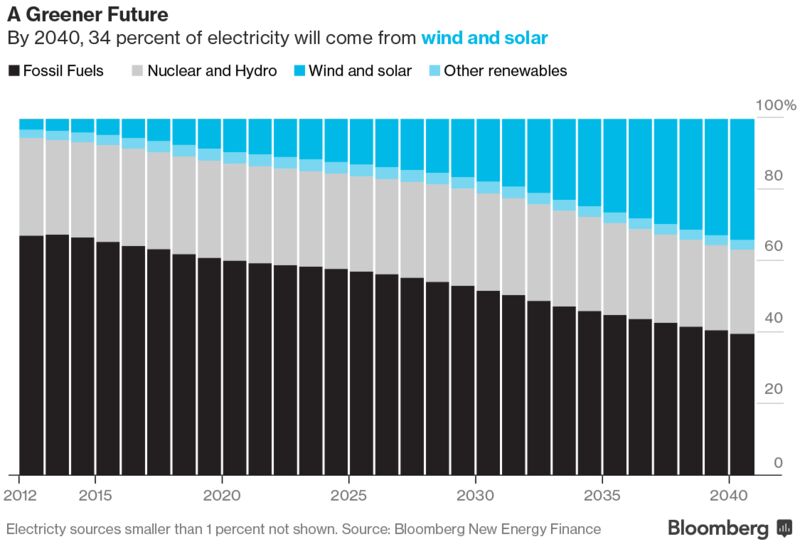
Bloomberg New Energy Finance’s outlook shows renewables will be cheaper almost everywhere in just a few years.

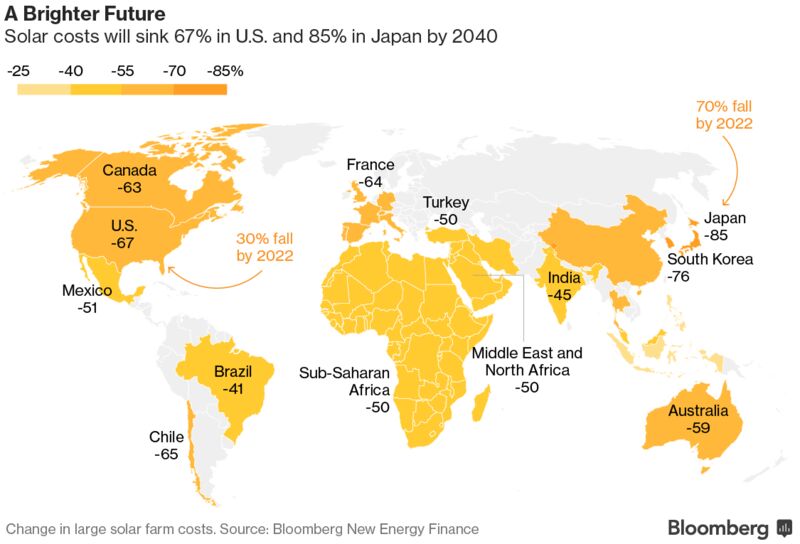
Solar power, once so costly it only made economic sense in spaceships, is becoming cheap enough that it will push coal and even natural-gas plants out of business faster than previously forecast.

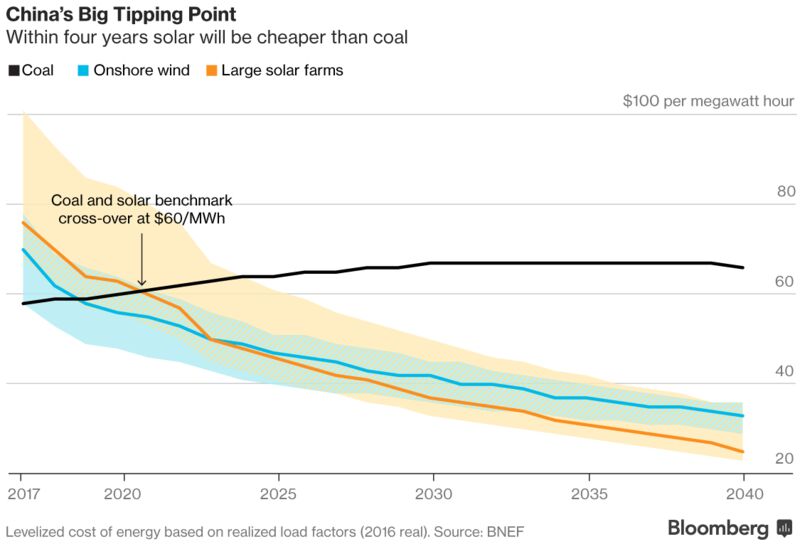
That’s the conclusion of a Bloomberg New Energy Finance outlook for how fuel and electricity markets will evolve by 2040. The research group estimated solar already rivals the cost of new coal power plants in Germany and the U.S. and by 2021 will do so in quick-growing markets such as China and India.

The scenario suggests green energy is taking root more quickly than most experts anticipate. It would mean that global carbon dioxide pollution from fossil fuels may decline after 2026, a contrast with the International Energy Agency’s central forecast, which sees emissions rising steadily for decades to come.

“Costs of new energy technologies are falling in a way that it’s more a matter of when than if,” said Seb Henbest, a researcher at BNEF in London and lead author of the report.

The report also found that through 2040:

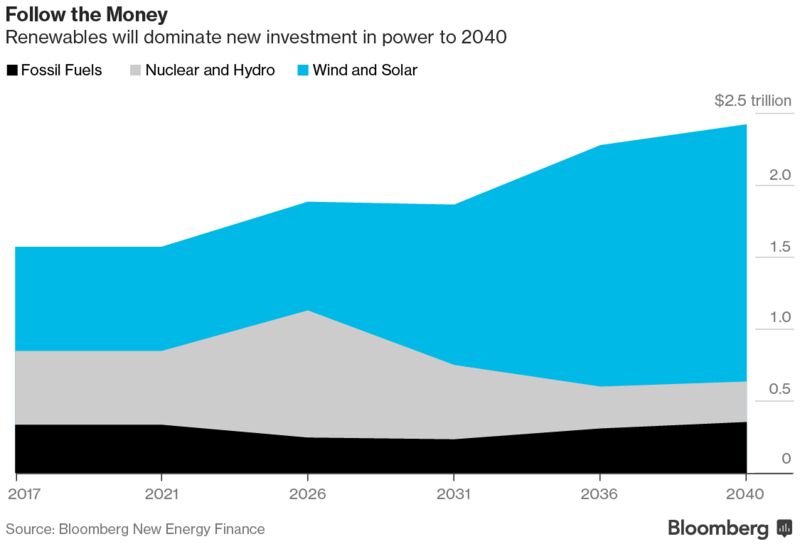
  • China and India represent the biggest markets for new power generation, drawing $4 trillion, or about 39 percent all investment in the industry.
  • The cost of offshore wind farms, until recently the most expensive mainstream renewable technology, will slide 71 percent, making turbines based at sea another competitive form of generation.
  • At least $239 billion will be invested in lithium-ion batteries, making energy storage devices a practical way to keep homes and power grids supplied efficiently and spreading the use of electric cars.
  • Natural gas will reap $804 billion, bringing 16 percent more generation capacity and making the fuel central to balancing a grid that’s increasingly dependent on power flowing from intermittent sources, like wind and solar.

BNEF’s conclusions about renewables and their impact on fossil fuels are most dramatic. Electricity from photovoltaic panels costs almost a quarter of what it did in 2009 and is likely to fall another 66 percent by 2040. Onshore wind, which has dropped 30 percent in price in the past eight years, will fall another 47 percent by the end of BNEF’s forecast horizon.

That means even in places like China and India, which are rapidly installing coal plants, solar will start providing cheaper electricity as soon as the early 2020s.

“These tipping points are all happening earlier and we just can’t deny that this technology is getting cheaper than we previously thought,” said Henbest.

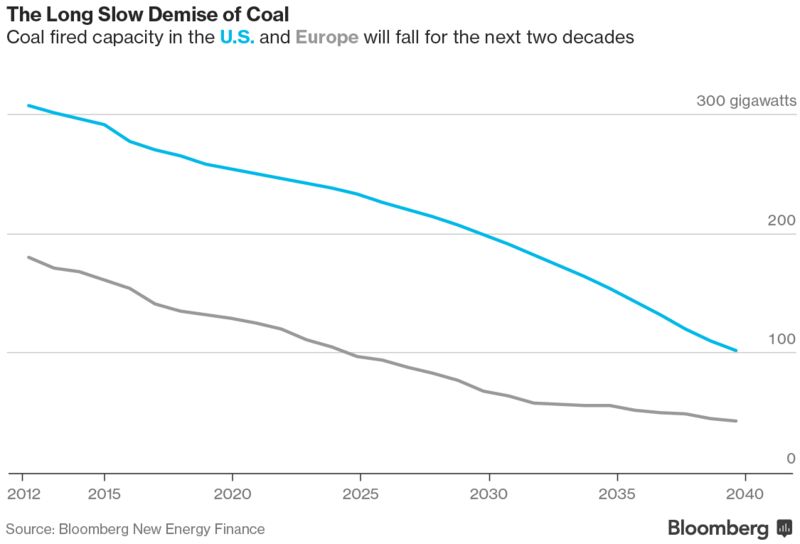
Coal will be the biggest victim, with 369 gigawatts of projects standing to be cancelled, according to BNEF. That’s about the entire generation capacity of Germany and Brazil combined.

Capacity of coal will plunge even in the U.S., where President Donald Trump is seeking to stimulate fossil fuels. BNEF expects the nation’s coal-power capacity in 2040 will be about half of what it is now after older plants come offline and are replaced by cheaper and less-polluting sources such as gas and renewables.

In Europe, capacity will fall by 87 percent as environmental laws boost the cost of burning fossil fuels. BNEF expects the world’s hunger for coal to abate starting around 2026 as governments work to reduce emissions in step with promises under the Paris Agreement on climate change.

“Beyond the term of a president, Donald Trump can’t change the structure of the global energy sector single-handedly,” said Henbest.

All told, the growth of zero-emission energy technologies means the industry will tackle pollution faster than generally accepted. While that will slow the pace of global warming, another $5.3 trillion of investment would be needed to bring enough generation capacity to keep temperature increases by the end of the century to a manageable 2 degrees Celsius (3.6 degrees Fahrenheit), the report said.

The data suggest wind and solar are quickly becoming major sources of electricity, brushing aside perceptions that they’re too expensive to rival traditional fuels.

By 2040, wind and solar will make up almost half of the world’s installed generation capacity, up from just 12 percent now, and account for 34 percent of all the power generated, compared with 5 percent at the moment, BNEF concluded.

The April 17, 2016, islandwide power outage cost the Jamaican economy $340 million in losses, stated consultant with the Office of Utilities Regulation Valentine Fagan.

He pointed out that the poor decisions made by the Jamaica Public Service Company (JPS), which resulted in the widespread power failure, had an economic cost that the country cannot afford.

Fagan’s comments came during a meeting of the Economy and Production Committee of Parliament yesterday where the parliamentary body urged the Ministry of Science, Energy and Technology to expedite plans to craft a scheme of fines for imposition on the JPS in cases where the country is plunged into darkness as a result of major system failures.

PENALTY SCHEME

Director General of the Office of Utilities Regulation (OUR) Ansord Hewett told members of the parliamentary committee that the Electricity Act of 2015 provides for a scheme of penalty, which can be enforced in a court of law, but the process could take an inordinately long period to resolve.

However, he said that there is an option to establish a scheme of penalties where the JPS agrees to paying a fine when it breaches certain service requirements.

Hewett said that the OUR has been pushing the ministry to get that arrangement in place, which would provide the regulatory body with an additional tool to impose sanctions if necessary.

The committee was discussing the OUR report on the JPS’s major system failure, which left most parishes without power for several hours on April 17, 2016.

Committee member Fitz Jackson suggested that the penalties sufficiently high to discourage breaches.

“I expect that the fines will be of sufficient magnitude to discourage any breaches,” he insisted.

Hewitt said that the ministry indicated recently that it would shortly be sending the OUR a proposal on the scheme of sanctions for it to review.

Committee chairman Anthony Hylton told his colleagues that in a situation where the JPS holds a monopoly, fines to regulate conduct becomes even more important. Commenting on proposals for penalties and fines to be imposed on the JPS, Sam Davis, head of government and regulatory affairs at the JPS, told the committee that the company did not intend to wait on sanctions to make appropriate decisions and take actions in relation to improved service to customers.

Gleaner

 Prime Minister Andrew Holness (right) greets Lascelles Chin, founder and executive chairman LASCO Affiliates Companies, at the LASCO Releaf Environmental Awareness Programme Awards Ceremony at The Jamaica Pegasus hotel, in New Kingston on Wednesday.

Prime Minister Andrew Holness says the Government will embark on a programme aimed at transforming the collection and management of garbage before the end of the year.

Prime Minister Holness says work is far advanced in examining options for waste-to-energy solutions.

He says the process is being handled by an enterprise team.

Prime Minister Holness was speaking at the LASCO Releaf Environmental Awareness Programme (REAP) Awards Ceremony yesterday in Kingston.

REAP is geared towards helping children become environmentally conscious through fun competition.

The programme incorporates some 120 primary and preparatory schools this year.

Holness says for Jamaica to experience sustainable growth, the practice of protecting the environment for future generations must be embedded in the mindset of children.

He states that the LASCO REAP initiative will add to the national effort in managing waste disposal and protecting the environment.

Gleaner

Tomblin admits stemming the problem her toughest task

Jamaica Public Service President and CEO Kelly Tomblin admitting that the company’s decision to cut electricity supply to some communities, because of non-payment, pained her.

Kelly Tomblin didn’t hesitate when she admitted that the greatest challenge she faced in her five years at Jamaica Public Service Company Limited (JPS) was electricity theft.In fact, the power company’s president and CEO, who is leaving next month, managed a chuckle as she spoke about the problem that has plagued her company for decades.

“You know, it is really hard to deal with the amount of electricity theft in Jamaica, it’s really hard,” she told the Jamaica Observer with a heavy sigh.

“We estimate about 180,000 homes, that’s about a million people”, who are benefiting from electricity theft, Tomblin said in an interview at her office last Wednesday.

Frustrated by the level and persistence of the theft, JPS, in January this year, said it was ready to name, shame, and prosecute offenders — a 180-degree turn in its policy of declining to take legal action against electricity thieves who, Tomblin had disclosed last year, were costing the company US$2 million per month.

“We now strongly believe that if we do not prosecute, name and shame, we cannot win. We will therefore be working more closely with the police to make arrests and prosecution a major part of our anti-theft strategy going forward,” JPS’s Director of Revenue Security Major George Kates wrote in the company’s Energy Matters column published in the Observer in January.

But even amidst the hard approach Tomblin has empathy for Jamaicans, who she believes are unable to pay for the utility.

“My heart’s torn because you have people who absolutely cannot pay,” she lamented last Wednesday. Her pain, she said, got worse when the company took a decision to cut electricity to communities where theft was more than 80 per cent.

“That’s the one that leaves me with the most pain… that one moment of turning the power off,” she admitted.

“We can’t keep giving power to these communities and make other people pay. That was a defining moment for us, because I think we said we just cannot take this any more,” Tomblin told the Sunday Observer.

“We did cut off people, and we had a cease-and-desist order from the OUR (Office of Utilities Regulation) and public outrage, but for us it’s just like it comes to a point where you have to say the situation is not being addressed,” Tomblin explained.

Although electricity theft is now a crime punishable by a heavy fine and/or five years in prison, JPS has been working with communities to halt the practice.

That effort, Tomblin said, started under an agreement with the previous Government for a community renewal programme which involves the installation of prepaid meters.

The programme was implemented in 10 communities and appears to be working well.

“One of the things I’m proud of is, I was just in Majesty Gardens — where we have community representatives who are helping people get power,” Tomblin said.

“I’m excited because these last few months we’ve seen losses go down. We’re happy we’re seeing a downward trend, the first time in a long time. This is the best performance we’re seeing in four years,” she added.

The improvement, while not yet in double figures, is significant as, according to Winsome Callum, director, corporate communications, the company actually saw a stabilisation of the losses before the movement south.

“It was a big thing just to keep it from going up,” said Callum, who sat in on the interview.

She attributed the development to a combination of strategies. “We continue to pull down [illegal connections], but we also continue to do a lot more with technology,” Callum explained.

In 2015, JPS took down 205,300 throw-ups — basically crude, illegal connections found mostly in depressed communities — and arrested 783 people for electricity theft that resulted in a loss of US$18.8 million to the company.

The power company continues to argue that it cannot solve the problem alone; the responsibility needs to be shared by political representatives who have influence over large numbers of people, as well as law-abiding Jamaicans.

“Can you imagine what a culture change it would be if people really got legitimate electricity throughout Jamaica?” Tomblin asked.

Jamaica Observer

JAMAICA’S CLIMATE Change Division (CCD) is working on strengthening coordination and overall efficiency within the island’s focal point network, tasked to ensure climate change considerations are included in the planning and operations of each ministry, department and agency of government.

A first step is a lunch meeting to be held this Friday to share on the state of play with international climate change deliberations, post the entering into force of the historic Paris Agreement Jamaica’s ratification of which became official on May 10.

“We will also have a discussion about how we prepare for a pre-COP (Conference of the Parties to the United Nations Framework Convention on Climate Change), what type of pre-COP event we would want to have this year (ahead of the international talks to be held in Bonn), and the mini-COP we have planned for schools with the Ministry of Education,” revealed Una May Gordon, principal director for the CCD.

This meeting follows on a recent stocktaking of how the focal point representatives currently do their work and the way in which they use their knowledge of climate change.

The next step will be to secure a dedicated officer to handle coordination of the network, which currently has some 27 representatives from across the public sector.

“We are hoping that the consultant should be on board in June,” Gordon told The Gleaner, adding that funding for that person has come through the Japan Caribbean Climate Change Partnership (JCCCP).

The Jamaica component of the JCCCP was launched in June last year by the United Nations Development Programme and is designed to “bring together policymakers, experts and representatives of communities to encourage policy innovation for climate technology incubation and diffusion”.

The island is set to receive US$1.8 million of the US$15 million earmarked for eight Caribbean islands to help with climate change adaptation and mitigation.

Network Coordination

In addition to coordination of the focal point network with a focus on sectors such as forestry, water and energy, for which adaptation and mitigation plans are being or will be developed Gordon said the consultant will also support the climate change board and its activities.

Attention is also being paid to the composition of the network.

“We are re-examining the focal points to see if we have the right people in place and to ensure we get more depth and adequate coverage across all the portfolios,” Gordon noted.

“I think we can add a few more (representatives) because some ministries have changed. There is (for example) the Ministry of Education, Youth and Information, so we need two there. Another is the Ministry of Culture, Gender, Entertainment and Sport,” she added.

The CCD, meanwhile, has managed to add to its own team over recent months. There is now a mitigation officer Omar Alcock who takes over from Gerald Lindo, who left last year.

There is also a climate finance adviser whose services have been provided through support from the Commonwealth Secretariat, as well as a public awareness and behaviour change officer, appointed through the Pilot Programme for Climate Resilience.

“I am quite satisfied with my little team,” said a smiling Gordon.

Gleaner

Thousands of photovoltaic panels across the UK generate 8.7GW, smashing previous high of 8.48GW earlier this month

Woman relaxes on deckchair in London.

Solar power has broken new records in the UK by providing nearly a quarter of the country’s electricity needs, thanks to sunny skies and relatively low summer demand.

National Grid said the thousands of photovoltaic panels on rooftops and in fields across the UK were generating 8.7GW, or 24.3% of demand at 1pm on Friday, smashing the previous high of 8.48GW earlier this month.

Experts said the unprecedented share for solar energy meant about 60% of the UK’s power was low carbon, taking into account Britain’s wind farms and nuclear power stations too. That figure is normally around 50%.

National Grid, which is tasked with ensuring a match between supply and demand for electricity, said it was excited but unfazed by the challenge of accommodating “significant volumes” of renewables.

Solar provided a record percentage of UK power at 1pm on 26 May 2017
 Screen Shot 2017-05-29 at 20.40.20

Duncan Burt, who manages day-to-day operation of the grid, said: “We have planned for these changes to the energy landscape and have the tools available to ensure we can balance supply and demand.”

Hannah Martin, head of energy at Greenpeace, said: “Today’s new record is a reminder of what the UK could achieve if our government reversed its cuts to support for solar, and backed the clean technologies that could provide jobs, business opportunities and plentiful clean energy for decades to come.”

The milestone reached on Friday is the latest in a series of records for solar, which has grown from almost nothing seven years ago to 12GW of capacity today. Last summer it provided more power than the UK’s last 10 coal-fired power stations.

In April this year, Britain achieved its first-ever full working day without coal powersince it started burning the fuel in 1882, thanks in part to solar energy.

Solar’s rapid growth is overturning conventions for the managers of the UK’s power grid. In March, for the first time ever, the amount of electricity demanded by homes and businesses in the afternoon was lower than it was in the night, thanks to the cut in demand due to solar panels.

Alastair Buckley, a solar expert at the University of Sheffield, said of the latest record: “I think it’s a positive sign. It’s free electricity today, for the consumer, and we should make the most of it.”

Solar power generation in the UK
 Screen Shot 2017-05-29 at 20.41.54

He said that with solar continuing to be installed despite the government’s drastic subsidy cuts in 2016, further records will certainly be broken this summer and for years to come.

Buckley said the grid could handle a far greater proportion of solar power than currently seen, because gas power stations could be ramped down. For National Grid, periods of high pressure bringing lovely weather to the UK like this week were: “really predictable, so easy to plan for,” Buckley said.

Robert Gross of Imperial College said: “This doesn’t pose fundamental problem for the grid – many sunnier countries manage a similar proportion of solar on a much more regular basis.”

Government statistics published on Thursday show that UK solar power capacity has grown from 11.3GW in April last year to 12.1GW this year, enough to power 3.8m homes.

Guardian graphic | Source: MyGridGB
This 2016 photo shows erosion along the beach in Annotto Bay, St Mary, due to high waves.

A warning has been issued to governments across the Caribbean, including Jamaica, to do more to make countries resilient to climate change as there is a price to pay if nothing is done.

According to a report commissioned by the Commonwealth Marine Economies Programme, the Caribbean is “in the front line” and at greater risk from more severe impacts than many other parts of the world because of its geographic location as most regional states are smaller islands where people live close to and depend on the sea.

The Caribbean Marine Climate Change Report Card 2017, which was conducted by scientists and researchers, said more intense storms, floods, droughts, rising sea levels, higher temperatures, and ocean acidification are major threats to all regional economies and pose a danger to lives as well, both directly and indirectly.

“As the seas, reefs and coasts on which all Caribbean people depend are under threat, much more needs to be done to protect these resources, and the authors recommend building more resilient environments to prepare for, and protect against, climate change,” the report noted.

It has recommended developing a regional network of marine protected areas designed to future-proof marine biodiversity against climate change and stabilise shorelines to preserve natural barriers such as mangroves, salt marshes, and coral reefs.

STRONG HURRICANES TO INCREASE

The scientists warn that while the overall frequency of Atlantic storms may decrease, the strongest hurricanes are likely to increase. Global average sea level is projected to rise by a further 10-32 inches over the coming century a devastating amount for a country as low-lying as Cayman, where it could be even worse.

“In the northern Caribbean, sea-level rise could be 25 per cent higher than the global average due to other physical factors affecting land elevation,” the report states. “This projected rise in sea level and severe storms is likely to increase the risk of storm-surge events for Caribbean states, which will further exacerbate risks to biodiversity, settlements and infrastructure.”

The report also zeroed in on some countries in the region including Jamaica, Belize, St Vincent and the Grenadines, Guyana and St Lucia.

Where fishing is concerned, the researchers noted that if there is no action – permanent fishing camps on low lying offshore cays may be completely submerged by future sea level rise, and these are particularly vulnerable during extreme-weather events.

Gleaner

Kelly Tomblin, who has been the face of the Jamaica Public Service Company (JPS) since she joined the light and power company as president and chief executive officer in 2012, is on her way out of the company, and heading to take up the CEO position at the United States-based power company, INTREN, effective July 10.

Tomblin will take over the day-to-day running of the firm from Loretta Rosenmayer, the firm’s founder and current CEO, who will now chair the board of what has become one of the leading utility contractors in North America.

Up to press time, Tomblin was off the island and unavailable for a comment. However, 4-traders.com, a reputable international stock market and financial news website, said Tomblin had confirmed to them that she is to be the new CEO at INTREN.

“INTREN would not be what it is today without Loretta’s vision, leadership and unwavering commitment to high standards and values,” Tomblin was quoted by the website as saying. “I am honoured to lead the INTREN team and continue the progress evolving before me.”

According to reports, Tomblin was selected from a competitive selection process from a strong field of candidates.

“She is a highly impressive and respected executive known for her ability to build diverse, meaningful cultures in a collaborative leadership style. As a recipient of the prestigious 2016 Platt’s Global Energy CEO of the Year Award, Kelly topped an impressive list of finalists leading companies in the United States and around the world,” the website stated.

ENERGY SAVING PROJECTS

During her time at JPS, Tomblin introduced several energy saving projects, as well as the use of liquefied natural gas in the country’s energy mix, even as she guided the light and power company through a profound transformation.

“This evolution comes at an extraordinary time for INTREN,” a report quoted Rosenmayer as saying. “Our momentum is strong, and our management team and employees have built an exceptional company that is one of the most trusted and respected in the industry. I’m confident Kelly is ideally positioned for her new role to continue our growth.”

INTREN has been an innovative solution partner, dedicated to building and maintaining the infrastructure of the energy industry for more than 25 years, and has served many of the nation’s foremost utility companies, private contractors and developers, and municipalities and cooperatives.

Gleaner

Screen Shot 2017-05-12 at 1.32.37 PM

The Tesla solar roof is a wonderful innovative technology that will revolutionize the solar industry especially as more companies start to produce their own solar roofs. Tesla launched their solar roof with combined Powerwall battery system this week and everyone got very excited. But how excited should we be in Jamaica?

Here at Solar Buzz we get a lot of calls regarding new technology and the solar roof has been on people’s minds for 7 months since the initial announcement. My response to prospective solar clients would be to not get too excited about owning a solar roof in Jamaica anytime soon, for a few reasons:

  • Not available outside USA initially: If you go to the Tesla Solar Roof page there is a calculator. It will predict the cost of the roof but this calculator only works for US addresses. As with the Tesla Powerwall battery system, which launched over 2 years ago, demand will be high and availability will be limited to the USA until all the kinks are worked out. I have yet to come across a Tesla Powerwall battery system in Jamaica so I would not look for a solar roof in Jamaica for a while.
  • New technology is expensive: The solar roof is very new therefore the price is going to be very high. On the Tesla calculator I typed in a Florida address and put the house size at 2,000sf, the costing is below:

Screen Shot 2017-05-12 at 7.26.48 AM

A 2,000sf roof would cost J$10,500,000 before shipping and is estimated to offset 70% of your electricity bill. Florida has a solar tax credit but Jamaica has much higher energy costs so let’s say these even out for simplicity. A rough payback of this roof in Jamaica would be about 20yrs which puts us back to the early days of solar when regular panels were expensive at US$2/watt compared to US$0.50/watt now. Solar did not sell in those early days because the payback was too long. Actually solar is very cheap now and the solar market still struggles in Jamaica! This is mostly due to the lack of and a tedious financing process in Jamaica but that’s a whole different thesis.

  • The Tesla calculator assumes the home would only need one Powerwall battery bank which produces 14kWh. For a home with a family of four, the solar system would mostly likely need at least two Powerwall battery banks to achieve 100% offset, so add another US$7,000 to the cost.

This assessment is not to discourage anyone towards the solar roof as eventually all roofs will be made of solar tiles. However until that time conventional solar systems are at their most inexpensive levels of all time. A homeowner could buy a new roof and install a traditional solar system to offset 100% of electricity costs and payback for both in half the time of a Tesla solar roof right now. Eventually this will change but at this moment in time do not bank on a solar roof being available in Jamaica or feasible for many years to come. The time you spend waiting  on the Tesla solar roof in Jamaica you could have bought a traditional solar system, a new roof and paid off both through your energy savings.

Solar Buzz Jamaica CEO-Jason Robinson