image1.jpeg

The Jamaica Public Service Company (JPS) says it is unable to definitively state how the use of both automotive diesel oil and liquefied natural gas (LNG) at the Bogue power plant in St James will impact the price of electricity to consumers.

It said the power plant currently burns on automotive diesel oil “and we are doing a conversion that adds the capability to also burn natural gas. So we will end up with the ability to burn both fuels at no extra cost”.

Responding to Wednesday Business queries about the rationale for the dual-fuel facility, the JPS said natural gas will be the primary fuel on which the plant operates and automotive diesel oil will be a back-up fuel “in case we have any problems with receiving natural gas”.

It added that under normal conditions, the plant will effectively be a gas-fired power plant.

IMPACTON ELECTRICITY PRICES

As to how it will impact the price of electricity the JPS said in emailed responses that “we cannot speak to the likely impact on electricity prices given the uncertainty of prices in the future (for oil vs LNG)”.

However, it said that the impact is expected to be negligible given that Bogue only represents approximately 10 per cent of the company’s total costs.

“What we can say with fairly good certainty is that the cost of electricity today is 30 per cent lower than it was one year ago, and we expect that trend to continue throughout 2016, given that 80 per cent of our net generation (production) will still be based on oil, 10 per cent will be from natural gas, and we expect renewables to make up 10 per cent of our net generation once the three renewable energy projects currently under construction (for circa 80 megwatts) are completed before the end of 2016.”

The JPS, an integrated electric utility company and the sole distributor of electricity in Jamaica, added that “that means we continue doing a good job as a country of increasing the penetration of renewable, while also diversifying our fuel mix and reducing our overexposure to oil”.

It said that it is hoping to continue doing more of that through the 37 megawatts of renewables currently being pursued by the Office of Utilities Regulation through a request for proposal, as well as its 190 megawatt gas-fired power plant that will be commissioned in mid-2018.

IMPROVING COMPETITIVENESS

Reducing the cost of electricity is critical to improve competitiveness, according to the International Monetary Fund’s latest updated memorandum of economic and financial policies.

It said that the action plan prepared by the Electricity Sector Enterprise Team foresees replacing current oil-fired generation capacity with gas, coal and ethane-fired plants to achieve significant cost savings.

Next steps will include the conversion of the Bogue power station from oil to gas, a process which the JPS is currently undertaking.

In addition, said the memorandum, the Government has approved the construction of Jamaica’s first natural gas-fired power plant, a 190-megawatt facility to be built and operated by JPS, and to be completed by 2018. Several renewable energy projects are also under way.

The Government said it will prepare a plan to ensure that all public entities – central government, local government and public bodies – meet their financial obligations in a timely manner.

In the memorandum, the Government also pointed out that urgent actions will be taken to reduce the time needed for entrepreneurs to get an electricity connection. Plans foresee the automation of the work processes within the government electrical regulator and the acquisition of an Application Management and Data Automation (AMANDA) software to streamline procedures for scheduling, inspecting, approving and certifying electrical installations.

An action plan for implementation of the reforms and adoption of the AMANDA system are expected to be completed in fiscal year 2016/17, with support from the Inter-American Development Bank.

The Gleaner

Light company at ease with increase in customer satisfaction

Light distributor Jamaica Public Service (JPS) has reported a 24 per cent jump in annual profits, increasing from US$23 million in financial year 2014 to US$28.6 million for 2015.

The increase in profits came despite a 54 per cent decline on year-on-year net profits for the December period, with the quarter closing at US$4.87 million ($589 million), compared to almost US$10.5 million for the same quarter in 2014.

The decline in net profit was led by a US$47.6 million dip in revenues as oil which fuels most of JPS power stations continues to trend downward and the consistent passing of the reduced rates on customer’s electricity bills, according to just released data.

Revenue for the three-month period ending December 2015 was US$176.7 million, compared with US$224.3 million a year earlier.

“It’s really great to have lower prices, yes, but what’s not great is for them to go up and down. So we’ve worked on how we do create a more sustainable environment that doesn’t have that volatility. I have to say that the one that’s right here, right now is the Bogue project,” JPS CEO Kelly Tomblin stated at a press conference earlier this month.

“The other thing that will help with this problem is an integrated resource plan (IRP), which will help us in determining what resource and where will best support sustainability and most of all affordability,” she added.

Consumer electricity rates are currently at a five-year low.

Despite seeing significant declines in net profit, JPS expressed some satisfaction with the quality of service being provided to consumers which trended upwards at 70 per cent in 2015.

JPS saw one of its lowest satisfaction rates back in 2012 at 22 per cent; however, Tomblin is encouraged by the growth in customer satisfaction and plans on implementing 10 initiatives geared towards continued growth in customer service.

“You can see how customer satisfaction has grown; it’s almost at 70 per cent. We are not happy with that but we have worked very hard to say to our customers we appreciate you and we want to be in a different conversation,” she said.

Senior vice-president for energy delivery and technology, Gary Barrow, noted that the company has already seen a 30.3 per cent decrease in the frequency of outages when compared with the previous year. The company also noted that it is working on the Government of Jamaica to improve payment for street lights, as it moves to implement LED lighting over the next five years.

Throughout 2016, JPS plans on completing the conversion of the Bogue power plant, while partaking in initiatives to lead in a ‘clean and green’ Jamaica. Additionally, the company has started the process of implementing advance smart grid, proliferate prepaid meters, improving customer engagement, and the implementation of the JPS mobile application.

JPS also plans on connecting 10 new communities during the year.

Jamaica Observer

Warmer and wetter conditions facilitate transmission of mosquito-borne diseases, which may have added to spread, says lead climate change scientist


Zika virus Central South America climate change

Tamires da Costa, 16, who is four months pregnant, stands in a street with standing flood water next to her home in the Parque Sao Bento shantytown of Rio de Janeiro, Brazil on 29 January 2016. Photograph: Leo Correa/AP

The outbreak of Zika virus in Central and South America is of immediate concern to pregnant women in the region, but for some experts the situation is a glimpse of the sort of public health threats that will unfold due to climate change.

“Zika is the kind of thing we’ve been ranting about for 20 years,” said Daniel Brooks, a biologist at University of Nebraska-Lincoln. “We should’ve anticipated it. Whenever the planet has faced a major climate change event, man-made or not, species have moved around and their pathogens have come into contact with species with no resistance.”

It’s still not clear what role rising temperatures and altered rainfall patterns have had on the spread of Zika, which is mainly spread by mosquitos; the increased global movement of people is probably as great an influence as climate change for the spread of infectious diseases. But the World Health Organization, whichdeclared a public health emergency over the birth defects linked to Zika, is clear that changes in climate mean a redrawn landscape for vector and water-borne diseases.

According to WHO, a global temperature rise of 2-3C will increase the number of people at risk of malaria by around 3-5%, which equates to several hundred million. In areas where malaria is already endemic, the seasonal duration of malaria is likely to lengthen. Aedes aegypti, the mosquito that carries Zika and other diseases, is expected to thrive in warmer conditions.

As climate change reaches almost every corner of the Earth’s ecology, different diseases could be unleashed. Increased precipitation will create more pools of standing water for mosquitos, risking malaria and rift valley fever. Deforestation and agricultural intensification also heightens malaria risk while ocean warming, driven by the vast amounts of heat being sucked up by the oceans, can cause toxic algal blooms that can lead to infections in humans.

“We know that warmer and wetter conditions facilitate the transmission of mosquito-borne diseases so it’s plausible that climate conditions have added the spread of Zika,” said Dr Diarmid Campbell-Lendrum, a lead scientist on climate change at WHO.

“Infectious agents in water will proliferate with more flooding. It’s clear that we need to strengthen our surveillance and response to a range of diseases. Globalization, the movement of people, is an important factor too. In a world where we are disrupting the climate system we’ll have to pay the price for that.”

WHO estimates that an additional 250,000 people will die due to climate change impacts – ranging from heat stress to disease – by 2050, but Campbell-Lendrum said this is a “conservative estimate”.

“It is based on optimistic assumptions that the world will get richer and we’ll get better at treating these diseases,” he said. “We do need to get better at controlling diseases at their source and we do need to drive down greenhouse gases because there is a limit to our adaption. By moving to cleaner energy sources we will also help relieve one of the largest health burdens we have, which is the air pollution that kills seven million people a year.”

Until now, efforts to push back the threat of infectious diseases has been successful. Malaria, for example, used to be found in the New York area – and there is evidence to suggest it was once present in southern England; much earlier, the Romans used to retreat to the hills at certain times of the year to avoid mosquitos carrying the disease. Vaccines have been developed for a range of diseases including, belatedly, Ebola.

The eradication of threats like these makes wealthy western countries fret over outbreaks like Zika. As the world warms, there may be a lack of preparation for other diseases not currently considered threats.

“This is likely to become an equal opportunity crisis,” said Brooks. “The developing, poorer countries are impacted disproportionately but they deal with these diseases all the time, they are not surprised by them. But in Europe and North America, people have lived in a bubble where we think our wealth and technology can protect us from climate change. And that’s not true.

“The thing that worries me most is a death by a thousand cuts. I don’t think an Andromeda strain will wipe out all humans. But the amount of time, money and effort needed to combat these many different problems can overwhelm a healthcare system.”

So which climate-fueled diseases are likely to pop up next? Some experts believe that water-borne diseases could escalate, which would have significant consequences for countries such as Bangladesh – a low-lying nation with plenty of rivers that has a public health system already struggling to meet its population’s current needs.

“There’s not nearly enough attention paid to diseases that cause diarrhea, crypto spiridium, Hepatitis A,” said Aaron Bernstein, a pediatrician at Harvard Medical School.

“We’ve seen outbreaks of these diseases in the past due to extreme precipitation. The build environment we live in wasn’t designed for the climate we will soon be living in; when you consider half the world’s waterways have been engineered by man, they won’t be able to contain the extra water that will flood them.

“Flooding will certainly lead to mosquito-borne diseases but also cause water-borne diseases and also a lack of drinking water. People in Asia and Africa, particularly those living on the coast, will be very vulnerable, climate change could be the straw that breaks the camel’s back in terms of public health.”

The Guardian

Kelly Tomblin, president and CEO of JPS.

Jamaica Public Service Company (JPS) said it wrote off $100 million in debt owed by residential and commercial customers for electricity under its year-end amnesty programme.

It offered customers the opportunity to start the new year at least partially debt free.

The power utility also said it continues to work with the Government, through the Ministry of Finance, to ensure payment for street lights on a timely basis.

In introducing the amnesty, which ran from November to December 2015, JPS said it had identified critical cases where some of its customers’ debts to the light and power provider had accumulated so significantly over time that they had been classified as bad debt.

However, for customers who wanted to regularise their accounts and in some cases restore their electricity, JPS gave residential rate 10 and commercial rate 20 customers an opportunity to negotiate up to 70 per cent debt forgiveness.

Persons qualified to apply were those owing in excess of $50,000 at August 2015 and had their service disconnected; as well as residential and small commercial customers who owed more than $100,000 up to August, but whose accounts were still active.

Last Friday, JPS President and Chief Executive Officer Kelly Tomblin, addressing a media briefing at the company’s offices in New Kingston, said more than 1,000 account holders benefited from the amnesty.

STREET LIGHT REPAIRS ONGOING

As for the issue of defective street lights, Tomblin said repairs were ongoing, while acknowledging that the utility got daily complaints.

JPS has about 100,000 street lights and last year the company replaced 27,700 of them, an average of 514 per week.

“We are replacing street lights, hundreds and hundreds every week, so it’s not that JPS isn’t aware…”, she said.

Against that background, Tomblin said: “There are two things that are going on that we have to fix.

“We are working with the Government right now to find a way for us to get paid more promptly,” she said. “I have a commitment by the minister of finance. We work with him all the time. We all know that we have a lot of different obligations and a lot of different challenges to meet and we do know today that we are working on solutions to run our street lights on, for instance, LED.”

At the same time, she said the company has to be careful how much it invests in the current solution “if we are going to have this three to four year plan to replace them.”

She acknowledged the issue is, for some, one of security, but said the street light problem is compounded by theft.

“With the level of electricity theft, we will never have first-class street lights … we cannot have street lights operating if we have a couple of hundred people stealing,” the utility boss said.

JPS is manager of the national grid and monopoly distributor of electricity supplies. The utility collects around $100 billion per year in billings.

The Gleaner

The Private Sector Organisation of Jamaica (PSOJ) says it is in the country’s best interest to further hedge against the upward movement in the price of oil, a strategy the Government first adopted in June last year.

The hedge purchased by Jamaica last year at a strike price of US$66 has come in for criticism because oil prices are currently falling, and analysts are predicting further decreases this year.

However, PSOJ president William Mahfood said if the world crude prices remain low for an extended period, the options to buy will also be reduced and gives Jamaica an opportunity to hedge at concomitantly lower prices.

“We feel strongly that if the strike prices are attractive and if prices are maintained at these lower levels that it is in the country’s best interest to buy that insurance policy going forward,” Mahfood told Wednesday Business.

Asked if the PSOJ would encourage the Government to negotiate any differently in entering into such contracts, Mahfood, while noting that “it’s really a function of time, and it’s a question of volatility,” emphasised that “if oil prices remain low for an extended period of time, what you will find is that the option prices will come down, and if those prices come down further, it will definitely be in the country’s interest for us to hedge further”.

While some projections are for prices to fall to US$20, Mahfood said that no one knows exactly where they will end up.

“The best analysts in the world will tell you that the oil price might be a US$53 in December or it might be at US$100.”

He said the PSOJ feels strongly about maintaining some sort of stability in terms of the prices, given what the impact the lower costs have had on the economy in terms of energy which has, for example, resulted in lower electricity bills for both households and manufacturers.

In a release on Monday, the PSOJ said it has taken note of commentary on the oil hedge strategy Jamaica effected last year by purchasing options to buy eight million barrels of oil, representing about half the country’s annual requirement, at a price of US$66 per barrel.

The total cost of the option, which became effective in June 2015 and expires September this year, was approximately US$20 million.

One argument, the PSOJ said, was that the hedge was a waste of money as oil prices have fallen to US$30 per barrel, and the strike price, where Jamaica would have started to benefit, is US$66 per barrel.

The PSOJ noted that projections last year were for oil prices to recover in 2016 with most expecting it to go past US$66 per barrel and settling at around US$80 per barrel, which at 17 million barrels per year, would have had an annual cost above the strike price of US$234 million.

“If this had happened then we would have saved US$214 million (net of the option cost of US$20m). So for us to even have broken even on the cost of the option, oil prices would have had to go to US$67.20 per barrel (additional US$20 million based on our usage above the strike price),” PSOJ said.

It noted that the hedge is not a contract for supply at the strike price of US$66, but an option to purchase at that price so the only cost would be the US$20 million fee.

“It is also important to note that the amount applied to pay for the hedge was applied while prices were falling, so it was not an additional cost, which was important as it did not reduce already existing consumption spending,” the private sector group said.

“The fact is that we could ill afford oil moving back to US$80 per barrel, and the cost of US$20 million to mitigate a US$200 million risk, like insurance, makes good business sense,” said the PSOJ.


The Gleaner

Screen Shot 2016-02-01 at 10.24.56

Energy Minister Phillip Paulwell

ALMOST a year after net billing was suspended, there are indications that the programme is to resume, although Energy Minister Phillip Paulwell is yet to set a timeline.

He said recommendations have been made to the Office of Utilities Regulation (OUR) to resume processing licences. But, before that can happen, the Electricity Lighting Act must be amended and the Jamaica Solar Energy Association (SEA) raised concerns that nothing has been done to have the legislation amended.

At Wednesday’s national conference for the development of an energy services company industry in Jamaica, Paulwell said that the Government is committed to reopening net billing.

He, however, explained that while the law names the Energy Sector Enterprise Team (ESET) as the body responsible for regulating new generation capacity, it was felt that it (net billing) is not appropriately placed at ESET, and that the OUR is expected to resume processing net billing licences.

So far, more than 300 licences have been issued, but solar energy providers have not been able to interconnect to the JPS grid since May of last year.

David Barrett, president of SEA, says the association’s membership is still in a state of confusion.

“It’s static now (the sector) because people have no entity to get a licence from, they don’t know who to go to. Some persons have gone to the OUR or the JPS (Jamaica Public Service company) but they can’t do it because of the obvious reasons,” he told the Jamaica Observer last Thursday.

Over the months, entrepreneurs in the solar energy sector have complained bitterly of suffering millions in losses after the JPS stopped net billing to carry out an assessment of the pilot. The review was completed by the United States’ National Renewable Energy Laboratory and the report made public in June, but all grid interconnection for new net billing projects islandwide have still remained on hold.

Solar energy providers say the prolonged suspension has dealt their outfits a serious blow, arguing, too, that the JPS has too much power over the arrangement and that the Government needs to act decisively on the issue.

Barrett said the members are neither pleased with the pace of the process nor the new conditions that are being established.

“What has been decided is that the cap is to be five megawatts instead of 11 as it would have been in the previous phase, and that the cap for the individual locations will remain as they are. The association is not too happy about that because we feel that there is easy opportunity to increase potential for renewables in Jamaica without disturbing the grid in any way,” he told the Observer earlier this month.

Additionally, Barrett expressed disappointment that the association had not been invited to the table when the new cap was being set. “So we don’t have the information that fed into the decision-making process,” he stated.

Net billing permits JPS customers, who own renewable energy generators, to produce electricity for personal use and to sell excess energy to the light and power monopoly at wholesale prices, which are set by the OUR.

Jamaica Observer 

Ten companies submitted bids to build and operate renewable energy plants that run on solar, wind, water or waste, but two are in danger of being disqualified for non-payment of the bid security.

The Office of Utilities Regulation (OUR) received the bids for supply of up to 37 megawatt of renewable power to the grid on Wednesday and will determine the preferred bidders by April.

The bids included a 24.7MW waste-to-energy plant at US$110 million, by Green Waste Energy Inc; a 37MW wind plant at US$61 million by Wigton WindFarm Limited; a 20MW solar plant, at US$33.15 million, by WRB Enterprise Inc and a separate bid to build a 37MW solar plant at US$72.15 million, which contains three options.

Great Valley bid US$50 million to develop a 26.4MW wind farm; Tamarind Energy proposed a 36.3MW at US$76.96 million; and BMR Jamaica bid US$18.27 million for a 9.9MW wind farm to expand the existing wind farm that it is developing in central Jamaica.

The other four bids were a 37MW solar project at US$48.7 million with an alternative option by Eight Rivers Energy Company Limited; a 2MW hydropower project, at US$8.9 million, by Petroleum Corporation of Jamaica; a 37MW solar plant at US$77.14 million by Jamaica Energy Partners; and a 30MW biothermal energy plant, at US$93.8 million by Bio Energy Resources Limited.

“We are happy with the process. It was done in an orderly and professional manner,” said Angella Rainford of Eight Rivers Energy Company following the bid openings held at the OUR.

“The returns are attractive, but it’s also the right fit for the country as it mitigates against the reliance on oil,” said Rainford.

Eight Rivers took no chances and submitted a US$700,000 bid security.

Two of the 10 bidders – Green Waste Energy and Bio Energy Resources – did not put up the required security, OUR legal Chenee Rily disclosed at the bid opening.

The OUR required each bidder to submit security equivalent to one per cent of the project cost.

“The only two bids with firm capacity failed to offer a bid security it’s unfortunate,” said Cecil Gordon, the director of generation at Jamaica Energy Partners, in discussion with the Financial Gleaner at the OUR event. “Waste-to-energy gives a constant output so it’s firm capacity.”

Gordon explained that wind solar and hydro can fluctuate depending on external factors, including weather. He also indicated that waste-to-energy projects are more expensive to operate – “which means a lower return,” he added.

OUR said on Thursday that the decision on whether to disqualify the two waste-to-energy bids would be considered by the bid review committee when it convenes.

Last July, the OUR issued a Request for Proposals (RFP) from local and international interests to supply up to 37MW of electricity generation from renewable energy resources on a build, own and operate basis. Wednesday was the deadline for the receipt of bid documents.

This latest project is to complete an RFP process started in 2012 to identify interested entities to submit proposals for the supply of one or more plants of varying configurations greater than 100kW and up to 115MW of renewable energy. At that time, 78MW was identified from three successful bidders.

The Gleaner

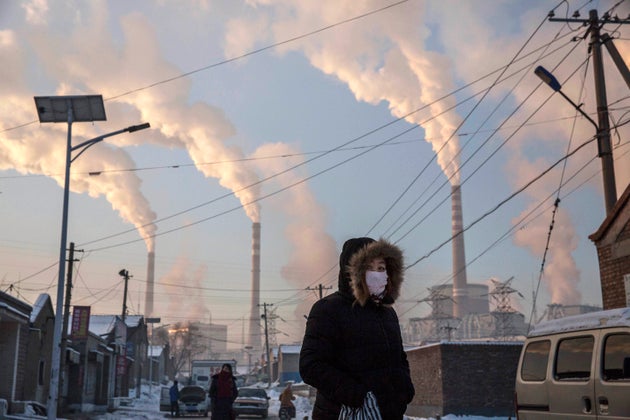
A woman wears as mask while walking in a neighbourhood next to a coal-fired power plant on Nov. 26, 2015, in Shanxi, China.

The market is encouraging pension funds and institutions to jettison fossil fuels from their portfolios, waving a clear warning flag to investors about the financial future of oil and coal companies.

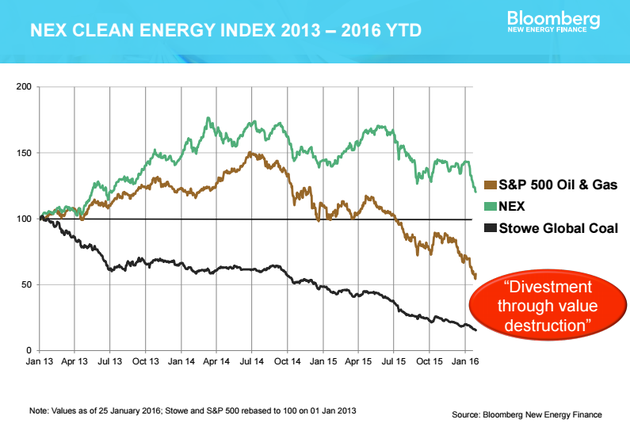
Fossil fuel stocks are performing poorly compared to the market as a whole — and perhaps most importantly, compared to renewable energy stocks, said Michael Liebreich, chairman of Bloomberg New Energy Finance, at a summit on climate risk put on by the nonprofit sustainability advocacy group Ceres.

Referring to investors who won’t divest and continue to own fossil fuel stocks, Liebreich pointedly said that the market was “divesting through value destruction” — in other words, cutting their holdings in traditional, polluting energy companies by slashing their value.

Renewable energy stocks have dramatically outperformed fossil fuels.

Over the last 10 years, the S&P 500 index is up just over 50 percent. Yet energy stocks over the same time period have risen only 1.3 percent.

For big investors to simply allow their holdings in big energy companies to fall toward a vanishing point of worthlessness is deeply irresponsible, observers say.

Indeed, former Vice President Al Gore, who shared the Nobel Peace Prize in 2007 for his work on climate change, compared the risk that some fossil fuel companies’ assets will become worthless to the danger of mortgage-backed securities, whose collapse triggered the 2008 financial crisis.

The nonprofit research group Carbon Tracker estimates that if the world changes its energy sources to keep climate change below 2 degrees Celsius, $2 trillion in fossil fuel assets will be stranded — that is, unusable, far less valuable, and in some cases, liabilities.

Huffington Post

Jamaica is to reduce greenhouse gas emissions by the equivalent of 1.1 million metric tonnes of carbon dioxide per year by 2030, as part of its global commitment to take climate-change mitigation action.

To bring this about, the island – as reflected in its nine-page Intended Nationally Determined Contributions (INDCs) document to the United Nations Framework Convention on Climate Change – has undertaken to implement energy policies that ensure the island:

– uses energy wisely and aggressively to pursue opportunities for conservation and efficiency;

– has a modernised and expanded energy infrastructure that enhances energy generation capacity and ensures that energy supplies are safely, reliably and affordably transported to homes, communities and the productive sectors on a sustainable basis; and

– achieves its energy resource potential through the development of renewable energy sources by increasing their share in its primary energy mix of 20 per cent by 2030.

Such policies are also to ensure that government agencies and ministries are a model/leader in energy conservation and environmental stewardship, and that the island has a well-defined and established governance, institutional, legal, and regulatory framework.

Fully implemented energy polices need, too, to ensure that private industry embraces “efficiency and ecological stewardship to advance international competitiveness and to move towards a green economy”, the document said.

The Gleaner

With the ink now dry on Jamaica’s Climate Change Policy Framework and Action Plan, the island’s Climate Change Division (CCD) is to drive the realisation of its goals.

“We never did have a launch of the policy framework per se, but Minister (of Water, Land, Environment and Climate Change Robert Pickersgill) did speak to [its completion]. The Climate Change Division will now drive the implementation,” Colonel Oral Khan, the ministry’s chief technical director, told The Gleaner.

Khan added that the publication of the policy was expedited last September, following the inclusion of comments from public consultations done, final approval from Cabinet and some three years of work.

“Some of the priorities highlighted include the mainstreaming of climate change in policy and development planning frameworks, and we have started that process,” noted CCD head Albert Daley.

According to Daley, “There is a 2015 to 2018 framework which highlights the priority actions to be done and who is to do them, timelines, and so on.

“We have been working closely with the Planning Institute of Jamaica to ensure climate-change concerns are reflected in the actions for the various sectors,” he noted.

WORK IN PROGRESS

As things stand, there are a number of adaptation and mitigation sector plans on which work has been ongoing.

The policy was made possible through the Government of Jamaica/European Union/United Nations Development Programme Climate Change Adaptation and Disaster Risk Reduction project, funded by the EU under the Global Climate Change Alliance.

In addition to facilitating and coordinating the national response to the impacts of climate change and promoting low-carbon development, the 36-page policy is to:

– mobilise climate financing for adaptation and mitigation initiatives; and

– improve communication at all levels on climate-change impacts and also adaptation- and mitigation-related opportunities so that decision makers and the general public will be better informed.

This is while mainstreaming climate-change considerations and supporting those institutions, including research entities that would enable that process.

The Gleaner