
Why Jamaica’s fuel relief strategy is only half the equation

A Solar Buzz 15.1kW system installation at a Kingston residence.
The Government’s proposal to consider a return to post-COVID style hybrid or remote working arrangements to ease fuel demand arrives at a pivotal moment for Jamaican households.
With the removal of fuel price caps and a shift to more market-reflective electricity pricing, any increase in daytime residential energy use must be met with a clear cost-control strategy.
On April 15, 2026, Energy Minister Daryl Vaz highlighted the unsustainability of the current fuel price cap mechanism, which has cost Petrojam between J$1.3 billion and J$1.4 billion in a recent four-week period. With tiered pricing now tracking international markets on a weekly basis, households face greater and more immediate exposure to global energy volatility.
The Incomplete Equation
Remote work offers real savings on transportation fuel. However, a professional working from home shifts substantial daytime energy consumption including air conditioning, computing equipment, lighting, internet infrastructure, and often additional household activity onto their home’s electricity bill.
For upper-middle and executive households best positioned for hybrid arrangements, this represents a meaningful transfer of consumption from commercial to residential settings.
Without a supporting energy solution, the intended financial relief risks being redirected from the fuel pump to the electricity meter.
|
The Government is offering relief at the fuel pump. Solar completes the equation at the meter. |
The Other Half of the Equation
A properly designed solar system with battery storage offers a practical and accessible way to complete that energy picture. It directly offsets the higher daytime residential demand, stabilises costs against weekly price movements, and delivers genuine net savings for many households.
The supporting framework already exists: the GCT exemption on solar systems, panels, and battery storage equipment reduces the effective cost of adoption meaningfully. The residential solar tax credit offers a further 30% on system value, claimable against up to 50% of taxable income. And through the National Housing Trust, eligible contributors have access to financing that the open market cannot approach, at subsidised rates of 3 to 5%.
Hybrid Work and the Energy Equation
Eligible NHT contributors can access up to J$2.5 million through the Smart Energy Loan, designed specifically for solar PV systems with battery storage and energy-efficient appliances, and up to J$5 million via the Home Improvement Loan for a broader scope of work including roof repair, structural upgrades, and solar installation. These two facilities are not mutually exclusive. Used in combination they unlock up to J$7.5 million, enough to design, finance, and install a complete solar and battery solution in a single coordinated project, at repayment terms of up to 10 years or until the homeowner reaches age 70.
The critical design principle is that the monthly loan repayment should be structured to be equivalent to or less than the existing JPS bill it replaces. The fuel savings from reduced commuting are retained rather than redirected to the utility. And the household acquires an asset with a design life measured in decades.
Consider two profiles from the Solar Buzz client base. The distinction between their outcomes lies in loan tenure eligibility, which directly shapes the financial result in each case.
In the first, a professional household with a 6.05 kW hybrid system and 20.48 kWh of battery storage offsets 98% of its consumption. Even with near-doubled electricity usage to support home offices and air conditioning, the JPS bill drops to roughly J$1,200.
Because this client was eligible only for the standard 10-year NHT Smart Energy Loan term, total monthly outgoings including loan repayment sit at approximately J$26,300, only about J$9,000 more than their average JPS bill, yet delivering almost twice the electricity. Full energy freedom is achieved once the loan is repaid.
In the second, a 5.0 kW hybrid system with 15.36 kWh battery storage achieves a 100% offset. Full eligibility for the loan repayment term provided considerably more favourable financing conditions.
The household effectively substitutes its JPS electricity bill with the NHT loan repayment, reducing the monthly JPS charge to fixed non-fuel costs only, delivering complete energy independence during the loan period itself. The combination of system output and financing terms positions the household for what can genuinely be described as cash-flow-positive energy freedom.
System Design that Supports Hybrid Work
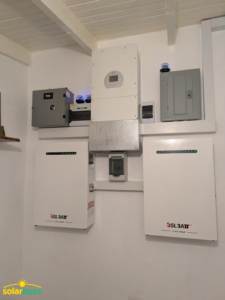
A Solar Buzz 7.65kW system with 20kWh battery storage installed for a hybrid-working household.
Jamaica’s grid, despite ongoing investment commitments, remains characterised by outages that are disproportionate to the ambitions of a professional or executive household relying on continuity of power for productive work. A solar system without battery storage offers billing relief when the sun shines and supply holds, but it does not offer energy independence.
Jamaica’s grid realities, combined with increasingly variable weather patterns, mean that resilience matters as much as generation. What has traditionally been understood as the dry season has become structurally less predictable, with extended cloud cover and above-normal rainfall now appearing well into what should be the island’s driest months.
Extended cloud cover during a significant weather system can suppress solar generation entirely for twenty-four to forty-eight hours or longer. A well-sized battery system ensures continuity for professional work through outages and extended cloud cover. It is no longer sufficient to size a battery for overnight use. It must be sized for sustained generation loss.
During Hurricane Melissa, Solar Buzz systems continued to deliver power for clients in severely affected areas through extended JPS outages lasting three to four months. This experience highlights the practical importance of well-designed solar-plus-storage solutions for households that require reliable daytime energy, particularly under work-from-home arrangements.

A Solar Buzz 13.5kW system installation.
The Energy Policy Block in the Hybrid Work Equation
One targeted policy refinement would make a meaningful difference.
The net billing licence is currently required as a precondition for the residential solar tax credit, even for systems installed entirely for self-consumption. Most home-office households will consume what they generate during daylight hours. There is no surplus to export and no commercial rationale for the requirement as applied to these households. It adds months of administrative delay and upfront cost that run directly counter to the goal of broader solar adoption.
An interim waiver of this requirement, pending formal review, would allow households to act now, ahead of further equipment price pressures and any increase in residential energy demand that a work-from-home policy would introduce.
The fiscal impact to the Government would be negligible. The impact to Jamaican households would be immediate.
Hybrid Work and the Energy Opportunity
Those considering solar are encouraged to act ahead of further price movements. Using NHT contributions where eligible, and doing so early, can secure more favourable loan terms and help position a system to deliver cash-flow-positive benefits during the repayment period itself.
Solar Buzz is an NHT-approved vendor. Our consultations begin with your actual energy bill, your roof’s current condition, your NHT eligibility, and your appliance load.
Ready to see what your numbers look like? We design the system, model the projected savings, and structure the financing so the numbers make sense before any commitment is made. Contact us for your online solar consultation.
Written By: Deidre Wedderburn
Client Relations Manager, Solar Buzz