

From the CEO’s Desk

A Shift in the Rationale for Solar
For many Jamaican households, the decision to invest in solar energy has moved well beyond environmental considerations, and is now increasingly a matter of financial prudence, resilience, and long-term stability.
Electricity costs remain among the most volatile components of household expenditure, while inflationary pressures and climate-related disruptions continue to underscore the importance of energy independence. For many families, electricity is now one of the largest and least predictable monthly expenses.
Against this backdrop, solar energy has become an increasingly rational investment for households looking to stabilise energy costs while strengthening their resilience in an uncertain environment.
The Government’s introduction of the Residential Photovoltaic (PV) Solar Tax Credit (RPSTC) in 2024 was therefore a welcome and important step. The incentive has the potential to accelerate distributed solar adoption and allow thousands of households to transform their homes into efficient, resilient, and economically productive assets. But as with many well-intentioned policies, the practical details of implementation matter.
Where Implementation Meets Opportunity
We appreciate Minister Vaz’s continued openness to engagement on policies that support Jamaica’s transition to renewable energy, including the temporary administrative waiver previously granted to facilitate residential solar adoption.
In recent weeks we have written to the Minister to respectfully request a review of the mandatory Net Billing Licence requirement currently associated with the tax credit application process.
Under the present framework, many homeowners applying for the solar tax credit must first obtain this licence even when their systems are designed primarily for self-consumption rather than exporting electricity to the grid.
At first glance, the requirement may appear administrative. In practice, however, it introduces costs and delays that risk weakening the incentive’s effectiveness.
The licensing process can take many months to complete, while the standard Government Electrical Regulatory (GER) Compliance Certificate – which confirms that a solar system has been safely installed and meets the required electrical standards – can typically be obtained within a matter of days. When this delay is compounded by the processing timelines associated with the portal for claiming the tax credit itself, many homeowners may wait a year or longer before realising the benefit of an incentive designed to accelerate solar adoption.
The licensing process also introduces additional costs, compounding the upfront investment households are already making. These costs can be particularly difficult to absorb for middle-income families, precisely the demographic the incentive is best positioned to serve. For households where affordability is a genuine consideration, every friction point in the process matters.
For households considering a substantial investment in solar, both time and cost are crucial. A delayed and more expensive incentive weakens the economics of the investment and extends the system’s payback period.
What the Grid Never Sees
More fundamentally, the requirement risks applying an export-based regulatory framework to systems that are not designed to export electricity at all.
Most modern residential solar installations in Jamaica are configured primarily for self-consumption with battery storage. During the day, households draw electricity directly from their solar panels while simultaneously charging their battery systems. In the evenings and overnight, homes typically rely on that stored energy rather than the grid.
In this configuration, the utility grid functions largely as a backup supply, used mainly during periods of extended cloud cover or unusually high household demand. As a result, these systems are designed to minimise reliance on grid electricity, not to generate significant surplus energy for export.
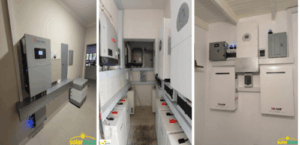
In practical terms, this means that many battery-based residential systems are structurally unlikely to produce meaningful excess electricity beyond the household’s own consumption needs. Applying a licensing framework designed for electricity exporters to these self-consumption systems therefore introduces regulatory complexity without addressing a genuine operational need.
A more proportionate approach would clearly distinguish between:
- Systems designed to export electricity to the grid, for which a net billing licence is appropriate and necessary; and
- Systems designed primarily for household self-consumption, for which a streamlined pathway – anchored in the GER Compliance Certificate – would be both sufficient and more administratively efficient.
Such clarity would not only simplify the process for homeowners, but would also strengthen confidence in the policy framework governing residential solar. We have respectfully advocated for precisely this distinction in our engagement with the Ministry, and we remain encouraged by the constructive dialogue to date.
When Policy and Finance Align
When incentives operate efficiently, solar investments produce faster returns. Shorter payback periods improve household cash-flow profiles and strengthen borrowers’ ability to service solar financing.
In practical terms, well-aligned policy can materially de-risk solar lending by improving borrower capacity and stabilising household energy expenses. For financial institutions evaluating solar loans, predictable cash flows and shorter payback timelines are not abstract benefits as they directly improve the credit profile of borrowers and help unlock broader access to financing for clean energy technologies.
The Bank of Jamaica’s caution that credit conditions may tighten further lends urgency to the need for a seamless and accessible incentive process for households seeking to finance solar adoption.
Administrative efficiency within incentive programs such as the RPSTC is not simply a regulatory matter. It directly influences the pace at which households are able to adopt solar, strengthen their long-term energy resilience, and confidently manage the financial commitment involved.
A Narrowing Window in Global Solar Pricing
Global solar pricing may soon face upward pressure following the scheduled removal of export tax rebates on photovoltaic products such as batteries, panels and inverters by the Chinese government.
Given Jamaica’s reliance on imported solar equipment, these shifts are expected to gradually translate into higher landed costs for distributors and homeowners, tighter inventory allocation and possibly shorter quotation validity periods. In practical terms, this means the window for securing systems at today’s pricing may narrow over the coming months.
Ensuring that the solar tax incentive operates smoothly and efficiently is therefore not merely beneficial but also time-sensitive. A streamlined process would allow more households to adopt solar while equipment pricing remains relatively favourable, helping them lock in lower energy costs for years to come.
Beyond Installation
At Solar Buzz, our advocacy on this issue is guided by a simple principle: when our clients and subscribers are willing to invest their own capital in strengthening their household’s energy resilience and in doing so, contribute to the country’s broader energy future, public policy should facilitate that decision rather than inadvertently complicate it.
The transition toward distributed renewable energy will not be driven by government policy alone. It will depend on the cumulative decisions of thousands of households choosing to invest in solar technologies. Ensuring that the incentive framework reflects the practical realities of that investment will help accelerate that transition for everyone.
The Path Forward
We remain committed to constructive engagement between policymakers, regulators and industry as Jamaica’s renewable energy framework continues to evolve toward outcomes that are economically sound, administratively efficient and supportive of homeowners.
At Solar Buzz, we will continue to advocate for our clients and for the homeowners helping to build Jamaica’s more resilient energy future.